

Fashion
Polopiqué and StampDyeing suspend production units in Portugal


Published
September 1, 2025
Polopiqué and StampDyeing – Tinturaria, Estamparia e Finamentos, located in Guimarães, Santo Tirso, and Vila Nova de Famalicão, are announcing the suspension of some of their production units in Portugal.
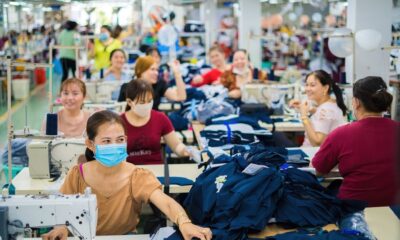
The Polopiqué group alone, which exports to more than 47 countries around the world, with important markets in Angola, Brazil, the United States, Europe, and the Middle East, is closing two factories that are already insolvent and laying off 280 workers, with two more units undergoing restructuring, which may well increase the number of redundancies. Chinese online platforms such as Shein and Temu are being blamed for the decline of the Portuguese textile industry.
According to MaisGuimarães (+G), Têxteis J.F. Almeida S.A, Polopiqué Comércio e Indústria de Confeções, S.A, Polopiqué – Acabamentos Têxteis, S.A, and Stampdyeing, Serviços, Lda have already filed applications for Special Revitalization Processes (PER) with the courts throughout August. The four companies are part of Portuguese textile giants with branches throughout the Ave Valley (Guimarães, Famalicão, and Santo Tirso) that directly employ around two thousand people. In the case of J.F. Almeida, only the credit institutions are affected by a process that aims to reschedule debt in the face of cash flow difficulties, but at Polopiqué there are plans to make almost 300 redundancies.
Also according to +G, Polopiqué Comércio e Indústria de Confeções, with 54.5 million euros in debt, is complaining of difficulties in meeting its commitments. We also remember the turnover of 81.1 million euros in 2024, 19.5% more than in the same period last year, and the net profit of 1.3 million euros, 35.9% more than in 2023.
According to ECO, the group, which has around 800 employees who are expected to be cut in half, has started a restructuring plan that includes revitalization plans and the insolvency of business units.
According to the chairman of the board, Luís Guimarães, the textile group “will maintain the strategic and most profitable activities in its value chain, focusing on areas where it has greater differentiation, control, and operational return. In this way, it will maintain an activity of excellence in the areas of design, logistics and sales, textile finishing, and yarn production,” he told ECO, guaranteeing in a statement that “the restructuring will be conducted with a total sense of social responsibility”.
“The group will move forward with a set of measures aimed at simplifying processes, optimizing the value chain, and strengthening the economic and environmental sustainability of its operations,” it continues, stressing that the “concentration of production capacity in the units with the highest operational performance and flexibility, closing the garment manufacturing and fabric weaving units,” the statement points out.
For its part, StampDyeing, part of the Mabera – Coelima Group, which currently exports around 25% of its production to the US and around 70% to the European market, has not paid salaries for two months to around 100 workers, including vacation pay. Dâmaso Lobo, the administrator of the group that owns the Vimaranense dyeing and printing plant, said that he will meet with the affected employees this Monday, September 1. “With the gas cut off since then, they continue to work 8 hours a day without producing anything,” confirms AbrilAbril.
Also according to the information space, linked to Abril values, which follows national and international news, Dâmaso Lobo had already committed himself, in a meeting with the Textile Union of Minho and Trás-os-Montes (affiliated to the CGTP-IN), to paying off the debts he owes to the affected workers, but so far he has failed to pay the salaries at StampDyeing.
Nevertheless, Coelima’s turnover grew by 15% in 2024, reaching results of 8.5 million euros, with even better expectations for 2025, as Dâmaso Lobo himself confirmed to PortugalTêxtil, which acquired the historic textile company in 2021.
“At Coelima there was talk of profits, but at the expense of StampDyeing. Here we have no wages and no future,” lamented a worker to the newspaper MaisGuimarães, in one of the many protests that took place in August, the month in which a chemical supplier filed for insolvency against the company on the first day, due to lack of payments.
This article is an automatic translation.
Click here to read the original article.
Copyright © 2025 FashionNetwork.com All rights reserved.












Current account excluding gold and energy indicated net deficit of $3.9 billion, while goods saw a deficit of $9.5 billion.
Turkiye recorded a current account deficit (CAD) of $9.6 billion in March, the country’s central bank said.
Treasury and Finance Minister Mehmet Simsek said the CAD is expected to widen this year, due to high energy and non-energy commodity prices.
Simsek said the deterioration is likely to remain temporary and manageable, thanks to stronger macroeconomic fundamentals and policy gains.
According to annualised data, current account deficit recorded as $39.7 billion (2.6 per cent of gross domestic product) in March, while the goods deficit recorded as $77.8 billion.
Simsek said the deterioration is likely to remain temporary and manageable thanks to stronger macroeconomic fundamentals and policy gains, domestic media outlets reported.
Turkiye is heavily reliant on imported energy, whose prices spiralled due to the Middle East conflict.
Simsek said elevated global commodity prices would put pressure on the external balance, but emphasised that the government’s economic programme had improved resilience against such shocks.
He said foreign direct investment (FDI) inflows totalled $1 billion in March, bringing annualised foreign direct investment to $12.6 billion.
The new investment incentive package under discussion in parliament now is expected to strengthen the country’s financing structure and support long-term capital inflows, he added.
Fibre2Fashion News Desk (DS)

During the first quarter of ****, the UK’s imports of textile fabrics eased down *.** to £*,*** million (~$*,*** million), against £*,*** million in January-March **** but slightly higher from £*,*** million in the fourth quarter of ****. Its imports of fibre were noted at £** million (~$***.** million) steady as £** million in Q*, **** but slightly lower than £** million in Q*, ****.
During the third month of this year, the country’s clothing imports declined *.** per cent to £*.*** billion (~$*.*** billion), compared with £*.*** billion in March ****. But the inbound shipment was slightly higher month on month compared with £*.*** billion in February ****.

Higher rents, utility bills and fuel prices are eating away at already thin profit margins, it found.
High inflation is cutting deep into Bangladesh consumer spending, with weak demand turning one of the biggest concerns for businesses, DCCI said.
Higher rents, utility bills and fuel prices are eating away at already thin profit margins.
DCCI’s economic position index revealed that consumers have sharply reduced spending as the cost of living continues to rise.
SMEs are feeling the pressure the most.
The chamber’s economic position index (EPI) revealed that consumers have sharply reduced spending as the cost of living continues to rise, putting pressure on retailers, transport operators and other service providers.
Small and medium enterprises (SMEs) are feeling the pressure the most as they struggle to manage higher operating costs without losing customers.
Businesses also cited difficulties in obtaining bank loans, while delays in licensing and other regulatory procedures are adding to costs.
The DCCI report identified a shortage of skilled workers, particularly in technical and customer service roles, as another challenge for the sector.
The country’s inflation rose to 9.04 per cent in April from 8.71 per cent in March, according to official statistics.
Fibre2Fashion News Desk (DS)


San Diego Islamic Centre shooting leaves five dead, police say threat ‘neutralised’

CDC says American tests positive for Ebola in Africa, risk in the U.S. remains low

New subscribers to pay more starting May 20

-

 Entertainment6 days ago
Conan O’Brien hat tricks as Oscar host
-

 Tech1 week ago
Could Contact-Tracing Apps Help With the Hantavirus? Not Really
-

 Fashion5 days ago
Italy’s Zegna Group’s Q1 growth boosted by strong organic performance
-

 Entertainment1 week ago
Martin Short: Facing tragedy with joy
-

 Entertainment1 week ago
Tom Brady gets back at Kevin Hart during Netflix roast
-

 Sports1 week ago
Jacob Fatu unleashes vicious assault on Roman Reigns after World Heavyweight Championship loss at WWE Backlash
-

 Entertainment1 week ago
Martha Stewart: How to make an omelet
-

 Tech1 week ago
Papa Johns Is Getting Into Drone Delivery—but Not for Pizza