

Business
Poor planning not deforestation to blame for devastation | The Express Tribune

ISLAMABAD:
Pakistan inherited the legacy of British Forestry institutional and legal framework. Khyber-Pakhtunkhwa (K-P) holds 40% of the country’s forest share, making it the richest province in this respect.
Within K-P, 14.1% of the total land area is covered with forests. The northern, north-western, and eastern parts of K-P are steep and mountainous, making them highly vulnerable to erosion and landslides.
Yet, these forests provide freshwater to major rivers running from north to south of the country. They also offer habitat for biodiversity, promote tourism, preserve natural beauty, and stabilise climate impacts on humans and other species.
Forests act as the lungs of Pakistan by absorbing carbon dioxide and supplying oxygen through carbon sequestration. They balance the environment in both time and space. Beyond these services, they provide food, shelter, fruit, and livelihoods. Forestry plays many roles in stabilising nature, but flood and erosion control is one of the most vital.
Forests and their ecosystems stabilise soil and protect it from erosion. The K-P forest department, working with local communities, forest landowners, and other stakeholders, carries out plantation drives twice a year during spring and monsoon seasons.
Major programmes include the Tarbela watershed plantation, social and farm forestry, Kalam integrated forestry, and the Billion and Ten Billion Tree plantation drives. Recently, the Green Pakistan Programme was also launched.
Hundreds of thousands of acres have been planted and protected through natural regeneration. Some of these projects received technical and financial support from the World Bank, WFP, GIZ, KFW, USAID, FAO, Dutch agencies, and UN organisations, while others were locally supported.
The Billion Tree programme was entirely funded by K-P, while the Ten Billion and Green Pakistan initiatives were financed jointly by the provinces and the federation.
Pakistan gained significant recognition for these pioneering projects, particularly the Billion and Ten Billion Tree programmes. They helped the country achieve the Bonn Challenge; restoring 150 million hectares of degraded and deforested land by 2020 and targeting 350 million hectares by 2030. These efforts brought international goodwill and respect for Pakistan’s commitment to forestry.
Despite these achievements, the recent floods in K-P sparked criticism, with some blaming deforestation for the devastation. Most critics, however, are either non-professionals or using the argument for point-scoring.
Monsoon rains have been part of the region’s history for centuries, and the north-eastern parts of K-P regularly receive heavy showers. Flood disasters are not unique to Pakistan, India, China, and other regional countries also face similar challenges.
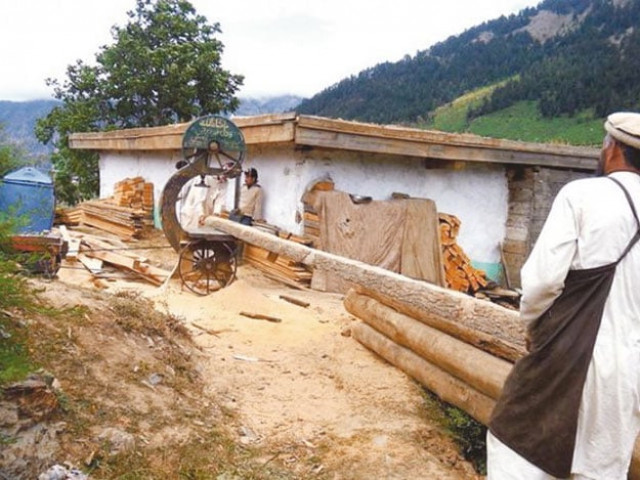
Forests do reduce the intensity of rainfall by intercepting drops, but steep terrain, surface runoff, and soil saturation often result in flash floods regardless. Trees are living entities with life cycles, and their timber supports many needs at an economically viable age.
Exploitation beyond carrying capacity poses risks, but the forest department is already regulating usage under forestry laws. Importantly, Pakistan also achieved its first carbon credits in the forestry sector for mangrove restoration in Sindh.
If deforestation alone were responsible for floods, then how do we explain Karachi’s crisis? With less than two days of rain, life in the city is paralysed, schools close, offices shut, and people face severe losses. Karachi is flat and barely above sea level, yet devastation is immense.
In contrast, K-P has endured downpours for nearly two weeks. This contrast highlights the real culprits: unplanned infrastructure and obstruction of natural waterways.
Blaming forests or climate change alone oversimplifies the issue. Climate change is indeed a pressing factor, but it is often discussed superficially.
A look back at the Ice Age reveals that CO2 once fell below 190 ppm, with the lowest levels at 182 ppm. Below 150 ppm, most terrestrial plants could not survive. This shows that while global warming beyond tolerable limits is dangerous, some degree of warming is essential for life on Earth. Human responsibility for pushing warming beyond safe thresholds cannot be ignored.
Most natural forests in K-P belong to local communities but are managed by the forest department. The International Union for Conservation of Nature (IUCN) reports that only 7% of forests are government-owned, while 93% belong to people and communities.
Legal forest categories in K-P include reserved forests, which are government-owned, and protected or Guzara forests, which belong to local people but are managed by the department. Community and private forests also exist.
In the early 1970s, the K-P forest department-initiated tree plantations and soil conservation on private grazing lands in the Tarbela watershed. Agreements with landowners allowed planting of trees and soil conservation to reduce erosion and prolong Tarbela reservoir’s life.
Accusing the forest department alone for deforestation is therefore unjustified, since most forests belong to communities. Still, under law, the department must manage them to protect ecosystems. Property rights, community ownership, and open access make management highly challenging.
Another obstacle is the sheer scale of forest areas, which are open and boundary-less, unlike urban banks that are heavily guarded yet still robbed. Expecting forest staff to control vast, open lands without strong governance structures is unrealistic.
Thus, the issue goes deeper than forestry staff or tree cover. It is about poverty, community rights, and governance. Policymakers must recognise these ground realities.
Strengthening forest protection requires supporting local communities, reducing poverty-driven dependence on forests, and improving management practices. Only then can K-P’s forests be safeguarded while also minimising flood risks.
THE WRITER HOLDS A PHD IN FORESTRY AND IS A CLIMATE CHANGE, FORESTRY, AND ENVIRONMENT EXPERT

1729471601-0/image-(8)1729471601-0-640x480.webp "Pakistan’s crisis differs from world | The Express Tribune")



Business
Private sector data: Over 2 lakh private companies closed in 5 years; govt flags monitoring for suspicious cases – The Times of India

NEW DELHI: The government on Monday said that over the past five years, more than two lakh private companies have been closed in India.According to data provided by Minister of State for Corporate Affairs Harsh Malhotra in a written reply to the Lok Sabha, a total of 2,04,268 private companies were shut down between 2020-21 and 2024-25 due to amalgamation, conversion, dissolution or being struck off from official records under the Companies Act, 2013.Regarding the rehabilitation of employees from these closed companies, the minister said there is currently no proposal before the government, as reported by PTI. In the same period, 1,85,350 companies were officially removed from government records, including 8,648 entities struck off till July 16 this fiscal year. Companies can be removed from records if they are inactive for long periods or voluntarily after fulfilling regulatory requirements.On queries about shell companies and their potential use in money laundering, Malhotra highlighted that the term “shell company” is not defined under the Companies Act, 2013. However, he added that whenever suspicious instances are reported, they are shared with other government agencies such as the Enforcement Directorate and the Income Tax Department for monitoring.A major push to remove inactive companies took place in 2022-23, when 82,125 companies were struck off during a strike-off drive by the corporate affairs ministry.The minister also highlighted the government’s broader policy to simplify and rationalize the tax system. “It is the stated policy of the government to gradually phase out exemptions and deductions while rationalising tax rates to create a simple, transparent, and equitable tax regime,” he said. He added that several reforms have been undertaken to promote investment and ease of doing business, including substantial reductions in corporate tax rates for existing and new domestic companies.

Pakistan’s textile exports surged to $6.4 billion during the first four months of the 2025-26 fiscal year, marking the highest trade volume for the sector in this period.
According to the Pakistan Bureau of Statistics (PBS), value-added textile sectors were key contributors to the growth.
Knitwear exports reached $1.9 billion, while ready-made garments contributed $1.4 billion.
Significant increases were observed across several commodities: cotton yarn exports rose 7.74% to $238.9 million, and raw cotton exports jumped 100%, reaching $2.6 million from zero exports the previous year.
Other notable gains included tents, canvas, and tarpaulins, up 32.34% to $53.48 million, while ready-made garments increased 5.11% to $1.43 billion.
Exports of made-up textile articles, excluding towels and bedwear, rose 4.17%, totaling $274.75 million.
The report also mentioned that the growth in textile exports is a result of improved global demand and stability in the value of the Pakistani rupee.

UK investment bank Peel Hunt has given some support to under-pressure Chancellor Rachel Reeves over last week’s Budget as it said efforts to boost the London market and invest in UK companies were “positive steps”.
Peel Hunt welcomed moves announced in the Budget, such as the stamp duty exemption for shares bought in newly listed firms on the London market and changes to Isa investing.
It comes as Ms Reeves has been forced to defend herself against claims she misled voters by talking up the scale of the fiscal challenge in the run-up to last week’s Budget, in which she announced £26 billion worth of tax rises.
Peel Hunt said: “Following a prolonged period of pre-Budget speculation, businesses and investors now have greater clarity from which they can start to plan.
“The key measures were generally well received by markets, particularly the creation of additional headroom against the Chancellor’s fiscal rules.
“Initiatives such as a stamp duty holiday on initial public offerings (IPOs) and adjustments to the Isa framework are intended to support UK capital markets and encourage investment in British companies.
“These developments, alongside the Entrepreneurship in the UK paper published simultaneously, represent positive steps toward enhancing the UK’s attractiveness for growth businesses and long-term investors.”
Ms Reeves last week announced a three-year stamp duty holiday on shares bought in new UK flotations as part of a raft of measures to boost investment in UK shares.
She also unveiled a change to the individual savings account (Isa) limit that lowers the cash element to £12,000 with the remaining £8,000 now redirected into stocks and shares.
But the Chancellor also revealed an unexpected increase in dividend tax, rising by 2% for basic and higher rate taxpayers next year, which experts have warned “undermines the drive to increase investing in Britain”.
Peel Hunt said the London IPO market had begun to revive in the autumn, although listings activity remained low during its first half to the end of September.
Firms that have listed in London over recent months include The Beauty Tech Group, small business lender Shawbrook and tinned tuna firm Princes.
Peel Hunt added that deal activity had “continued at pace” throughout its first half, with 60 transactions announced across the market during that time and 10 active bids for FTSE 350 companies, as at the end of September.
Half-year results for Peel Hunt showed pre-tax profits jumped to £11.5 million in the six months to September 30, up from £1.2 million a year earlier, as revenues lifted 38.3%.
Peel Hunt said its workforce has been cut by nearly 10% since the end of March under an ongoing savings drive, with full-year underlying fixed costs down by around £5 million.
Steven Fine, chief executive of Peel Hunt, said: “The second half has started strongly, with the group continuing to play leading roles across both mergers and acquisitions and equity capital markets mandates.”


Richie Moriarty on season 5 of "Ghosts," his character and the cast: "We really are a family"

The Best Cyber Monday Streaming Deals With a Convenient Roommate’s Email Address

Indian man kills wife, takes selfie with dead body

-

 Sports1 week ago
WATCH: Ronaldo scores spectacular bicycle kick
-

 Entertainment1 week ago
Welcome to Derry’ episode 5 delivers shocking twist
-

 Politics1 week ago
Washington and Kyiv Stress Any Peace Deal Must Fully Respect Ukraine’s Sovereignty
-
 Business1 week ago
Key economic data and trends that will shape Rachel Reeves’ Budget
-

 Tech6 days ago
Wake Up—the Best Black Friday Mattress Sales Are Here
-

 Politics1 week ago
53,000 Sikhs vote in Ottawa Khalistan Referendum amid Carney-Modi trade talks scrutiny
-

 Fashion1 week ago
Canada’s Lululemon unveils team Canada kit for Milano Cortina 2026
-

 Tech1 day ago
Get Your Steps In From Your Home Office With This Walking Pad—On Sale This Week