

Politics
Putin, Xi hail ‘unyielding’ ties in talks after Trump visit

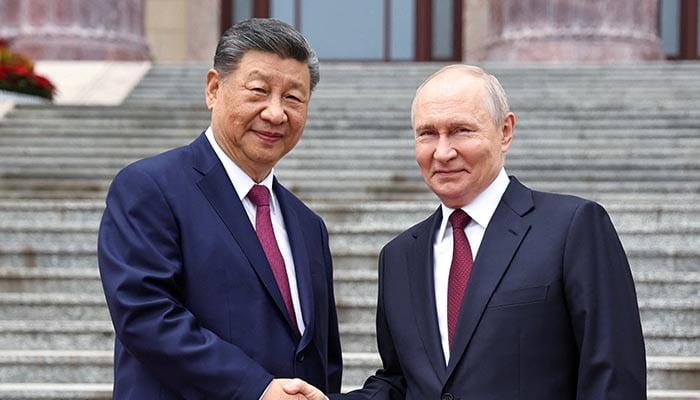
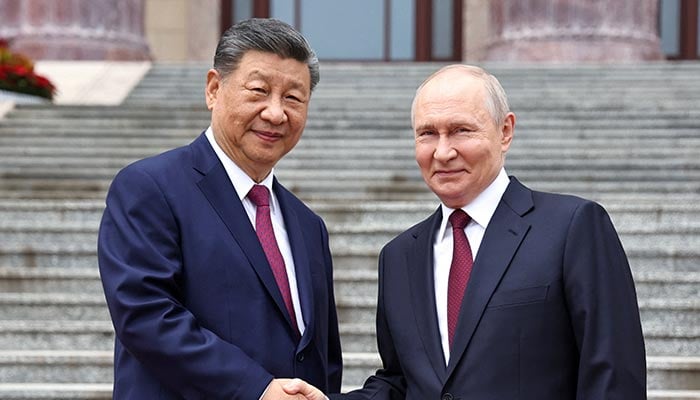
- Beijing and Moscow continuously deepened mutual trust: Xi.
- Putin says relations reached “unprecedentedly high level”.
- Xi warns of “unilateral countercurrents running rampant”.
President Xi Jinping hailed China and Russia’s “unyielding” ties in talks with Vladimir Putin on Wednesday, as the pair met to underscore their alliance days after Donald Trump’s visit to the Asian superpower economy.
After the US president was received with pomp last week but left without major breakthroughs, including on help with reopening the Strait of Hormuz, Putin’s visit will be scrutinised for tangible takeaways.
Putin is, however, weakened by years of Russia’s war on Ukraine, as sanctions by Western powers put the squeeze on energy revenues and increased Moscow’s dependence on China, the main buyer of Russian oil.
The US war on Iran has however hampered crude and gas flows, giving an opportunity to Putin to offer Russian energy sources as an alternative.
Analysts believe that Putin could use the visit to push for progress on the major “Power of Siberia 2” natural gas pipeline from Russia to China through Mongolia — a land alternative to crude imported by sea from the Middle East.
Opening talks in Beijing’s opulent Great Hall of the People, Putin and Xi were quick to laud their countries’ special ties as they extended their treaty of “friendly cooperation”.
Beijing and Moscow have “continuously deepened our political mutual trust and strategic coordination with a resilience that remains unyielding”, Xi told the Russian leader, according to Chinese state media.
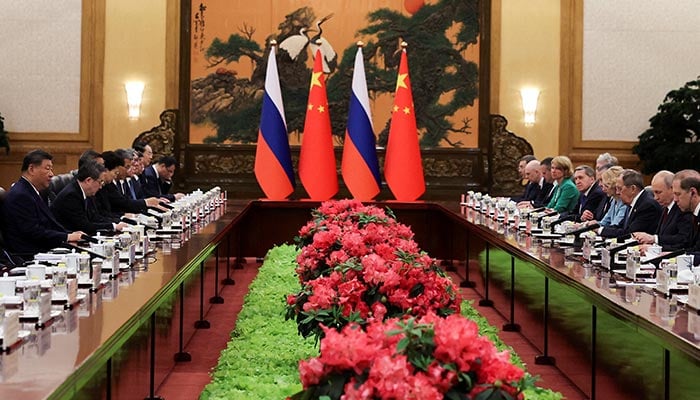
Putin, meanwhile, told Xi relations had reached and “unprecedentedly high level” despite “unfavourable external factors”, without naming any third country, video from Russian media showed.
Xi warned of “unilateral and hegemonic countercurrents running rampant”, in a veiled swipe at the United States.
‘Old friend’
Xi has played host to a series of world leaders as an increasingly unpredictable United States under Trump pushed many to shore up alliances with Beijing, and the war in Iran has further accelerated the trend.
Russia-China ties have deepened since Moscow launched its invasion of Ukraine in 2022, with Putin visiting Beijing every year since as his country is shunned by Western powers.
Putin’s visit promises to be less opulent than Trump’s, emphasising that “the Xi-Putin relationship does not require that kind of performative reassurance”, said Patricia Kim from the Brookings Institution in Washington.
Xi welcomed Putin with open arms as an “old friend” when he last visited Beijing in September 2025 — language the Chinese leader did not extend to Trump last week.
Both Putin and Xi view ties as “structurally stronger and more stable” than those between China and the United States, she told AFP.
Beijing has regularly called for talks to end the war in Ukraine but has never condemned Russia for sending in troops, presenting itself instead as a neutral party.
But with Russia reliant on sales to China to sustain its war effort, “Putin does not want to lose that support”, Asia Societys Lyle Morris told AFP.
Middle East priorities
When it comes to the US-Israeli war on Iran, though, China and Russia may have different priorities.
Russia has sought to capitalise on the energy crisis and rocketing oil prices spurred by the closure of the Hormuz strait.
Russia’s top diplomat Sergei Lavrov had said after meeting Xi in April that Russia could “compensate” for China’s energy shortages as the Middle East war hits global supplies.
China, however, wants the Middle East conflict concluded as soon as possible.
Xi underlined in talks with Putin that further hostilities in the Middle East is “inadvisable” as he said a “comprehensive ceasefire is of utmost urgency”.
“(China) relies on the freedom of the world´s major waterways to sustain its economic activities, and would prefer that the standoff in the Strait of Hormuz end sooner rather than later,” James Char of Singapore´s Nanyang Technological University told AFP.
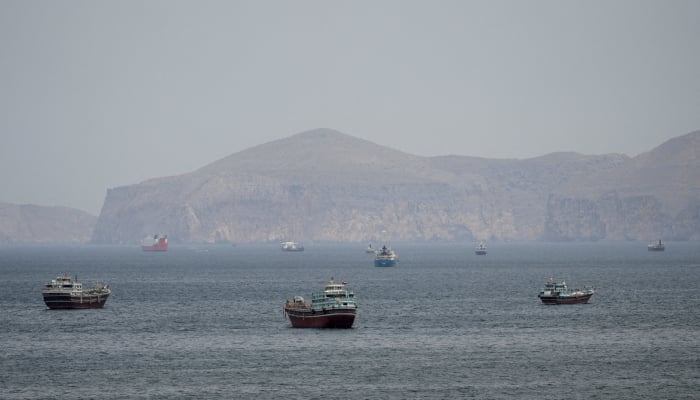
- Two Chinese tankers exit Hormuz carrying 4m barrels.
- US leader says Tehran begging for a deal.
- Vice President Vance says lots of progress made in talks.
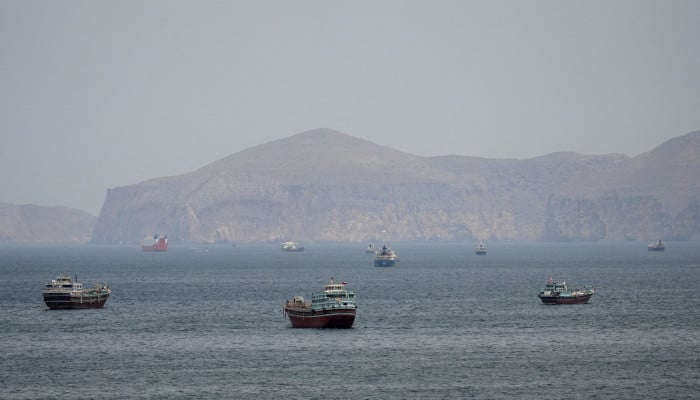
SINGAPORE/WASHINGTON: Two Chinese tankers laden with oil exited the Strait of Hormuz on Wednesday, shipping data showed, brightening hopes that the US-Israeli conflict with Iran may soon be resolved after positive comments from the US president and his deputy.
President Donald Trump said on Tuesday the war would be over “very quickly” while Vice President JD Vance talked up progress in talks with Tehran about an agreement to end hostilities.
“We’re in a pretty good spot here,” Vance told a White House press briefing.
Trump made his comments a day after saying he had paused a planned resumption of hostilities following a new proposal by Tehran to end the conflict.
“I was an hour away from making the decision to go today,” Trump told reporters at the White House on Tuesday.
Iran’s leaders are begging for a deal, he said, adding that a new US attack would happen in the coming days if no agreement was reached.
The United States has been struggling to end the war it began with Israel nearly three months ago. Trump has repeatedly said during the conflict that a deal with Tehran was close, and similarly threatened heavy strikes on Iran if it did not reach an accord.
The US president is under intense political pressure at home to reach an accord that would reopen the Strait of Hormuz – a key route for global supplies of oil and other commodities. Gasoline prices remain high and Trump’s approval rating has plummeted with congressional elections looming in November.
The conflict has caused the worst-ever disruption to global energy supplies, blocking hundreds of tankers from leaving the Gulf while damaging energy and shipping facilities across the region.
Two Chinese ships, among a handful of supertankers carrying Iraqi crude, exiting the Gulf this month, passed through the narrow strait carrying around 4 million barrels of crude, according to data from LSEG and Kpler.
Oil prices eased on the positive signals from the White House and in the Gulf, with Brent crude LCOc1 falling to as low as $110.16 a barrel, before regaining much of its losses.
“Investors are keen to gauge whether Washington and Tehran can actually find common ground and reach a peace agreement, with the US stance shifting daily,” said Toshitaka Tazawa, an analyst at Fujitomi Securities.
Difficulties in negotiations
Speaking to reporters at a White House briefing, Vance acknowledged difficulties in negotiating with a fractured Iranian leadership. “It’s not sometimes totally clear what the negotiating position of the team is,” he said, so the US is trying to make its own red lines clear.
He also said one objective of Trump’s policy is to prevent a nuclear arms race from spreading in the region.
Ebrahim Azizi, head of the Iranian parliament’s national security committee, said on X that Trump’s pausing of an attack was due to the realisation that any move against Iran would mean “facing a decisive military response.”
Iranian state media said Tehran’s latest peace proposal involves ending hostilities on all fronts, including Lebanon, the exit of US forces from areas close to Iran, and reparations for destruction caused by the US-Israeli attacks.
Tehran also sought the lifting of sanctions, release of frozen funds and an end to the US marine blockade, according to Deputy Foreign Minister Kazem Gharibabadi as cited by IRNA news agency.
The terms as described in the Iranian reports appeared little changed from Iran’s previous offer, which Trump rejected last week as “garbage.”
Ceasefire mostly holding
The US-Israeli bombing killed thousands of people in Iran before it was suspended in a ceasefire in early April. Israel has killed thousands more and driven hundreds of thousands from their homes in Lebanon, which it invaded in pursuit of the Iran-backed Hezbollah militia.
Iranian strikes on Israel and neighbouring Gulf states have killed dozens of people.
The ceasefire has mostly held, although drones have lately been launched from Iraq towards Gulf countries, including Saudi Arabia and Kuwait.
Trump and Israeli Prime Minister Benjamin Netanyahu said they launched the war to curb Iran’s support for regional militias, dismantle its nuclear programme, destroy its missile capabilities and create conditions for Iranians to topple their rulers.
But the war has yet to deprive Iran of its stockpile of near-weapons-grade enriched uranium or its ability to threaten neighbours with missiles, drones and proxy militias.
The Islamic Republic’s leadership has withstood the superpower onslaught with no sign of organised opposition.
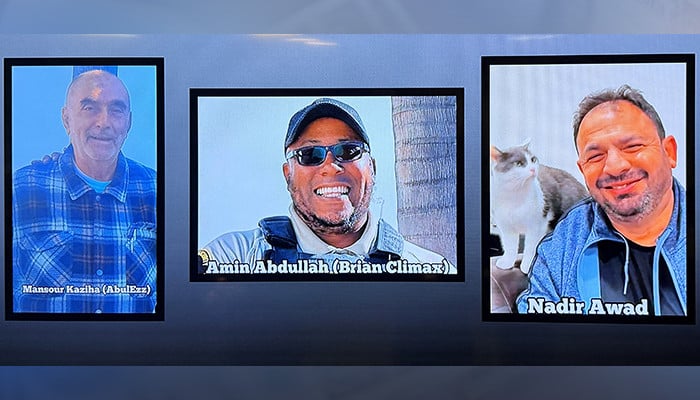
SAN DIEGO: The security guard slain at the Islamic Centre of San Diego was hailed on Tuesday as a fallen hero who sacrificed his life to keep 140 school children inside the mosque safe by engaging two gunmen in a shootout that deterred the teenage suspects and helped thwart their attack.
Authorities also disclosed that the 17- and 18-year-old assailants, who took their own lives shortly after Monday’s shooting, were believed to have met online and apparently were “radicali[s]ed” in hate-related ideology on the internet.
The alleged gunmen have been identified as Caleb Vasquez, 18, and Cain Clark, 17, a Department of Justice official told Reuters.
A day after the gun violence, police, FBI, and other officials held a news conference focused on the three men, all affiliated with the mosque, who were slain in the attack and credited with putting themselves in harm’s way to save others.
The security guard, Amin Abdullah, also known to friends as Brian Climax, immediately recognised the two youths as a threat and opened fire on them as they ran past him outside the mosque, according to San Diego Police Chief Scott Wahl. The suspects then paused to return fire, Wahl said.
Abdullah wound up fatally shot in the parking lot, along with two other men who distracted the suspects after they stormed into the building, drawing their attention through a window, thus luring the two teens back outside, Wahl said.
Two men lured gunmen outside
The two other victims, mosque elder Mansour Kaziha, and Uber driver Nadir Awad, a neighbour whose wife worked as a teacher at the school there, were cornered and shot to death in the parking lot by the gunmen when they re-emerged.
In the midst of the confrontation, it was Abdullah who transmitted the radio call that activated a security lockdown, which Wahl said also prevented further bloodshed there.
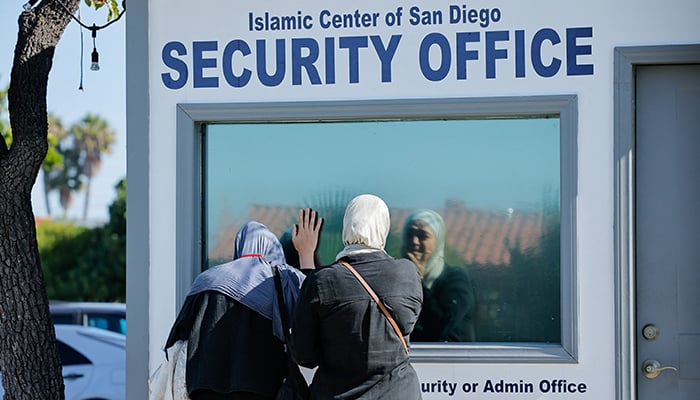
The gunfight and the security alert gave others in the building time to take shelter behind locked doors, Wahl said, while Kaziha and Awad coaxed the suspects out of the building. Kaziha was also the first person to call 911 before he was shot, police said.
Minutes before officers from around California’s second-most-populous city converged on the mosque, the two suspects fled by car. They were found dead in their vehicle a short time later, several blocks away, apparently from self-inflicted gunshot wounds, police said.
Wahl singled out Abdullah for special praise of his “heroic action,” adding that at first, “I had no idea how heroic those actions were.”
“His actions, without a doubt, delayed, distracted and ultimately deterred those two individuals from gaining access to the greater areas of the mosque where as many as 140 kids were within 15 feet of these suspects,” Wahl told reporters.
Taha Hassane, the imam and director of the Islamic Centre, called all three of the victims “our martyrs and our heroes.”
Addressing a separate news conference at a local park, the security guard’s daughter, Hawaa Abdullah, offered prayers and paid a tearful tribute to her father as a man who doted on his family and was so dedicated to his job that he would not break for meals when he was on duty.
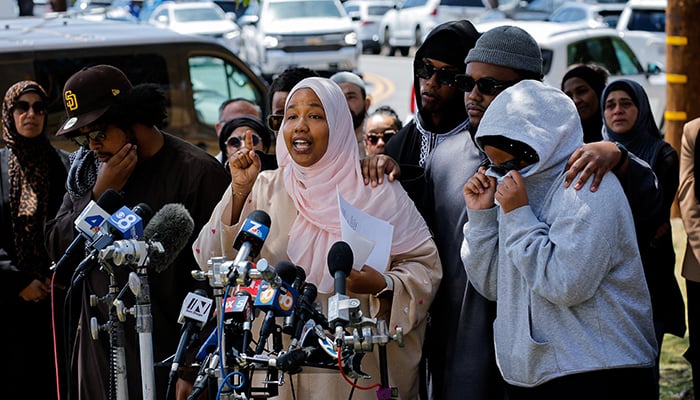
She called on people of all faiths to honour him by coming together and being kind. “He stood against any form of hate,” she said.
Hate-crime inquiry
Police and FBI have said that they are investigating the attack as a hate crime but have declined to offer details about a possible motive.
Investigators have yet to definitively conclude that the mosque “was the specific target,” said FBI special agent Mark Remily. “What I can say is (the suspects) definitely had a broad hatred towards a lot of folks.”
Remily said one of the gunmen left behind a manifesto, but he declined to characterise it in detail. Officials also said police had seized more than 30 guns and a crossbow in searches of dwellings connected to the suspects. Wahl said all those weapons were registered to the parents of one of the youths.
“Anti-Islamic writings” were found in a vehicle connected to the suspects, the DoJ official with knowledge of the investigation said.
The mother of Clark, one of the suspects, is cooperating with authorities, the official added. Officers sprang into action on Monday, about two hours before the shooting, when she called police describing her son as suicidal and said he had run off with her vehicle and three of her guns, police said.
Police initially raced to a local shopping mall and the boy’s school before calls came in about the shooting at the mosque, which ranks as the largest in San Diego County and houses the Bright Horizon Academy.
Anti-Muslim and anti-Arab bias in the US surged to record levels last year, according to a report from a leading Muslim advocacy group.
The Council on American-Islamic Relations said it recorded 8,683 anti-Muslim and anti-Arab complaints in 2025, the most in any year since it began publishing data in 1996. Most complaints were about employment discrimination, immigration and asylum issues, as well as hate incidents, the report said.
- Putin seeks stronger Chinese support after Trump’s Beijing visit.
- Xi, Putin expected to discuss “Power of Siberia 2” gas pipeline.
- Kremlin says leaders to discuss regional, global developments.
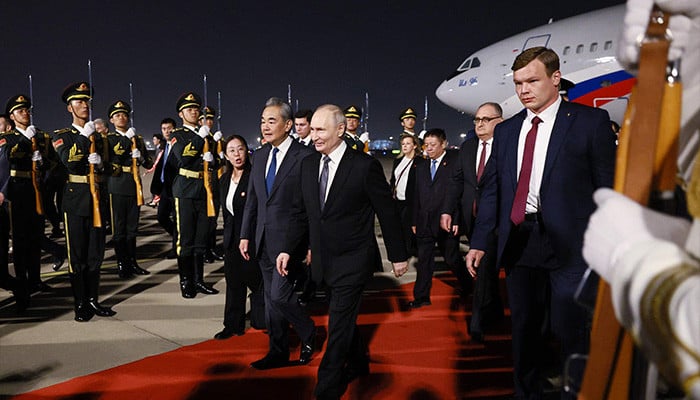
Russian President Vladimir Putin arrived in Beijing late on Tuesday for talks with his Chinese counterpart and “long-time good friend” Xi Jinping, intending to show their ties are unshakeable days after a visit by Donald Trump.
The confirmation of Putin’s trip came just hours after Trump wrapped up his visit on Friday, the first to China by a US president in nearly a decade and one aimed at stabilising their turbulent relations.
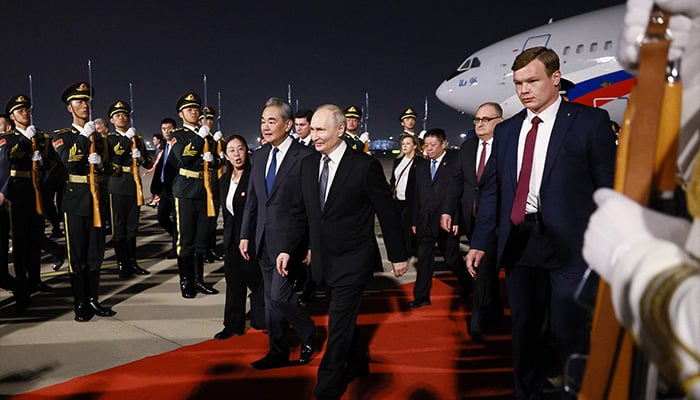
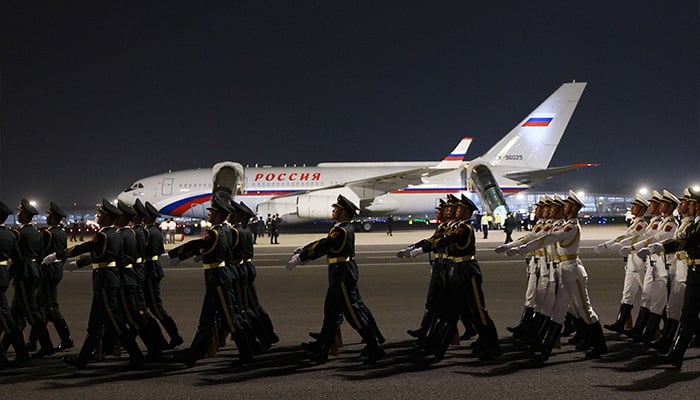
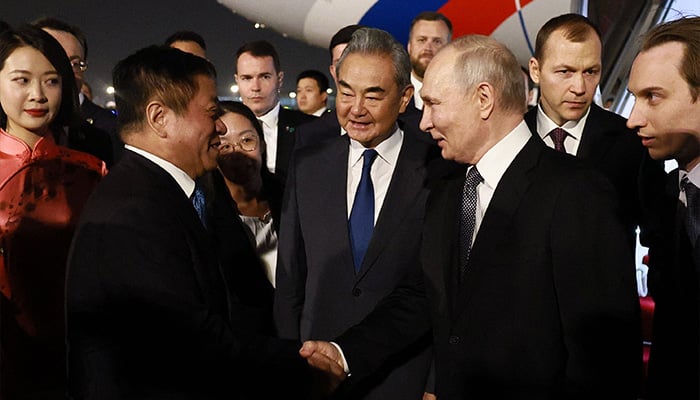
Putin arrived at Beijing Capital International Airport around 11:15pm (1515 GMT) on Tuesday, where he was greeted by Chinese Foreign Minister Wang Yi and a military band.
It was a near-mirror image of Trump’s arrival days earlier, with both leaders stepping out of their planes onto a red carpet as Chinese youths chanted “welcome, welcome” — this time, waving Russian flags instead of American.
Putin and Xi are set to discuss how to strengthen Russia and China’s strategic partnership and “exchange views on key international and regional issues”, according to a Kremlin statement.
Their ties have deepened since Russia’s invasion of Ukraine in 2022, with Putin visiting Beijing every year since as his country is cut off diplomatically on the world stage.
However, their relationship is far from equal, with Moscow heavily dependent economically on Beijing, the main buyer of sanctioned Russian oil.
Among topics Xi and Putin could discuss is the construction of the major “Power of Siberia 2” natural gas pipeline from Russia to China through Mongolia — a land alternative to crude imported by sea from the Middle East — which Moscow is keen to get underway.
Setting a warm tone for the visit, Xi and Putin exchanged “congratulatory letters” on Sunday to mark 30 years of their countries’ strategic partnership.
Chinese foreign ministry spokesperson Guo Jiakun lauded “the enduring friendship between China and Russia” on Tuesday.
And in a video message to the Chinese people released on Tuesday, Putin said relations have reached “a truly unprecedented level”, and that “trade between Russia and China continues to grow”.
“The close strategic relationship between Russia and China plays a major, stabilising role globally. Without allying against anyone, we seek peace and universal prosperity,” Putin said, without mentioning any third country.
The two leaders are also expected to sign a joint declaration after their talks.
‘Dear, old friends’
Xi welcomed Putin with open arms as an “old friend” when he last visited Beijing in September 2025 — language the Chinese leader did not extend to Trump last week.
Putin, who in turn called Xi his “dear friend”, will be keen to show the world that their relations are unaffected by Trump’s visit.
While Putin’s visit is not expected to receive the same pomp as Trump’s, “the Xi-Putin relationship does not require that kind of performative reassurance”, said Patricia Kim from the Brookings Institution in Washington.
Both sides view ties as “structurally stronger and more stable” than those between China and the United States, she said.
Beijing has regularly called for talks to end the war in Ukraine but has never condemned Russia for sending in troops, presenting itself instead as a neutral party.
Trump and Xi discussed Ukraine last week, but the US president left China without a breakthrough.
“Xi will almost certainly brief Putin on his summit with Trump,” Kim said.
The lack of clear outcomes from the Xi-Trump meeting, though, “likely reassures Moscow that Xi did not strike any understanding with Trump that would materially undercut Russian interests”.
Appetite for oil
Putin will be hoping for China to deepen its commitment to Moscow, after Trump told Fox News during his visit that Beijing had agreed to buy US oil to feed its “insatiable” appetite for energy.
With Russia reliant on sales to China to sustain its war effort, “Putin does not want to lose that support”, Asia Society’s Lyle Morris told AFP.
“Putin will likely be keen to hear from Xi about China’s next step in the Middle East,” Morris said, after “Trump signalled clearly that he hopes Beijing will play a leading role”.
When it comes to the US-Israeli war on Iran, though, China and Russia may have different priorities.
“(China) relies on the freedom of the world’s major waterways to sustain its economic activities, and would prefer that the standoff in the Strait of Hormuz end sooner rather than later,” James Char of Singapore’s Nanyang Technological University told AFP.
On the other hand, Moscow has “been benefitting economically from the fighting in Iran due to the relaxation of sanctions against Russian energy supplies, so may have a different view”, he said.
Russia’s top diplomat Sergei Lavrov said after meeting Xi in April that Russia could “compensate” for China’s energy shortages as the Middle East war hits global supplies.
“Expanded energy ties may feature prominently at the meeting (as) Beijing seeks more Russian energy,” said Joseph Webster from the Atlantic Council.
“From Moscow’s perspective, shipping more oil east may be more attractive in the wake of Ukraine’s relentless campaign targeting Russian energy infrastructure.”


Belgium’s Summa launches F Series Vantage flatbed cutters at FESPA
Indian Railways eyes 350 kmph speeds with its next indigenous bullet train; first one to have 280 kmph potential

Rising costs push Sri Lankan apparel SMEs to the edge

-
 Entertainment1 week ago
Conan O’Brien hat tricks as Oscar host
-
 Fashion7 days ago
Italy’s Zegna Group’s Q1 growth boosted by strong organic performance
-
 Tech1 week ago
Papa Johns Is Getting Into Drone Delivery—but Not for Pizza
-

 Tech1 week ago
CUDA Proves Nvidia Is a Software Company
-

 Fashion1 week ago
India’s Raymond Lifestyle’s FY26 income tops $743 mn for 1st time
-
 Tech1 week ago
Chevron Wants a School District Tax Break for a Data Center Power Plant in Texas
-
 Business1 week ago
Pound wobbles and bonds suffer as Starmer battles on
-

 Sports1 week ago
Orioles pitcher takes part in gender reveal as he walks off mound following relief appearance