

Sports
Raphinha shines as Barça get thrilling win over Madrid in Supercopa final

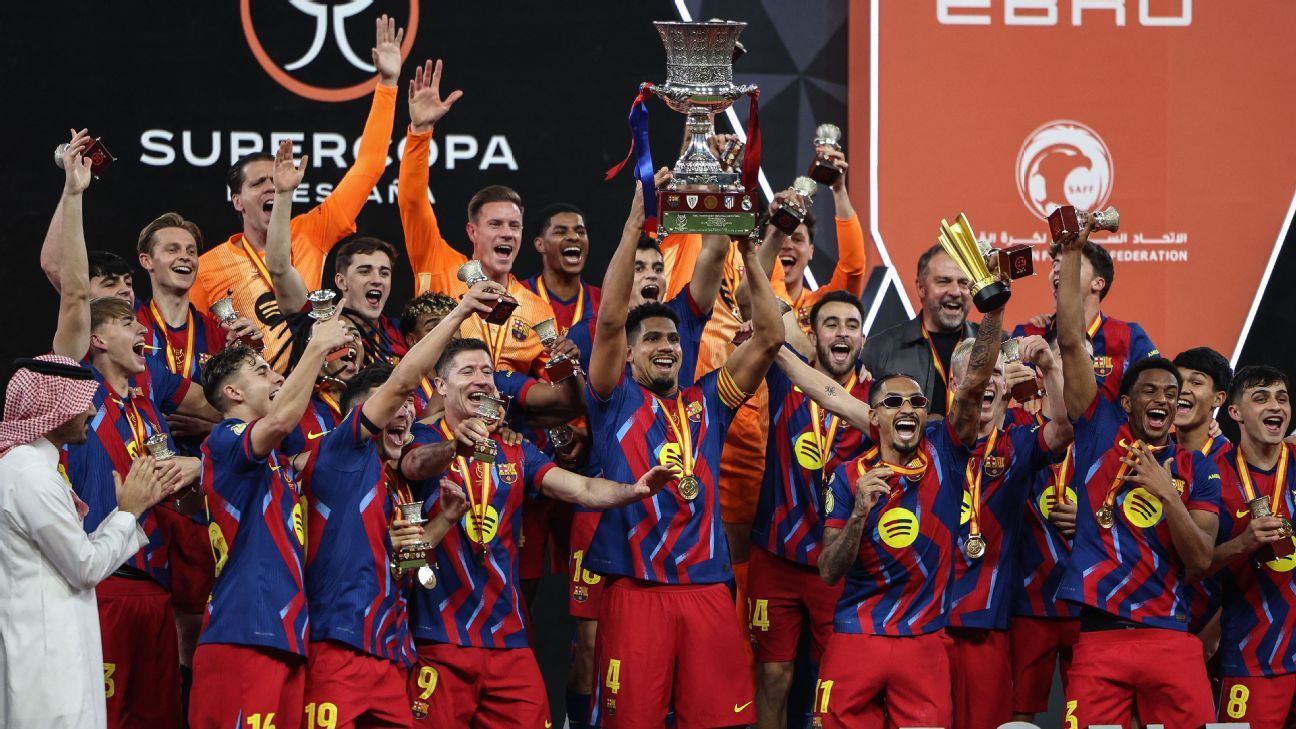
Raphinha scored twice as Barcelona beat Real Madrid 3-2 in an enthralling Clásico on Sunday to retain the Supercopa de España in Saudi Arabia.
The Brazilian struck the winner in the 73rd minute as Barça celebrated a third successive final victory over Madrid under Hansi Flick, following last season’s Supercopa and Copa del Rey successes.
Heading into the final 20 minutes, the tie had been delicately poised following a wild first half, which yielded three stoppage-time goals after Raphinha’s opener in the 36th minute.
First, Vinícius Júnior leveled, then Robert Lewandowski nudged Barça back ahead and there was still time for Gonzalo García to restore parity before halftime.
Madrid brought on Kylian Mbappé, back from a knee injury, in the second half, but it was Raphinha who proved the hero as Madrid’s Álvaro Carreras and Raúl Asencio spurned great late chances to take the game to a penalty shootout after Frenkie de Jong had been sent off. — Sam Marsden
– £298m for Lamine Yamal? The top 100 most valuable players
– Unai Simon, Joan García battling to be Spain’s World Cup No.1
– LaLiga is back! Can Real Madrid beat leaders Barcelona to title?
Barça win first trophy of the season, avenges October’s Clásico loss
Barça can now look back on the LaLiga defeat to Madrid in October as a blip. After winning all four Clásicos last year, there was the slight suggestion earlier this season that the tide could be turning after Xabi Alonso’s side earned a 2-1 victory at the Santiago Bernabéu.
For that reason, Barça’s players were desperate to reassert their dominance over their biggest rivals and they will feel they did that in Jeddah on Sunday.
For large parts of the game, they completely controlled proceedings, accumulating almost 70% of the possession by full time. They deserved their lead when Raphinha netted, with Madrid’s two equalizers feeling like sucker punches.
That’s not to say Madrid didn’t also create chances on the counter. Both teams ended with eight shots on target, but the xG totals paint a better picture of who created the best openings, with Barça’s 2.6 considerably more than Madrid’s 1.38.
That is now four trophies Barça have won under Flick. The German coach spoke this past week about the Supercopa last season, providing the platform for them to go on and win LaLiga and the Copa del Rey. With a four-point lead at the top of the league, more silverware looks likely, although it’s the UEFA Champions League that this set of players is so desperate to get their hands on. — Marsden
Vini Jr steps up, ends 16-game goalless streak
With Mbappé fit enough for only a place on the substitute’s bench — eventually being introduced in the 76th minute — there was more pressure than ever on another of Madrid’s star names to deliver: Vinícius Júnior.
But Vinícius hadn’t scored in 16 games, an unprecedented dry spell. It’s not just that he hadn’t been scoring; his lack of impact has seen him whistled by the Bernabéu crowd. His performance in the semifinal in Jeddah was notable only for his touchline war of words with Atlético Madrid coach Diego Simeone.
But when Vinícius picked up the ball late in the first half, in the second minute of added time, none of that mattered. Wide on the left, one-on-one with Jules Koundé, this was suddenly Vinícius at his absolute, unplayable best: teasing Koundé with the ball before smoothly nutmegging the right back, dancing into the box and finishing low past Joan García. His celebration, racing across to kick the corner flag, was an explosive release of emotion.
Vinícius badly needed this goal, and so did Real Madrid. As the second half began, he looked like a different player than the one we’ve seen in recent weeks, freed of so much tension and baggage. Twice, he went close to scoring again, Koundé unable to cope. Only late in the second half, perhaps tiring, the Brazil international was less of a threat, and he was replaced by Arda Güler in the closing minutes.
Vinícius’ goal didn’t end up mattering. Madrid lost the game. But if there’s one positive they can take home from this final, and this tournament, it’s that one of the world’s best players — on his day — has refound the form that made him a Ballon d’Or contender. Now we wait to see if it was just a mirage or something more concrete. — Alex Kirkland
Madrid’s safety-first setup almost works
Madrid started this game with what looked like a deeply conservative, defensively minded system. Often, when Barcelona had the ball and were pushing forward, Madrid were dropping into a deep block with a back five, as Federico Valverde dropped into right back, and Aurélien Tchouaméni joined Dean Huijsen and Raúl Asencio in the middle, with Carreras on the left.
Logically, Barça dominated. In the first half, they had 76% possession to Madrid’s 24%. There were legitimate reasons for Madrid’s approach: They were without key defenders such as Éder Militão and Antonio Rüdiger, and with the team having struggled to really convince for months now, they could be forgiven for taking the risk-averse, cautious approach.
Madrid suffered some heavy defeats to Barça last season, including a 5-2 loss in the Supercopa final. They could not afford a similar scoreline this time, especially given the precarious situation coach Alonso finds himself in, where a humiliation in this final might have cost him his job.
And in that sense, the night was a success: Madrid avoided that kind of defeat. There were five goals, but divided between the teams in a way that allowed them to emerge with some credit. They competed, they fought, and they lost by a single goal.
But it wasn’t the “rock ‘n’ roll” style we were promised from an Alonso team, and it wasn’t an approach Madrid can expect to replicate frequently without facing criticism for a playing style unbefitting a big team.
On Sunday night, it worked to a point. Madrid were in with a chance right until the very end, when they spurned two great opportunities to equalize in added time. But it isn’t a template for the future. — Kirkland
Raphinha continues his scoring streak
Raphinha absolutely thrives against Madrid. With the benefit of hindsight, it is perhaps no coincidence that Barça lost their first Clásico under Flick in October when the former Leeds United forward was sidelined with an injury.
Madrid had no such luck here. Raphinha returned at the end of November and has been slowly regaining his top form since. He sent a warning to Madrid with two goals in the semifinal win against Athletic Club and should have opened the scoring in the first half in Jeddah, shooting wide after receiving a fine pass from Lamine Yamal.
Given his tireless running, it didn’t take long for his next chance to arrive, and he took it brilliantly to open the scoring in the latter stages of the first half. The winner was slightly more fortuitous, taking a deflection to deceive Thibaut Courtois, but if anyone had earned it, it was Raphinha.
His recent record against Madrid is phenomenal. That is now seven goals and three assists in his past six appearances against them. Three of those matches have been finals: two now in the Supercopa and one in the Copa del Rey.
Meanwhile, he has 11 goals in 19 games this season. If this latest trophy is to prove a springboard for more Barça success this season, you would imagine they will need to keep Raphinha fit. It’s not just goals and assists he contributes, but the energy and intensity he supplies in heaps in defense and attack. — Marsden
Barca’s defensive and clean sheet mirage ends
Barcelona’s run of five straight clean sheets in all competitions, their longest such streak since 2020, always felt a little deceptive and so it proved against Madrid.
Vinícius deserves credit for his brilliant equalizer, but that is unlikely to alter how the first-team analysts dissect the defending beforehand. Questions need to be asked about Kounde’s role in the goal, as the Brazilian player skipped past him. The Frenchman has been below par throughout this season, although he could also have benefited from some help from Pau Cubarsí this time. The young center back was a spectator as Vinícius came on to his right foot.
The defending for the second goal was arguably worse. Cubarsí again didn’t deal with a corner well, while Pedri, who had just supplied a fine assist for the Lewandowski goal, was also too loose on García. Barça complained about stoppage time overrunning, but they would have done well to take some advice from Roy Keane and, rather than worrying about that, do their jobs.
So, there is still work for Flick to do at the back. Whether the arrival of the attacking full back João Cancelo will help remains to be seen, but for the neutral, it means much more fun, such as in the recent run of Clásicos and last season’s Champions League semifinal loss to Internazionale, should always be just around the corner. — Marsden
What does it all mean for Xabi Alonso?
So, where does this leave Real Madrid’s coach?
Alonso has faced several match points now, and he’s saved them all. Before Christmas, when the pressure on him was near-unbearable following losses to Celta Vigo and Manchester City, Madrid won three games in a week to ensure Alonso stayed in the job over the Christmas break. On their return to action in 2026, Madrid beat Real Betis 5-1 before a narrow, 2-1 win over Atlético Madrid in Thursday’s Supercopa semifinal. And now this: a 3-2 final defeat to a good team.
In a way, it all leaves Alonso back where he started. The doubts about him among senior figures at the club remain, because nothing that’s happened since has been significant enough to shift them. But there also hasn’t been anything bad enough to force a change. Madrid have been winning, without playing especially well — or here, they lost, while doing OK.
It means that barring something unexpected — always a possibility at Real Madrid — the most likely scenario is that Alonso stays in his job, and stays under pressure. For that to change, Madrid need to not just win games, but do so playing with a persuasive shape and style that feels like the team’s future, rather than a reaction to circumstances.
“We have to move on as soon as possible,” Alonso said afterward. “It’s the least important of the competitions we play. We have to look forward.” — Kirkland

Ugly scenes marred the end of Tuesday’s AFC Champions League Elite semifinal between Machida Zelvia of Japan and United Arab Emirates’ Shabab Al Ahli — and it was perhaps understandable why the latter were infuriated by the manner in which they had just been eliminated from Asian football’s premier club competition.
Shabab Al Ahli’s hopes of becoming champions of Asia had just come to an end in the penultimate stage of the tournament with a 1-0 loss, but they were adamant that tie should have been headed for extra-time after their 92nd-minute equaliser was disallowed.
The U.A.E side immediately remonstrated with referee Shaun Evans. Then once more at the final whistle, where the Australian official eventually required a police escort off the field as he was surrounded by a mob of seething Shabab Al Ahli players.
Peculiarly, and perhaps for the first time ever, it was a substitution that led to VAR intervention which prompted Evans to overturn his original decision of letting Guilherme Bala‘s brilliant solo effort stand.
So, what exactly caused the controversy?
After Machida had seemingly made their fifth and final substitution of the tie, they immediately started making appeals to Evans the moment Shabab Al Ahli restarted play from a throw-in — although the reason behind those were initially unclear.
Shabab Al Ahli worked the way from one flank to the other, where Bala embarked on a dazzling 40-yard run and proceeded to skip inside two opponents before unleashing an unstoppable effort in the far corner.
It sparked wild scenes of celebration in the Shabab Al Ahli camp but, almost immediately, Machida continued their pleas to Evans.
And when VAR — upon conducting its mandatory check — called Evans to the pitch-side monitor, things became clearer.
As Machida’s Hotaka Nakamura was still on the field of play, briefly exchanging words with the man who was about to replace him in Henry Heroki Mochizuki, Shabab Al Ahli defender Kauan Santos had already thrown the ball back into play.
It then goes down to the minute details. Nakamura was as good as off the field with one foot almost on the touchline. Barely a second later, Mochizuki was charging onto the pitch.
It initially appeared that Evans had not sensed anything was amiss because of such a fine margin. And the rules are the rules.
Machida will defend the decision by arguing they were — quite blatantly — unprepared for the restart, especially considering he was replacing Nakamura at right-wingback — down the exact side where Bala produced his moment of magic.
Still, even if it had been a legal restart, he probably might not have made it to his designated position considering he had the entire width of the field to cover. Indeed, when Bala’s shot hit the back of the net, Mochizuki had only made it as far as the middle of the box — filling in the central role that was vacated by captain Gen Shoji‘s own covering of the aforementioned void down the right.
Obviously, teams are not obliged to wait till their opponents are completely ready — and in their designated positions — after substitutions. In the grand scheme of things, Bala would probably still have scored even if Shabab Al Ahli had waited that extra second before restarting play. The fact of the matter is they didn’t.
But here’s where it gets even more intriguing. Evans’ whistle could be heard being blown, calling for play to be restarted. Whether or not it came before or after Santos’ throw-in is — again — so marginal that it is a difficult to determine in real-time.
This bit is purely conjecture but, at the juncture of the game when teams are often suspected of bringing on players to take time of the clock, and with Machida taking a bit of time to complete their substitution, he may have — in an attempt to force the Japanese team to get on with the game — called for Shabab Al Ahli to continue proceedings.
So, when VAR decided that there was a serious missed incident that warranted an on-field review, it is quite possible that it was one that had actually been instigated by Evans himself. Even then, if he had decided to restart play prematurely because Machida were wasting time, then wouldn’t he have been well within his rights to stick by his original decision?
After all, there is no law in the game that decrees both teams must have 11 players on the pitch for the game to go on. Even discounting the scenario of sending-offs, numerical discrepancies are commonplace when players require medical treatment off the field.
Expectedly, Shabab Al Ahli coach Paulo Sousa — who vacated his dugout for the remainder of the contest after the disallowed goal — was indignant after the game.
“There was a goal that was scored and then it was cancelled — this is a very technical mistake by the referee,” said Sousa. “Unfortunately, this is what is turning football into rubble. It was a big mistake to choose this referee for this match.
“What saddens me is the organisation [the Asian Football Confederation] choosing referees who aren’t up to the quality of this tournament, these players, and the coaches present.”
“We deserved to be in the final and we deserve to play this important game.”
Of course, nothing can now change the outcome of the contest. It is Machida who are moving on to Saturday’s decider — a story in itself considering this is their tournament debut and they were still in the second tier of Japanese football as recently as in 2023.
Nonetheless, Shabab Al Ahli are well within their rights to be aggrieved that they did not at least have extra-time, or even penalties, to pull off a victory of their own.
Not for the first time, VAR has courted controversy. But perhaps for the first time, over a substitution.
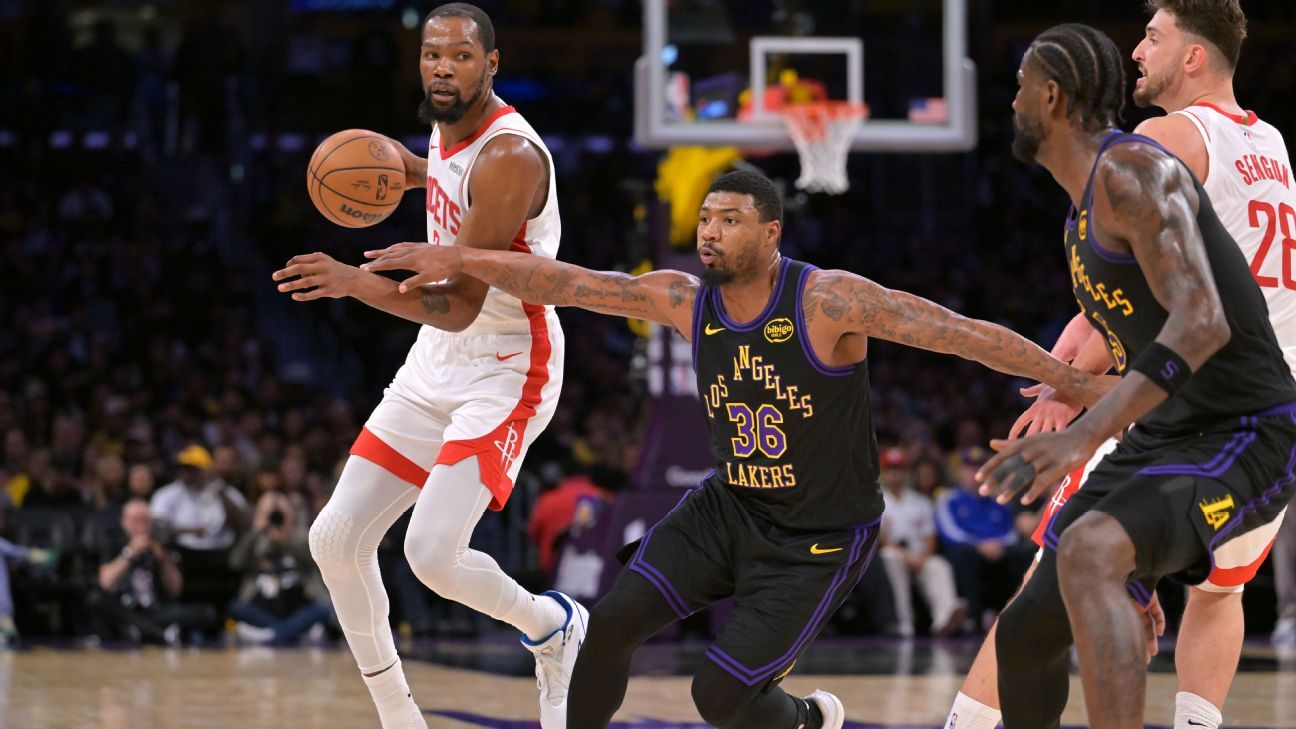
LOS ANGELES — The Houston Rockets had Kevin Durant back for Game 2 of their first-round matchup Tuesday. So the Lakers had Marcus Smart guard him in their 101-94 win to take a 2-0 series lead.
“It was good for them to have KD out there for them,” Smart said, “and it was good for us to be able to do what we did tonight against him.”
Durant returned from a right knee injury that kept him out of Game 1 to score 23 points on 7-for-12 shooting — but shot just 1-for-3 and committed three of his playoff career-worst nine turnovers in the 18 possessions he was defended by Smart, according to ESPN Research.
“He’s not afraid of the moment,” said LeBron James, who led L.A. with 28 points, eight rebounds and seven assists. “He’s always been assigned some of the best players that [have] ever played this game in his career. So, to have someone like that it just brings a lot of composure to our team.
“Especially when we’re missing — I hate to beat a dead horse, but it’s two big horses — with AR [Austin Reaves] and Luka [Doncic] out. So, to have that, it means a lot to our ballclub.”
As effective as Smart was defensively, grabbing five steals, he was equally important on offense, scoring 25 points on 8-for-13 shooting (5-for-7 from 3) with seven assists.
“Smart, he just had a killer game today,” Lakers coach JJ Redick said.
The veteran guard, signed to a two-year, $11 million contract in the offseason after being recruited to L.A. by Doncic, was great from the start of Game 2, scoring 14 of his points in the first quarter.
“He set the tone for us, got us going,” said Luke Kennard, who followed up 27 points in Game 1 with 23 in Game 2. “And we know with those guys out, it could be anybody on any given night right now.”
Houston, which was held below 100 points for the second straight game and shot just 40.4%, cut what was once a 15-point lead by the Lakers to just five with under three minutes remaining.
Which was when Smart, fittingly, hit his fifth 3 of the night to put the Lakers back up by eight with 2:23 to go and give them some breathing room.
“He hit a big one,” Redick said.
While Redick said before the game that Reaves had started his return to play progression, confirming ESPN’s Shams Charania’s report that he began on-court one-on-one workouts as he continues to rehabilitate from a Grade 2 oblique strain that’s kept him out since April 2, the coach did not provide an updated timeline on when Reaves could be back in the lineup.
Redick added that Doncic had yet to begin his return to play progression from the Grade 2 left hamstring strain that’s also sidelined him since April 2 and provided no timetable update on the Slovenian star, either.
In other words, as the series shifts to Houston for Game 3 on Friday, Smart will still be as important as ever.
“I can look at him, and he knows what the hell I’m talking about,” said James, who revealed that his viral meme moment from Game 1 was him making eye contact with none other than Smart to get his attention from across the court. “He can relate to me.”
And Redick said that the team can relate to Smart’s will to win.
“Because he has the voice he has, he can help create the belief and the confidence in our group,” Redick said. “And I think he’s done that.”
For Smart, who was named the Defensive Player of the Year for the 2021-22 season before helping the Boston Celtics make it to the 2022 NBA Finals before two injury-riddled seasons in Memphis and Washington, Game 2 served as a reminder of his capabilities.
“I’m very grateful to be doing this,” Smart said. “I thank God every day, because I could have been out the league, right? Injuries and things like that. So, to be able to be back on this stage again, making the plays that I’m making with these guys, with this team, this organization, I’m just grateful.”
When Sir Alex Ferguson left Manchester United in 2013, he did so with a Premier League winners’ medal around his neck. The downside was that he squeezed every last bit out of an aging team and the handover to his successor David Moyes was a traumatic one from which United have never really recovered.
Jurgen Klopp didn’t leave Liverpool as a champion when he departed Anfield two years ago, but he did pass Arne Slot a squad in decent shape — evidenced by their title win 12 months after his exit.
And when Arsène Wenger called it quits at Arsenal in 2018, he left behind neither the Premier League trophy nor the players to achieve it. Major surgery has been required from Mikel Arteta to restore them as genuine contenders.
It’s clear that moving on from a manager who has been in position for a long time can be complicated.
– Ogden: Arsenal are still Premier League title favorites, and here’s why
– Marcotti: Premier League now City’s to lose, Bayern clinch Bundesliga, more
– Man City 2-1 Arsenal: Haaland’s winner blows title race wide open
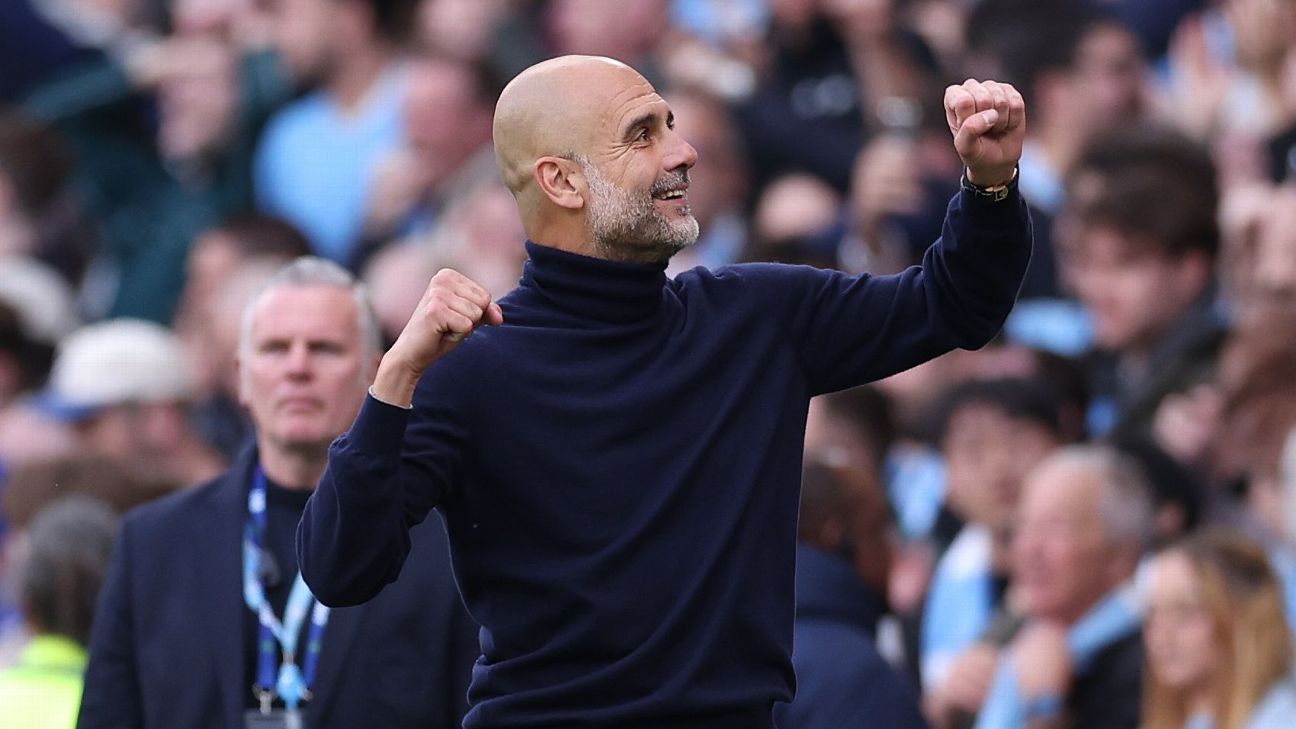
Manchester City might be about to go through the same thing as United, Liverpool and Arsenal, with doubts about whether Pep Guardiola will still be in charge in August. But if he does go, he’s in something of a unique position in the Premier League era when it comes to possibly signing off with a title and leaving behind a squad which — in theory — is only going to get better.
While still unconfirmed, there’s a growing feeling around City that Guardiola, 55, will leave at the end of the season. He is under contract until June 2027, but there was surprise at the time that the extension he signed in November 2024 was for two years rather than just one.
There will be very little shock if he doesn’t see out the final year.
There’s unlikely to be any kind of formal announcement while City are still in contention to win trophies; Guardiola has always looked to minimize distractions as much as possible.
Victory over Arsenal on Sunday has narrowed the gap in the title race to three points with five games to go — plus City have a game in hand — and with an FA Cup semifinal against Championship side Southampton to come on Saturday, there’s still the possibility of sealing a domestic treble after their success over the Gunners in the Carabao Cup in March.
Not even Ferguson went out like that.
Ferguson also left United with the club on the brink of a difficult transition. His title success in 2012-13 was achieved with a squad overly reliant on an older core of Patrice Evra, Rio Ferdinand, Nemanja Vidic, Michael Carrick, Ryan Giggs, Paul Scholes and Robin van Persie. Only Carrick stayed on the playing staff beyond 2015.
1:36
Moreno: I’d rather be in Man City’s dressing room right now
Alejandro Moreno believes Man City’s win over Arsenal puts them in a stronger position to win the Premier League.
Giggs said recently on a podcast appearance with Ferdinand that: “Another sign of a good manager is the team he leaves behind.”
Ferguson’s successor, Moyes, made plenty of mistakes of his own, but his task was made more difficult because of the squad he inherited.
Guardiola has done it differently. He has overseen the departure of a number of experienced campaigners over the last 18 months including Éderson, Kyle Walker, Ilkay Gündogan and Kevin De Bruyne.
In their place, Guardiola has bedded in younger players like Marc Guéhi, Josko Gvardiol, Abdukodir Khusanov, Nico O’Reilly, Antoine Semenyo and Rayan Cherki.
The average age of the City squad this season is 26.1; the average age of the starting XI against Arsenal on Sunday was even lower, at 25.3.
Whether Guardiola stays or goes, there will be further investment in the squad this summer. But any money spent will be used to fill specific needs — a midfielder to replace the departing Bernardo Silva and possibly a right back — rather than making wholesale changes. The foundations of City’s next team are already in place.
Guardiola has said that City will be better next season. That has prompted some hope among fans that he might decide he wants to benefit from the improvement himself rather than hand the golden ticket to a successor — whether that’s his former assistant Enzo Maresca (who is currently out of work after leaving Chelsea) or someone else.
1:36
Guardiola hails ‘legend’ Bernardo Silva after Man City beat Arsenal
Pep Guardiola sings the praises of Bernardo Silva after the midfielder’s star performance in Manchester City’s win over Arsenal.
He has shelved plans to leave before, most notably when he signed a second extension in November 2022, and one more crack at winning the UEFA Champions League might be tempting.
City have always been relaxed about Guardiola’s future, believing that their relationship is so strong that he would always factor in what’s best for the club as well as what works for him. It’s one of the reasons there were no internal concerns that he could leave last summer — despite a relatively poor season — because he knew a handover in a summer which included the FIFA Club World Cup would be difficult for the club to manage.
Whenever Guardiola decides to go, it will be a big blow for City.
The club have been molded around his vision since he arrived in 2016, and it’s paid off in the form of a bucketload of silverware. He could yet walk away as a champion while also leaving behind a team capable of adding more in the future.
And that is something not even Premier League greats like Ferguson, Klopp and Wenger were able to achieve.


Oil prices fluctuate as Trump extends Iran war ceasefire

Chaos reigns in Asian Champions League after VAR intervenes over substitution

Italy’s inflation edges up to 1.7% in March: Istat

-

 Fashion6 days ago
France’s LVMH Q1 revenue falls 6%, shows resilience amid Iran war
-

 Entertainment7 days ago
Is Claude down? Here’s why users are seeing errors
-
 Business1 week ago
Delta Air Lines unveils first new Delta One suite in premium cabin arms race
-

 Fashion1 week ago
Asia claims largest share of markets on Kearney FDI Confidence Index
-

 Sports7 days ago
PSL 11: Peshawar Zalmi win toss, opt to field first against Quetta Gladiators
-

 Tech1 week ago
The Deepfake Nudes Crisis in Schools Is Much Worse Than You Thought
-

 Tech1 week ago
Bremont Is Sending a Watch to the Moon’s Surface
-

 Tech1 week ago
Human-machine teaming dives underwater