

Business
Renewable sector seeks tax cut | The Express Tribune

KARACHI:
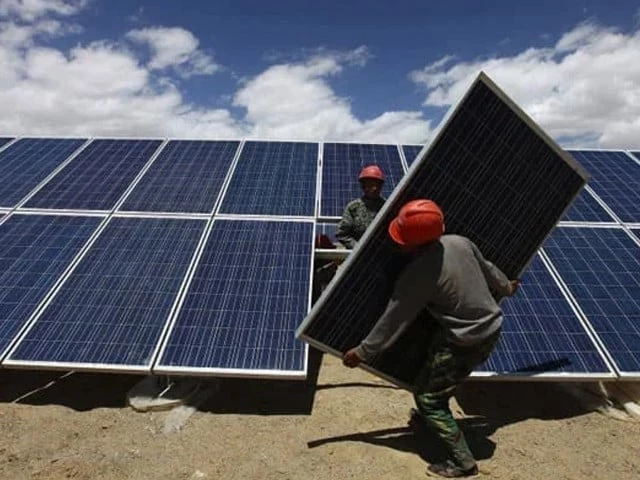
Renewable energy stakeholders have urged the Engineering Development Board to slash taxes on lithium battery cells to support domestic production and green energy adoption, according to a statement on Friday.
Pakistan Renewable Energy Development Forum Chairman Irfan Allahawala said cells are taxed at 50%, discouraging local battery assembly. High duties keep battery prices elevated, creating a barrier to renewable energy transition.
He called for a level playing field to attract investors for local manufacturing. Pakistan imported 26,000 MW of solar panels during 2022-2024, all requiring batteries. Lithium?ion battery imports reached 1.25 GWh in 2024 and are projected to hit 2.5-3 GWh in 2025. Lower taxes would reduce reliance on imported petroleum products and lower the import bill, Allahawala added.
The Department for Work and Pensions (DWP), which runs the CMS, did not address the experiences of John Hammond and other individual cases, or explain why in some cases money was taken wrongly from bank accounts. It said it tries to arrange voluntary arrears payments and “enforcement measures are only taken if parents continue not to pay”.
Business
Petrol, diesel prices up by Rs 3, CNG by Rs 2, further hike likely; no change in piped gas yet
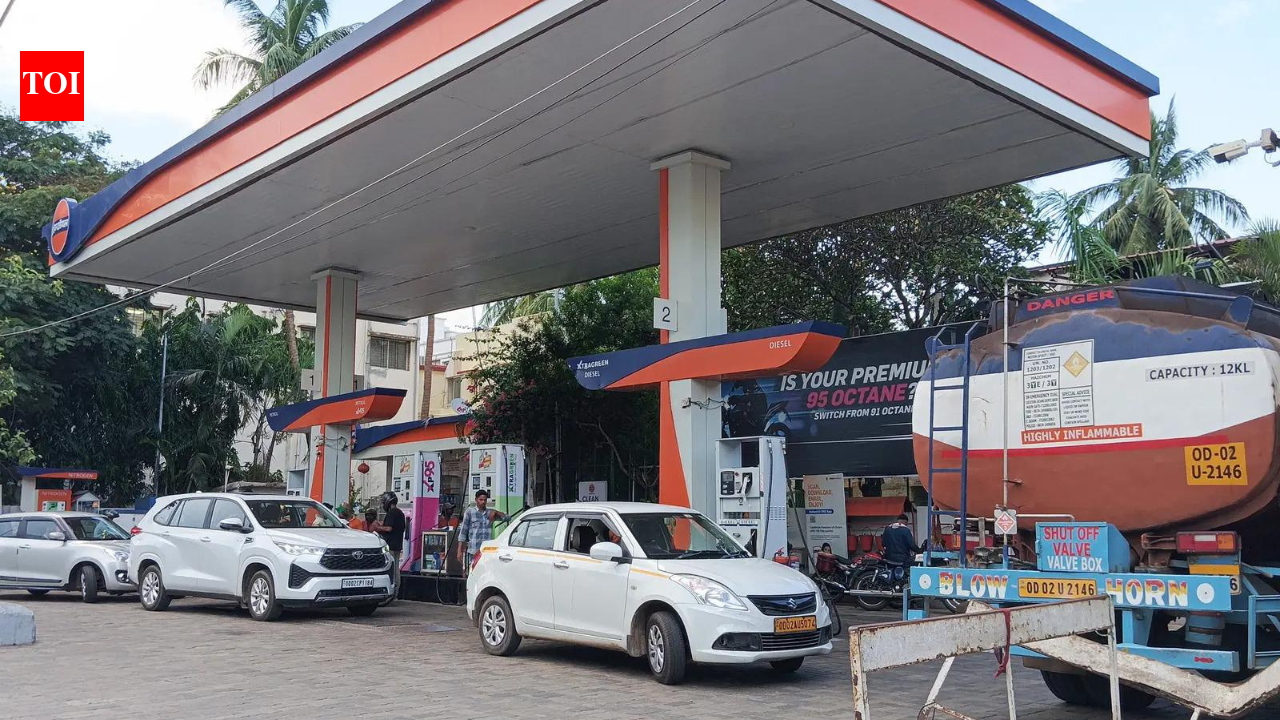
NEW DELHI: Amid mounting losses, public sector oil firms announced the much-anticipated increase in petrol and diesel prices, raising it by around Rs 3 a litre across metros on Friday, which was lower than expected. Piped kitchen gas prices were, however, left unchanged.Oil company executives did not rule out the possibility of a further increase in petrol and diesel prices, but that will depend on a green light from the govt, including extent and timing.The hike for the two auto fuels will only partially cover the losses of state-run oil retailers with ratings agency Crisil estimating under-recoveries at Rs 10 a litre for petrol and Rs 13 for diesel. Oil companies follow a complex formula, which largely links retail prices to global prices for petrol and diesel. On top of that, taxes are added.While the cost of crude for Indian refiners has increased 53% from an average $69 a barrel in Feb to over $106 so far in May, there is a jump of around 75% each for petrol and diesel. Fuel prices in India had remained frozen since April 2022, barring March 2024, when the Centre reduced excise duty by Rs 2 a litre.The increase on Friday came a fortnight after the elections in four states and Puducherry ended.Petrol prices increased over 44% in US in a little over two monthsEarlier this week, the daily under-recovery for Indian Oil, Bharat Petroleum and Hindustan Petroleum was pegged at Rs 1,000 crore earlier this week. Ratings agency ICRA said that they may now be incurring losses of around Rs 500 crore a day, including on the sale of cooking gas cylinders to households below the market price. Besides, the Union govt has only allowed partial adjustment of aviation fuel prices for domestic scheduled airlines.Govt officials have argued that govt and oil companies had so far insulated citizens from an increase when several other countries were raising prices and imposing curbs. Govt data showed that petrol prices increased over 44% in US and diesel surged 48% in a little over two months. In Canada, the jump was 32% and 33%, respectively, while petrol prices in New Zealand rose nearly 31% and diesel by around 89%. Private fuel retailers such as Nayara Energy and Shell increased pump prices in March and April, respectively.Sehul Bhatt, director, Crisil Intelligence, called the hike a step towards unwinding a prolonged under-recovery cycle. “At their peak, oil marketing companies were absorbing losses of Rs 23-30 per litre on petrol and diesel, translating into a combined daily loss of Rs 1,300-1,400 crore across petrol, diesel and LPG. Govt intervention through excise duty relief of Rs 10 per litre narrowed these to Rs 14 and Rs 17 per litre, reducing the daily loss run rate to around Rs 1,000 crore,” Bhatt said.

The FTSE 100 slumped on Friday as talks between the US and China failed to deliver hoped for progress on the Middle East, adding to jitters caused by domestic political uncertainty.
“There’s a downbeat feel around at the end of the week as big problems crowd in, without resolutions in sight,” said Susannah Streeter, chief investment strategist at Wealth Club.
The FTSE 100 closed down 177.56 points, 1.7%, at 10,195.37.
The FTSE 250 ended down 231.93 points, 1.0%, at 22,596.14, and the AIM All-Share fell 8.23 points, 1.0%, at 808.89.
For the week, the FTSE 100 fell 0.4%, the FTSE 250 lost 1.1% and the AIM All-Share shed 0.6%.
Investors were left disappointed as highly anticipated talks between US President Donald Trump and Chinese leader Xi Jinping failed to deliver major breakthroughs on the Middle East war or trade relations.
“The meeting… was big on warm words and symbolism but not outcomes,” said Ms Streeter.
“With diplomatic efforts aimed at resolving the Middle East conflict in limbo, fresh uncertainty has flooded in,” she added.
The White House said the leaders had “agreed that the Strait of Hormuz must remain open to support the free flow of energy”.
But investors had hoped for more progress towards reopening the crucial strait, where oil tanker traffic has ground to a near standstill since the outbreak of the war, sending energy prices soaring.
The lack of progress pushed oil prices higher once more.
Brent crude for July delivery was trading at 108.83 dollars a barrel on Friday, up compared with 104.92 dollars at the time of the equities close in London on Thursday.
In Europe on Friday, the CAC 40 in Paris ended down 1.6%, and the DAX 40 in Frankfurt slid 2.1%.
In New York, the Dow Jones Industrial Average was down 0.9%, the S&P 500 fell 1.0%, and the Nasdaq Composite was 1.2% lower.
In London, sentiment was further knocked by another wave of worry about political instability as Mayor of Greater Manchester Andy Burnham pledged to fight for a return to Westminster, where he is likely to launch a leadership challenge to Prime Minister Sir Keir Starmer.
“Burnham’s big hurdle of course is winning the by-election and so this leadership race looks set to be long and cumbersome. Another bout of political infighting, with yet another Prime Ministerial shuffle under way is hardly a good look for a country which needs to portray stability to attract investment,” said Ms Streeter.
The double whammy of Middle East and Westminster uncertainty saw UK government borrowing costs soar and the pound sink.
The yield on 10-year gilts traded at 5.17% compared with 5.00% at the same time the day before.
ING said the biggest risk here is that investors begin to question the UK’s longer-term fiscal discipline.
“Gilt markets rely on foreign investors and any signs that fiscal dynamics risk turning unsustainable could quickly turn sentiment,” ING explained.
“Until we get a better understanding around the fiscal path forward, political risk premium is likely to keep rising. A rise towards 5.30% is quite possible in the near term,” ING added.
The pound fell against the dollar to 1.3319 dollars on Friday afternoon from 1.3480 dollars on Thursday. Against the euro, sterling ebbed to 1.1462 euros from 1.1549 euros on Thursday.
The euro traded lower against the greenback, at 1.1622 dollars on Friday, from 1.1677 dollars on Thursday. Against the yen, the dollar was trading at 158.68 yen, higher than 158.14 yen.
The yield on the US 10-year Treasury widened to 4.58% on Friday from 4.46% on Thursday. The yield on the US 30-year Treasury stretched to 5.12% from 5.01%.
On a quiet day for company news, reports of possible bids drove price moves for Hiscox and Magnum Ice Cream.
Bermuda-based insurance provider Hiscox topped the FTSE 100 leaderboard, up 12%, as Insurance Post reported Canada’s Intact Financial Corp was exploring a potential bid.
Citing multiple sources, Insurance Post said Intact is exploring a potential bid for Hiscox as it tries to build out its commercial lines business.
Meanwhile, Magnum Ice Cream jumped 9.4% as Reuters named Blackstone and Clayton, Dubilier & Rice as among several private equity firms in the early stages of exploring bids for the owner of Cornetto and Ben & Jerry’s which was spun out of Unilever less than six months ago.
But analysts at JPMorgan think a deal will not be straightforward and say tax considerations may limit the potential for a Magnum takeover in the near term.
In a research note, published after the Reuters report, JPM explained that since the separation of Magnum was a tax-free de-merger, the company has agreed to refrain from actions that could create a tax liability – including for two years being restricted from engaging in “certain acquisition, merger, liquidation, sale, and stock redemption transactions”.
In addition, Magnum has agreed to indemnify Unilever for any taxes or losses if the de-merger fails to qualify as tax-free.
Thus, JPM said it sees the likelihood of a takeover as “remote” given these constraints.
Among the blue chip losers, miners sank amid falling metals prices. Fresnillo fell 10%, Antofagasta dropped 11% and Anglo American fell 5.7%.
Gold traded at 4,544.53 dollars an ounce on Friday, down from 4,688.75 dollars on Thursday. The price of silver was 8.5% lower from the day before and copper around 5.0% lower.
Political uncertainty and rising gilt yields weighed on utilities, with Severn Trent down 8.0%, SSE down 7.7% and United Utilities down 7.5%.
The biggest risers on the FTSE 100 were Hiscox, up 202p at 1,841p, 3i Group, up 98p at 2,210p, JD Sports Fashion, up 1.76p at 72.02p, Relx, up 58p at 2,423p and BP, up 11.5p at 552.2p.
The biggest fallers on the FTSE 100 were Airtel Africa, down 39.8p at 328.4p, Antofagasta, down 457p at 3,810p, Fresnillo, down 372p at 3,335p, Severn Trent, down 252p at 2,882p and National Grid, down 102.5p at 1,188p.
Monday’s global economic calendar has China industrial production, retail sales and unemployment data before GDP data in Switzerland.
Monday’s local corporate calendar has full-year results from airline Ryanair and self-storage operator Big Yellow.
Contributed by Alliance News


Zara Tindall’s ‘secret’ promotion from Prince William: What it really means?

PCB chief Naqvi ‘receives invitation’ to attend ICC meeting, IPL final in India

Meera says ‘Psycho’ can compete with Bollywood, Hollywood

-

 Tech1 week ago
A new frontier: Identity stack evolves for agentic systems | Computer Weekly
-

 Tech1 week ago
‘Orbs,’ ‘Saucers,’ and ‘Flashes’ on the Moon: Pentagon Drops New UFO Files
-

 Tech1 week ago
What Microsoft Executives Really Thought About OpenAI in 2018
-
 Fashion1 week ago
New orders in German manufacturing up 5% MoM in Mar 2026: Destatis
-

 Tech1 week ago
Nick Bostrom Has a Plan for Humanity’s ‘Big Retirement’
-

 Sports1 week ago
Shaheen Afridi achieves landmark feat during opening Test against Bangladesh
-
 Fashion1 week ago
US’ Carter’s taps retail veteran Sharon Price John as new CEO
-

 Entertainment1 week ago
Rihanna embraces new tattoo given by children