

Business
Revolution Medicines says its potential breakthrough pancreatic cancer drug succeeds in late-stage trial


Revolution Medicines‘ drug for pancreatic cancer succeeded in a highly anticipated Phase 3 trial, almost doubling the typical length of survival and slashing the risk of death by 60% versus chemotherapy, the company said Monday.
RevMed said its daily pill, daraxonrasib, met all primary and secondary endpoints in a trial of people whose cancer had already progressed on another treatment. People who took daraxonrasib typically lived for 13.2 months versus 6.7 months for people who took chemotherapy, an increase of 6.5 months, RevMed said in a press release.
“These are dramatic, practice-changing outcomes, and our focus now is moving quickly to bring this potential new treatment option to patients who urgently need new treatment,” RevMed CEO Mark Goldsmith said in an interview.
Goldsmith called the results “unprecedented,” saying no drug has shown an overall survival benefit greater than one year in a Phase 3 trial for pancreatic cancer. The company plans to soon seek Food and Drug Administration approval using a Commissioner’s National Priority Voucher, which grants a review within a matter of months.
RevMed’s pill could bring a new option for people with pancreatic cancer, an aggressive disease that has the lowest five-year survival rate of any major cancer, at 13%. Daraxonrasib broadly targets RAS mutations, which drive tumor growth and are found in about 90% of pancreatic cancer cases.
“These results usher in a new era of RAS-targeted medicines for pancreatic cancer, which has been exclusively treated with cytotoxic intravenous chemotherapy,” Goldsmith said.
For patients, these results are “truly transformational,” said Dr. Shubham Pant, professor of gastrointestinal medical oncology at The University of Texas MD Anderson Cancer Center. Pant said he’s been involved in numerous other studies that have failed, and said previous positive trials extended survival by a few weeks or months.
He’s been involved in trials for RevMed’s daraxonrasib since its early days, and choked up multiple times when describing the results and what they mean for patients, including one who participated in the pivotal trial that Pant had seen just before the interview.
“Today, I’m just, I’m just thankful,” Pant said. “That’s all I can say. And you know, just seeing patients in my clinic today, I’ve got a busy clinic today, and I’m just thankful.”
Daraxonrasib gained more attention last week, when former Republican Sen. Ben Sasse, who was diagnosed with pancreatic cancer late last year and given only months to live, shared his experience taking the drug in an interview with The New York Times. He told the Times that Pant is his doctor.
Sasse said his tumors have shrunk 76% since he started taking the drug, but said it causes “crazy” side effects like a facial rash. His face appeared to be peeling during the interview.
RevMed’s CEO Goldsmith said the company can’t comment on any individual patient, but that a rash is a known side effect and one that’s generally manageable. Pant couldn’t speak to the specifics of Sasse’s case, but said the majority of patients in previous trials of daraxonrasib did experience a rash, though less than 10% of them developed a “dramatic” rash. He said strategies like stopping the drug temporarily or treating with antibiotics can help.
“Honestly, since our journey three years ago, we are getting better at managing these side effects, and I think we keep on getting better at managing side effects,” Pant said.
RevMed on Monday said the drug showed a manageable safety profile in the pivotal study and that no new concerns were observed. The full results will be disclosed at a medical meeting.
The company will seek approval for second-line treatment, or in patients whose cancer has already spread while taking another drug. It’s conducting a Phase 3 trial for newly diagnosed patients.
Daraxonrasib could become a foundation that can be built upon and used in combination with other drugs, said Dr. Andrew Aguirre, associate director of the Hale Family Center for Pancreatic Cancer Research and co-director of the Center for RAS Therapeutics at Dana-Farber Cancer Institute. The results are a “whopping improvement” to be “incredibly excited about as really a foundation,” he said.
“And honestly, it’s reason for optimism for the whole field that targeting RAS in this patient population, and hopefully many other contexts for pancreatic cancer and many other difficult-to-treat diseases is going to have real benefit for patients and be something that we can continue to expand and use in combination,” Aguirre said.
Revolution Medicines shares jumped more than 30% following release of the results Monday. Its stock has climbed about 274% in the last year, in part because it has long been seen as an acquisition target.
Monday’s stock move brings the company’s market value to more than $26 billion. Goldsmith said the company is focused on preparing for approval and launch of its drug, rather than any potential acquisition.


Business
Hormuz flashpoint: Why Indian-flagged ships are in focus as Middle East tensions hit global shipping – The Times of India
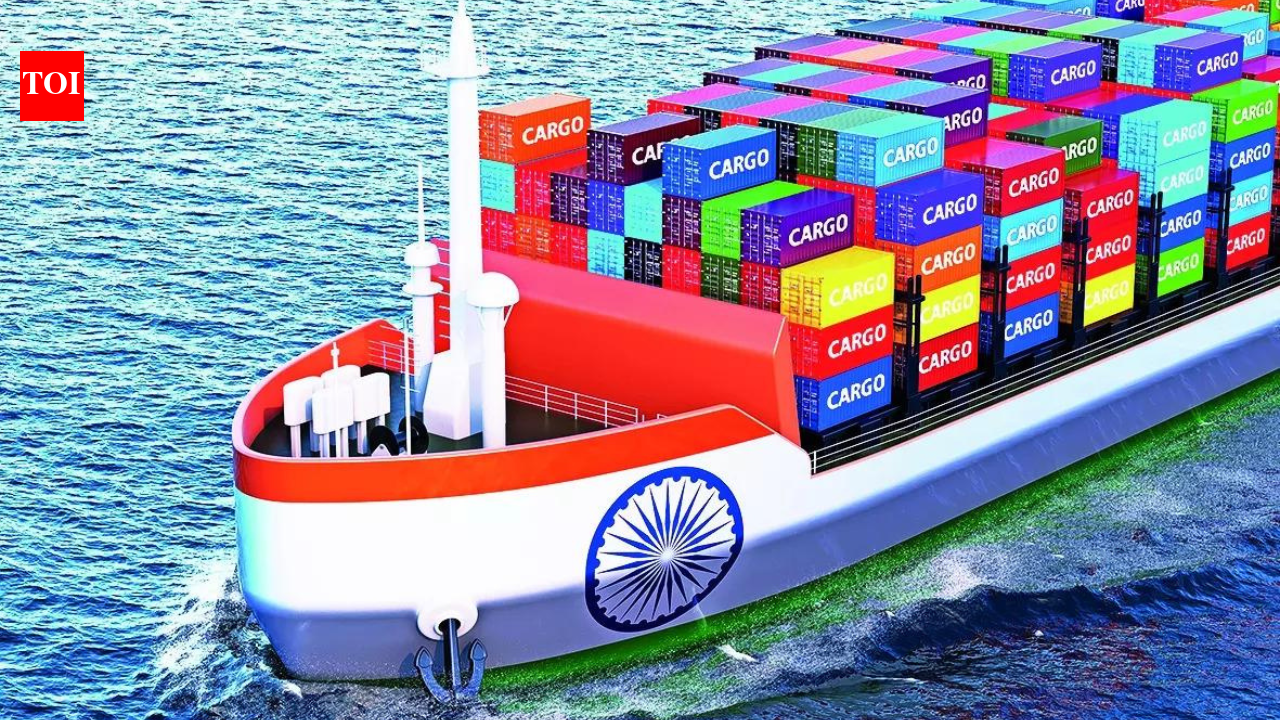
As tensions rise in Middle East and vessel safety in the Strait of Hormuz comes under renewed focus, the flag a ship flies has emerged as a key factor in maritime security, regulation and state protection.Flagging a vessel means it is registered with a country and must comply with that nation’s maritime laws and regulations. It also gives the flag state powers to investigate and penalise violations of domestic and international laws. Since regulations differ across countries, shipowners often choose jurisdictions that best suit operational and commercial needs, according to an ET report.An Indian-flagged vessel is a commercial ship registered with the Directorate General of Shipping and authorised to fly the national flag. Such vessels are governed by the Merchant Shipping Act and operate under Indian jurisdiction as a sovereign extension on the high seas.These ships are taxed by Indian authorities and must comply with Indian maritime safety, labour and environmental rules. To qualify for Indian flagging, vessels must come to domestic waters for registration and the owning company must be incorporated in India.Indian-flagged ships also receive strategic backing. India protects their interests through naval and diplomatic intervention when required. Experts say this creates a higher compliance burden than “Flag of Convenience” jurisdictions such as Panama and St Kitts.According to Rajeev Kumar Yadav, as quoted ET, director at Vertex Marine Services, Flag of Convenience systems allow vessels to be flagged from anywhere in the world within “3-4 days”.Indian-flagged ships calling at domestic ports can also benefit from lower port levies and tax liabilities, along with priority in government cargo movement and public sector charter contracts.During the Iran crisis, more than two dozen Indian ships were stranded west of the Strait of Hormuz after strict high-risk area classifications were imposed. The Indian Navy escorted several tankers to safety, though some vessels remain in the Persian Gulf.No direct attacks have been reported on Indian-flagged vessels so far, largely due to India’s balanced diplomatic approach in the crisis.However, being Indian-flagged does not give the government powers to decide freight rates or commercial destinations. The state’s role is limited to enforcing civil, criminal and regulatory laws onboard, along with international safety, environmental and labour compliance norms.India’s flagged fleet has been expanding. The Indian-flagged vessel fleet reached 14.2 million Gross Tonnage (GT) in March, with 92 vessels of 1.5 million GT joining during FY26.The long-term Maritime Amrit Kaal Vision 2047 aims to sharply raise India’s share of the global flagged fleet and increase utilisation of Indian-flagged ships from about 7 per cent currently to 30-40 per cent by 2047.
Brent crude sinks by a tenth after Iran says the key waterway is open for commercial ships for the rest of the ceasefire.
Source link
Oil prices tumbled on Friday after Iranian officials said they would allow commercial traffic to resume in the Strait of Hormuz. This lifted equity markets in Europe and New York, where major indices hit new records.
Citing the ceasefire between Israel and Lebanon, Iran’s Foreign Minister Abbas Araghchi said Tehran would lift its blockade on shipping through the key Gulf energy trade route.
“In line with the ceasefire in Lebanon, the passage for all commercial vessels through Strait of Hormuz is declared completely open for the remaining period of ceasefire,” Araghchi said.
Traffic in the strategic waterway, through which one-fifth of the world’s crude oil normally flows, has been disrupted by Iran since the US-Israeli offensive began on Feb. 28. At one point, this sent oil prices to a peak of nearly $120 a barrel and roiled the global economy.
Both Brent, the benchmark international contract, and its US equivalent WTI fell below $90 per barrel following Tehran’s announcement. Brent later cut its losses and finished at $90.38 a barrel, down 9.1%.
‘Immediate impact’
“This news is having an immediate impact on markets,” said Kathleen Brooks, research director at XTB.
The move also sent a jolt through equity markets, extending a rally in New York. There, equities have pushed ever higher since late March in anticipation of a breakthrough in the Middle East crisis.
“We had seen a big move the last two weeks, and now it’s just really pricing completely out the worst-case scenario, said Angelo Kourkafas, from Edward Jones.
Kourkafas also pointed to underlying strength in the US economy that should get more attention in the coming period as geopolitical concerns ebb.
“Geopolitical developments are moving in the right direction, and at the same time, the earning strength is hard to ignore,” Kourkafas said.
The broad-based S&P 500 finished at 7,126.06, up 1.2% for the day and 4.5% for the week.
‘Good news’
Earlier, European stocks closed higher, with both Frankfurt and Paris gaining 2%.
US President Donald Trump cheered the reopening of the Strait of Hormuz in an interview with AFP.
“We’re very close to having a deal,” Trump said in a brief telephone call with AFP from Las Vegas. He added there were “no sticking points at all” left with Tehran.
But Iran quickly pushed back on one key point.
Iran’s foreign ministry said Friday that its stockpile of enriched uranium would not be transferred “anywhere.” It rejected an earlier claim by Trump that the Islamic Republic had agreed to hand it over.
Shipping industry figures, meanwhile, gave a cautious welcome to Iran’s announcement.
A spokesman for German transportation giant Hapag-Lloyd, which has ships stuck in the Gulf, told AFP by phone that the reopening was “in general… good news.”
But he cautioned that shippers still needed details of what route vessels could take and in what order, citing fears of mines.
“One thousand ships cannot just go now to the entrance of the strait, that will be chaos. They (the Iranians) need to give clear orders,” said the spokesman, Nils Haupt.
“We would be ready to go very soon if some of these open questions can be solved within the weekend.”

Hormuz flashpoint: Why Indian-flagged ships are in focus as Middle East tensions hit global shipping – The Times of India

The Smart Home Gadgets to Amp Up Your Curb Appeal

Royal fan defends Meghan Markle amid brutal criticism: ‘There was no BS’

-

 Politics1 week ago
Indian airlines hit hardest after Dubai limits foreign flights until May 31
-

 Entertainment5 days ago
Palace left in shock as Prince William cancels grand ceremony
-

 Sports5 days ago
The case for Man United’s Fernandes as Premier League’s best
-

 Politics1 week ago
Chinese, Taiwanese will unite, Xi tells Taiwan opposition leader
-
 Business5 days ago
UK could adopt EU single market rules under new legislation
-

 Entertainment1 week ago
Dua Lipa hits major career high ahead of wedding with Callum Turner
-

 Sports7 days ago
Lamar Jackson hits back at critics with faithful message on social media
-
 Business1 week ago
He paid $248 in illegal tariffs for this coat. Will he ever get it back?