

Business
Iranian currency Rial hits 1.58 million per US dollar: Economy in freefall after war, civilian sector collapses – The Times of India


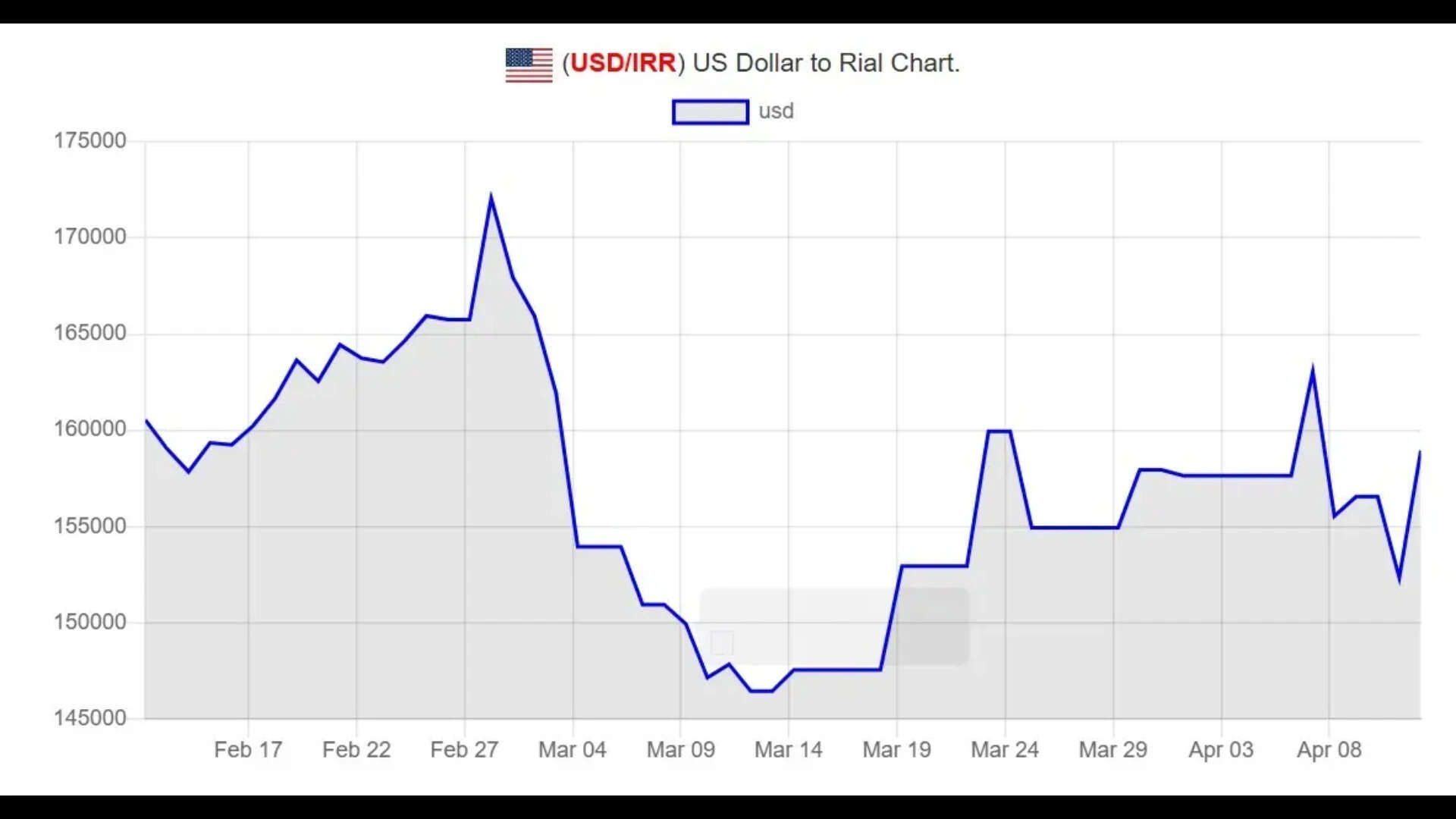
Iran’s currency has plunged sharply in the free market, with rates hovering around 15,69,410–15,80,000 Rial per US dollar, underlining deepening stress in an economy battered by war, sanctions and internal disruption, according to Bonbast data.Average rates stood at 156,9410 (sell) and 15,68,410 (buy), with extremes ranging between 14, 64,500 and 17,20,500 Rial, signalling heightened volatility in the parallel market.
–
Blockade threat deepens uncertainty
The economic strain is intensifying alongside fresh geopolitical escalation. The US military said it would begin a blockade of all Iranian ports after talks between the warring sides in Pakistan collapsed, even as Iran warned it would treat such action as piracy, AFP reported.US President Donald Trump said the blockade would target the strategic Strait of Hormuz after Vice President JD Vance left negotiations in Islamabad without a deal. The US military said the move would apply to all ships entering or leaving Iranian ports from 1400 GMT, though it remained unclear how it would be enforced.
Economy hit despite ‘strategic victory’ narrative
Iranian authorities have portrayed the truce with the US and Israel as a strategic success, but the country has emerged battered, with widespread job losses, surging prices and large-scale infrastructure damage, Reuters reported.Factories, power plants, railways, airports and bridges have been hit, while trade ties with Gulf states — a key economic channel — have been severed, possibly for years.Even as Iran appears emboldened regionally after asserting control over energy flows, it faces mounting internal pressures that could prove more destabilising than external military action.
Sanctions relief seen as critical
Interviews with political insiders, business owners and analysts point to an economy nearing collapse, with leaders increasingly concerned about a poorer and uncertain future, Reuters reported.Officials regard the economy as the country’s “Achilles heel”, a political insider was quoted as saying, amid fears that worsening conditions could trigger fresh nationwide protests similar to those earlier this year.Any comprehensive peace agreement would need to lift sanctions and release frozen funds, without which authorities may struggle to meet payroll obligations or rebuild damaged infrastructure, an insider told Reuters.“We can’t really see the extent of damage and blowback inside Iran. But on any metric it’s a fiasco for Iran – there’s no money and the infrastructure is shot,” said Ali Ansari, a professor of history at St Andrews University.“Closing Hormuz was the option of last resort… the cost for Iran in the medium to long term is going to be absolutely enormous,” he added.
Industries crippled, supply chains disrupted
The scale of damage suggests major industrial facilities could take months or years to repair, with officials warning the country “will face a disaster” if sanctions are not lifted, Reuters reported.Strikes have hit key production centres including the South Pars gas field and petrochemical units, while steel plants in Khuzestan and Isfahan have faced shutdowns affecting thousands of workers, Iranian press reports indicated.The disruption has cascaded across supply chains, forcing dependent industries to halt operations and pushing unemployment higher, an official said.Economic ties with Gulf countries– particularly the UAE–have also been strained, with one official saying the conflict had created “a huge trust gap” that could last for decades.
Prices surge, jobs vanish
On the ground, inflation has accelerated sharply, with some prices rising by as much as 40% since the war began, Reuters reported.Amir, a resident of Tehran, said the price of a basic food item jumped from 700,000 rials to 1,000,000, while a cancer treatment tablet that earlier cost three million rials surged to 180 million rials, AFP reported.Businesses across sectors have been forced to shut. Arash, a clothing factory owner in Tabriz, said he halted production, leaving 12 employees without work.“Even now I don’t know when I’ll be able to reopen. It all depends on when this really comes to an end,” he said.Mass layoffs have hit construction, retail and services, while communication restrictions have disrupted e-commerce and digital businesses, AFP reported.“I’m honestly really scared about our future, especially economically… Things are a disaster right now,” a finance professional in Isfahan said, describing the situation.
Banking stress, inflation risks mount
Iran’s banking system, already fragile before the conflict, faces further strain as borrowers struggle to repay loans, AFP reported.Adnan Mazarei, a former IMF official, warned the sector may require additional rescues, which could force the central bank to print money, adding to inflationary pressures.Annual inflation stood at 47.5% in February, with currency depreciation, sanctions and economic mismanagement compounding the impact of war damage.Some estimates suggest the conflict could shrink the economy by as much as 10% this year, with any gains from higher oil prices likely to benefit state-linked entities rather than the wider population, analysts noted.Despite the turmoil, essential goods remain available and businesses continue to function in many areas, though consumers are cutting spending amid uncertainty, Reuters reported.The government has increased spending to support displaced populations and repair infrastructure, but officials caution that public patience could erode once the immediate conflict subsides.With currency volatility, inflation, job losses and geopolitical risks converging, Iran’s economy faces a prolonged and uncertain recovery path.





Around 65,000 young people will be able to train to enter the defence, clean energy, digital and manufacturing industries under the latest round of Government investment into colleges.
The Government will provide £175 million for 19 new Technical Excellence Colleges across the country to deliver training in sectors deemed important for the future of the UK.
Minister for skills Baroness Jacqui Smith said the investment would help build a pipeline of skilled workers for industries key to Britain’s future.
The Government has identified the areas most likely to help grow the economy, Baroness Smith told the Press Association, and said given the war happening in the Middle East, the UK needed to be able to support different ways of getting its energy.
“The Clean Energy (technical excellence colleges) that we’re announcing today will help us to develop that to speed up our shift to clean energy, to protect our energy supply and to help people with their bills,” she said.
“In the area of defence, where, given the instability and some of the new challenges to our defence in the world, and our contribution to that, this Government has pledged a big increase in defence spending that needs to support our armed forces and our capacity, but that spending also needs to deliver quality jobs to the UK defence industry, who will need skilled people in order to be able to deliver it.”
It is estimated nearly 600,000 additional workers will be needed in these key sectors by 2030, the Department for Education said.
If follows the first wave of 10 technical excellence colleges announced last year specialising in construction.
Prime Minister Sir Keir Starmer said: “I want every young person to know there is a clear route into well‑paid work, whatever their background. These colleges put technical skills front and centre, opening up high‑quality jobs in the industries driving Britain’s future.
“We are backing talent across the country, strengthening our workforce and making sure opportunity is built into the system – not left to chance.”
The colleges may spend the funding they receive on specialist equipment, developing new courses, training more specialist staff, and more.
On Monday, Baroness Smith met students and staff at Milton Keynes College, selected as a technical excellence college for digital, where students are already learning about robotics and artificial intelligence (AI).
It comes after the latest figures showed nearly a million (957,000) 16 to 24-year-olds were “Neet” (not in education, employment or training) in October to December 2025.
The high number of young people who were Neet was a “loss of opportunity” and a “loss for the country”, Baroness Smith told PA.
“That’s why we need really high-quality provision for young people between 16 to 19 to be able to access,” she said.
“We need our schools to better identify the young people who are potentially going to become Neet, we need them to take responsibility for making sure that young people have got the places, the college places, the apprenticeships, the jobs to go into.
“And we need brilliant colleges like Milton Keynes, where I am today, to be supported, to be able to provide the opportunities for young people who would otherwise be lost at such a crucial time in their lives and for the future of the skills that we need as a country as well.”
The Government has set a target for two-thirds of young people to be in higher education, higher-level training or doing a gold standard apprenticeship by age 25.
Jawad Al Midani, 21, started studying at Milton Keynes College for a Level 1 course, and has since worked his way up to studying for a Higher National Diploma (HND) in cyber security.
“I feel as soon as I finish my qualifications I’ll be ready to start my career,” he told PA.
Christian Proctor, 18, who is studying for a Higher National Certificate (HNC) in games design and will go on to an HND next year, said he was confident the skills he was learning would equip him for the next step once he finished college.
The 19 new Technical Excellence Colleges are as follows:
Defence
– Blackpool and The Fylde College– City College Plymouth– Lincoln College– RNN Group– Yeovil College
Clean Energy
– Colchester Institute– South Bank Colleges– The City of Liverpool College– The Education Training Collective– University Centre Somerset College Group
Digital and Technologies
– Birmingham Metropolitan College– Capital City College Group– Gloucestershire College– LTE Group– Milton Keynes College
Advanced Manufacturing
– City of Wolverhampton College– New College Durham– Newcastle and Stafford College Group– Weston College of Further and Higher Education

Consumer spending on non-food items remained “tepid” in March as shoppers exercised heightened caution amid ongoing conflict in the Middle East, new figures reveal.
Data from the British Retail Consortium (BRC) and KPMG shows that non-food sales saw a modest 0.9% year-on-year increase last month, falling short of the 12-month average of 1.1%.
This subdued performance was further underscored by online non-food sales, which rose by a mere 0.1%, significantly below the annual average of 1%, indicating a dip in consumer confidence.
While overall UK retail sales climbed by 3.6% compared to a year ago, surpassing the 12-month average of 2.6%, this was largely attributed to an early Easter and inflationary pressures. Food sales experienced an artificial boost, increasing by 6.8%, which skewed the total retail figures.
Demand proved robust for categories such as computers, toys, and homeware. However, the clothing and footwear sectors continued to face challenges. Furthermore, the uncertainty surrounding international travel due to the Middle East situation negatively impacted sales of travel-related goods.
BRC chief executive Helen Dickinson said: “An early Easter provided a much-needed boost to food sales as families came together over the long weekend.
“Retailers hope that the Middle East ceasefire will bring lasting stability, but the outlook remains uncertain.
“Damage to supply chains has already been done, and rising costs – from shipping and fertiliser to insurance and commodities – are piling yet more pressure on to already stretched retailers.
“Government must act decisively and boldly now to curb inflation by delaying domestic policies that would push prices even higher for shoppers.”
Linda Ellett, UK head of consumer, retail and leisure at KPMG, said: “Food and drink continue to drive monthly retail sales growth, with inflation a key factor.
“Non-food sales growth remains tepid, growing at under 1% so far this year, as consumer spending caution is heightened by the current and potential impact of the Middle East conflict.”
Separate figures from Barclays show travel spending declined by 3.3% in March after five years of growth as trips abroad were delayed or swapped for staycations.
Consumer card spending increased 0.9% year on year, down from February’s 1%, the bank’s data shows.
Essential spending returned to growth – up 0.5% – for the first time since July last year as fuel prices surged, while discretionary spending growth slowed to 1.1%, driven by the decline in travel, for the first time since 2021.
However, a survey for Barclays found overall consumer resilience remained strong, with 71% of UK adults feeling confident in their ability to live within their means each month.
In response to uncertainty around the Middle East conflict, 14% said they were delaying major purchases or financial decisions, while the same proportion were building up a savings buffer in case costs rise.
Some 74% anticipate ongoing tensions will continue to affect the cost of living throughout the rest of the year.
Jack Meaning, chief UK economist at Barclays, said: “Shoppers delaying major purchases and building up a savings buffer in response to the shock from the Middle East reinforces our view that activity will be muted in the coming months.
“With an interest rate decision due in less than three weeks’ time, the Bank of England will need to consider how to balance this softening economy with the inflation already taking effect.
“Our modelling suggests this balance is best struck by holding rates, containing the worst of inflation without unduly squeezing consumers.”
Opinium surveyed 2,000 UK adults between March 27-31.

Goldman Sachs on Monday posted first-quarter results that topped expectations on record equities trading results and higher-than-expected investment banking revenue.
Here’s what the company reported:
- Earnings: $17.55 per share vs. $16.49 LSEG estimate
- Revenue: $17.23 billion vs. $16.97 billion expected
The bank said profit climbed 19% from the year-earlier quarter to $5.63 billion, or $17.55 per share. Revenue rose 14% to $17.23 billion.
Trading desks across Wall Street were busy at the start of the year as institutional investors set new positions against the churn of artificial intelligence-led disruption in markets. For Goldman, that resulted in its biggest quarter from equities trading, helping propel the overall firm to its second-highest quarterly revenue.
Equities revenue rose 27% to $5.33 billion, or about $420 million more than the StreetAccount estimate, on rising financing activity to hedge fund clients in its prime brokerage business, as well as matching more buyers and sellers in cash equities products.
Investment banking fees climbed 48% to $2.84 billion, about $340 million more than expected, on a surge in advisory revenue from completed mergers transactions. The firm also cited higher revenue in equity and debt underwriting.
But the firm’s fixed income operations didn’t fare as well. Revenue there fell 10% to $4.01 billion, an unusually large miss of $910 million versus the StreetAccount estimate. Goldman cited “significantly lower” revenues in interest rate products, mortgages and credit for the results.
The firm’s asset and wealth management division saw a 10% jump in revenue to $4.08 billion in the quarter. But that was about $140 million below expectations, as higher management fees from rising assets under supervision were partially offset by lower private banking revenues.
Goldman’s provision for credit losses rose nearly 10% from a year earlier to $315 million, or more than double the StreetAccount estimate of $150.4 million, on loan growth and impairments on wholesale loans.
It was the bank’s largest increase in loan loss provisions since 2020, which raises questions as to what Goldman executives see developing in credit markets, Wells Fargo banking analyst Mike Mayo said Monday morning in a note.
Shares of the bank fell almost 2% Monday.
The bank’s results in the quarter were also helped by a lower-than-expected tax rate, compensation ratio and a larger-than-expected stock buyback, Barclays banking analyst Jason Goldberg said in a note.
For Goldman Sachs, which gets most of its revenue from its trading and investment banking franchise, the main question analysts will have is about the impact of the Iran war that started on Feb. 28.
Disruptive events that impact the price of commodities — like the Iran conflict has — can sometimes force corporate clients to the sidelines, which could threaten future capital markets deals like mergers or debt issuance.
Goldman CEO David Solomon referenced rising volatility “amid the broader uncertainty” of the period.
“Goldman Sachs delivered very strong performance for our shareholders this quarter, even as market conditions became more volatile,” Solomon said in the earnings release. “The geopolitical landscape remains very complex – so disciplined risk management must remain core to how we operate.”
Later Monday, Solomon told analysts on a conference call that while the environment for mergers and other deals has been resilient, he was closely monitoring how the war in the Middle East was developing.
“if the resolution of the conflict drags, that probably will be a headwind in some of these areas, particularly inflation trends as we get further into the second and the third quarter,” Solomon said. “So we’ll have to watch that.”
Solomon also said that market churn from the war cooled IPO listings in March, but that he still saw the need for several large IPOs in the pipeline to come to market.


Energy shock, uncertainty slow growth in East Asia Pacific: World Bank

Nepal’s LDC graduation raises job loss concerns in garment sector

Diplo reacts to Justin Bieber Coachella set amid mixed reviews

-

 Fashion7 days ago
India’s exports face reset as EU links trade to carbon metrics: EY
-

 Politics1 week ago
Trump confirms rescue of airman whose F-15 was downed in Iran
-

 Entertainment6 days ago
Queen Elizabeth II emotional message for Archie, Lilibet sparks speculation
-

 Tech5 days ago
As the Strait of Hormuz Reopens, Global Shipping Will Take Months to Recover
-

 Tech6 days ago
Azure customers up in arms over ‘full’ UK South region | Computer Weekly
-

 Entertainment7 days ago
Lamar Odom shocking response to Khloé Kardashian account of his overdose
-

 Sports1 week ago
With Messi goal, Inter Miami open new stadium with dream moment
-

 Tech5 days ago
This AI Button Wearable From Ex-Apple Engineers Looks Like an iPod Shuffle