

Fashion
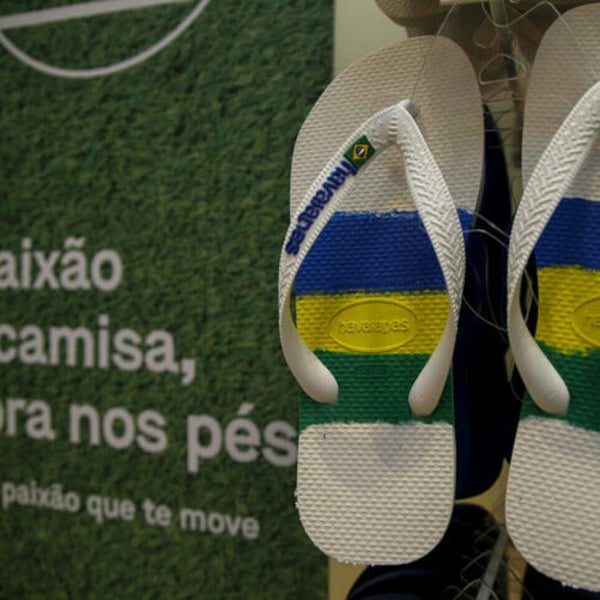
Right wing urges boycott of iconic Brazilian flip-flops

By
AFP
Published
December 22, 2025
Prominent figures on Brazil’s right wing are calling for a boycott of Havaianas, the iconic Brazilian flip-flop sandals, over an ad seen as taking sides ahead of next year’s presidential elections.
In a video posted on the brand’s social media accounts, actress Fernanda Torres urges the public “not to start 2026 on the right foot,” but “on both feet.”
Torres, a supporter of the Brazilian left, was the lead actress in the Brazilian film “Ainda Estou Aqui” (“I’m Still Here”), which won the Oscar for Best Foreign Language Film this year.
The advertisement has sparked outrage in conservative circles.
Eduardo Bolsonaro, one of the sons of far-right former president Jair Bolsonaro — who is serving a 27-year prison sentence for an attempted coup after losing the last election — took to Instagram on Sunday to register his disgust.
In a video, he throws a pair of the flip-flops, recognizable from their straps adorned with the Brazilian flag, into the trash.
“Havaianas used to be a national symbol. I’ve seen many foreigners wearing this Brazilian flag on their feet… but I’m sorry, I’m going to throw these flip-flops in the trash,” says the US-based, former Brazilian lawmaker.
Conservative congressman Rodrigo Valadares posted on X: “Havaianas has chosen its side. The RIGHT has opted for a boycott.”
“My feet are burning on the asphalt, but Havaianas, never again,” right-wing influencer Thiago Asmar posted Monday on Instagram, where he has more than two million followers.
Havaianas are among the world’s best-selling sandals. The Alpargatas group, which owns the brand, employs 10,000 people and sold 226.6 million pairs of flip-flops in 2024, mostly in Brazil, according to its LinkedIn page.
The company has not responded to AFP requests for comment.
Left-wing congresswoman Duda Salabert denounced the reactions from the right as “idiotic attacks,” saying calls for a boycott threatens jobs in Minas Gerais, the southeastern state she represents, where one of the brand’s factories is located.
Torres won the Golden Globe for Best Actress for “I’m Still Here,” which recounts the years of the military dictatorship in Brazil, a period often evoked with nostalgia by Bolsonaro’s supporters.
South America’s largest nation is set to hold general elections in October 2026. Leftist President Luiz Inacio Lula da Silva, who defeated Bolsonaro in 2022, has said he plans to run for a fourth term.
Copyright © 2025 AFP. All rights reserved. All information displayed in this section (dispatches, photographs, logos) are protected by intellectual property rights owned by Agence France-Presse. As a consequence you may not copy, reproduce, modify, transmit, publish, display or in any way commercially exploit any of the contents of this section without the prior written consent of Agence France-Presses.










The increase was driven primarily by higher reinvested earnings and intra-company loans, indicating continued engagement by existing investors with Bangladesh.
Reinvested earnings rose by 318.25 per cent, from $103.79 million in 2024 to $434.10 million in 2025, while intra-company loans increased by 25.68 per cent, from $621.96 million to $781.68 million.
Bangladesh’s net FDI inflows increased by 39.36 per cent last year to $1,770.42 million compared with $1,270.39 million in 2024, the Bangladesh Bank said.
The increase was driven primarily by higher reinvested earnings and intra-company loans.
Reinvested earnings rose by 318.25 per cent, from $103.79 million in 2024 to $434.10 million in 2025, while intra-company loans rose by 25.68 per cent.
Equity capital remained broadly stable, rising by 1.84 per cent, from $544.64 million to $554.64 million in 2025, a release from Bangladesh Investment Development Authority said.
Greenfield project announcements declined by 16 per cent in 2025.
Fibre2Fashion News Desk (DS)
The company’s adjusted EBITDA, excluding Employee Stock Option Plan (ESOP) expenses, rose around 14 per cent YoY to ₹468 crore, while EBITDA margin improved by 20 basis points to around 9.3 per cent. Excluding the reciprocal tariff impact of around ₹36 crore and incremental losses of around ₹13 crore in Bihar and Guatemala, adjusted EBITDA margin stood at around 10.3 per cent.
Pallab Banerjee, managing director, Pearl Global Industries, said: “FY26 marked the company’s second consecutive year of double-digit growth and improved profitability. This performance further solidifies the position of Pearl Global’s diversified operating model and disciplined execution across geographies.”
Pearl Global Industries has reported its highest-ever FY26 revenue of ₹5,025 crore (~$523.93 million), up 11.5 per cent YoY, driven by volume growth and value-added products.
PAT rose 17 per cent to ₹270 crore (~$28.15 million), while Q4 revenue hit ₹1,314 crore (~$137 million).
The company shipped 78.1 million pieces.
Its net worth stands at ₹1,438 crore (~$149.93 million).
He said that geopolitical shifts and Gulf conflicts could lead to energy cost escalation, affecting raw material and logistics costs. However, the company remains prepared to manage these headwinds, supported by its diversified manufacturing base, strong order book, and broad market presence.
The profit after tax (PAT) increased 17 per cent YoY to ₹270 crore (~$28.15 million), the company said in a press release.
On a standalone basis, FY26 revenue stood at ₹1,081 crore, while adjusted EBITDA was ₹67 crore, with EBITDA margin improving by 60 basis points to 6.2 per cent, mainly due to cost restructuring. Standalone PAT rose to ₹69 crore from ₹55 crore in the previous year.
The company’s net worth stood at ₹1,438 crore (~$149.93 million) as of March 31, 2026, compared with ₹1,146 crore a year earlier.
“In FY26, Group delivered another year of resilient performance against a complex geopolitical backdrop. Group achieved, among others, two major milestones this year: revenue crossed INR 5,000 crore mark and installed capacity surpassed 100 million pieces per annum,” said Pulkit Seth, vice-chairman and non-executive director, PGIL.
Seth added that the global apparel industry faced tariff-related disruptions during FY26, with the company’s India operations impacted by tariffs and penal duties imposed by the US. However, he added that Pearl Global leveraged its diversified, multi-country manufacturing presence to mitigate these challenges and deliver double-digit growth.
For the fourth quarter (Q4) of FY26, PGIL posted its highest-ever quarterly revenue of ₹1,314 crore (~$137 million), up 6.9 per cent YoY. Adjusted EBITDA rose 13.7 per cent to ₹135 crore, with margin at 10.3 per cent, the highest EBITDA margin recorded by the company in any quarter. PAT for the quarter stood at ₹81 crore, up 24.6 per cent YoY, PGIL said in a press release.
Standalone revenue during the quarter stood at ₹304 crore, adjusted EBITDA at ₹24 crore, and PAT at ₹14 crore.
PGIL shipped its highest-ever volumes in Q4 FY26 and FY26, at 22 million pieces and 78.1 million pieces respectively. Its annual installed capacity crossed 100 million pieces, reaching around 101 million pieces.
The ongoing capex in Bangladesh is expected to be completed by the first half of FY27 and will add around 6-7 million pieces of capacity during the year.
Fibre2Fashion News Desk (SG)


After provinces, Centre lifts austerity-driven business-hour curbs until May 31

Vietnam’s flat apparel exports hide the real trade signal

A Danish Couple’s Maverick African Research Finds Its Moment in RFK Jr.’s Vaccine Policy

-

 Entertainment5 days ago
Conan O’Brien hat tricks as Oscar host
-

 Tech1 week ago
Could Contact-Tracing Apps Help With the Hantavirus? Not Really
-

 Tech1 week ago
I Tried the Best Captioning Smart Glasses, and Only One Leads the Pack
-

 Fashion5 days ago
Italy’s Zegna Group’s Q1 growth boosted by strong organic performance
-

 Sports1 week ago
Bobby Cox, legendary Atlanta Braves manager who led 1995 World Series champions, dead at 84
-

 Entertainment1 week ago
Martin Short: Facing tragedy with joy
-

 Entertainment1 week ago
Tom Brady gets back at Kevin Hart during Netflix roast
-

 Entertainment1 week ago
Martha Stewart: How to make an omelet