

Tech
Save on WIRED-Tested Gear for the New School Year. These Are the Best Deals

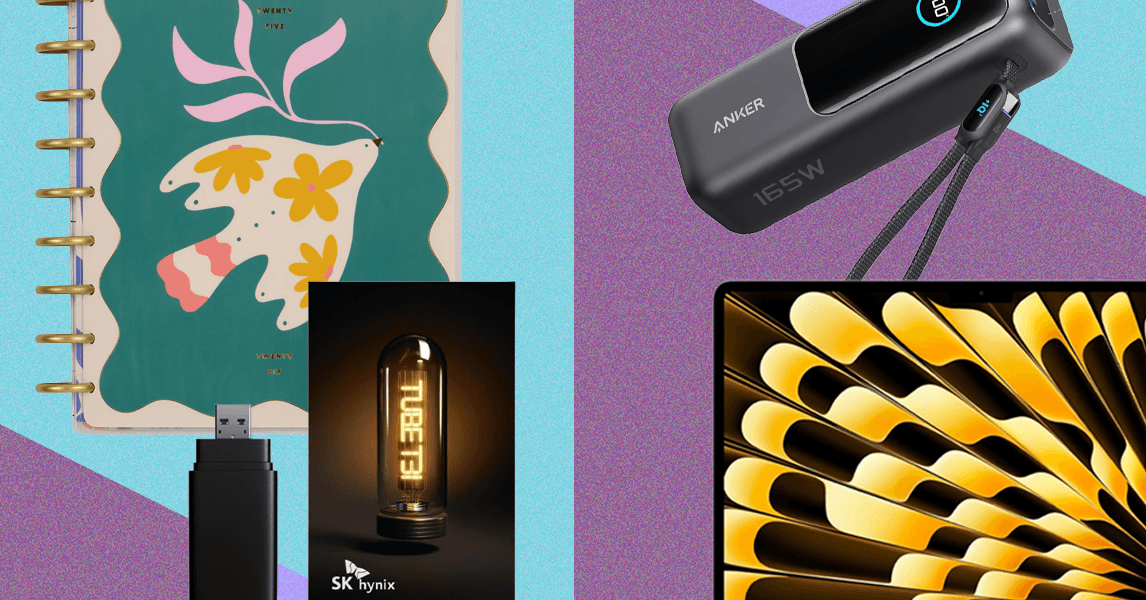
It’s “back to school” season for some and “been back in school” season for others, but regardless of your specific situation, now is the time of year when retailers are discounting all the school essentials. We’ve hunted down discounts on the best back-to-school gear our reviewers have hand-tested, from laptops and mattress toppers to bags and chairs.
Be sure to check out our related guides, including the Best Back-to-School Laptop Deals, the Best Dorm Gear, and the Best Kids Backpacks.
Top Back-to-School Deals
Tech Deals
Photograph: Brenda Stolyar
The MacBook Air M4 (2025) is a rock-solid MacBook for college students. It’s our favorite laptop overall and the Best MacBook you can buy, and it gets you excellent value for the money. It strikes a fantastic balance between performance and price, and it’ll have no trouble handling multiple browser tabs or lasting you all day. It has support for external displays and Apple Intelligence, a high-resolution 12-MP webcam, and a thin form factor that won’t bother your back while you’re toting it around.
The Lenovo Flex 5i Chromebook Plus is a very good Chromebook for students, especially if you need a solid laptop and your budget is tight. The 2-in-1 design can be used in laptop mode or tablet mode, and while the battery life could be better, the performance is smooth. It’s hard to find more laptop for the price.
The Apple iPad (2025, A16) sells for this price pretty frequently, but it does jump back up to its MSRP of $350 regularly and rarely falls much below $300. It’s the best iPad for most people, and it’s a solid contender if you want some of the capabilities of doing basic schoolwork without a traditional laptop. It’s compatible with the first-generation Apple Pencil, the USB-C Apple Pencil, the Smart Folio, and the Magic Keyboard Folio. We have more recommendations in our iPad Accessories Buying Guide.
.png)
Photograph: Julian Chokkattu
The OnePlus 13 came out earlier this year, and this is the best price drop we’ve seen for it so far. It’s a great Android phone, especially if you care a lot about the battery: Not only does it last up to two days, depending on what you’re doing, but it can also be charged from zero to 100 in just over 30 minutes. Battery aside, the rest of the phone is good, too: Snappy performance, water resistance, and a slick triple-lens camera. If you order from OnePlus directly, you’ll get a free phone case or pair of earbuds. It’s a very solid deal if you want to upgrade your phone for the new school year.
This is a great deal on the best high-capacity USB-A flash drive, and if you need more space for some reason, the 2-terabyte version is also discounted. It has zippy speeds, a three-year warranty, and enough space to store console games or 4K movies. (Or, you know, many school papers.)
This is the best budget gaming monitor. (We also quite like the AOC QD-OLED Monitor (Q27G4ZD) but it is not currently on sale.) The price has only dropped by $20, but this is a match of the lowest it tends to drop outside of events like Black Friday, and just $20 above the lowest price we’ve seen. It’s not 4K, but you’ll get a 180-Hz refresh rate with this 27-inch 1440p screen. It has adaptive sync for smooth gameplay, and it’ll be a noticeable upgrade if you’re using a 1080p monitor. If you want to spend some time gaming between Zoom calls or homework, and your monitor needs an upgrade, this is a safe bet.

Photograph: Parker Hall
If you don’t need Dolby Vision support, then this is the Roku you want. It’s the best streaming stick for most people. The Roku Streaming Stick Plus (2025) is a 4K and HDR-friendly streaming stick with a voice remote and a small footprint. It’s very similar to the stick we recommend below—it just doesn’t have Dolby Vision, and it has shorter Wi-Fi range, which shouldn’t be a problem if your dorm is small.
This is the best Roku overall. It supports 4K streaming and Dolby Vision, and it comes with a voice remote. It’ll plug directly into the back of your TV. Roku’s interface is slick and easy to use, and there are even free live TV shows so you can watch Antiques Roadshow or How It’s Made. If you’ve been using your parents’ streaming stick and you’re off to college, this is an option worth considering.
When these fantastic workout headphones aren’t selling for $250, they’re selling for $200. It’s very rare to find a better discount, and even then, it’s usually minimal. The Beats Powerbeats Pro 2 Earbuds are aesthetically pleasing, with popping colors like purple and orange available. They’re comfortable to wear, with good sound and noise cancelation. They have on-board controls. They play well with Android and iOS devices. And the wireless charging case can top them up when the 10-hour battery life runs out. It’s hard to find a better pair of workout-friendly earbuds, and they’re a great choice for student athletes who want to zone out at the gym.
-SOURCE-Ryan-Waniata.jpg)
Photograph: Ryan Waniata
This Bluetooth speaker has a built-in carabiner that can be attached to your backpack, bike handlebars, or belt loop. We like the durable water- and dust-resistant body, and it has surprisingly good sound for a speaker as small as it is. It’s not perfect for parties, but it is a solid pick if you want on-the-go sound for your bicycle commute or your after-school workouts.
The Apple Watch Series 10 is the best smartwatch for iPhone owners, and it’s also an excellent fitness tracker. If you don’t already have a smartwatch, you might be surprised at all the little ways it can improve your life. From at-a-glance notifications to workout and sleep tracking to emergency SOS alerts in case of an accident, these wrist gadgets are worth considering for going off to college or leading a class full of students. For an Android alternative, we like the Google Pixel 3 on sale for $318 ($82 off), but a new watch is coming later this month, so you might want to wait.
If your kiddos are going to be using laptops or tablets for school this year, they might need a pair of headphones. These are great kid-safe headphones that offer noise cancellation to help keep them focused, with volume limited to 85 decibels to help protect little ears. They’re comfortable to wear and can be used wirelessly or with the included 3.5-mm audio cable.
This is the best power bank for those who want more than the basics. Its 25,000-mAh capacity and up to 165-watt delivery are more than enough for your phone, tablet, and laptop, and the power bank itself recharges quickly as well. It also has a handy display for at-a-glance information, and built-in USB-C cables that’ll come in handy in a pinch.
Backpack, Tote, and School Supply Deals

Courtesy of The Happy Planner
The Happy Planner makes our favorite paper planners for students, and its warehouse sale offers many steep discounts on planners as well as accessories and expansion packs. Some of these planners have layouts that started in July of 2025, but they go through December 2026, so you’ll still get plenty of use out of them.
This is a fantastic carry-all for people who don’t mind carrying a purse-style tote bag. The medium tote is reasonably sized, but you should go with the large if you have a 13-inch laptop or bigger. The nylon is durable, the bag has feet on the bottom to protect it from floor gunk, and there are a few different internal compartments for laptops, shoes, and other necessities. It’s a very solid bag for your day-to-day life.
Amazon is offering 10 percent off when you purchase four qualifying items across several categories, including office supplies. There are a ton of school supplies in the sale, including paper, pencils, folders, index cards, dry-erase markers, and more. Being AmazonBasics items, most are already affordable, so the extra discount is just icing on the cake. This deal is especially great for any teachers restocking their classrooms—or parents whose kiddos manage to lose pencils with abandon. Simply add four items to your cart and the discount will automatically be applied.
Home and Dorm Deals

Photograph: Brooklyn Bedding
This excellent memory foam mattress topper is the perfect pick to upgrade your dorm bed, and every size (from Twin to King) is on sale. There’s even a Twin XL option in case your supplied mattress is that size. At 4 inches tall, this is practically a mattress in and of itself, and it’ll definitely be better than the bed you’re given. It has antimicrobial properties and cooling covers, and it’s CertiPur-US certified. Need more bedding recommendations? We can help—check our pillows and sheets buying guides.
The Anthros V2 is the best ergonomic office chair, with plush seating, good support, and smooth casters. You can adjust the upper and lower back separately to match your body shape; the thick Cloudfloat seat is both firm and cushy; and you’ll even get to video chat with an Anthros ergonomics therapist to help make sure your seat is set up properly. It could have better heat dissipation, and we wish the seat were deeper, but this remains a fantastic pick if you’re staring down the prospect of sitting down while doing homework or teaching.
Deals on Everything Else

Photograph: Last Crumb
Maybe you want to give a teacher a gift to curry favor … or simply start the school year off right. Or maybe your favorite chocoholic teen is off to college. Last Crumb’s cookies are excellent edible gifts, with a luxurious flavor and mouthfeel and the price tag to match. Sales are pretty rare, and this deal helps you save on a 12-pack. You’ll get four each of Better Than Sex, Floor Is Lava, and James Dean—chocolate chip, chocolate lava, and Oreo milkshake, respectively. I can confirm that the Floor is Lava cookies changed my life.
Power up with unlimited access to WIRED. Get best-in-class reporting and exclusive subscriber content that’s too important to ignore. Subscribe Today.













The European online age verification app is ready.
The app works with passports or ID cards, is built to be “completely anonymous” for the people who use it, works on any device (smartphones, tablets, and PCs), and is open source. “Best of all, online platforms can easily rely on our age verification app, so there are no more excuses,” said European Commission president Ursula von der Leyen at a press conference on Wednesday. “Europe offers a free and easy-to-use solution that can protect our children from harmful and illegal content.”
High Expectations
“It is our duty to protect our children in the online world just as we do in the offline world. And to do that effectively, we need a harmonized European approach,” von der Leyen said at Wednesday’s press conference. “And one of the central issues is the question, how can we ensure a technical solution for age verification that is valid throughout Europe? Today, I can announce that we have the answer.”
This answer takes the form of an open source app that any private company can repurpose, as long as it complies with European privacy standards and offers the same technical solution throughout the European Union. The user downloads the app, agrees to the terms and conditions, sets up a pin or biometric access, and proves their age through an electronic identification system, or by showing a passport or ID card (in which case biometric verification is also provided). The app does not store your name, date of birth, ID number, or any other personal information, according to the European Commission—only the fact that you are over a certain age.
After that, when a person using the app wants to access a social network (minimum age: 13), pornographic site (minimum age: 18), or any other age-protected content, if they are logged in from a computer, they need only scan the QR code shown on the site they want to visit. If, on the other hand, the person logs in from a smartphone, the app sends the proof of age directly. The platform does not access the document with which the user proved it in the first place.
Adoption Event
The need to introduce a common system for the entire European Union has been discussed for some time, and according to commission technicians, the technical work is now complete. Of course, it will still be possible to circumvent the system—all it takes is for an adult to lend their phone to a younger friend—but the technological architecture exists, and it will be up to EU member states to decide whether to integrate it into national digital wallets or develop independent apps.
“No More Excuses”
For the app to really be effective, platforms must be obligated to verify the age of their users—that’s where things get tricky. The Digital Services Act, which went into effect in 2024, requires “very large online platforms”—those with more than 45 million monthly users in the European Union—to take concrete steps to mitigate systemic risks related to child protection, with heavy penalties for noncompliance.
“And that’s why Europe has the DSA: to call online platforms to their responsibilities. Because Europe will not tolerate platforms making money at the expense of our children,” European Commission executive vice president Henna Virkkunen told a press conference. She added that after an investigation into TikTok, the European institutions plan to take similar action against Facebook, Instagram, and Snapchat, as well as four porn sites. “Since the platforms do not have adequate age verification tools, we developed the solution ourselves,” he concluded. In short, as von der Leyen also remarked, “there are no more excuses.”
Bare Minimum
So far, this is the European framework that sets the general rules. On this basis, member states can consider more restrictive measures. Italy was among the first to discuss how to regulate the use of social media by minors but has so far not landed on anything concrete. Elsewhere in the EU, France’s Emmanuel Macron has been a trailblazer on the issue, pushing France to discuss a rule to ban social networks for minors under the age of 15 entirely. So far, this measure has received broad political support—but the outcome depends largely on compatibility with the Digital Services Act and the availability of effective age verification systems like the app the European Commission just released.
This article originally appeared on WIRED Italia and has been translated.

Anthropic is moving into a new London office as it seeks to expand its research and commercial footprint in Europe, setting up a scrap between the leading AI labs for talent emerging from British universities.
The company, which opened its first London office in 2023, is moving to the same neighborhood as Google DeepMind, OpenAI, Meta, Wayve, Isomorphic Labs, Synthesia, and various AI research institutions.
Anthropic’s new, 158,000-square-foot office footprint will have space enough for 800 people—four times its current head count—giving it room to potentially outscale OpenAI, which itself recently announced an expansion in London.
“Europe’s largest businesses and fastest-growing startups are choosing Claude, and we’re scaling to match,” says Pip White, head of EMEA North at Anthropic. “The UK combines ambitious enterprises and institutions that understand what’s at stake with AI safety with an exceptional pool of AI talent—we want to be where all of that comes together.
UK government officials had reportedly attempted to coax Anthropic into expanding its presence in London after the company recently fell out with the US administration. Anthropic refused to allow its models to be used in mass surveillance and autonomous weapon systems, leading to an ongoing legal battle between the AI lab and the Pentagon.
As part of the expansion, Anthropic says it will deepen its work with the UK’s AI Security Institute, a government body that this week published a risk evaluation of its latest model, Claude Mythos Preview. According to Politico, the UK government is one of few across Europe to have been granted access to the model, which Anthropic has released to only select parties, citing concerns over the potential for its abuse by cybercriminals.
The increasing concentration of AI companies in the same London district is an important step in creating a pathway for research to translate into AI products, says Geraint Rees, vice-provost at University College London, whose campus is around the corner from Anthropic’s new office.
“This cluster didn’t emerge from a planning document. It grew because serious researchers and companies understand that proximity isn’t a nice-to-have,” he said last month, speaking at an event attended by WIRED. “That’s how the innovation system actually works. It’s not a clean, linear transfer from lab to market. It’s messier, richer, more human than that.”
The increasingly long-in-the-tooth Computer Misuse Act (CMA) of 1990 remains an albatross around the neck of British cyber security professionals, and even though the UK government committed last December to reforming it, every minute of delay is holding back the nation’s security innovation, resilience, talent, and ability to defend itself against cyber attacks, campaigners have warned.
Ahead of the National Cyber Security Centre’s (NCSC’s) upcoming CYBERUK conference in Glasgow, the CyberUp Campaign for reform of the Computer Misuse Act (CMA) has published a new report, titled Protections for Cyber Researchers: How the UK is being left behind to maintain pressure on Westminster.
The CMA defines the vague offence of unauthorised access to a computer, which the campaigners want changed because it was written 35 years ago and fails to account for the development of the cyber security profession, and the fact that in the course of their day-to-day work, cyber pros may sometimes need to hack into other systems.
“Cyber attacks are growing in scale, sophistication and severity, with a devastating impact on infrastructure, businesses and charities,” said a CyberUp campaign spokesperson.
“While other countries have moved to refresh their cyber laws in response, the UK’s Computer Misuse Act hasn’t been updated since before the modern internet – hardly the best platform for accelerating our defences into the next decade.”
The group’s report highlights how other nations, Australia, Belgium, France, Germany, Hong Kong, Malta, Portugal, and the USA, have already secured legal protections for cyber professionals that enable them to go about their business without fear of prosecution.
In Portugal – Britain’s oldest formal ally under a treaty dating back to the 14th Century – the government last year published Decreto-Lei 125/2025, implementing the European Union (EU) Network and Information Systems (NIS2) Directive and revising the country’s cyber crime law to ensure that ethical hackers and professional cyber security practitioners working in good faith are both recognised and protected.
Portgual’s laws now accept some elements of cyber work may have to happen without explicit permission or involve unanticipated technical overreach that has a legitimate purpose.
As such, Portugal says that security work undertaken in good faith won’t be punished as long as the researcher fulfills a set of conditions. For example, they can act only to find vulnerabilities and these must be reported immediately, they must avoid taking harmful actions, like conducting DDoS attacks or installing malware, and they must respect the integrity of any data they may find or access and delete it within 10 days once the issue is addressed.
CyberUp said Portugal’s example demonstrates how cyber crime laws can be modernised to legally protect research carried out in the public interest.
“Portugal has demonstrated how to modernise their equivalent law through cyber legislation. We urge the government to follow this example and act swiftly through the Cyber Security and Resilience Bill to achieve meaningful reform, or risk lagging even further behind our peers,” the spokesperson said.
Defence Framework
Working with cyber security experts and legal advisors, the CyberUp campaign has developed its own Defence Framework that would allow cyber professionals to present a statutory defence in court as long as they adhere to the Framework’s four core principles.
- Harm Vs. Benefit: The benefits of the activity must outweigh the potential harms;
- Proportionality: Cyber pros must take all reasonable steps to minimise the risks of their activity;
- Intent: They must act honestly, sincerely, and clearly direct themselves towards improving security;
- Competence: Their qualifications and professional memberships should demonstrate they are suitably equipped to perform cyber security work.
The campaigners say this framework will bring clarity and confidence to the security sector, enabling cyber pros to run essential research tasks without fear of criminal prosecution, helping organisations operate to recognised legal standards, and enabling a more open and collaborative relationship between the cyber sector and the UK government.


Europe’s Online Age Verification App Is Here

Trump hints at possible Islamabad trip if Iran deal signed

Orioles lose controversial challenge after Coby Mayo unintentionally triggers review

-

 Entertainment1 week ago
Queen Elizabeth II emotional message for Archie, Lilibet sparks speculation
-

 Tech1 week ago
Azure customers up in arms over ‘full’ UK South region | Computer Weekly
-

 Tech1 week ago
As the Strait of Hormuz Reopens, Global Shipping Will Take Months to Recover
-

 Fashion1 week ago
CII submits 20-pt agenda to Indian govt to back firms hit by Iran war
-

 Tech1 week ago
This AI Button Wearable From Ex-Apple Engineers Looks Like an iPod Shuffle
-

 Politics7 days ago
Indian airlines hit hardest after Dubai limits foreign flights until May 31
-

 Entertainment4 days ago
Palace left in shock as Prince William cancels grand ceremony
-

 Politics6 days ago
Chinese, Taiwanese will unite, Xi tells Taiwan opposition leader