

Business
SBP working on exchange, interest rates for stability: FinMin | The Express Tribune

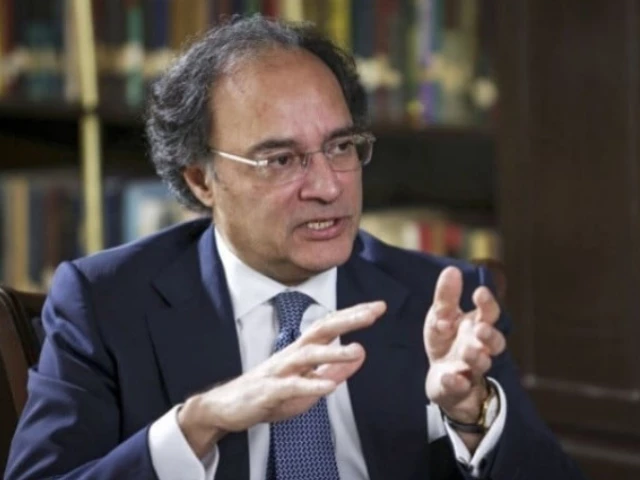
Finance Minister Muhammad Aurangzeb has stated that the State Bank of Pakistan is working on the exchange rate and interest rate, and the situation is expected to improve further.
The federal finance minister inaugurated the Job and Education Expo at the Expo Centre, Karachi, organised by the Pakistan Hindu Council. At the expo, around 120 stalls were set up by various institutions and companies for students.
Speaking to the media, Aurangzeb expressed gratitude to the organisers, saying that he had the opportunity to meet the country’s future leadership here. He noted that both public and private institutions were present at the job fair, but the absence of the corporate sector was felt.
He said that technology is the path to the future. Youth should work with their hearts and minds, and always strive for excellence.
Speaking about the Independence Day celebration of the “Marka-e-Haq,” the finance minister said that followers of all religions in the country commemorated it with great spirit.
Read: PM pushes for cashless, digital economy
He added that the corporate sector needs to step forward. Interest rate should not be made the single-point agenda.
In order to promote working capital, Pakistan must look beyond banks and include capital markets as well. He emphasised that the debt capital market also needs to be shifted to the Pakistan Stock Exchange mechanism for greater efficiency.
Aurangzeb highlighted that the circular debt in the power sector is declining, with three distribution companies (DISCOs) set to be privatised soon. He added that the government is also working to resolve circular debt in the gas sector, which has long been a burden on the economy.
On monetary policy, the minister clarified that the government has no role in setting interest rates, as this falls under the mandate of the State Bank of Pakistan. He said the exchange rate would continue to be determined by the market. Pakistan already has funding available, he noted, and the challenge now is to put those resources to effective use.
He praised Mustafa Kamal’s efforts in population control and underlined the importance of women’s economic participation, saying it could be a key driver in eradicating poverty. Aurangzeb confirmed that discussions with the World Bank regarding funding to support such initiatives have already taken place.
The finance minister said the IMF’s review mission would soon arrive in Pakistan under the ongoing 37-month programme, adding that the government remains in constant contact with the Fund. Looking ahead, he expressed optimism that by 2047 Pakistan’s economic situation would be that of a developed nation.
Aurangzeb also pointed to Pakistan’s strong anti–money laundering laws, which he said had enabled the country’s removal from the FATF grey list. He expressed confidence that Pakistan would remain off the list going forward.
Speaking on the recent rainfall damage in Khyber Pakhtunkhwa, he said his immediate priority was helping and rehabilitating affected people, while it was still too early to estimate the scale of losses.
When asked about traders’ demand for a new province, the finance minister refrained from giving a direct response.
There is no button for growth; the real thinking should be about sustainable growth. The role of the government is to provide an enabling environment. Public-private partnerships are working successfully. We are moving toward the AI world, and there is no room for doubt that we must move forward.
The finance minister said that ups and downs keep coming, but talent remains unaffected. Economic stability has now been achieved in the country.
The three major rating agencies are positive about Pakistan. The State Bank is working on the exchange rate and interest rate, and as stability increases, the situation will improve further.




Piotr Swat | Lightrocket | Getty Images
As its high-margin compounded GLP-1 business evolves, Hims & Hers Health may be finding a new opportunity in peptides.
Shares of the telehealth company jumped Thursday after HHS Secretary Robert F. Kennedy Jr. announced Wednesday that the FDA plans to convene a Pharmacy Compounding Advisory Committee meeting to review peptides for potential inclusion on the 503A bulk list, a designation that allows drugs to be compounded on an individual prescribed basis rather than mass producing.
For Hims, the bigger story is how expanding compounding for peptides could unlock new revenue streams as it directs members toward branded rather than more profitable compounded GLP-1 drugs. The telehealth company has been building toward a peptide business for years.
Peptides are short chains of amino acids — think of them as small building blocks of proteins — that are being explored for a wide range of health and wellness uses. They’re controversial because scientific evidence on their long-term safety and effectiveness is limited, and their production remains largely unregulated.
Hims & Hers made a significant move into the space in February 2025 when it acquired a California-based peptide facility. At the time, CEO Andrew Dudum called peptide demand “future-facing innovation.”
“Many use cases have yet to be launched,” said Dudum. “Peptide innovation is at the forefront of so many categories we’re excited to start offering.”
Following Kennedy’s announcement on Wednesday, Hims Chief Medical Officer Dr. Patrick Carroll applauded the news as a move away from the “gray market,” saying the goal is to bring peptide therapy into regulated, physician-led care.
“Our medical team believes certain peptide therapies hold meaningful potential in helping Americans live healthier lives, and we are actively exploring how to expand access in a way that will be aligned with FDA guidance,” Carroll said.
Leerink Partners called the news that the FDA will review peptides for the compounding list a positive outcome that could give Hims a clearer regulatory path to scale peptide therapies. Even so, the firm said it will take time for peptides to boost the company’s bottom line.
“This would not immediately translate into revenue, but would seemingly be a growth avenue that HIMS would push hard on,” said Leerink analyst Michael Cherny, who has a hold-equivalent rating on the stock and a $25 price target. It was trading around $26 a share Thursday.
For now the opportunity is still early, and clinical evidence supporting many peptide therapies is still limited.
Of the dozen peptides listed by Kennedy for consideration on the compounding bulk list, one — MK-677 — is often treated as an illegal drug when sold for human consumption. The growth hormone has also been banned by the World Anti-Doping Agency.
Other peptides on the list, such as GHK-Cu and Semax, which are used for cosmetic or cognitive enhancement, are generally viewed as less controversial, but still lack robust scientific backing.
Kennedy — who has supported many medical treatments and food options outside of those backed by mainstream science — was asked about his plans for expanding peptide therapies during a House Ways and Means Committee hearing Thursday.
“Peptides were not supposed to be regulated,” Kennedy said, arguing the Biden administration restricted the use of peptides due to safety concerns that he considers unfounded.
The FDA process is just beginning, and the July meeting will be advisory only, so change is not expected to be immediate.
Even so, investors are already focusing on what replaces GLP-1 driven growth for Hims, and peptides are emerging as one of the clearest candidates so far.

The Netflix logo is seen on an office building in Los Angeles, California, on Feb. 5, 2026.
Michael Yanow | Nurphoto | Getty Images
Netflix kicks off earnings season for media companies on Thursday with a quarterly report that Wall Street hopes will give more updates on the company’s path forward after walking away from its proposed deal for Warner Bros. Discovery.
Here’s how Netflix is expected to perform when it reports results for the first quarter of 2026, according to estimates from analysts polled by LSEG:
- Earnings per share: 76 cents estimated
- Revenue: $12.18 billion estimated
Last quarter Netflix’s management focused much of its earnings call with investors on its interest in WBD’s streaming and film assets, as well as progress in its advertising business.
Just weeks after the January earnings update, however, Netflix dropped its pursuit for WBD after Paramount Skydance put forth a superior offer for the entirety of WBD.
“Heading into earnings, Netflix finds itself in a very different spot than many expected just a month and a half ago. We were supposed to be talking about the company’s progress toward closing the Warner Bros. deal,” said Mike Proulx, vice president and research director at Forrester. “Instead, the question now is how Netflix competes in a streaming market that’s likely to get more crowded at the top.”
While Netflix’s stock has made considerable gains since walking away from its WBD deal — a more than 25% rally — it has raised questions about the path forward for the streaming giant.
In withdrawing from the acquisition of WBD, Netflix “avoided a substantial increase in debt, extensive regulatory scrutiny, and a long, complex integration process,” according to a Deutsche Bank research note on Monday.
The note added this will allow Wall Street to return its focus to Netflix’s engagement, pricing and advertising.
Outside of the WBD deal and Netflix’s potential aspirations in the broader media landscape, Wall Street’s attention has most often been on the advertising business, which has made considerable gains since launching in late 2022.
In January, Netflix management said the cheaper, ad-supported option was hitting its stride after being “slower out of the gate” in its early years on the market. Netflix reported more than $1.5 billion in advertising revenue in 2025, or about 3% of its total full-year revenue — which it expects to double this year.
For years, Wall Street was focused on subscriber growth for streaming platforms. However, since Netflix reported its first subscriber loss in 10 years in 2022, investors have shifted their focus to profitability. In response, media companies are focusing less on reporting subscriber numbers and more on other business initiatives, such as advertising and pricing increases.
Netflix once again hiked prices in late March, which analysts expect will add to overall 2026 revenue growth. The company did provide a subscriber update in January, when it said it had reached 325 million global paid customers, a new milestone since it had last reported membership numbers the year prior.
This story is developing. Please check back for updates.

Royal Mail is poised to scrap Saturday second-class letter deliveries across the UK by December, having reached an agreement with the staff trade union on the nationwide implementation of the changes.
This significant overhaul, which will see second-class post no longer delivered on Saturdays and the service adjusted to every other weekday, brings an end to a lengthy dispute with unions. The reforms will initially extend to 240 delivery offices as part of a wider trial, before being fully implemented across the entire 1,200-strong UK network by the end of the year.
The deal struck with the Communications Workers Union (CWU) includes a 4.75% pay rise for staff, alongside improved terms for those who joined Royal Mail on or after 1 December 2022. Employees on legacy contracts will receive a 3% salary increase. Additionally, Royal Mail has agreed that new starters will be offered contracts based on standard 37-hour working weeks, and around 6,000 part-time postal workers will have the option to increase their average weekly hours as part of the changes.
CWU members are now set to be consulted on the agreement.
Alistair Cochrane, chief executive of Royal Mail, said: “This agreement with the CWU paves the way for Universal Service reform rollout and represents a significant investment in our people.
“Moving ahead with reform will make a real difference to Royal Mail’s quality of service, supporting the delivery of a reliable, efficient and financially sustainable postal service for our customers across the UK.”
Regulator Ofcom last year gave the green light to Royal Mail’s plans to scale back second class letter deliveries, starting from July 28.
It launched the changes across 35 delivery offices as a pilot, but has yet to expand this nationwide due to a disagreement with the union.
It kicked off intensive talks with the CWU at the beginning of February to resolve the dispute.
Under the Universal Service Obligation, Royal Mail must keep Monday to Saturday deliveries for first class post and maintain the target for second class letters to arrive within three working days.
The group has argued the changes to second class deliveries are crucial to helping it maintain the letter delivery service and ensure it is sustainable for the future.
It comes as Royal Mail has continued to fail to meet delivery targets set by Ofcom and amid MP concerns over practices in the postal service and worries that parcels are being prioritised over letters.
In a cross-party Commons committee session last month, the CWU told MPs the postal service had become “chaotic” with Royal Mail workers being told to leave doctors’ and hospital letters on racks to prioritise parcels.
Royal Mail’s owner Daniel Kretinsky, who was also giving evidence to the committee, insisted there was no “management decision” for parcels to be prioritised over letters and argued the service cannot be fixed until plans for reform of the USO are put in place.
On the agreement with Royal Mail, the CWU said in a statement to its members: “It is now imperative that all branches, representatives and members have the opportunity and time to fully consider this agreement properly, not only on the basis of how we have moved the company significantly on all the key issues, but also in its wider context around why USO reform is necessary and why we must shift our focus to changing the role of Ofcom and create a level playing field with our competitors.
“Delivering change will always be difficult but we are clearly in a stronger position to support our members under the terms of this agreement.”


Europe’s Online Age Verification App Is Here

Trump hints at possible Islamabad trip if Iran deal signed

Orioles lose controversial challenge after Coby Mayo unintentionally triggers review

-

 Entertainment1 week ago
Queen Elizabeth II emotional message for Archie, Lilibet sparks speculation
-

 Tech1 week ago
Azure customers up in arms over ‘full’ UK South region | Computer Weekly
-

 Tech1 week ago
As the Strait of Hormuz Reopens, Global Shipping Will Take Months to Recover
-

 Fashion1 week ago
CII submits 20-pt agenda to Indian govt to back firms hit by Iran war
-

 Tech1 week ago
This AI Button Wearable From Ex-Apple Engineers Looks Like an iPod Shuffle
-

 Politics7 days ago
Indian airlines hit hardest after Dubai limits foreign flights until May 31
-

 Entertainment4 days ago
Palace left in shock as Prince William cancels grand ceremony
-

 Politics6 days ago
Chinese, Taiwanese will unite, Xi tells Taiwan opposition leader