

Politics
Settler violence disrupts West Bank olive harvest

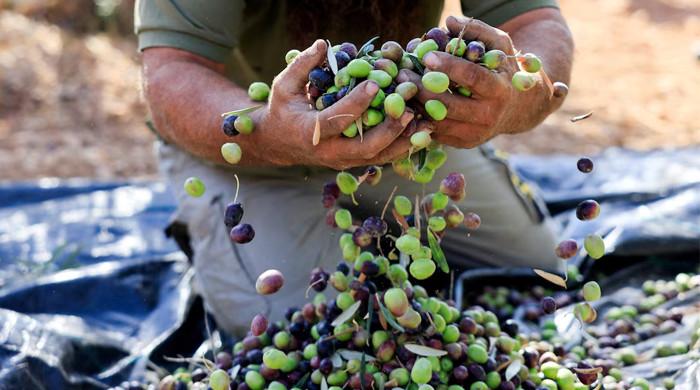
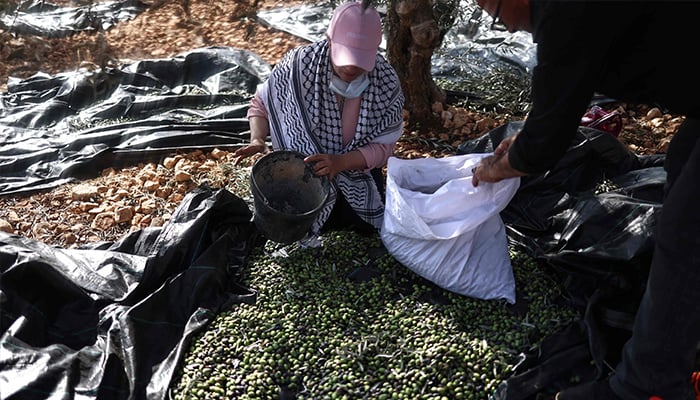
The scene shocked many and highlighted the violence of this year’s olive harvest in the Israeli-occupied West Bank: a young masked man clubs an older Palestinian woman picking olives, who then collapses on the ground.
The incident during an attack by Israeli settlers, filmed by an American journalist, took place in the town of Turmus Ayya near Ramallah, a hotspot of violence this year.
“Everybody was fleeing because the settlers attacked suddenly, maybe 100 of them,” witness Yasser Alkam told AFP, adding that one Swedish activist also had his arm and leg broken by settlers.
Alkam, a Turmus Ayya city official, said that the woman, 55-year-old Um Saleh Abu Aliya, was struck as she was waiting for her son to drive her away from a mob of settlers.
“Fighting back would only bring more violence, sometimes with the army’s backing,” lamented Nael al-Qouq, a Turmus Ayya farmer who was prevented from reaching his olive trees that same day.
Expanded settlements
Not far from the scene, an Israeli flag flapped in the wind at a settlement outpost, illegal even under Israeli law.
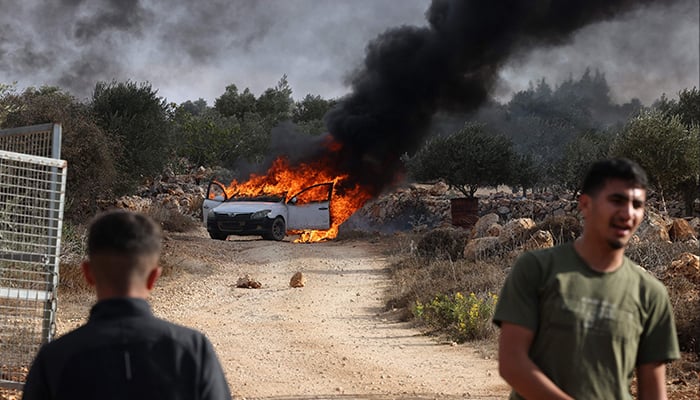
The army eventually arrived in Turmus Ayya and dispersed the crowd with tear gas, an AFP journalist witnessed.
But not before the youths who descended on the village burned at least two cars.
The head of the West Bank’s Israeli police, Moshe Pinchi, told his district commanders to find the man who attacked Abu Aliya, according to a leaked WhatsApp message reported by Israeli media.
The Israeli army told AFP that it “works in coordination with the Israel Police to enforce the law concerning Israelis involved in such incidents”.
But Turmus Ayya is far from an isolated case, and AFP journalists have witnessed at least six different instances of Palestinians being denied access to their land, attacked by settlers, or being victims of vandalism during the 2025 olive harvest.
Clashes in rural areas reached new heights this year, prompted by ever-expanding Israeli settlements and a growing number of settlers — not all of whom engage in violence against Palestinians.
More than 500,000 Israelis live in settlements in the West Bank, which Israel has occupied since 1967.
All settlements in the West Bank are illegal under international law.
‘Uprooted’
Near Turmus Ayya, in the village of Al-Mughayyir, one villager was prevented from harvesting altogether.
“I own ten dunams (one hectare) of olives. All I have left are the olive trees in the garden of the house … They uprooted it all,” Abdul Latif Abu Aliya, 55, told AFP.
Abu Aliya’s land borders a road on the other side of which three trailers make up a recently-installed settlement outpost.
After a settler was injured during an altercation near Abu Aliya’s house, an army order called for the trees his father and grandfather planted to be uprooted.
Bulldozers then pushed mounds of soil and roots halfway up the field and 100 metres from the family house, making a barrier that Abu Aliya and his family do not cross for fear of being attacked by settlers.
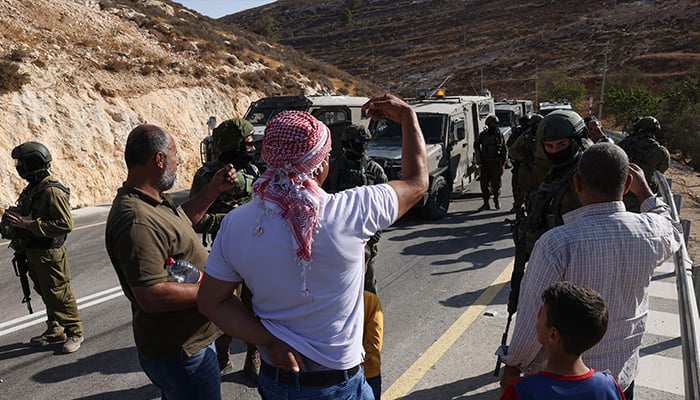
Faced with unprecedented violence during this year’s olive season, the Palestinian Authority’s agriculture minister called for the international community to protect farmers and pickers.
“It’s the worst season in the last 60 years,” Agriculture Minister Rizq Salimia told journalists, adding that this year’s crop was already bad due to poor climate.
Ajith Sunghay, head of the UN’s Human Rights Office in the Palestinian territories, condemned “severe attacks” during this year’s harvest and deplored “dangerous levels of impunity” for perpetrators.
The annual harvest, once a peaceful gathering for the occupied West Bank’s families, has in recent years turned into a series of increasingly violent confrontations involving Israeli settlers, troops, Palestinian harvesters and foreign activists.
Identity marker
The season began in October and will last until mid-November, as Palestinians across the West Bank harvest olives from trees they see as deeply connected to their national identity.
The West Bank boasts over eight million olive trees for three million Palestinians, according to the agriculture ministry’s 2021 census.
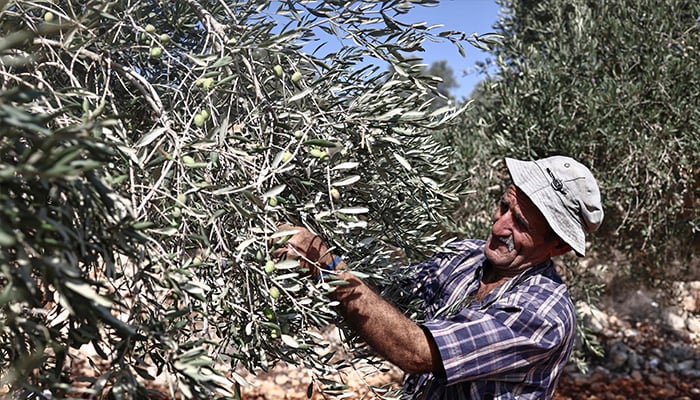
Every autumn, Palestinians farmers, but also city folk whose families own a few trees, head out into the fields to pick olives, mostly by hand.
The UN’s humanitarian agency, OCHA, said that 27 West Bank villages were affected by harvest-related attacks in the week of October 7 to 13 alone.
“The incidents included attacks on harvesters, theft of crops and harvesting equipment, and vandalism of olive trees, resulting in casualties, property damage, or both,” OCHA said.


An investigative reporter best known for exposing fraud at Silicon Valley blood-testing startup Theranos sued Elon Musk’s xAI, Anthropic, Google, OpenAI, Meta Platforms and Perplexity on Monday for using copyrighted books without permission to train their artificial intelligence systems.
New York Times reporter and “Bad Blood” author John Carreyrou filed the lawsuit in California federal court with five other writers, accusing the AI companies of pirating their books and feeding them into the large language models (LLMs) that power the companies’ chatbots.
The lawsuit is one of several copyright cases brought by authors and other copyright owners against tech companies over the use of their work in AI training. The case is the first to name xAI as a defendant.
Spokespeople for the defendants did not immediately respond to requests for comment on the lawsuit.
Unlike other pending cases, the writers are not seeking to band together in a larger class action – a type of lawsuit they said favours defendants by allowing them to negotiate a single settlement with many plaintiffs.
“LLM companies should not be able to so easily extinguish thousands upon thousands of high-value claims at bargain-basement rates,” the complaint said.
Anthropic reached the first major settlement in an AI-training copyright dispute in August, agreeing to pay $1.5 billion to a class of authors who said the company pirated millions of books.
The new lawsuit said class members in that case will receive “a tiny fraction (just 2%) of the Copyright Act’s statutory ceiling of $150,000” per infringed work.
Monday’s complaint was filed by attorneys at law firm Freedman Normand Friedland, including Kyle Roche, whom Carreyrou profiled in a 2023 New York Times article.
During a November hearing in the Anthropic class action, US District Judge William Alsup criticised a separate law firm Roche co-founded for gathering authors to opt out of the settlement in search of “a sweeter deal.” Roche declined to comment on Monday.
Carreyrou told the judge at a later hearing that stealing books to build its AI was Anthropic’s “original sin” and that the settlement did not go far enough.


US President Donald Trump described Pakistan’s Chief of Army Staff (COAS) and Chief of Defence Forces (CDF) Field Marshal Syed Asim Munir as a “highly respected general” while reiterating claims that he helped prevent a war between Pakistan and India.
“We stopped a potential nuclear war between Pakistan and India,” reiterated Trump while responding to a question during an event in Florida alongside Secretary of Defence Pete Hegseth and Secretary of the Navy John Phelan on Monday.
He went on to say that “highly respected general […] he is a field marshal” and also the prime minister of Pakistan credited him with saving 10 million lives by stopping the war.
“You know, eight planes were shot down [during the Pakistan-India war]. That war was going to rage,” Trump said.
The US president claimed that he has stopped eight wars so far.
He made these remarks while addressing a press conference in Florida to unveil his plans for a new “Trump class” of battleships, marking the start of an expanded naval buildup.
Trump has repeatedly claimed credit for easing tensions between the nuclear-armed rivals, which have fought three wars since independence and remain locked in a dispute over Indian Illegally Occupied Jammu and Kashmir (IIOJK).
In May, Pakistan and India engaged in a military showdown, the worst between the old foes in decades, which was sparked by a terrorist attack on tourists in IIOJK’s Pahalgam area, which New Delhi said was backed by Pakistan.
Islamabad denied involvement in the Kashmir attack, which killed 26 men and was the worst assault on civilians in India since the Mumbai attacks in 2008.
After the incident, India killed several innocent civilians in unprovoked attacks on Pakistan for three days before the Pakistan Armed Forces retaliated in defence with the successful Operation Bunyanum Marsoos.
Pakistan downed seven IAF fighter jets, including three Rafale, and dozens of drones. After at least 87 hours, the war between the two nuclear-armed nations ended on May 10 with a ceasefire agreement brokered by the US.
US-Pakistan ties have warmed under Trump after Washington had for years viewed Pakistan’s rival India as a counter to China’s influence in Asia.
Following the brief conflict between Pakistan and India, the US president held a rare one-on-one meeting with Field Marshal Munir over lunch at the White House Cabinet Room in June, where he thanked the army chief to thank him for ending the war with India.
In September, Trump met Prime Minister Shehbaz Sharif and COAS Munir at the Oval Office.
Ahead of the Oval meeting, which lasted for more than an hour, the US president, while speaking to the media, called PM Shehbaz and Field Marshal Munir “great” people.
Later, Trump showered praises on the Pakistani army chief once again, calling him a “great fighter” while speaking at a luncheon during the Asia-Pacific Economic Cooperation (APEC) summit in Gyeongju, South Korea, in October.
Trump commended PM Shehbaz and COAS Munir’s efforts in promoting regional stability.
“I’m doing a trade deal with India, and I have great respect and love for Prime Minister Modi. We have a great relationship,” he said.
“Likewise, the Prime Minister of Pakistan is a great guy. They have a Field Marshal. You know why he’s a Field Marshal? He’s a great fighter. And so I know them all.
“I’m reading that seven planes were shot down. These are two nuclear nations. And they’re really going at it,” he added.
The Pakistan-India conflict eventually ended via a US-brokered ceasefire for which Islamabad has credited President Trump, while also nominating him for the Nobel Peace Prize.
Since then, Islamabad and Washington have been engaged with each other in high-level interactions between both civil and military leadership and have also finalised a much-hyped trade deal, reflecting improving relations between the two countries.
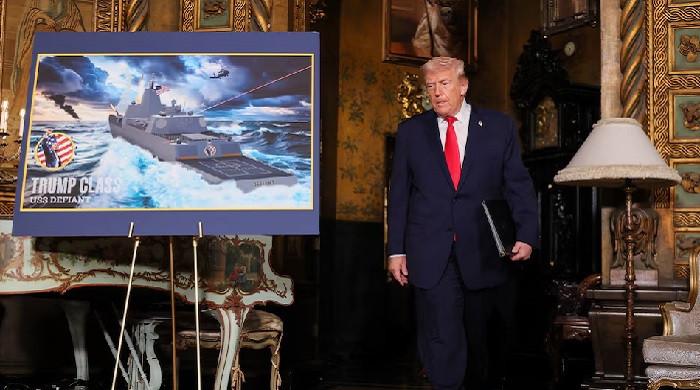
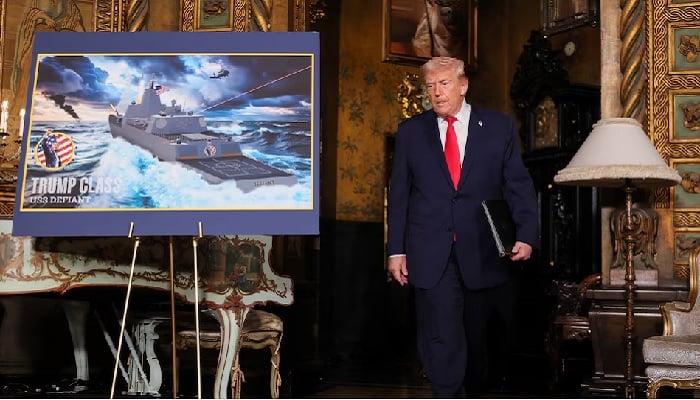
President Trump on Monday announced plans for a new “Trump class” of battleships, marking the start of an expanded naval buildup and signalling increased scrutiny of defence contractors over production delays and cost overruns.
The announcement represents the latest example of the president rebranding an aspect of the federal government in his image. Trump – who has previously criticised the appearance of US warships – will be personally involved in the designs.
He said the ships will weigh more than 30,000 tons, larger than current destroyers, and be equipped with the latest technology, including artificial intelligence and directed energy lasers.
“We haven’t built a battleship since 1994. These cutting-edge vessels will be some of the most lethal surface warfare ships… other than our submarines,” Trump said.
Some US officials have warned that a failure to build new battleships in recent years has handed an advantage to economic and military rival China. Trump downplayed China’s influence on the decision, saying the expansion was “a counter to everybody.”
He said the naval expansion would also be paired with renewed pressure on defence contractors to speed up production and rein in costs. He said he will meet with major defence firms next week to address delays and overruns, and to examine whether executive compensation, stock buybacks and dividends are contributing to missed production targets.
“We don’t want to have executives making $50 million a year, issuing big dividends to everybody, and also doing buybacks” while production of F-35s and other jets languishes, Trump said.
Reuters reported last week that the administration was planning an executive order to limit dividends, buybacks and executive pay for defence contractors whose projects are over-budget and delayed.
Trump and the Pentagon have been complaining about the expensive, slow-moving and entrenched nature of the defence industry, promising dramatic changes that would make the production of war equipment more nimble.


SIMTA joins ITMF as corporate member

New York Times reporter sues Google, xAI, OpenAI over chatbot training

Egypt stepping up efforts to modernise textile, spinning sector: PM

-
 Business1 week ago
Studying Abroad Is Costly, But Not Impossible: Experts On Smarter Financial Planning
-
 Business1 week ago
KSE-100 index gains 876 points amid cut in policy rate | The Express Tribune
-

 Fashion5 days ago
Indonesia’s thrift surge fuels waste and textile industry woes
-

 Sports1 week ago
Jets defensive lineman rips NFL officials after ejection vs Jaguars
-
 Business5 days ago
BP names new boss as current CEO leaves after less than two years
-

 Tech5 days ago
T-Mobile Business Internet and Phone Deals
-

 Entertainment1 week ago
Prince Harry, Meghan Markle’s 2025 Christmas card: A shift in strategy
-

 Sports5 days ago
PKF summons meeting after Pakistani player represents India in kabaddi tournament