

Business
Shrinking economy takes toll on FTSE 100 amid ‘unsurprising surprise’

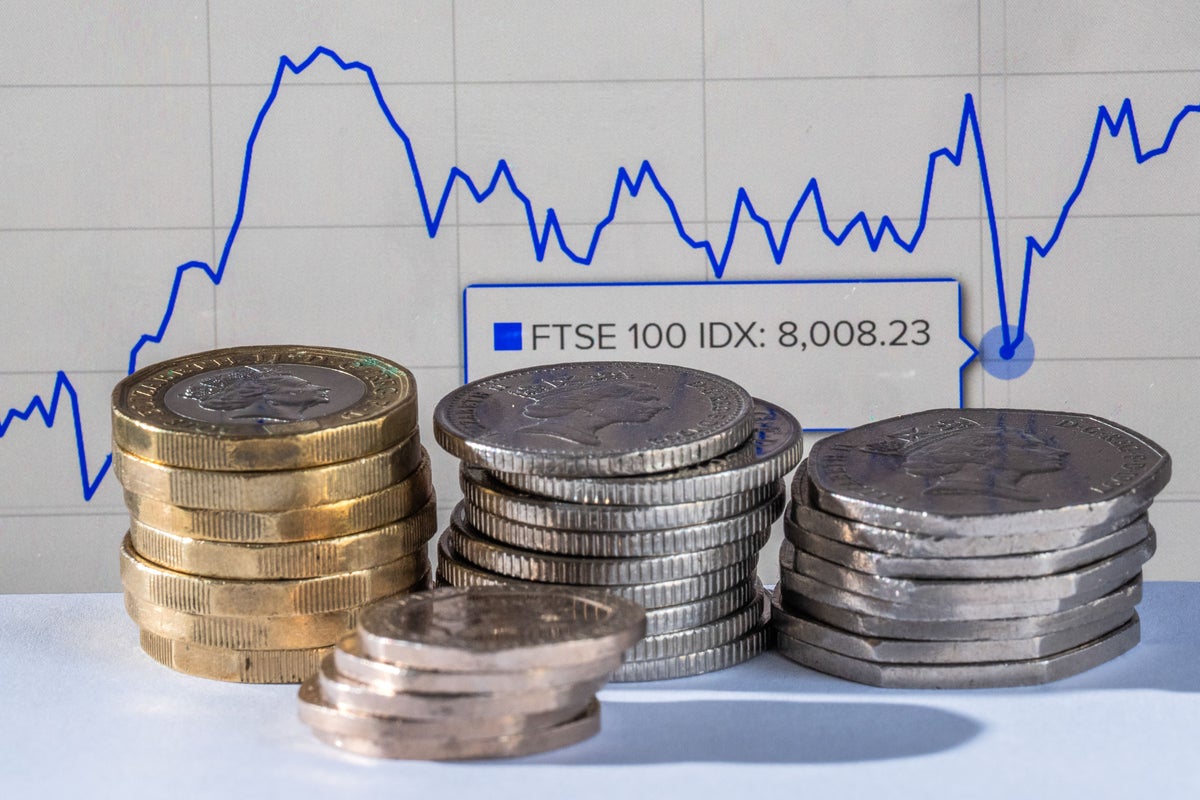
The FTSE 100’s early promise faded on Friday amid downbeat economic growth figures and fresh US tech weakness.
The FTSE 100 index closed down 54.1 points, 0.6%, at 9,649.03.
It had earlier traded as high as 9,761.47.
The FTSE 250 ended 24.45 points higher, 0.1%, at 21,876.55, and the AIM All-Share ended up 3.70 points, 0.5%, at 751.36.
For the week, the FTSE 100 fell 0.2%, the FTSE 250 declined 0.9% and the AIM All-Share dropped 0.2%.
The mood was knocked by news that the UK economy shrank in October, according to figures from the Office for National Statistics.
Gross domestic product is estimated to have fallen by 0.1% in October, the same as in September, missing the FXStreet-cited market consensus for a 0.1% rise.
Services output fell by 0.3%, while construction output fell by 0.6%.
Production output, however, climbed 1.1%.
Citi analyst Callum McLaren-Stewart called the data “an unsurprising surprise”.
“A miss in October is perhaps not the most surprising outcome.
“Pre-budget uncertainty, and particularly the degree of speculation ahead of the event, can likely explain the miss relative to forecasts,” he said.
“For households, the prospect of income tax increases (which was still very much live during October) would likely have put the brakes on consumer spending,” the Citi analyst said, while, on the business side, “the associated lack of clarity around which sectors were to be taxed, will have likely delayed/slowed investment decisions”.
Berenberg analyst Andrew Wishart fears some of the slowdown in the UK economy could be due to underlying issues and not just budget uncertainty.
“We suspect that deteriorating fundamentals rather than a budget-related setback in confidence are to blame, so a recovery seems unlikely in the near term,” Mr Wishart said.
The data was seen as cementing a quarter-point interest rate cut at next week’s Bank of England Monetary Policy Committee meeting.
“Not that it was in any doubt at all, but today’s data essentially guarantees that the Bank of England will slash rates again next week.
“The focus will instead be on the guidance for rates in 2026.
“Any dovish undertones that hint at further easing ahead could bode ill for the pound,” Ebury analyst Matthew Ryan said.
Mr McLaren-Stewart agrees the data “clearly supports the consensus case for a cut”.
“However, we anticipate the (BoE) will be obliged to cut lower than currently priced in 2026, necessitating a terminal rate below 3%, supported by weaker GDP outlook,” he added.
Sterling fell back after the figures, after rallying in recent days.
The pound was quoted lower at 1.3356 US dollars at the time of the London equities close on Friday, compared to 1.3416 US dollars on Thursday.
The euro stood at 1.1739 US dollars, down against 1.1746 US dollars.
Against the yen, the dollar was trading higher at 155.69 yen compared to 155.24.
In Europe on Friday, the CAC 40 in Paris closed down 0.1%, while the DAX 40 in Frankfurt ended 0.5% lower.
Stocks in New York were lower at the time of the London equity close.
The Dow Jones Industrial Average was down 0.7%, the S&P 500 index was 1.4% lower, while the Nasdaq Composite was down 2.1%.
Technology stocks were firmly in the red once more as Broadcom slid 11% after results failed to match lofty expectations, while Oracle fell a further 4.6%.
The yield on the US 10-year Treasury was quoted at 4.19%, stretched from 4.12% on Thursday.
The yield on the US 30-year Treasury was at 4.86%, widened from 4.77%.
Supporting the dollar and pushing yields higher, comments from two officials who voted against the Federal Reserve’s decision to lower interest rates this week.
Chicago Fed President Austan Goolsbee had joined Kansas City Fed President Jeffrey Schmid in pushing to keep rates unchanged instead at the central bank’s two-day policy meeting, which ended on Wednesday.
“I believe we should have waited to get more data, especially about inflation, before lowering rates further,” said Mr Goolsbee in a statement Friday.
In a separate statement, Mr Schmid, who also pushed for no rate cut at the Fed’s October meeting, said: “Right now, I see an economy that is showing momentum and inflation that is too hot, suggesting that policy is not overly restrictive.”
In addition, Federal Reserve Bank of Cleveland President Beth Hammack said she would prefer interest rates to be slightly more restrictive to keep putting pressure on inflation, which is still running too high.
Back in London, InterContinental Hotels Group rose 2.3% as Jefferies upgraded to “buy” from “hold”‘, but Whitbread dropped 2.2% as the broker moved the Premier Inn owner the other way, to “hold” from “buy”.
Elsewhere, 1Spatial soared 45% after agreeing in principle to a proposed £87.1 million offer from VertiGIS, a portfolio company of London-based private equity firm Battery Ventures.
The Cambridge, England-based location master data management software company said the cash bid would value each 1Spatial share at 73 pence.
VertiGIS confirmed that it has completed commercial due diligence, has a clear understanding of the 1Spatial business and requires only limited confirmatory diligence to proceed to making a firm offer.
But Card Factory plummeted 27% after cutting its profit guidance as it said weak high-street retail footfall hurt its UK store sales performance.
The Wakefield, England-based greeting cards, gifts and celebration merchandise retailer said it expects adjusted pretax profit of between £55 million and £60 million for financial 2026, which ends on January 31, if current trading trends persist.
This is lower than the company’s previous guidance, which was for mid-to-high single-digit-percentage growth in adjusted pretax profit from £66.0 million in financial 2025, roughly £70 million.
Card Factory attributed weak consumer confidence to the lower high street footfall, which has persisted into its “most important” trading period.
Brent oil was quoted at 61.30 dollars a barrel at the time of the London equities close on Friday, up from 60.91 late on Thursday.
Gold was quoted at 4,291.08 dollars an ounce on Friday, higher against 4,254.97.
The biggest risers on the FTSE 100 were Burberry, up 54.50 pence at 1272.5p, Ashtead Group, up 128.0p at 5,138.0p, BT Group, up 3.7p at 180.5p, Intercontinental Hotels Group, up 185.0p at 10,235.0p and Fresnillo, up 46.0p at 2,904.0p.
The biggest fallers on the FTSE 100 were St James’s Place, down 49.0p at 1,316.5p, British American Tobacco, down 146.0p at 4,238.0p, Anglo American, down 80.0p at 2,817.0p, Weir, down 80.0p at 2,856.0p and Imperial Brands, down 86.0p at 3,179.0p.
Monday’s economic calendar has CPI figures in Canada.
Later in the week, interest rate decisions are due in Europe, Japan and the UK. In addition, US nonfarm payrolls figures will be released, plus UK and US inflation and retail sales data.
Next week’s UK corporate calendar has delayed full-year results from travel retailer WH Smith and half-year numbers from electricals retailer Currys.
Contributed by Alliance News.

The speed of price rises in the UK has stayed the same, according to data which was collected before the US-Israel war with Iran began.
Source link

Buying continued at the Pakistan Stock Exchange (PSX), with the benchmark KSE-100 Index gaining over 1,700 points during the opening minutes of trading on Wednesday. At 10 am, the benchmark index was at 155,730.37, up 1,764.37 points (1.13%).
Buying interest was observed in key sectors, including automobile assemblers, cement, commercial banks, fertiliser, oil and gas exploration companies, OMCs, power generation, and refinery. Index-heavy stocks, including ARL, HUBCO, PSO, MARI, OGDC, POL, PPL, HBL, MCB, and MEBL traded in the green.
On Tuesday, PSX ended with moderate gains as thin volumes and profit-taking capped the upward momentum despite supportive global cues and easing geopolitical concerns.
The KSE-100 Index closed at 153,966.36 points, gaining 1,225.99 points or 0.80%.
K-Electric led trading volumes with over 35 million shares exchanged, coinciding with the company’s announcement of a new chief executive earlier in the day.
Market heavyweights, including Engro Holdings, Fauji Fertiliser Company, Lucky Cement, Systems Limited, and Hub Power Company, contributed significantly to the index gains, while banking and select industrial stocks weighed on overall performance.
Despite the rebound, analysts noted that the market remained cautious after last week’s decline, which was driven by geopolitical uncertainty, particularly tensions in the Middle East, and concerns over global energy prices.
Experts suggest that future market direction will depend on regional stability, energy policy developments, and progress in ongoing discussions with the International Monetary Fund.
Globally, stocks rose, and oil fell on Wednesday on reports the US is seeking a month-long ceasefire in its war on Iran, and had sent a 15-point plan to Iran for discussion, raising hopes for a resumption of oil exports out of the Persian Gulf.
S&P 500 futures rose 0.9% in the Asian morning, European futures lifted 1.2%, and Brent crude futures fell about 6% to $98.30 a barrel.
Fed hike odds jump to 26% from 70% cut probability week ago as Middle East war fuels inflation fears
A picture showing $100 bills. SOURCE: REUTERS
Currency markets took a breather on Wednesday, with traders cautious over United States President Donald Trump’s efforts to bring an end to the war with Iran. While Trump told reporters at the White House the US was making progress in talks with Iran, Tehran denied that direct negotiations had taken place, keeping investors on edge.
The US dollar index, which measures the greenback’s strength against a basket of six currencies, was last 0.13% higher at 99.317, with the euro little changed at $1.1603. The British pound was 0.16% weaker at $1.3388 as data showed that British consumer price inflation held at an annual rate of 3.0% in February, unchanged from January’s rate. However, inflation is broadly expected to pick up as the war in the Middle East pushes up prices.
The subdued volatility contrasted with a pickup in equities and a fall in crude oil prices after Trump said on Tuesday the US was making progress in its efforts to negotiate an end to the war.
Read: Trump approval sinks to 36% as fuel prices surge amid Iran war
“For those reacting to every breaking headline around dialogue between the US and its allies and Iran, including speculation of high-level talks and temporary ceasefire proposals, an element of fatigue is now firmly setting in,” said Chris Weston, head of research at Pepperstone Group Ltd in Melbourne.
Against the yen, the US dollar was up a slight 0.2% at 158.99, after the release of minutes from the Bank of Japan’s January policy meeting showed many board members saw the need to keep raising interest rates without any specific pace in mind. The Australian dollar weakened 0.33% to $0.697 after the release of inflation data for February, which showed a 3.7% rise prior to the start of the US-Israeli war with Iran, a slightly slower pace than expected by analysts.
Although markets still anticipate no change in US interest rates this year, expectations of policy tightening are rising. Fed funds futures now imply a 26.1% chance of a 25-basis-point hike at the Federal Reserve’s December meeting, compared to a 69.5% probability of a cut a week ago, according to CME Group’s FedWatch tool.
Read More: Global shares skid as oil surge threatens inflation shock
The Fed may need to keep interest rates steady “for some time” before further cuts are warranted, Fed Governor Michael Barr said on Tuesday, noting continued inflation above the Fed’s 2% target and the risks posed by the conflict in the Middle East.
Bond markets rebounded after a volatile week, with the yield on the US 10-year Treasury bond down 3.4 basis points at 4.356%. “Higher oil prices added to expectations of increasing inflationary pressures and tighter monetary policy,” analysts from Westpac wrote.
In cryptocurrencies, bitcoin climbed 1.6% to $71,202.33, while ether was up 1.2% at $2,174.14.


US’ Torrid sees FY25 sales fall 9.4%, reports $7 mn loss

Wristband enables wearers to control a robotic hand with their own movements
UK inflation rate steady in February ahead of Iran war

-

 Fashion7 days ago
Sales at US apparel, clothing accessories stores up 4% YoY in Jan 2026
-
 Business1 week ago
Peloton is launching bikes and treadmills for gyms, accelerating commercial strategy
-

 Tech1 week ago
Justice Department Says Anthropic Can’t Be Trusted With Warfighting Systems
-

 Fashion1 week ago
Trump signs order to combat fraudulent ‘Made in America’ labels
-
 Business1 week ago
Stocks and pound rise as US rate call approaches
-

 Fashion1 week ago
Lenzing launches TENCEL Lyocell-HV100 at Intertextile Shanghai
-

 Sports7 days ago
March Madness 2026 – How to watch in SA, start time, schedule, TV channel for NCAA championship basketball tournament
-

 Entertainment7 days ago
Val Kilmer revived 1 year after death through AI