

Business
Significant fall in government borrowing in December, figures show

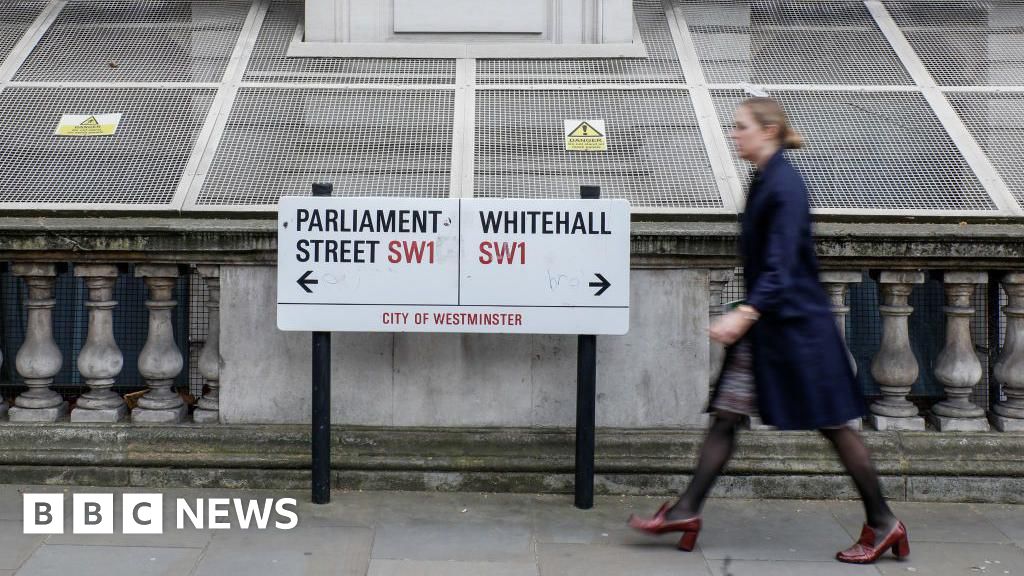
UK government borrowing was significantly lower last month, due to more income from taxes and higher National Insurance Contributions outweighing spending, figures show.
In December government borrowing – the difference between public spending and tax income – was £11.6bn, the Office for National Statistics (ONS) said.
It is down £7.1bn – 38% – from the previous December, and lower than what many economists had predicted, but still higher than that borrowed in the same month in 2023.
Tom Davies, Deputy Director for the ONS public service division, said the fall was a result of “receipts being up strongly on last year whereas spending is only modestly higher”.
Despite the annual fall, the December 2025 figure was the tenth highest for the month since records began in 1993, without adjusting for inflation.
And it remains higher than December 2023, when borrowing stood at £8.1bn.
The figures show the government received £7.7bn more – an 8.9% rise – in taxes in December 2025 than it did in the same month in 2024.
This comprised increases in income tax, corporation tax, VAT and National Insurance contributions (NIC), the ONS said – with changes to the rate of NIC paid by employers coming into effect in April last year.
According to provisional estimates, borrowing over the financial year to December totalled £140.4bn, about £300m lower than the same period in 2024, the ONS said.
The borrowing figure was estimated as 4.6% of GDP – 0.2 percentage points down from the same period last year.
It was the third-highest level of borrowing over April-December on record, after those in 2020 and 2024.
Chief Secretary to the Treasury, James Murray, said the government was “stabilising the economy, reducing borrowing, rooting out waste in the public sector”.
He said: “Last year we doubled our headroom and we are forecast to cut borrowing more than any other G7 country with borrowing set to be the lowest this year since before the pandemic.”
Ruth Gregory, deputy chief UK economist at Capital Economics, said public finances were “finally showing signs of improvement in recent months”.
“What’s more, a further improvement in January is on the way. Those figures will probably show a bumper set of self-assessment tax and capital gains tax (CGT) receipts reflecting the freeze on income tax thresholds and a disposal of assets due to the speculation that Reeves would raise CGT.”
But she said the “big picture is that the pace of deficit reduction remains very slow”.
Business
Markets are underpricing the risk of Middle East pullback in AI, says tech investor Jack Selby

A potential pullback by Middle East sovereign wealth funds could drain hundreds of billions of dollars from the artificial intelligence boom and threaten key data center projects, according to tech investor Jack Selby.
Middle East investors — including sovereign wealth funds and government entities — account for roughly a quarter of global investments committed to AI over the next five years, said Selby, managing director of Peter Thiel’s family office, Thiel Capital. If the war in Iran drags on, and the United Arab Emirates, Saudi Arabia and other countries divert their investments to rebuilding at home, the lost capital could ripple through data centers as well as public and private tech companies, he said.
“I think markets have underappreciated how important the Middle East region is for capex spending as it relates to AI and AI infrastructure,” Selby told CNBC in an interview. “If the Middle East starts taking some of these projects offline or canceling some of these projects, the impact on the market could be much, much, much larger than what they currently suggest.”
Selby’s warning has implications for high-net-worth investors, family offices and funds betting on the AI trade. A Wall Street Journal report this week about missed revenue targets at OpenAI rattled tech and chip stocks. Selby said the Middle East poses another funding risk, as AI companies grew more dependent on the region for capital.
Oracle, Nvidia and Cisco are part of OpenAI’s campus in the UAE to build out 5 gigawatts of capacity. Microsoft plans to invest $15 billion in the UAE by 2029. The sovereign wealth funds of the UAE and Saudi Arabia have become key investors in private AI companies, with OpenAI reportedly seeking $50 billion from the big funds in the region earlier this year.
Selby estimates that half of the Middle East’s AI funding is dedicated to data centers located in the region. The other half is allotted to projects and data centers worldwide. Middle East funds and companies have already started canceling various shipping and business contracts by invoking force majeure, he said. The big risk is that they start canceling data centers as well.
“Markets don’t seem to grasp that this is a very real situation,” he said. “It’s very volatile. I hope and I pray that it goes back to some semblance of normalcy soon. But it seems to me that markets are underpricing this volatility and the risk.”
Beyond the war, AI also faces a broader risk of overinvestment and speculation, Selby said. Like the dot-com bubble, he said investors and founders are bidding up values of AI and infrastructure companies indiscriminately. He said the AI boom is consuming far more capital, with the top hyperscalers expected to spend more than $700 billion this year. So the wealth destruction will overshadow the losses of the dot-com bust.
“AI is a revolutionary technology, don’t get me wrong,” he said. “But it can also be an exceptional bubble. There will be extreme winners and there also be some real losers. And those losers will be orders of magnitude larger than any of the losers that we’ve seen before. The AI bubble, when it busts, will be at least one more zero, probably two and three more zeros than the dot-com bubble. That will be tens, if not hundreds, of billions of dollars.”
He cited Google as an example from the dot-com era. While investors were bidding up the values of Ask Jeeves, Infoseek, AltaVista and other early search functions, Google came along and upended all their business models. He said similar disruptions could happen to today’s AI leaders.
Selby’s AI strategy is to avoid the crowds. With a second fund he’s launching at Copper Sky, his Arizona-based VC fund, Selby is targeting tech firms outside of California, New York and Massachusetts. He said tech firms in those three states — especially the Stanford and MIT clusters — are attracting all the capital and attention. So the best values lie elsewhere, he said.
“Probably 90%-plus of all venture capital investment went to California, New York, Massachusetts, an all-time high,” he said. “The good news is you get outside of those three states and go to the other 47 states, the deals, the investment opportunities are far, far, far less expensive, and that’s what we do.”
Selby declined to give many details on Thiel’s family office, saying only that Thiel invests in great founders rather than specific industries. Thiel Capital, which ranked on the Inside Wealth Family Office 15 list of most active family office investors, has invested in everything from German drone makers (Stark) and gene therapy startups (Kriya Therapeutics) to an AI hiring company (Mercor) and space research firm (Varda).
Yet as a family office director and head of a VC fund that raises money from family offices, Selby said the biggest mistake for many family offices today is making their own direct investments. A survey from Citibank last year found that seven out of 10 family offices have made direct investments in private companies, without going through a fund.
Selby said he understands why family offices are striking out on their own, given the dismal performance of private equity and venture capital funds and lack of distributions. He said two-thirds of venture capital firms are “zombie VCs,” that aren’t raising or returning money and should close.
“Family offices are so frustrated with people like ourselves, who have not been returning their capital, so why shouldn’t they try it themselves?” Selby said. “They couldn’t do any worse than a lot of what [VCs] have been doing in terms of making investments, not giving money back, having marks on paper.”
At the same time, however, he said typical family offices aren’t adequately trained in assessing, valuing and restructuring private companies. Many ultra-wealthy investors are more motivated by status and peer pressure than by disciplined returns.
“When these fancy people go to their cocktail parties in Manhattan, they have to have something interesting to talk about,” he said. “All of their friends are talking about some version of [direct investments]. So they have to have something to add to the conversation. So therefore, they do the same thing. The Greek shipping magnate that lives in Manhattan knows nothing about rocketry. So why is he investing in SpaceX? Because he just wants to have something fun to talk about at the fancy cocktail party.”
Business
Stock market holiday on May 1: Are NSE, BSE, MCX open on Maharashtra Day? – The Times of India

Indian markets are set for a shortened trading week, with the NSE and BSE remaining closed on Friday, May 1, for Maharashtra Day. The holiday will pause trading across equity, equity derivatives and related segments.For investors planning trades or settlements, Friday’s closure will be the latest scheduled market break after the April 14 holiday observed for Dr Baba Saheb Ambedkar Jayanti.
Are NSE and BSE open on May 1?
No. Both the National Stock Exchange and BSE will remain shut on Friday, May 1.Normal trading will resume on the next working day after the holiday which is May 4, 2026.
Is MCX open on May 1?
The Multi Commodity Exchange (MCX) will remain closed in the morning session but will reopen for the evening session.The National Commodity & Derivatives Exchange (NCDEX), however, will remain shut for both sessions on Friday.
What is the next stock market holiday after May 1?
After Maharashtra Day, the next scheduled holiday for stock markets is May 28 on account of Bakri Id.
How many market holidays are left in 2026?
A total of 16 stock market holidays are scheduled for 2026. Seven have already passed. After the May 1 break, eight more full market holidays remain this year.The remaining holidays are:
- May 28- Bakri Id
- June 26 – Muharram
- September 14 – Ganesh Chaturthi
- October 2 – Gandhi Jayanti
- October 20 – Dussehra
- November 10 – Diwali Balipratipada
- November 24 – Guru Nanak Jayanti
- December 25 – Christmas
Which holidays fall on weekends?
Some major holidays in 2026 fall on weekends and therefore do not lead to exchange closures:
- Mahashivratri – February 15
- Eid-Ul-Fitr – March 21
- Independence Day – August 15
- Diwali Laxmi Pujan – November 8
Will there be Muhurat Trading?
Yes, Diwali Laxmi Pujan falls on a Sunday this year, and exchanges are expected to hold the customary Muhurat Trading session on November 8.The timing for the one-hour special session will be announced closer to the date.
Business
FDA proposes excluding Novo, Lilly weight loss drugs from bulk compounding list in win for the companies

The headquarters of the U.S. Food and Drug Administration in Silver Spring, Maryland, Nov. 4, 2009.
Jason Reed | Reuters
The Food and Drug Administration on Thursday proposed excluding the active ingredients in Novo Nordisk and Eli Lilly‘s blockbuster obesity and diabetes medications from the list of drugs that outsourcing facilities can use for compounding in bulk.
If that proposal is finalized, the exclusion would likely limit the mass compounding — or the making of custom, often cheaper alternatives — of those medicines unless they appear on the FDA’s drug shortage list. The agency said it will consider public comments, which can be submitted until late June, before making a final decision.
The FDA finds “no clinical need” for outsourcing facilities to compound them from bulk drug substances, the agency said in a release.
The proposal includes semaglutide, the active ingredient in Novo’s obesity drug Wegovy and diabetes counterpart Ozempic, and tirzepatide, which is in Lilly’s weight loss injection Zepbound and diabetes shot Mounjaro. It also covers Novo’s older molecule liraglutide.
“When FDA-approved drugs are available, outsourcing facilities cannot lawfully compound using bulk drug substances unless there is a clear clinical need,” FDA Commissioner Marty Makary said in the release.
The agency’s proposal specifically targets 503B outsourcing facilities, which manufacture compounded drugs in bulk with or without prescription and are largely regulated by FDA guidelines.
The proposal does not impact 503A pharmacies, which make compounded drugs according to individual prescriptions for a specific patient and are largely regulated by states rather than the FDA.
Lilly and Novo have invested billions to ramp up manufacturing capacity over the last several years, which has helped alleviate supply constraints. The companies have also pursued efforts to make their branded medications more affordable to win over users who had flocked to cheaper compounded medications.

Markets are underpricing the risk of Middle East pullback in AI, says tech investor Jack Selby

Olivia Rodrigo teases exciting ‘SNL’ double duty episode with one twist
Stock market holiday on May 1: Are NSE, BSE, MCX open on Maharashtra Day? – The Times of India

PSL 11: Hyderabad Kingsmen opt to field after winning toss against Multan Sultans

Trump administration in advanced talks for a rescue package for Spirit Airlines, source says
UK inflation accelerates after Iran war drives sharp rise in fuel prices

-
 Sports1 week ago
PSL 11: Hyderabad Kingsmen opt to field after winning toss against Multan Sultans
-
Business1 week ago
Trump administration in advanced talks for a rescue package for Spirit Airlines, source says
-
Business1 week ago
UK inflation accelerates after Iran war drives sharp rise in fuel prices
-

 Tech1 week ago
Microsoft faces court battle in £2bn Windows Server class action | Computer Weekly
-
 Business1 week ago
Gold prices in Pakistan Today – April 23, 2026 | The Express Tribune
-

 Entertainment1 week ago
Anne Hathaway shares major news about ‘Princess Diaries 3’
-

 Tech1 week ago
Blackbox replaces two racks of HPE storage with 8U of Everpure | Computer Weekly
-

 Fashion1 week ago
Bangladesh RMG units call for allowing local FOC raw material sourcing