

Business
Six-month unfair dismissal right to begin in January 2027

Paul SeddonPolitical reporter
 Getty Images
The government will commit to bringing in enhanced protections against unfair dismissal from the start of 2027, after watering down its plans last week.
Labour ministers agreed to introduce the right to make a claim after six months in a job instead of on day one, after a backlash from business groups.
This new qualifying period would still be shorter than the current two years.
At the time of last week’s climbdown, the business department did not specify when the amended six-month right would come into force.
However, ministers are now expected to make a commitment to implement the new protection from 1 January 2027, when the legislation to deliver the change returns to the House of Commons on Monday.
Such assurances, made from the dispatch box, are not legally binding but are seen as carrying additional political weight by MPs and peers.
The move, which was first reported by The Guardian, followed talks this week between ministers and former deputy PM Angela Rayner and ex-employment minister Justin Madders, two key architects of the original proposals.
Following the talks, Rayner agreed to withdraw an amendment she had planned to table, which would have made the start date 2026.
Writing on social media, Rayner appeared to welcome the government’s decision, saying a January 2027 start date would introduce protection for those hired after July 2026, bringing “real change for workers”.
Probation period shelved
Currently, after two continuous years in a job workers gain additional legal protections against so-called “ordinary” unfair dismissal.
It means employers must identify a fair reason for dismissal – such as conduct or capability – and show that they acted reasonably and followed a fair process.
Until last week, Labour was planning to scrap this qualifying period completely at an unspecified point during 2027, with a new legal probation period, likely to have been nine months, introduced as a safeguard for companies.
But following talks with unions and business groups last week, the qualifying period will instead be set at six months’ service, and the legal probation period shelved.
The U-turn has been widely welcomed by business groups, which had warned the original proposals would discourage companies from hiring.
It has been condemned by some MPs on the left of the Labour Party, as well as the Unite union, a major donor through the affiliation fees its members pay to the party.
The government still plans to bring in new day-one rights to sick pay and paternity leave rights from April 2026.
Compensation cap
Separately, the government is also expected to abolish the current limits on compensation for financial loss in ordinary unfair dismissal cases.
Currently, awards to former employees who successfully bring a claim are limited to either their annual salary or £118,223, whichever is lower.
But the government plans to amend its employment rights bill to abolish both these caps, as the bill goes through its final stages in Parliament.
This would bring the process more into line with “automatic” unfair dismissal cases – where workers have been sacked for reasons such as discrimination and whistleblowing – where financial loss awards are uncapped.
Abolishing the caps did not feature in the original version of the bill unveiled in October last year, or in Labour’s general election manifesto.
But ministers committed to do so last week during talks to reach an agreed route forward between some unions and industry groups.

Washington: The International Monetary Fund on Monday raised India’s economic growth projection for 2025 by a sharp 0.7 percentage point to 7.3 per cent, citing stronger-than-expected performance in the second half of the year, even as it expects growth to moderate in the coming years.
In its World Economic Outlook Update, the IMF said the upward revision reflects a “better-than-expected outturn in the third quarter of the year and strong momentum in the fourth quarter,” underscoring India’s position as one of the fastest-growing major economies in the world.
The IMF projected that India’s growth would ease to 6.4 per cent in 2026 and 2027 as cyclical and temporary factors wane.
Despite the expected moderation, India remains a key driver of growth among emerging market and developing economies, which the IMF said are projected to expand at just over 4 per cent in 2026 and 2027.
Emerging and developing Asia continues to benefit from strong technology-related investment and trade, even as global momentum becomes uneven.
The update noted that global growth is projected to hold steady at 3.3 per cent in 2026, supported by easing trade tensions, accommodative financial conditions and a surge in investment linked to technology, particularly artificial intelligence.
Inflation trends were also favourable for India. The IMF said inflation in India “is expected to go back to near target levels after a marked decline in 2025, driven by subdued food prices,” offering additional support to domestic demand.
However, the IMF cautioned that risks to the outlook remain tilted to the downside. A reassessment of expectations around AI-driven productivity gains could lead to a pullback in investment and tighter global financial conditions, with spillover effects for emerging economies.
On the upside, the Fund said faster adoption of artificial intelligence could lift global growth, provided productivity gains materialise, and financial risks are contained.
Adrienne MurrayBusiness reporter, Helsinki
 Aker Arctic Technology
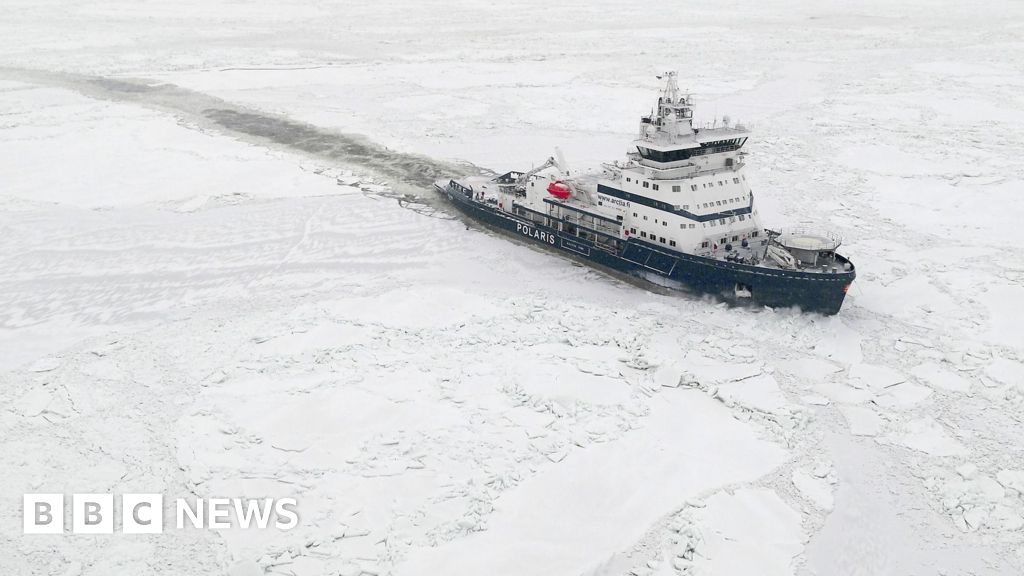
As President Donald Trump continues to insist that the US needs to own Greenland, his wider focus on the Arctic region has seen Washington order new icebreakers.
For these ships, which can sail through seas covered in solid ice, the US has gone to the world expert – Finland.
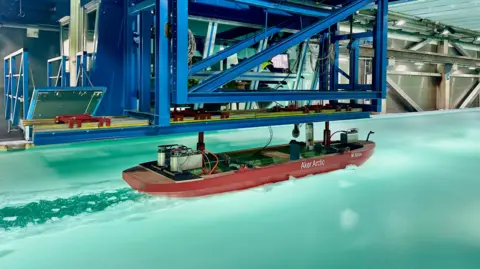
Temperatures are sub-zero inside Aker Arctic Technology’s ice laboratory, as the scale model of an icebreaker cruises down a 70m-long simulation tank.
It ploughs a neat channel through the frozen surface of the water.
Undergoing testing at a facility in Helsinki, Finland’s capital, this is a design for the next generation of the country’s icebreakers.
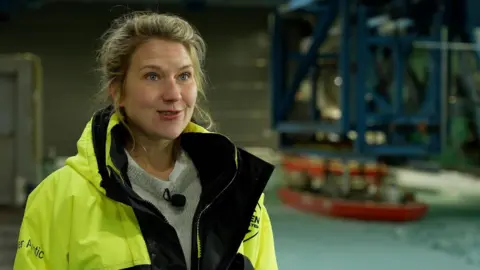
“It’s crucial that it has sufficient structural strength and engine power,” says ice performance engineer, Riikka Matala.
Mika Hovilainen, the firm’s chief executive, adds that the shape of the vessel is also crucial. “You have to have a hull form that breaks ice by bending it downwards,” he says. “It’s not cutting, it’s not slicing.”
Finland is the undisputed world leader when it comes to icebreakers. Finnish companies have designed 80% of all those currently in operation, and 60% were built at shipyards in Finland.
The country leads the way out of necessity, explains Maunu Visuri, president and chief executive of Finnish state-owned company Arctia, which operates a fleet of eight icebreakers.
“Finland is the only country in the world where all the harbours may freeze during wintertime,” he says, adding that 97% of all goods to the country are imported by sea.
During the coldest months, icebreakers keep Finland’s ports open, and work as pathfinders for big cargo ships. “It’s really a necessity for Finland. We say that Finland is an island.”
It was this expertise that saw Trump announce in October that the US planned to order four icebreakers from Finland for the US Coast Guard.
A further seven of the vessels, which the US is calling “Arctic Security Cutters”, are to be built in the US, using Finnish designs and expertise.
“We’re buying the finest icebreakers in the world, and Finland is known for making them,” said Trump.

 Adrienne Murray
Under US law, the country’s naval and coastguard ships must be domestically-built, but in this case the president waived that requirement on national security grounds. He cited “aggressive military posturing, and economic encroachment by foreign adversaries”, by which he means Russia and China.
This US concern comes as climate change continues to make the Arctic Ocean more navigable for cargo ships, at least if icebreakers lead the way by cutting a path. This opens up commercial trade routes from Asia to Europe, either above Russia, or north of Alaska and Canada’s mainland, and down past Greenland.
Reduced ice levels also mean that oil and gas fields beneath the Arctic are more accessible.
“There’s simply a lot more traffic in that part of the world now,” notes Peter Rybski, a retired US Navy officer and Helsinki-based, Arctic expert.
“You have an active oil and gas exploration and extraction industry in Russia, as well as a newly-emerging trans-shipment route from Europe to Asia.”
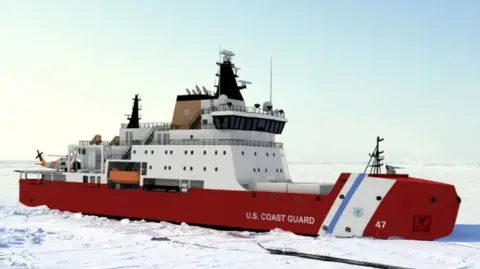 Rauma Marine Constructions
Following Trump’s outline announcement last autumn, the first contracts were awarded on 29 December.
Finland’s Rauma Marine Constructions is to build two icebreakers for the US Coast Guard at its shipyard in the Finnish port of Rauma. The first ship is due to be delivered in 2028.
A further four will be constructed in Louisiana, with all six using an Aker Arctic Technology diesel-electric powered design.
The US orders are part of an effort to catch up with the number of Russian icebreakers. Currently Russia has around 40, including eight that are nuclear powered.
By contrast, the US presently only has three in operation.
Meanwhile China operates around five polar-capable vessels. “None of them are technically icebreakers,” says Rybski, pointing to their design not meeting the strict criteria. “But they are increasing their fleet.”
He adds that China has increasingly been sending these “research” ships into Arctic waters between Alaska and the far east of Russia, including areas that the US considers its “exclusive economic zone”.
“With limited means to respond this becomes a problem [for the US].”
Trump’s desire to enlarge its icebreaker fleet goes beyond the practicalities of operating in ice-clad Arctic seas, assesses Lin Mortensgaard, a researcher at the Danish Institute of International Studies. She says it is also about projecting power.
“No matter how many aircraft carriers you have and how much you use them to threaten states with, you cannot sail your aircraft carrier into the central Arctic Ocean,” she says.
“Icebreakers are really the only kind of naval vessel to signal that you are an Arctic state, with Arctic capabilities. And I think this is what much of the US discourse is about.”
 James Brooks
Back in Finland, Helsinki Shipyard occupies a dock on the capital’s waterfront. It is where half of the world’s icebreakers have been made. Today owned by Canadian firm Davie, it also hopes to win new contracts from the US Coast Guard.
“The geopolitical situation has changed definitely,” says the shipyard’s managing director, Kim Salmi.
“We have our eastern neighbour here [Russia]. They are building their own [new] fleet. And the Chinese are building their fleet.”
He adds: “The US, Canada and the western allies in general, are looking for the power balance.”
Inside a cavernous shipbuilding hangar, workers cut and weld steel for the yard’s latest icebreaker, a heavy-duty Arctic vessel, called Polarmax that’s destined for the Canadian coastguard.
The Finns can build these complex vessels remarkably swiftly – it takes between two-and-a-half and three years – thanks to a streamlined production method, and decades of experience.
“Over 100 years, we have practised this,” says Arctia’s Visuri. “You’ve got this cycle of designers, operators, builders. That’s why Finland is the superpower of icebreakers.”
Business
Gold price today: How much 22K, 24K gold cost in Delhi, Mumbai & other cities – Check rates – The Times of India
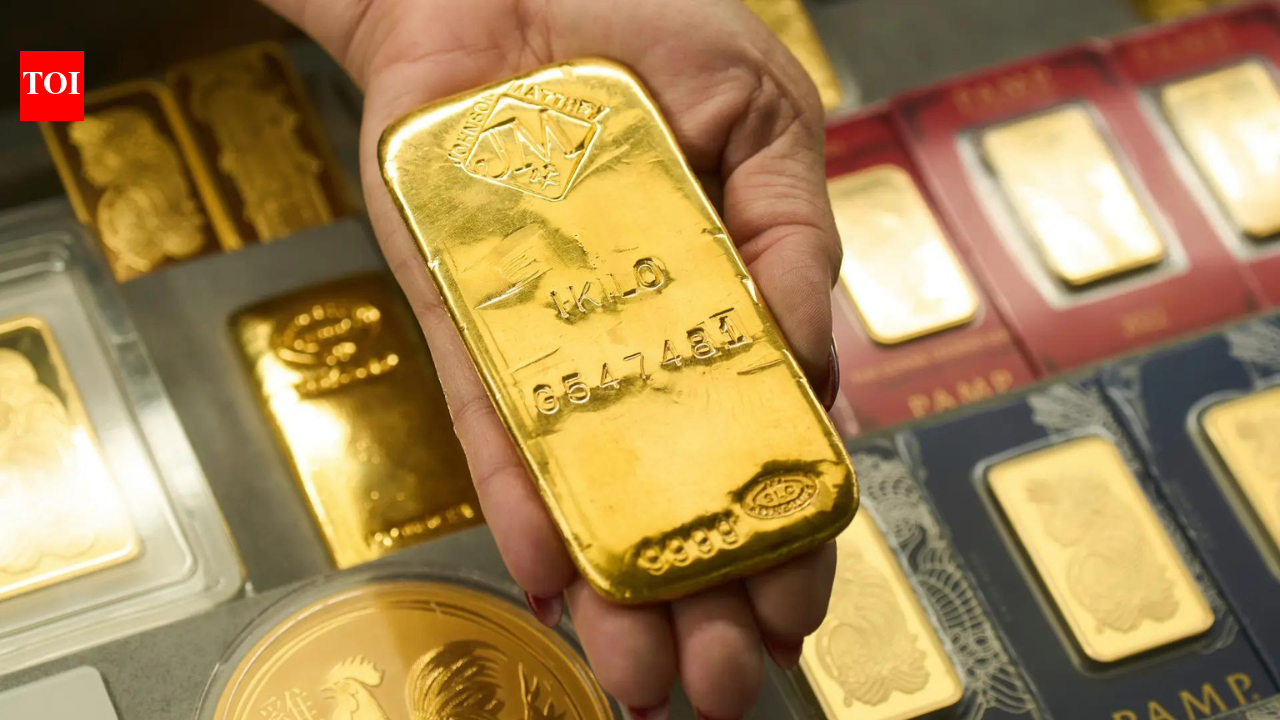
Gold prices remained high on Monday as investors continued to seek safety amid rising geopolitical tensions and trade-related uncertainties.Gold and silver prices surged to fresh record levels as escalating geopolitical risks and shifting US monetary expectations boosted demand for safe-haven assets. Renewed unrest in Iran, fresh US tariff threats against several European countries over Greenland and broader global uncertainty supported buying in precious metals.On the MCX, gold February futures jumped nearly Rs 3,000, or over 2%, to hit a fresh all-time high of Rs 1,45,500 per 10 grams. Silver also outperformed, with futures rising sharply to record levels.In international markets, spot gold climbed 1.7% to a new high of $4,673 an ounce, while silver rose about 3% to around $94 per troy ounce. Overseas silver futures surged more than 6% to hit a record $94.35 per ounce.
Gold prices in Delhi today
Gold prices in Delhi rose on Monday. The price of 24-carat gold stood at Rs 14,584 per gram, up by Rs 191. The rate for 22-carat gold was Rs 13,370 per gram, higher by Rs 175, while 18-carat gold was priced at Rs 10,942 per gram, up by Rs 143.
Gold prices in Mumbai today
In Mumbai, 24-carat gold was priced at Rs 14,569 per gram, up by Rs 191. The price of 22-carat gold stood at Rs 13,355 per gram, up by Rs 175, while 18-carat gold was trading at Rs 10,927 per gram, up by Rs 143.
Gold prices in Chennai today
Gold prices in Chennai also moved higher. The price of 24-carat gold was Rs 14,673 per gram, up by Rs 186. The rate for 22-carat gold stood at Rs 13,450 per gram, up by Rs 170, while 18-carat gold was priced at Rs 11,230 per gram, up by Rs 140.
Gold prices in Ahmedabad today
In Ahmedabad, 24-carat gold was trading at Rs 14,574 per gram, up by Rs 191. The price of 22-carat gold rose to Rs 13,360 per gram, up by Rs 175, while 18-carat gold was priced at Rs 10,932 per gram, up by Rs 143.
Gold prices in Bhubaneswar today
Gold prices in Bhubaneswar rose on Monday, with 24-carat gold at Rs 14,569 per gram, up by Rs 191. The rate for 22-carat gold was Rs 13,355 per gram, up by Rs 175, while 18-carat gold stood at Rs 10,927 per gram, up by Rs 143.
Gold prices in Hyderabad today
In Hyderabad, gold prices remained firm. The price of 24-carat gold stood at Rs 14,569 per gram, up by Rs 191. The rate for 22-carat gold was Rs 13,355 per gram, up by Rs 175, while 18-carat gold was priced at Rs 10,927 per gram, up by Rs 143.
Gold prices in Kolkata today
Gold prices in Kolkata also moved higher. The price of 24-carat gold was Rs 14,569 per gram, up by Rs 191. The rate for 22-carat gold stood at Rs 13,355 per gram, up by Rs 175, while 18-carat gold was priced at Rs 10,927 per gram, up by Rs 143.
Gold prices in Jaipur today
In Jaipur, 24-carat gold was priced at Rs 14,584 per gram, up by Rs 191. The price of 22-carat gold stood at Rs 13,370 per gram, up by Rs 175, while 18-carat gold was trading at Rs 10,942 per gram, up by Rs 143.
Gold prices in Lucknow today
Gold prices in Lucknow rose on Monday, with 24-carat gold at Rs 14,584 per gram, up by Rs 191. The rate for 22-carat gold was Rs 13,370 per gram, up by Rs 175, while 18-carat gold was priced at Rs 10,942 per gram, up by Rs 143.
Gold prices in Bengaluru today
In Bengaluru, gold prices were higher, with 24-carat gold trading at Rs 14,569 per gram, up by Rs 191. The price of 22-carat gold stood at Rs 13,355 per gram, up by Rs 175, while 18-carat gold was priced at Rs 10,927 per gram, up by Rs 143.
Gold prices in Patna today
Gold prices in Patna also edged higher. The price of 24-carat gold stood at Rs 14,574 per gram, up by Rs 191. The rate for 22-carat gold was Rs 13,360 per gram, up by Rs 175, while 18-carat gold was priced at Rs 10,932 per gram, up by Rs 143.


After 2025’s dispute, DSquared2 and Staff International renew their license deal

De-Gunk and Descale Your Keurig with These Cleaning Tips

Antonio Conte makes subtle dig at Ruben Amorim over Rasmus Højlund

-

 Tech7 days ago
New Proposed Legislation Would Let Self-Driving Cars Operate in New York State
-

 Sports1 week ago
Clock is ticking for Frank at Spurs, with dwindling evidence he deserves extra time
-

 Entertainment6 days ago
X (formerly Twitter) recovers after brief global outage affects thousands
-
 Fashion1 week ago
South India cotton yarn gains but market unease over US tariff fears
-

 Fashion1 week ago
China’s central bank conducts $157-bn outright reverse repo operation
-

 Sports1 week ago
US figure skating power couple makes history with record breaking seventh national championship
-

 Sports4 days ago
Pak-Australia T20 series tickets sale to begin tomorrow – SUCH TV
-
 Business1 week ago
Modern seafood processing zone planned at Korangi harbour | The Express Tribune