Connect with us

Business

Six Pakistani firms to showcase at FinTech | The Express Tribune

Published

on

Six Pakistani firms to showcase at FinTech | The Express Tribune


Deputy High Commissioner commends the participation of Pakistani fintech companies


SINGAPORE:

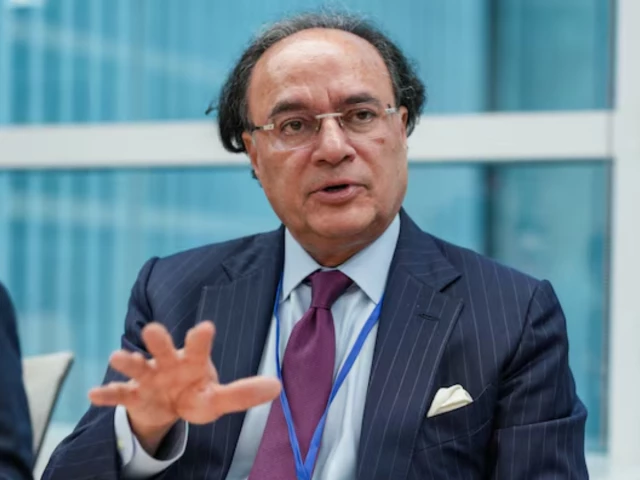
The Pakistan Pavilion was officially inaugurated at the Singapore FinTech Festival (SFF) 2025 on Wednesday by Deputy High Commissioner and Charge d’Affaires Salman Mehmood, according to an official statement.

Speaking at the ceremony, Mehmood commended the participation of Pakistani fintech companies and encouraged them to capitalise on the global platform to form international partnerships, attract investment, and promote Pakistan’s fast-growing technological capabilities.

A delegation of six leading Pakistani fintech firms is representing the country at this year’s event, underscoring Pakistan’s rising profile as an emerging player in the global fintech arena. Their participation reflects Pakistan’s growing engagement with Singapore’s vibrant fintech ecosystem and its commitment to expanding its footprint in the digital economy.

Running from November 12 to 14, 2025, the Singapore FinTech Festival is among the world’s largest gatherings of financial technology leaders, innovators, investors, regulators, and policymakers. The 2025 edition features over 600 exhibitors and 41 international pavilions, providing a dynamic platform to explore developments in fintech, digital finance, and emerging technologies.



Source link

Business

Anthropic At $380 Billion Surpasses India’s Top IT Firms Combined As AI Fears Rock Stocks

Published

on

Anthropic At 0 Billion Surpasses India’s Top IT Firms Combined As AI Fears Rock Stocks


Last Updated:

Anthropic’s AI tools have triggered a sharp decline in Indian IT stocks like TCS, Infosys, Wipro, eroding Rs 3,11,873 crore in market value.

Anthropic's valuation surpassed combined value of total IT firms in India

Anthropic’s valuation surpassed combined value of total IT firms in India

The entire Information Technology (IT) industry in India is battering with the existential threat, which comes on the heels of rising generative AI, posing doubts over the viability of their business model.

Stocks of the IT industries, including Tata Consultancy Services (TCS), Infosys, Wipro, etc., hit brutally over the past week. This was triggered with the launch of new AI tools by Anthropic’s Claude for Cowork, which is like an office teammate helping the user to do tasks such as file sorting, reading legal drafts, etc.

Anthropic’s Valuation vs Nifty IT Index

Anthropic’s phenomenal valuation rise has surpassed the combined value of India’s top IT firms. Standing at a valuation of $380 billion, the US-based AI company has eclipsed India’s Nifty IT index, whose market cap was at $296.4 billion by the time of writing this report.

Investors are accelerating their exit from technology stocks as concerns intensify that advanced artificial intelligence tools could disrupt core segments of the global software and IT services industry.

This week alone, TCS, Infosys and HCL Technologies dragged 9-11 per cent.

The sharp correction has wiped out substantial investor wealth. Based on intraday lows, the combined market capitalisation of the top five domestic IT companies has eroded by nearly Rs 3,11,873 crore this week.

TCS emerged as the biggest laggard, losing Rs 1,28,800 crore in market value, with its market capitalisation slipping to Rs 9,35,253 crore. The fall also pushed it to the fifth-most valued listed company from the fourth position.

Infosys has seen its market capitalisation shrink by Rs 91,431 crore following a 15 per cent decline this week. HCL Technologies has lost Rs 53,647 crore in market value over the past five trading sessions. Wipro and Tech Mahindra have also recorded declines, with their market capitalisations falling by Rs 22,762 crore and Rs 15,233 crore, respectively, during the same period.

Company Name Mcap ($Billion)
Tata Consultancy Services 107.4
Infosys 61.2
HCL Technologies 43.6
Wipro 24.8
Tech Mahindra 16.6
LTIMindtree 16.7
Persistent Systems 9.5
Oracle Financial Services Soft 6.4
Coforge 5
Mphasis 5.2
Total 296.4
Source: Bloomberg

Anthropic’s Recent Funding Round

Anthropic has recently raised $30 billion in Series G funding led by GIC and Coatue, valuing Anthropic at $380 billion post-money, as announced by the company in the press release.

The investment will fuel the frontier research, product development, and infrastructure expansions that have made Anthropic the market leader in enterprise AI and coding.

Click here to add News18 as your preferred news source on Google.

Follow News18 on Google. Join the fun, play games on News18. Stay updated with all the latest business news, including market trends, stock updates, tax, IPO, banking finance, real estate, savings and investments. To Get in-depth analysis, expert opinions, and real-time updates. Also Download the News18 App to stay updated.
News business economy Anthropic At $380 Billion Surpasses India’s Top IT Firms Combined As AI Fears Rock Stocks
Disclaimer: Comments reflect users’ views, not News18’s. Please keep discussions respectful and constructive. Abusive, defamatory, or illegal comments will be removed. News18 may disable any comment at its discretion. By posting, you agree to our Terms of Use and Privacy Policy.

Read More


Source link

Continue Reading

Business

Piyush Goyal Dismisses Rahul Gandhi’s Farmer Meet Video, Rebuts ‘Fake Narrative’ On India-US Trade Deal

Published

on

Piyush Goyal Dismisses Rahul Gandhi’s Farmer Meet Video, Rebuts ‘Fake Narrative’ On India-US Trade Deal


Last Updated:

The minister offered a detailed reality check to counter what he termed ‘Rahul ji’s fakery’

Goyal reiterated that Prime Minister Narendra Modi’s policies are intrinsically linked to farmer welfare. (File Photo: PTI)

Goyal reiterated that Prime Minister Narendra Modi’s policies are intrinsically linked to farmer welfare. (File Photo: PTI)

Union Commerce Minister Piyush Goyal has accused Congress leader Rahul Gandhi of orchestrating a “fake narrative” aimed at provoking India’s farming community. Responding to a video released on social media by the Leader of the Opposition on Friday, Goyal dismissed the interaction as a stage-managed performance featuring Congress activists masquerading as genuine farmer leaders. He asserted that the dialogue followed a predetermined script designed to mislead the public regarding the safeguards in the recent India-US trade deal.

Rahul Gandhi has alleged that “any trade deal that takes away the livelihood of farmers or weakens the food security of the country is anti-farmer”. He was pointing to the recently concluded India-US framework agreement for bilateral trade, which is expected to be signed after tweaks by the end of March.

Piyush Goyal offered a detailed reality check to counter what he termed “Rahul ji’s fakery”, placing on record that the Narendra Modi government has fully protected the interests of annadatas, fishermen, MSMEs, and artisans. The minister categorically clarified that sensitive crops like soyameal and maize have been granted no concessions whatsoever in the agreement, ensuring that domestic farmers remain shielded from competitive pressure. He criticised the opposition for repeating “baseless allegations” in an attempt to instill unnecessary fear among the rural population.

Addressing specific claims regarding apple and walnut imports, the minister provided a technical breakdown of the protectionist measures in place. He noted that while India already imports approximately 550,000 tonnes of apples annually due to high domestic demand, the new US deal does not allow unlimited entry. Instead, a strict quota has been established, far below current import levels, and subject to a Minimum Import Price (MIP) of Rs 80 per kg. With an additional duty of Rs 25, the landed cost of US apples will be roughly Rs 105 per kg—significantly higher than the current average landed cost of Rs 75 per kg from other nations—thereby ensuring Indian growers are not undercut. Similarly, for walnuts, the US has been offered a modest quota of 13,000 metric tonnes against India’s total annual import requirement of 60,000 metric tonnes, making it impossible for the deal to harm local producers.

Goyal also took a swipe at the historical record of the Congress party, pointing out the irony of its current stance. He reminded the public that during the Congress-led UPA era, India imported nearly $20 billion worth of agricultural products, including dairy items, which the current administration has strictly excluded from the US pact. He challenged Rahul Gandhi to explain his “betrayal of farmers” and questioned how much longer the opposition intended to peddle fabricated stories.

Concluding with the slogan “Kisan Surakshit Desh Viksit”, Goyal reiterated that Prime Minister Narendra Modi’s policies are intrinsically linked to farmer welfare. He maintained that the India-US agreement is a balanced framework that opens new markets for Indian exports like basmati rice and spices while keeping the nation’s agricultural backbone secure.

News politics Piyush Goyal Dismisses Rahul Gandhi’s Farmer Meet Video, Rebuts ‘Fake Narrative’ On India-US Trade Deal
Disclaimer: Comments reflect users’ views, not News18’s. Please keep discussions respectful and constructive. Abusive, defamatory, or illegal comments will be removed. News18 may disable any comment at its discretion. By posting, you agree to our Terms of Use and Privacy Policy.

Read More


Source link

Continue Reading

Business

AI disruption could spark a ‘shock to the system’ in credit markets, UBS analyst says

Published

on

AI disruption could spark a ‘shock to the system’ in credit markets, UBS analyst says


Mesh Cube | Istock | Getty Images

The stock market has been quick to punish software firms and other perceived losers from the artificial intelligence boom in recent weeks, but credit markets are likely to be the next place where AI disruption risk shows up, according to UBS analyst Matthew Mish.

Tens of billions of dollars in corporate loans are likely to default over the next year as companies, especially software and data services firms owned by private equity, get squeezed by the AI threat, Mish said in a Wednesday research note.

“We’re pricing in part of what we call a rapid, aggressive disruption scenario,” Mish, UBS head of credit strategy, told CNBC in an interview.

The UBS analyst said he and his colleagues have rushed to update their forecasts for this year and beyond because the latest models from Anthropic and OpenAI have sped up expectations of the arrival of AI disruption.

“The market has been slow to react because they didn’t really think it was going to happen this fast,” Mish said. “People are having to recalibrate the whole way that they look at evaluating credit for this disruption risk, because it’s not a ’27 or ’28 issue.”

Investor concerns around AI boiled over this month as the market shifted from viewing the technology as a rising tide story for technology companies to more of a winner-take-all dynamic where Anthropic, OpenAI and others threaten incumbents. Software firms were hit first and hardest, but a rolling series of sell-offs hit sectors as disparate as finance, real estate and trucking.

In his note, Mish and other UBS analysts lay out a baseline scenario in which borrowers of leveraged loans and private credit see a combined $75 billion to $120 billion in fresh defaults by the end of this year.

CNBC calculated those figures by using Mish’s estimates for increases of up to 2.5% and up to 4% in defaults for leveraged loans and private credit, respectively, by late 2026. Those are markets which he estimates to be $1.5 trillion and $2 trillion in size.

‘Credit crunch’?

But Mish also highlighted the possibility of a more sudden, painful AI transition in which defaults jump by twice the estimates for his base assumption, cutting off funding for many companies, he said. The scenario is what’s known in Wall Street jargon as a “tail risk.”

“The knock-on effect will be that you will have a credit crunch in loan markets,” he said. “You will have a broad repricing of leveraged credit, and you will have a shock to the system coming from credit.”

While the risks are rising, they will be governed by the timing of AI adoption by large corporations, the pace of AI model improvements and other uncertain factors, according to the UBS analyst.

“We’re not yet calling for that tail-risk scenario, but we are moving in that direction,” he said.

Leveraged loans and private credit are generally considered among the riskier corners of corporate credit, since they often finance below-investment-grade companies, many of them backed by private equity and carrying higher levels of debt.

When it comes to the AI trade, companies can be placed into three broad categories, according to Mish: The first are creators of the foundational large language models such as Anthropic and OpenAI, which are startups but could soon be large, publicly traded companies.

The second are investment-grade software firms like Salesforce and Adobe that have robust balance sheets and can implement AI to fend off challengers.

The last category is the cohort of private equity-owned software and data services companies with relatively high levels of debt.

“The winners of this entire transformation — if it really becomes, as we’re increasingly believing, a rapid and very disruptive or severe [change] — the winners are least likely to come from that third bucket,” Mish said.


Source link

Continue Reading

Trending