

Business
Stellantis shares plunge 27% after automaker announces $26 billion hit from business overhaul


Stellantis logo is pictured at one of its assembly plants following a company’s announcement saying it will pause production there, in Toluca, state of Mexico, Mexico April 4, 2025.
Henry Romero | Reuters
Shares of automaker Stellantis plunged 27% in European trading on Friday, after the company said it expects to take a 22-billion-euro ($26 billion) hit from a business reset and hinted at a pull-back from its electrification push.
In Milan, the company’s Italian shares were 26% lower. In early trading on Wall Street, the transatlantic firm’s New York-listed stock plummeted 25%.
Other French auto stocks also fell Friday morning, with Valeo and Forvia both down more than 1.2% and Renault sliding 2%.
“The charges announced today largely reflect the cost of over-estimating the pace of the energy transition that distanced us from many car buyers’ real-world needs, means and desires,” said Stellantis CEO Antonio Filosa in a statement.
“They also reflect the impact of previous poor operational execution, the effects of which are being progressively addressed by our new Team.”
Going forward, Stellantis said it would remain at the forefront of EV development, but said its own electrification journey would continue at “a pace that needs to be governed by demand rather than command.”
Stellantis also pre-released some figures for the fourth quarter on Friday, saying it anticipates a net loss for 2025. In recognition of that net loss, it has suspended its dividend for 2026 and plans to raise up to 5 billion euros by issuing hybrid bonds.
For 2026, the auto giant is targeting a mid-single-digit percentage increase in net revenue and a low-single-digit increase in its adjusted operating income margin.
The company said its dividend pause and bond issuance would help preserve its balance sheet, and outlined the actions it had taken last year as part of its reset strategy.
These included announcing “the largest investment in Stellantis’ U.S. history” — totalling $13 billion over four years — as well as launching 10 new products, canceling products that could not achieve profit at scale, and restructuring its global manufacturing and quality management capabilities.
Under the U.S. investment drive, the transatlantic automaker has said it will add 5,000 jobs to its American workforce.
While these moves had resulted in costs of 22.2 billion euros, the company said they had collectively delivered a return to positive volume growth in 2025.
In the second half of the year, Stellantis’ U.S. market share rose to 7.9%, while the company said it retained its overall second-place market share position in the enlarged Europe.
Stellantis’ writedown follows multibillion-dollar hits at rivals Ford and GM, which recently announced their own hits worth $19.5 billion and $7.1 billion, respectively — both being related to EV pullbacks.
Given the “magnitude of the kitchen sinking” and the soft 2026 guidance, UBS analysts said the negative share-price reaction was expected. They added, however, that new management’s “decisive” clean-up and solid regional market fundamentals leave the stock attractive as a potential U.S. “comeback” play.
‘Year of execution’
Friday’s writedown announcement came alongside news that Stellantis will offload its stake in NextStar Energy, a joint venture with LG Energy Solution that built and operated a Canadian battery manufacturing facility. LG Energy Solution will take over Stellantis’ 49% stake, the firms said on Friday morning.
The joint venture was part of Stellantis’ broader electrification strategy. In 2022, former CEO Carlos Tavares set a goal for 100% of sales in Europe and 50% of sales in the U.S. to be battery electric vehicles by the end of the decade.
The company is set to present an updated long-term strategy at its Capital Markets Day in May.
Stellantis’ stock has been under pressure for some time, with its Italian shares slumping nearly 25% last year and 40.5% the previous year. Shares are currently down more than 13% since the beginning of 2026.

Stellantis share price
Filosa previously dubbed 2026 the “year of execution” for the embattled automaker, which has been grappling with falling sales, leadership changes and disappointing earnings for several years. In July, the company said it expected to take a tariffs hit of around 1.5 billion euros in 2025, as it reported a first-half net loss of 2.3 billion euros.
In a Friday note, Russ Mould, investment director at AJ Bell, said Stellantis had placed a “miscalculated bet” on electric vehicles – but said the broader picture on EV adoption raised questions about Stellantis’ marketability.
“The long-held argument about why many drivers won’t go electric yet are concerns about price, access to charging infrastructure, and how long a battery will last during their journey,” he said.
“However, prices are coming down, more chargers are being installed, and battery range is improving. The success of companies like BYD suggests there are plenty of people willing to take the leap. That begs the question as to whether Stellantis’ frustration over its EV sales is linked to market issues or that drivers simply don’t like its vehicles.”
Stellantis is scheduled to publish its 2025 earnings in full on Feb. 26.


Business
Noida International Airport inauguration: Delhi-NCR gets new airport – all you need to know – The Times of India

NEW DELHI: Prime Minister Narendra Modi on Saturday inaugurated Phase I of the Noida International Airport at Jewar in Uttar Pradesh, marking a significant milestone in India’s expanding aviation infrastructure.PM Modi was accompanied by Uttar Pradesh chief minister Yogi Adityanath and Governor Anandiben Patel.
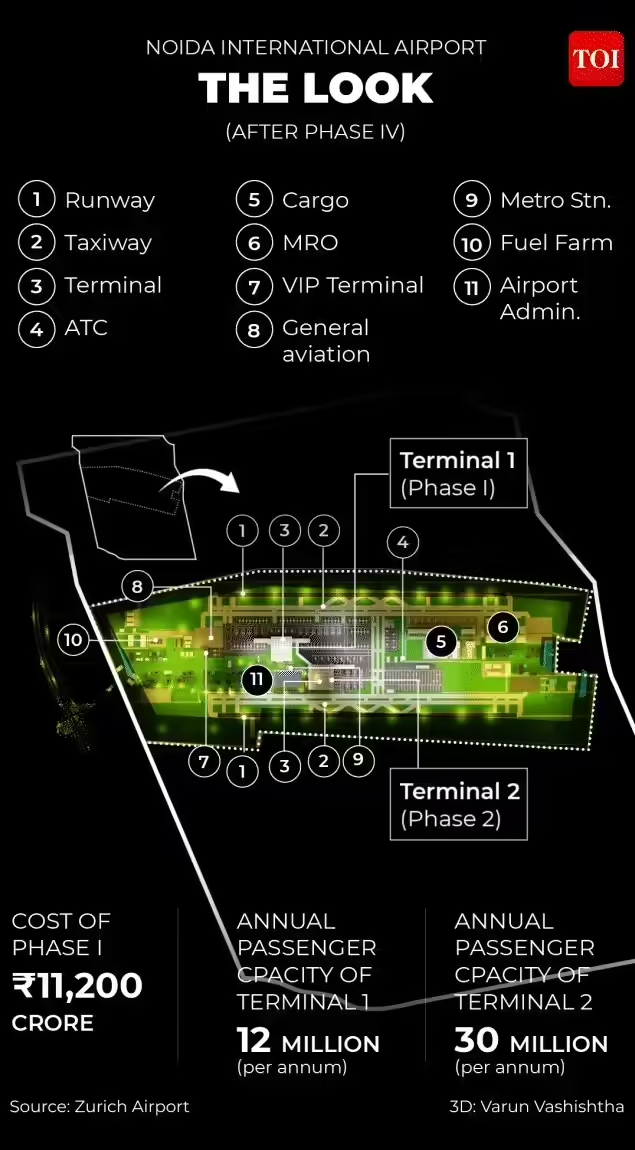
Developed at an investment of around Rs 11,200 crore under a Public–Private Partnership (PPP) model, the project is expected to enhance both regional and international connectivity for the National Capital Region (NCR).The airport is being positioned as a key addition to India’s aviation network, aimed at easing pressure on existing infrastructure while supporting the country’s ambition of becoming a global aviation hub.
Second international gateway for Delhi NCR
Noida International Airport has been developed as the second international gateway for Delhi NCR, complementing the existing Indira Gandhi International Airport, which currently handles the majority of the region’s air traffic.
.
With rising passenger demand and capacity constraints at IGI Airport, the new facility is expected to play a crucial role in distributing traffic more efficiently.Together, the two airports will function as an integrated aviation system, helping reduce congestion, improve connectivity, and enhance the region’s standing among leading global aviation hubs.
Phase I capacity and future expansion plans
Phase I of the airport is designed to handle 12 million passengers per annum (MPPA), providing immediate relief to the region’s growing air travel demand.The project has been planned with scalability in mind, with provisions to expand capacity to 70 million passengers annually in subsequent phases. This long-term vision reflects the government’s strategy to future-proof infrastructure and accommodate sustained growth in air travel.
Modern infrastructure and all-weather operations
The airport features a 3,900-metre runway capable of handling wide-body aircraft, making it suitable for both domestic and international long-haul operations.
.
Equipped with advanced navigation systems such as the Instrument Landing System (ILS) and modern airfield lighting, the facility is designed to support efficient, all-weather, round-the-clock operations. These features ensure operational reliability even under challenging weather conditions.
Cargo hub and logistics ecosystem
In addition to passenger services, the airport includes a comprehensive cargo ecosystem aimed at strengthening logistics and trade.The Multi-Modal Cargo Hub comprises an Integrated Cargo Terminal and dedicated logistics zones, with an initial handling capacity of over 2.5 lakh metric tonnes annually. This capacity is expected to expand significantly to around 18 lakh metric tonnes in the future, positioning the airport as a major cargo and logistics centre in North India.
Dedicated MRO facility to enhance efficiency
A key component of the airport’s infrastructure is a 40-acre Maintenance, Repair and Overhaul (MRO) facility.This dedicated facility is expected to improve operational efficiency by enabling airlines to service and maintain aircraft locally, reducing turnaround times and operational costs. It also strengthens India’s capabilities in aviation maintenance services.
Sustainability and future-ready design
Noida International Airport has been designed as a sustainable and future-ready infrastructure project, with a focus on achieving net-zero emissions.The project incorporates energy-efficient systems and environmentally responsible practices, aligning with India’s broader climate goals. The airport’s development reflects a growing emphasis on green infrastructure in large-scale projects.
Architecture inspired by Indian heritage
Blending modern infrastructure with cultural aesthetics, the airport’s architectural design draws inspiration from traditional Indian elements such as ghats and havelis.This approach aims to create a distinctive identity for the airport while offering passengers a sense of place rooted in Indian heritage.
Strategic location and multi-modal connectivity
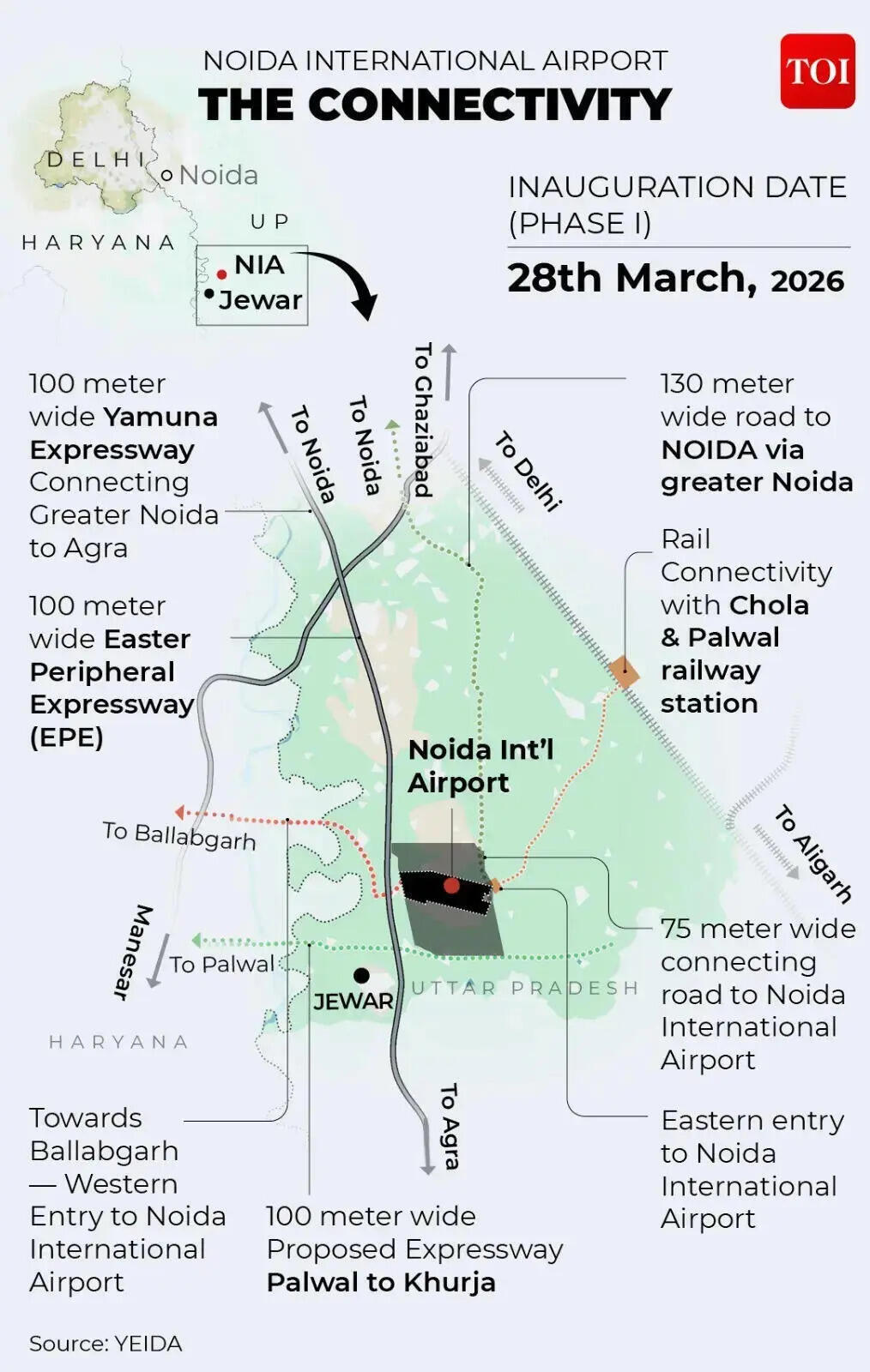
Strategically located along the Yamuna Expressway in Gautam Buddha Nagar district, the airport is planned as a multi-modal transport hub.It will feature seamless integration with road, rail, metro and regional transit systems, ensuring smooth connectivity for passengers and cargo. This connectivity is expected to significantly improve accessibility for travellers across Delhi NCR and neighbouring regions.
Boost to India’s aviation ambitions
The inauguration of Phase I of Noida International Airport is being seen as a major step in strengthening India’s aviation ecosystem.By expanding capacity, improving connectivity, and integrating modern infrastructure with sustainability, the project is expected to play a key role in positioning Delhi NCR as a major global aviation hub while supporting economic growth and regional development

Butter, chocolate, coffee and milk have all seen prices rocket. Tracing back through the story of one particular supermarket staple begins to explain why
Source link

MUMBAI/BENGALURU: The restaurant industry is struggling to run regular operations due to the meagre supplies of LPG cylinders . With the govt’s move to hike commercial LPG allocation to up to 70%, it will take some time before the measure actually translates into sustained supply, executives said. “Supply is still hugely limited and erratic. A feeling of uncertainty looms large,” said Anurag Katriar, founder at Indigo Hospitality. The key question is how quickly this revised allocation will translate into on-ground availability, said Pradeep Shetty, vice-president at Federation of Hotel & Restaurant Associations of India (FHRAI).A walk along Indiranagar’s 12th Main, known for its cluster of independent restaurants, reflects the strain. “It is all hand-to-mouth at this point,” said Nikhil Gupta, who runs brands including The Pizza Bakery and Paris Panini . The move doesn’t directly help the restaurant sector which is still getting 20%-30% of LPG supplies, said Sagar Daryani, co-founder & CEO at Wow! Momo Foods and president at National Restaurant Association of India (NRAI). State-wise, the supply situation varies with some such as Maharashtra, Karnataka, Rajasthan restricting allocation for restaurants, hurting the sector , Daryani said.


Zayn Malik shares personal video message on ‘Mind of Mine’ 10th anniversary

EU Parliament, Council reach deal on major reform of Customs Code
Noida International Airport inauguration: Delhi-NCR gets new airport – all you need to know – The Times of India

-
 Business1 week ago
Flipkart group CFO to leave co amid IPO plans – The Times of India
-
 Business1 week ago
Video: The Effects of High Oil Prices
-

 Fashion1 week ago
China’s textile & apparel exports surge 17% to $50 bn in Jan-Feb 2026
-

 Sports1 week ago
Rating Adidas’ 2026 World Cup away shirts: Argentina, Spain, Mexico and more
-

 Fashion1 week ago
The hidden $1.62 war tax now embedded in every garment you source
-

 Sports1 week ago
American Conference Commissioner Tim Pernetti thanks Trump for Army-Navy game executive order
-
Tech1 week ago
The Corsair 4000D RS PC Case Keeps Your System Cool
-

 Tech1 week ago
‘Uncanny Valley’: Nvidia’s ‘Super Bowl of AI,’ Tesla Disappoints, and Meta’s VR Metaverse ‘Shutdown’