

Tech
Super Bowl Tailgaters on Bad Bunny, Big Tech, and the Big Game


Jim Lockhart, from Boston:
Did you travel to get here today?
Yeah, we came in early on Friday morning. Planes, trains, and automobiles from Logan Airport.
And where are you staying?
The Intercontinental, right in San Fran, downtown.
Beautiful. I’m from San Francisco, born and raised, so I have a lot of hometown pride. Hope you’re enjoying your stay.
Oh, you know what? They’ve done an unbelievable job. San Fran’s been very accommodating. Everybody’s been awesome. Friendly bartenders, waitresses, concierge, Uber guys. Everyone’s been awesome, man. They’ve done a great job. The city stepped up. We went to Alcatraz yesterday, and what an experience. We love it. Golden Gate Bridge, Bay Bridge, all those. It was a great experience.
What are you most excited about?
I’m excited to see the game. I’m excited to win some money on the under.
I was just about to ask you. Yeah, did you place any bets today?
Of course I did. I got bets on everything. The coin toss, the Gatorade, everything. The first pass, everything. I got a mortgage on it.
Did you do any of the prediction markets?
So you can’t bet out here on the Draft Kings. It’s a weird thing. So I had to put all my bets in with the bookie. Offline.
Do you have any thoughts about the potential for ICE agents in the area?
No, I’m from Boston, you know? We love ICE. In my drinks and on the streets. Let’s go. Let’s keep those borders, shut them down.
And do you have any thoughts about Bad Bunny?
I think it’s disgusting that there’s a guy who doesn’t speak English who’s playing at the Super Bowl, at the largest sporting event in America. And there’s a guy singing that doesn’t speak English, and he also said that he was gonna leave America and never do a tour here again. My kids like him and stuff. I don’t even know him good enough to, like, make an opinion, but if he’s gonna be singing in Spanish and stuff, I mean, come on.
Will you be watching the halftime show?
No. I’m gonna walk out.
You’re gonna walk out?
I’m gonna go to the beer line. In protest. I know it’s not gonna make a difference, but, you know?
Have you taken a driverless car since you’ve been here?
We’re trying to get on those, but they kind of make me nervous. You know what I mean? It’s creepy to me to watch a car drive by without somebody driving the car. But we did take those scooters last night. So we were, like, Sons of Anarchy on these scooters last night. It was great. That was so fun.
You have the scooters in Boston, though, right?
We do. I’ve never taken one. We left a bar yesterday—a Patriots bar, a party—and we took them all the way back to our hotel.
If you get a chance to ride in a Waymo before you leave, I think it’s a fun experience for a tourist.












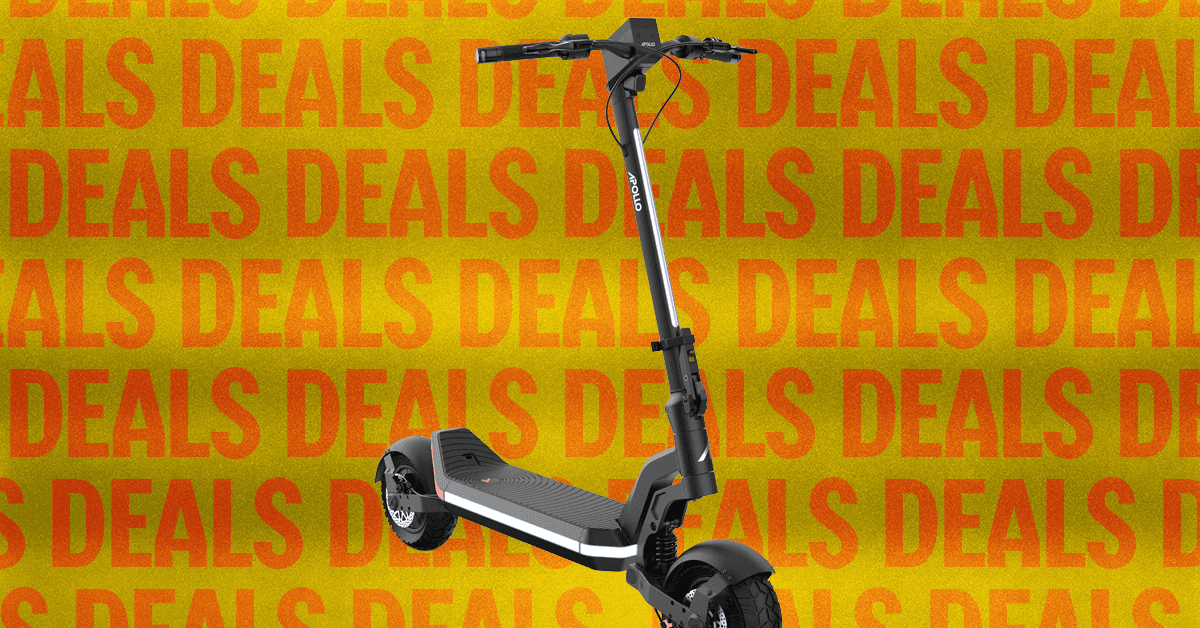
The snow is melting, the days are getting longer, and I can almost smell the springtime ahead. Soon, we’ll be cruising around town on ebikes and electric scooters instead of burning fossil fuels. For now, the weather hasn’t quite caught up, which is great for markdowns. Many of the best electric scooters are still seeing significant discounts. If you’ve been thinking about buying one, now’s the best time: prices are low, and sunny commuting days are just ahead.
Gear editor Julian Chokkattu has spent five years testing more than 45 electric scooters. These are his top picks that are also on sale right now.
Apollo Go for $849 ($450 Off)
This is Gear editor Julian Chokkattu’s favorite scooter. The riding experience is powerful and smooth, thanks to its dual 350-watt motors and solid front and rear suspensions. The speed maxes out at 28 miles per hour (mph), which doesn’t make it the fastest scooter on the market, but it has a good range. (Chokkattu is a very tall man and was able to travel 15 miles on a single charge at 15 mph.) Other Apollo features he appreciates: turn signals, a dot display, a bell, along with a headlight and an LED strip for extra visibility.
Apollo Phantom 2.0 for $2099 ($900 Off)
-
Photograph: Julian Chokkattu
-
Photograph: Julian Chokkattu
-
Photograph: Julian Chokkattu
.png)
.png)

The Apollo Phantom 2.0 maxes out at 44 mph, with plenty of power from its dual 1,750-watt motors. It’s a gorgeous scooter, designed with 11-inch self-healing tubeless tires and a dual-spring suspension system for a smooth riding experience. But with great power comes great weight. At 102 pounds, the Phantom 2.0 is the heaviest electric scooter Chokkattu has tested, so I would only recommend this purchase if you don’t live in a walkup and/or have a garage.
More Discounted Electric Scooters
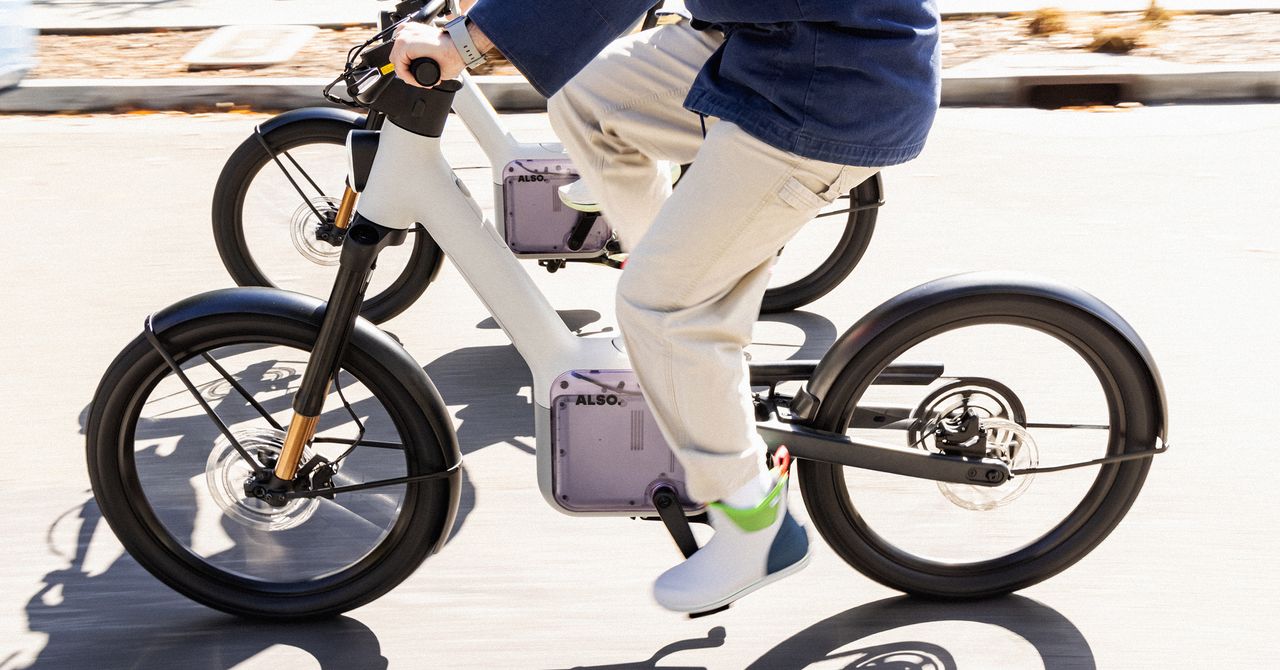
A few months ago, a family came into Pasadena Cyclery in Pasadena, California, for a repair on what they thought was their teenager’s e-bike. “I can’t fix that here,’ Daniel Purnell, a store manager and technician, remembers telling them. “That’s a motorcycle.” The mother got upset. She didn’t realize that what she thought was an e-bike could go much faster, perhaps up to 55 miles per hour.
“There’s definitely an education problem,” Purnell says. In California, bike advocates are pushing a new bill designed to clear up that confusion around what counts as an electric bicycle—and what doesn’t.
It’s a tricky balance. On one hand, backers want to allow riders access to new, faster, and more affordable non-car transportation options, ones that don’t require licenses and are emission-free. On the other hand, people, and especially kids, seem to be getting hurt. E-bike-related injuries jumped more than 1,020 percent nationwide between 2020 and 2024, according to hospital data, though it’s not clear if the stats-keepers can routinely distinguish between e-bikes and their faster, “e-moto” cousins. (Moped and powered-assisted cycle injuries jumped 67 percent in that same period.)
“We’re overdue to have better e-bike regulation,” says California state senator Catherine Blakespear, a Democrat who sponsored the bill and represents parts of North County in San Diego. “This has been an ongoing and growing issue for years.”
Senate Bill 1167 would make it illegal for retailers to label higher-powered, electric-powered vehicles as e-bikes. It would clarify that e-bikes have fully operative pedals and electric motors that don’t exceed 750 watts, enough to hit top speeds between 20 and 28 mph.
“We’re not against these devices,” says Kendra Ramsey, the executive director of the California Bicycle Coalition, which represents riders and is promoting the legislation. “People think they’re e-bikes and they’re not really e-bikes.”
Bill backers say they hope the fix, if it passes, makes a difference, especially for teenagers, who love the freedom that electric motors give them but can get into trouble if something goes wrong at higher speeds. Kids 17 and younger accounted for 20 percent of US e-bike injuries from 2020 to 2024, about in line with the share of the total population. But headlines—and the laws that follow them—have focused on teen injuries and even deaths.
There are no national laws governing e-bike riding. But bike backers spent years moving between states to pass laws that put e-bikes into three classes: Class 1, which have pedal-assist that only works when they’re actually pedaled, and goes up to 20 mph; Class 2, which have throttles that work without pedaling but still only reach 20 mph; and Class 3, which use pedal-assist to move up to 28 mph. Plenty of states and cities restrict the most powerful Class 3 bikes to people older than 16. (In a complicated twist, some e-bikes have different “modes,” allowing riders to toggle between Class 2 and Class 3.)
Last year, researchers visited 19 San Francisco Bay Area middle and high schools and found that 88 percent of the electric two-wheeled devices parked there were so high-powered and high-speed that they didn’t comply with the three-class system at all.
E-bikes have clearly struck a chord with state policymakers: At least 10 bills introduced this year deal with e-bikes, according to Ramsey.
Some bike advocates believe injuries have less to do with e-bikes than “e-motos,” a category that’s less likely to appear in retail stores or the sort of social media ads attracting teens to the tech. These have more powerful motors and can travel in excess of 30 mph. Vehicles, like the Surron Ultra Bee, which can hit top speeds of 55 mph, or Tuttio ICT, which can hit 50, are often marketed by retailers as “electric bikes.” Because so many sales happen online, it can be hard for people, and especially parents, to know what they’re getting into.
OpenAI has fired an employee following an investigation into their activity on prediction market platforms including Polymarket, WIRED has learned.
OpenAI CEO of Applications, Fidji Simo, disclosed the termination in an internal message to employees earlier this year. The employee, she said, “used confidential OpenAI information in connection with external prediction markets (e.g. Polymarket).”
“Our policies prohibit employees from using confidential OpenAI information for personal gain, including in prediction markets,” says spokesperson Kayla Wood. OpenAI has not revealed the name of the employee or the specifics of their trades.
Evidence suggests that this was not an isolated event. Polymarket runs on the Polygon blockchain network, so its trading ledger is pseudonymous but traceable. According to an analysis by the financial data platform Unusual Whales, there have been clusters of activities, which the service flagged as suspicious, around OpenAI-themed events since March 2023.
Unusual Whales flagged 77 positions in 60 wallet addresses as suspected insider trades, looking at the age of the account, trading history, and significance of investment, among other factors. Suspicious trades hinged on the release dates of products like Sora, GPT-5, and the ChatGPT Browser, as well as CEO Sam Altman’s employment status. In November 2023, two days after Altman was dramatically ousted from the company, a new wallet placed a significant bet that he would return, netting over $16,000 in profits. The account never placed another bet.
The behavior fits into patterns typical of insider trades. “The tell is the clustering. In the 40 hours before OpenAI launched its browser, 13 brand-new wallets with zero trading history appeared on the site for the first time to collectively bet $309,486 on the right outcome,” says Unusual Whales CEO Matt Saincome. “When you see that many fresh wallets making the same bet at the same time, it raises a real question about whether the secret is getting out.”
Prediction markets have exploded in popularity in recent years. These platforms allow customers to buy “event contracts” on the outcomes of future events ranging from the winner of the Super Bowl to the daily price of Bitcoin to whether the United States will go to war with Iran. There are a wide array of markets tied to events in the technology sector; you can trade on what Nvidia’s quarterly earnings will be, or when Tesla will launch a new car, or which AI companies will IPO in 2026.
As the platforms have grown, so have concerns that they allow traders to profit from insider knowledge. “This prediction market world makes the Wild West look tame in comparison,” says Jeff Edelstein, a senior analyst at the betting news site InGame. “If there’s a market that exists where the answer is known, somebody’s going to trade on it.”
Earlier this week, Kalshi announced that it had reported several suspicious insider trading cases to the Commodity Futures Trading Commission, the government agency overseeing these markets. In one instance, an employee of the popular YouTuber Mr. Beast was suspended for two years and fined $20,000 for making trades related to the streamer’s activities; in another, the far-right political candidate Kyle Langford was banned from the platform for making a trade on his own campaign. The company also announced a number of initiatives to prevent insider trading and market manipulation.
While Kalshi has heavily promoted its crackdown on insider trading, Polymarket has stayed silent on the matter. The company did not return requests for comments.
In the past, major trades on technology-themed markets have sparked speculation that there are Big Tech employees profiting by using their insider knowledge to gain an edge. One notorious example is the so-called “Google whale,” a pseudonymous account on Polymarket that made over $1 million trading on Google-related events, including a market on who the most-searched person of the year would be in 2025. (It was the singer D4vd, who is best known for his connection to an ongoing murder investigation after a young fan’s remains were found in a vehicle registered to him.)


Just in Time for Spring, Don’t Miss These Electric Scooter Deals

Haaland, Rice, Semenyo: Who is your Premier League Player of the Year?

What the Warner Bros deal could mean for streaming, cinemas and news

-
 Tech1 week ago
A $10K Bounty Awaits Anyone Who Can Hack Ring Cameras to Stop Sharing Data With Amazon
-
 Business1 week ago
US Top Court Blocks Trump’s Tariff Orders: Does It Mean Zero Duties For Indian Goods?
-

 Fashion1 week ago
ICE cotton ticks higher on crude oil rally
-
 Business6 days ago
Eye-popping rise in one year: Betting on just gold and silver for long-term wealth creation? Think again! – The Times of India
-

 Tech1 week ago
Donald Trump Jr.’s Private DC Club Has Mysterious Ties to an Ex-Cop With a Controversial Past
-

 Fashion1 week ago
India’s $28 bn reset: How 5 trade deals will reprice its T&A exports
-

 Sports1 week ago
Brett Favre blasts NFL for no longer appealing to ‘true’ fans: ‘There’s been a slight shift’
-

 Entertainment1 week ago
The White Lotus” creator Mike White reflects on his time on “Survivor