

Business
The true cost of cyber hacking on businesses

 Theo LeggettInternational Business Correspondent
 BBC
BBCThe first day of September should have marked the beginning of one of the busiest periods of the year for Jaguar Land Rover.
It was a Monday, and the release of new 75 series number plates was expected to produce a surge in demand from eager car buyers. At factories in Solihull and Halewood, as well as at its engine plant in Wolverhampton, staff were expecting to be working flat out.
Instead, when the early shift arrived, they were sent home. The production lines have remained idle ever since.
Though they are expected to resume operations in the coming days, it will be in a slow and carefully controlled manner. It could be another month before output returns to normal. Such was the impact of a major cyber attack that hit JLR at the end of August.
It is working with various cyber security specialists and police to investigate, but the financial damage has already been done. Over a month’s worth of worldwide production was lost.
Analysts have estimated its losses at £50m per week.
 Getty Images
For a company that made a £2.5bn profit in the last financial year, and which is owned by the Indian giant Tata Group, the losses should be painful but not fatal. But JLR is not an isolated incident.
So far this year there has been a wave of cyber attacks targeting big businesses, including retailers such as Marks & Spencer and the Co-op, as well as a key airport systems provider. Other high profile victims have included the children’s nursery chain Kido, while last year incidents involving Southern Water and a company that provided essential blood tests to the NHS raised serious concerns about the vulnerability of critical infrastructure and services.
In all, a government run survey on cyber security breaches estimates 612,000 businesses and 61,000 charities were targeted across the UK. So just how much are attacks like these costing businesses and the economy?
And could it be, as one expert analyst puts it, that this year’s major attacks are the result of a “cumulative effect of a kind of inaction” on cyber security from the government and businesses that is now starting to bite?
Pyramid of suppliers affected
What is significant about an attack on the scale of the one that hit JLR is just how far the consequences can stretch.
The company sits at the top of a pyramid of suppliers, thousands of them. They range from major multinationals, such as Bosch, down to small firms with a handful of employees, and they include companies which are heavily reliant on a single customer: JLR.
For many of those firms, the shutdown represented a very real threat to their business.
In a letter to the Chancellor on 25 September, the Business and Trade Committee warned that smaller firms “may have at best a week of cashflow left to support themselves”, while larger companies “may begin to seriously struggle within a fortnight”.
Industry analysts expressed concerns that if companies started to go bankrupt, a trickle could soon become a flood – potentially causing permanent damage to the country’s advanced engineering industry.
Resuming production does not automatically mean the crisis is over either.
“It has come too late,” explains David Roberts, who is the Chairman of Coventry-based Evtec, a direct supplier to JLR, with some 1,250 employees.
“All of our companies have had six weeks of zero sales, but all the costs. The sector still desperately needs cash.”
From Co-op to Marks & Spencer
A recent IBM report, which looked at data breaches experienced by about 600 organisations worldwide found that the average cost was $4.4m (or £3.3m).
But JLR is far from an outlier when it comes to high-profile cyber attacks on an even greater scale. Marks & Spencer and the Co-op supermarket chain this year are estimated to have cost £300 million and £120 million respectively.
Over the Easter weekend in April, attackers managed to gain entry to Marks & Spencer’s IT systems via a third-party contractor, forcing it to take some networks offline.
Initially, the disruption seemed relatively minor – with contactless payment systems out of action, and customers unable to use its ‘click and collect’ service. However, within days, it had halted all online shopping – which normally makes up around a third of its business.
It was described at the time as “almost like cutting off one of your limbs”, by Nayna McIntosh, former executive committee member of M&S and the founder of Hope Fashion.
 Bloomberg via Getty Images
When the Co-op supermarket chain was hit, the same group of hackers claimed responsibility.
It was, they suggested, an attempt to extort a ransom from the company by infecting its networks with malicious software. However the IT networks were shut down quickly enough to avoid significant damage.
As the criminals angrily described it to the BBC, “they yanked their own plug – tanking sales, burning logistics, and torching shareholder value”.
According to Jamie MacColl, a cyber expert at the security research group, the Royal United Services Institute (RUSI), it is no surprise to see major businesses being targeted in this way.
He says it is the result of hackers being easily able to get hold of so-called ransomware (software which can lock up or encrypt a victim’s computer networks until a ransom is paid).
“Historically, this kind of cyber crime… has mostly been carried out by Russian-speaking criminals, based in Russia or other parts of the former Soviet Union”, he explains.
“But there’s been a bit of a change in the last couple of years where English-speaking, mostly teenage hackers have been leasing or renting ransomware from those Russian-speaking cyber criminals, and then using it to disrupt and extort from the businesses they’ve gained access to.
“And those English-speaking criminals do tend to focus on quite high-profile victims, because they’re not just financially motivated: they want to demonstrate their skill and get kudos within this quite nasty sort of hacking ecosystem that we have.”
Weak spots of big business
What makes companies like Jaguar Land Rover and Marks & Spencer particularly vulnerable is the way in which their supply chains work.
Carmakers have a long tradition of using so-called “just-in-time delivery”, where parts are not held in stock but delivered from suppliers exactly where and when they are needed.
This cuts down on storage and waste costs. But it also requires intricate coordination of every aspect of the supply chain, and if the computers break down, the disruption can be dramatic.
Likewise, a retailer like Marks & Spencer relies on a carefully coordinated supply chain to guarantee customers the right quantities of fresh produce in the right places – which similarly proves vulnerable.
 Reuters
“Other industries have this model too: electronics and high-tech, because it’s expensive and risky to hold inventory for a long time due to obsolescence. And then other industrial firms, such as in aerospace, for similar reasons to automotive,” explains Elizabeth Rust, lead economist at Oxford Economics.
“So they’re a bit more vulnerable to supply chain disruption from a cyber attack.”
But she points out this is not the case for industries such as pharmaceuticals, where regulators require firms to hold minimum levels of stock.
Rethinking lean production
Andy Palmer, a former chief executive of Aston Martin who has spent decades working in the manufacturing sector, thinks the lean production models in the car and food industries need a rethink.
It is a major risk, he says, when you have “these systems where everything is tied to everything else, where the waste is taken out of every stage… but you break one link in that chain and you have no safety.
“The manufacturing sector has to have another look at the way it tackles this latest black swan”, he says, referring to an event that is unforeseen but which has significant consequences.
But according to Ms Rust, businesses are unlikely to change the way their supply chains operate.
“Cyber attacks are really expensive… but shifting away from just-in-time management is potentially even more expensive. This is hundreds of millions, possibly, that a firm would have to incur annually”.
She believes the costs would also make it a steep challenge for regulators to demand such changes.
‘The cumulative effect of inaction’
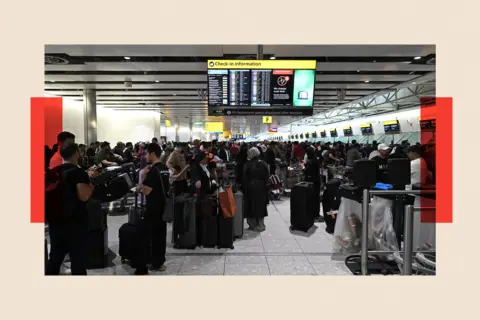
In late September a ransomware attack on American aviation technology firm Collins Aerospace caused serious problems at a number of European airports, including London Heathrow, after it disabled check-in and baggage handling systems.
The problem was resolved relatively quickly, but not before a large number of flights had been cancelled.
Industry sources warn that Europe’s airspace and key airports are so heavily congested that disruption in one area can quickly spread to others – and the costs can quickly add up.
In this instance, the knock-on effects were largely confined to widespread delays and flight cancellations. But it nods to a bigger question of what happens if a hack on critical infrastructure paralyses financial, transport or energy networks, potentially leading to huge economic costs – or worse?
 AFP via Getty Images
“I think the worst-case scenario is probably something affecting financial services or energy provision, because of the potential cascading effects of either of those two”, says RUSI analyst Jamie MacColl.
“The good news is the financial sector is by far the most heavily-regulated sector in the UK for cyber security. And I think it’s quite telling, there’s rarely been a very impactful cyber attack on a Western bank.”
The outlook, were there an attack on the energy sector, is not clear.
A 2015 study by Lloyds Bank, entitled “Business Blackout”, modelled the impact of a hypothetical attack on the US power grid, concluding that economic losses could exceed $1 trillion (£742bn). However Mr MacColl believes that in the UK, there is probably enough spare capacity in the grid to deal with a cyber incident.
More concerningly, Mr MacColl thinks the UK has had “quite a laissez-faire approach to cyber security over the past 15 years”, with the issue given little priority by successive governments.
He believes that this year’s major attacks may be the “cumulative effect of a kind of inaction on cyber security, both from the government and from businesses, and it’s sort of really starting to bite now”.
That inaction, he says, needs to change, with both regulators and large businesses taking more responsibility.
 Anadolu via Getty Images
In July last year the government did announce plans to introduce a Cyber Security and Resilience bill but its passage to becoming law has been repeatedly delayed.
In May, GCHQ’s National Cyber Security Centre published a report warning about the growing impact of cyber threats from hackers using artificial intelligence-based tools. It suggested that over the next two years, “a growing divide will emerge between organisations that can keep pace with AI-enabled threats, and those that fall behind – exposing them to greater risk, and intensifying the overall threat to the UK’s digital infrastructure.
However, what worries Jamie MacColl most are the sorts of attacks we haven’t yet thought to protect against.
“I would be more concerned about the sort of company that is the only business that provides a particular service, but that we don’t really know about, and that isn’t regulated as critical national infrastructure”, he says.
An attack on one of these less glamourous economic pivots, he argues, could have huge ramifications through the wider economy.
“That’s the sort of thing that would keep me up at night,” he says. “The single point of failure that we are not aware of yet.”
Top image credit: PA
BBC InDepth is the home on the website and app for the best analysis, with fresh perspectives that challenge assumptions and deep reporting on the biggest issues of the day. And we showcase thought-provoking content from across BBC Sounds and iPlayer too. You can send us your feedback on the InDepth section by clicking on the button below.

The boss of Tesco has said the supermarket giant will do “whatever we can” to keep down the price of food for shoppers as it warned that uncertainty linked to the Iran war is clouding its outlook for profits.
The UK’s largest supermarket chain said it has not yet seen any impact on product availability or prices, excluding fuel, since the conflict began at the end of February.
However, it said has been in contact with the Government to help plan for a worst-case scenario which could see the ongoing war lead to shortages of carbon dioxide used by the food industry.
Ken Murphy, chief executive of Tesco, told reporters: “We haven’t seen any issues and are in very strong shape.
“We constantly talk to our suppliers and none of our suppliers have raised any issues.”
He also said the retailer does not recognise predictions from the Food and Drink Federation that food inflation could jump above 9% this year if the conflict continues, stressing that it has not yet seen an impact on prices.
Fuel prices have already jumped higher in recent months due to the war between US-Israeli and Iranian forces, which have impacted energy production facilities and shipments through the Strait of Hormuz.
Mr Murphy said: “We are in good shape in our fuel stocks.
“We have seen elevated demand recently but we are still very competitively stocked.”
The boss also added that the retailer has not yet seen any impact from the conflict on customer sentiment in the UK.
It came as Tesco said that profits could dip over the current year as it flagged increased uncertainty linked to the conflict in the Middle East.
The UK’s largest supermarket group reported stronger-than-expected adjusted operating profits of £3.15 billion for the year to February 28, up slightly from £3.13 billion a year earlier.
The retailer said it expects this to be between £3 billion and £3.3 billion over the current financial year, telling shareholders it was “providing a wider range of guidance than we were previously planning” due to uncertainty caused by the Iran war.
Tesco also revealed that sales, excluding VAT and fuel, grew by 4.6% to £66.6 billion for the past year.
The group said on Thursday that it plans to make a further £500 million in cost savings in 2026/27, after surpassing its £535 million savings target last year.
Mr Murphy added: “We are committed to doing whatever we can to help keep down the cost of the weekly shop, and with the conflict in the Middle East creating further uncertainty for consumers and the economy more broadly, that commitment matters more than ever.
“Over the last year, despite cost pressures from new regulation, we have increased our investments in keeping prices low, further improving quality and offering even better service.
“Customers are choosing to shop more with us as a result, leading to our highest market share for over a decade.”
Tesco also announced that it will hand a £65 million award to its staff across its stores, warehouses and customers engagement centres following the latest performance.
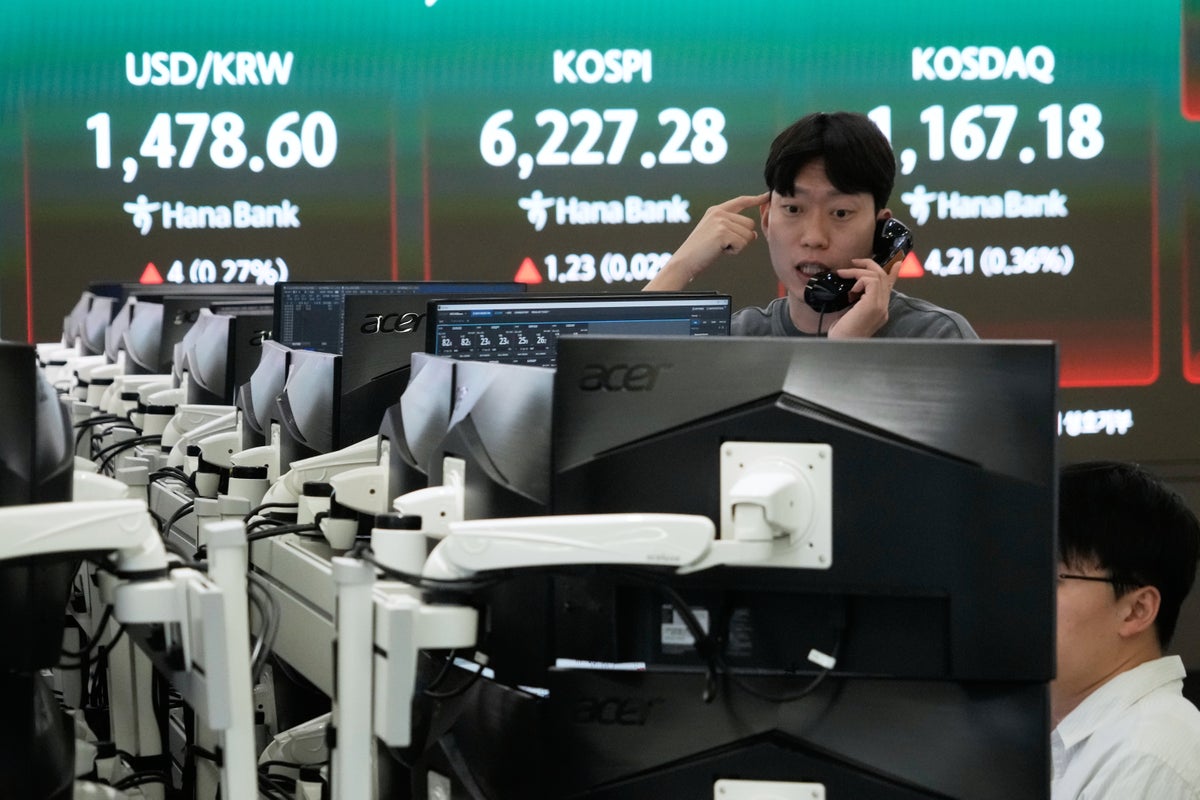
Oil prices remained below $100 a barrel on Friday as Wall Street set another record and Asian stocks headed for a second consecutive week of strong gains, with markets watching for signs that the Iran war ceasefire expiring next week would be extended.
Brent crude fell 1.1 per cent to $98.31 a barrel and US benchmark crude dropped 1.4 per cent to $89.90, after Donald Trump said the next meeting between the US and Iran could take place over the weekend and suggested he was open to extending the two-week ceasefire beyond its expiry next week.
Iran’s UN envoy said Tehran remained “cautiously optimistic” over negotiations with the US. A 10-day ceasefire between Lebanon and Israel also went into effect on Thursday.
Asian markets pulled back on Friday despite Wall Street setting another record the previous session. Tokyo’s Nikkei fell 1 per cent to 58,930 after hitting an all-time high on Thursday. South Korea’s Kospi was 0.6 per cent lower, Hong Kong‘s Hang Seng dropped 1 per cent and the Shanghai Composite edged down 0.1 per cent. Australia’s S&P/ASX 200 lost 0.3 per cent and Taiwan’s Taiex traded 0.5 per cent lower.
MSCI‘s broadest index of Asia-Pacific shares outside Japan remained close to its highest level since 2 March, the first trading day after the Iran war broke out. The index is up 14.5 per cent in April after dropping 13.5 per cent in March, with almost all stock markets now back to pre-war levels.
On Wall Street, the S&P 500 closed 0.3 per cent higher at 7,041 on Thursday, a day after eclipsing its previous all-time high set in January. The Dow Jones Industrial Average rose 0.2 per cent to 48,578 and the Nasdaq added 0.4 per cent to 24,102.
However, the speed of the recovery has surprised some analysts, who warned markets may be underpricing the risks.
“There’s quite a strong contrast between what policymakers and central bankers are saying about the risks that this conflict is creating versus what the market is implying,” Andrew Chorlton, chief investment officer for public fixed income at M&G, told Reuters.
“That seems somewhat complacent. It seems unlikely that there shouldn’t be some additional risk premium priced in, either to growth or to inflation.”
Others pointed to the strait as the critical test for whether the rally could hold.
“I think equity markets are remaining positive and some solid US earnings have helped, but — and it’s a big but — we need to see some concrete evidence that peace is going to last,” Nick Twidale, chief market strategist at ATFX Global, told Reuters.
“A full reopening of the Strait, or we could see some substantial corrections in global stocks in the coming days and weeks.”
The stakes on the energy side are rising. The head of the International Energy Agency warned on Thursday that Europe had “maybe six weeks or so” of jet fuel supplies remaining and that flight cancellations were coming “soon”.
The closure of the Strait of Hormuz has caused the worst oil price shock in history — Brent crude has surged roughly 40 per cent since the start of the Iran war in late February — and prompted the IMF to downgrade its global growth outlook, warning that a prolonged conflict could push the world to the brink of recession.
The US dollar, which had benefited from safe-haven demand in March, has since given up those gains, with the dollar index near its lowest level since 2 March after eight straight sessions of decline. The euro held at $1.1778 while the Australian dollar, considered a risk-sensitive currency, drifted near a four-year high. Gold edged up 0.1 per cent to $4,814.60 an ounce and silver gained 0.4 per cent to $79.04.
Business
Top stocks to buy today: Stock recommendations for April 17, 2026 – check list – The Times of India

Stock market recommendations: Reliance Industries, and Varun Beverages are the top stock recommendations by Bajaj Broking Research for April 17, 2026.Reliance IndustriesBuy in the range of ₹ 1330.00-1350.00
Reliance Industries stock has undergone a corrective phase over the past three months and is currently consolidating near a crucial support zone of ₹1270–₹1300. This technical setup offers a favorable risk-reward profile, positioning the stock for a potential bullish reversal and the next leg of uptrend.This ₹1270–₹1300 range serves as a crucial support area, reinforced by the convergence of multiple technical factors: (a) 61.8% retracement of the previous April 2025-January 2026 up move (1115-1611) (b) 200 weeks EMA placed around 1292, which has historically acted as strong demand area for the stockThe ongoing corrective phase appears to be nearing exhaustion, with price action indicating the potential for a fresh bullish reversal. We anticipate the stock to resume its uptrend and head towards ₹ 1474 levels in the coming quarters being the high of February 2026 and the 61.8% retracement of the recent decline of the last 3 months ₹ 1611-1290.Varun BeveragesBuy in the range of 455-465
The share price of Varun Beverages has generated a breakout above the falling channel containing last 3 months decline signaling strength and offers fresh entry opportunity.The stock has also formed a higher high and higher low signaling resumption of up move after recent corrective decline.We expect the stock to head higher towards 503 levels in the coming weeks being the 80% retracement of the previous decline from 534 to 381.(Disclaimer: Recommendations and views on the stock market, other asset classes or personal finance management tips given by experts are their own. These opinions do not represent the views of The Times of India)


FTAs, PTAs in focus as Sri Lanka aims for growth
Tesco will do ‘whatever it can’ to keep down food prices amid Iran war

Sangeet Syntex showcases innovations at FABTEX 2026

-

 Tech1 week ago
As the Strait of Hormuz Reopens, Global Shipping Will Take Months to Recover
-

 Tech1 week ago
This AI Button Wearable From Ex-Apple Engineers Looks Like an iPod Shuffle
-
 Politics1 week ago
Indian airlines hit hardest after Dubai limits foreign flights until May 31
-

 Entertainment4 days ago
Palace left in shock as Prince William cancels grand ceremony
-

 Sports4 days ago
The case for Man United’s Fernandes as Premier League’s best
-

 Politics1 week ago
Chinese, Taiwanese will unite, Xi tells Taiwan opposition leader
-

 Entertainment6 days ago
Dua Lipa hits major career high ahead of wedding with Callum Turner
-
 Business4 days ago
UK could adopt EU single market rules under new legislation