

Sports
Top 50 USMNT players of 2026, ranked by club form: USMNT Player Performance Index returns

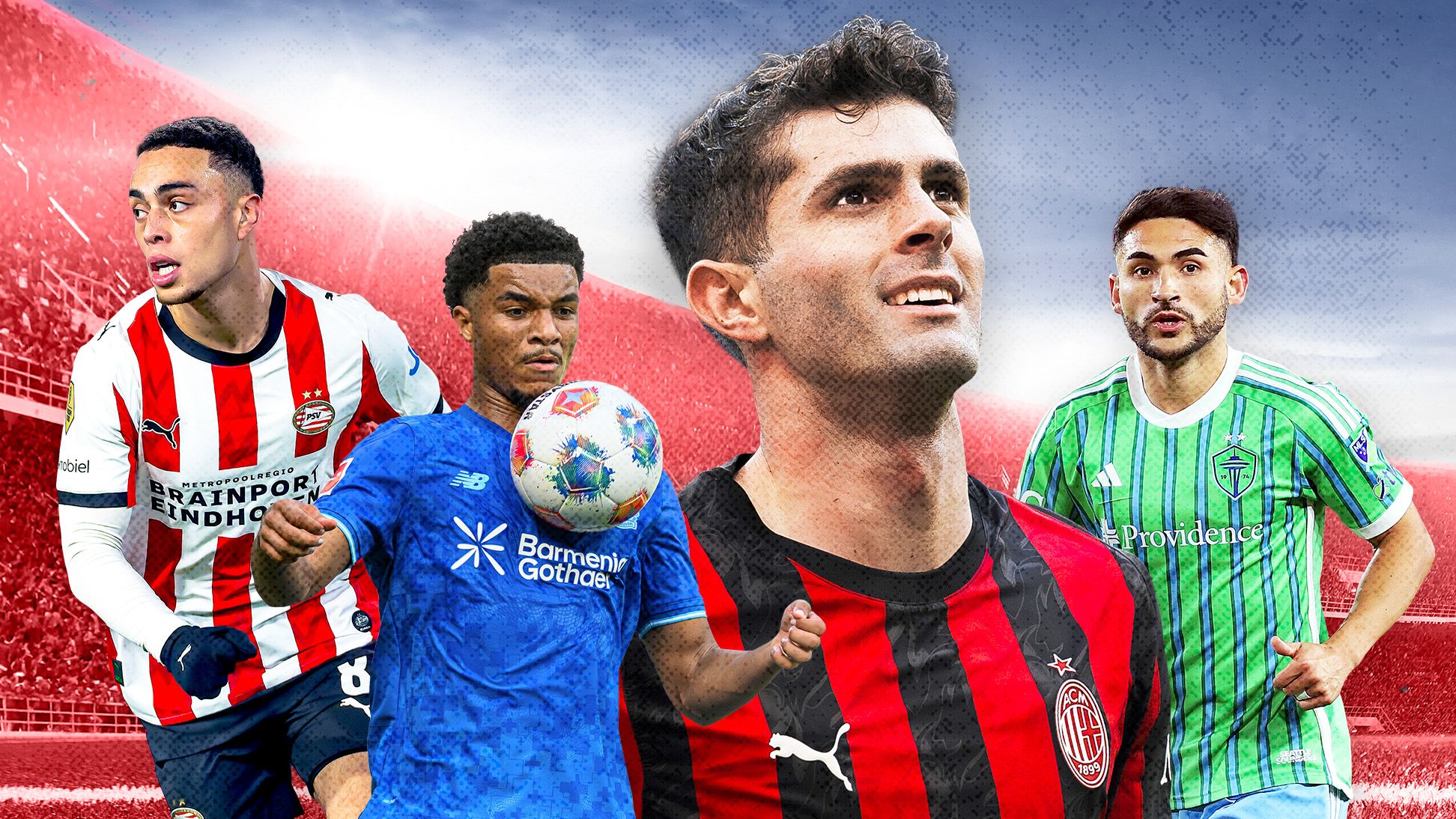
It’s that time of year that only happens once every four years: when every little injury in any professional men’s soccer game has the potential to affect the World Cup.
We’re close enough to the tournament that a serious injury is no longer required to keep a player out. And even a two-month injury carries with it all kinds of worries: Will he be fully fit come June? Will he be in form in June?
A less nihilistic spin on the same idea: We’ve reached the point in the pre-World Cup season where everything that happens in the club game starts to feel connected to the international game.
If a star player falls out of favor: Will he be rusty at the World Cup? If a star player for one of the favorites starts playing poorly: Will he even make the World Cup roster? If an unheralded outsider goes on a hot streak: Can they afford to leave him off the plane? If multiple strikers from the same country score a couple of goals in the same weekend: Can they play together?
All that is true, too, for the U.S. men’s national team.
Gone are the days where the USMNT had a couple of European-based guys who were locks for the roster and then a mishmash of MLS talent. Now, there are Americans starting and starring in every major league and the Champions League, and there are MLSers with legitimate claims to roster spots because of the rising quality of the domestic league. There are lots of questions over who should start and who should make the roster, and there will be a bunch of talented, accomplished players who will be on the bench or who won’t be called up.
So, to get a general sense of how all the eligible Americans are doing, we’re rolling out the latest edition of the USMNT Player Performance Index.
– Ranked: The top 25 manager jobs in soccer, from best to worst
– The USMNT’s top U-21 prospects of 2026, ranked
– How USMNTers endure long MLS offseason to stay World Cup-ready
What is the USMNT PPI again?
We’ve explained how this works enough times already, so we’ll be brief. This ranking is determined by a formula of three inputs: talent, playing time, and team quality.
Talent comes from Transfermarkt’s estimated market value for every player, the best and more straight-forward measure available. Playing time is the percentage of available minutes each player has played for his team in their domestic league. And team quality comes from Opta’s power rankings, which rate every professional club team in the world and offer a uniform way of assessing the quality of every USMNT player’s club team.
The rankings work off a simple premise: If you’re playing a lot of minutes and your team has a high rating, then you’re likely contributing valuable performance to your team.
The only thing that changes across the season is how much we weigh each metric. The farther into the season we go, the less we need to lean on the Transfermarkt value, so for this edition, that takes up only 4% of the rating, while 18% goes to the percent of minutes played and 78% goes to the team rating.
Although MLS starts this weekend, we’re just using last season’s numbers for any MLS-based players. And I’ve also removed any player who hasn’t featured in at least 10% of the minutes for his non-MLS club and any MLS player who didn’t play in at least 60% of his team’s minutes last season.
Major names missing: Patrick Agyemang has been quite productive for Derby County, who are currently in the playoff places in the Championship, but he’s punished by an early-season injury and a low power rating for his team. Alejandro Zendejas, too, has played only about half the minutes for Club América, who are having a down year. Cameron Carter-Vickers has been injured for much of the season and Celtic, too, are having a down year. Josh Sargent hasn’t played for Norwich since early January, as he tries to move to MLS, on top of Norwich sitting 17th in England’s second-tier Championship. And then in MLS, the likes of Diego Luna and Matt Turner miss out because their teams stunk last season.
With that, here is the list we ended up with that ranks Americans by club form…
 1. Chris Richards, center back, Crystal Palace
Consider this an argument for the strength of the Premier League.
Even with their recent struggles, Crystal Palace are still rated by Opta as the 22nd-best team in the world. And Richards, for his part, has been one of the club’s lone constants in a volatile season. He has played 84% of the minutes at center back, and Palace’s goal differential is nearly 0.7 goals better per 90 minutes when Richards has been on the field.
Richards’ development — from Bayern Munich youth prospect to Crystal Palace starter — is the reasonable best-case scenario for any American that moves to one of Europe’s superclubs as a teenager. Chances are they are not going to be good enough to play for Bayern Munich at the senior level, but that doesn’t mean they won’t get valuable development time and still become a starter somewhere else in Europe’s top leagues.
 2. Tyler Adams, midfielder, AFC Bournemouth
I wrote this back in December:
“If I told you that Adams had played nearly 90% of the minutes for a good Premier League team so far this season, you probably would have one of two reactions: (1) Wow, that’s such good news for the World Cup! Or (2) Oh my god, no, he’s going to get hurt before the World Cup.”
I know I can be quite hard on neurotic USMNT fans who think the USMNT should be the most important thing in every American soccer player’s life, even though 90% of their time and their earnings comes from something other than playing for the USMNT. But if you watched Adams excel at Bournemouth and thought, “This is bad” rather than “This is good,” then you were kind of right: He got hurt immediately after the last USMNT PPI was published, and he hasn’t played since the beginning of December.
A quirk of these ratings is that he moved up despite not playing because of the new weighting we use as the season progresses. He, of course, will move down soon if he doesn’t get back on the field.
 3. Weston McKennie, midfielder or forward (?), Juventus
Three years ago, Weston McKennie was in the middle of the worst season of his career — on loan at a soon-to-be-relegated Leeds United team that would fire multiple managers after he arrived at the club. Luciano Spalletti, meanwhile, was guiding a Victor Osimhen-powered Napoli team to one of the more surprising Serie A titles in recent memory.
Fast forward to today and, uh, here’s Spalletti: “McKennie is a perfect central striker. He fights, he’s strong in the air, and he can jump high. He plays to get results because he makes decisions. He would be a perfect striker.”
Spalletti replaced Igor Tudor as Juventus manager in October, and like every Juventus manager before him, he eventually fell in love with the American. With McKennie flourishing for a much-better-than-their-record Juve team, he should be back in the starting XI for the USMNT come this summer. I’m not sure USMNT manager Mauricio Pochettino will actually play him at striker, but this bears repeating: Weston McKennie just started a Champions League knockout match as the center forward for Juventus.
He hasn’t scored or assisted a goal since last year, and he’s still tied for the Serie A lead in non-penalty goals+assists per 90 minutes. He’s not No. 1 in this ranking mainly because he has only played about 40% of the league minutes so far this season.
2:49
Should Mauricio Pochettino be concerned with Christian Pulisic’s form?
The “Futbol Americas” crew breakdown Christian Pulisic’s form in 2026 and debate if it will affect his 2026 World Cup chances.
International soccer breaks your brain and causes you to say things like: Well, I guess he tore his ACL at the right time! Dest missed the Copa América and really hasn’t featured much under Pochettino, but two years has been enough time for Dest to get back up to speed and reintegrate himself as one of the best players on the best team in the Netherlands.
 6. Malik Tillman, attacking midfielder, Bayer Leverkusen
He hasn’t set the world on fire in Germany, but it speaks well of Tillman that his new club fired its manager (Erik ten Hag) after his first couple games with his new team and yet he has continued to be a first-choice player under new manager, Kasper Hjulmand.
There was a world where Tillman moved to the Bundesliga and just couldn’t hack it, but that does not appear to be the case. Establishing yourself as a reliable starter for one of the better teams in Germany is a pretty good place to be as you get ready to head into your peak years.
 7. Tanner Tessmann, midfielder, Olympique Lyonnais
What are midfielders supposed to do? First and foremost: pass the ball and win the ball. Per the grades from Gradient Sports, Tessmann has done those things at an above-average level for the third-place team in Ligue 1.
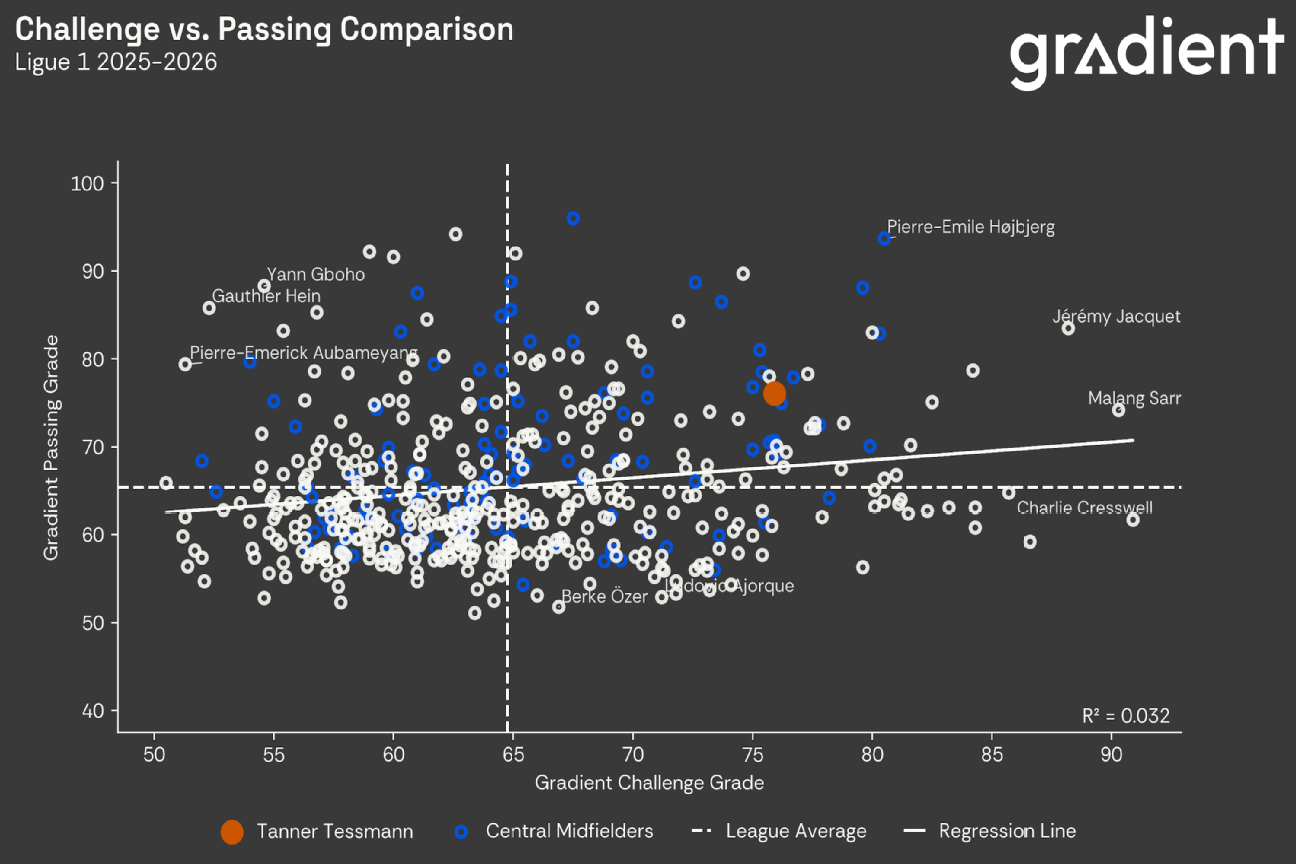
Given that he’s just entering his prime and that Ligue 1 midfielders tend to translate really well to the Premier League and he’s, well, a big dude, might a major-money move to England be in his future?
 8. Johnny Cardoso, midfielder, Atlético Madrid
Hey! He’s playing again! And he has been holding his own, too:
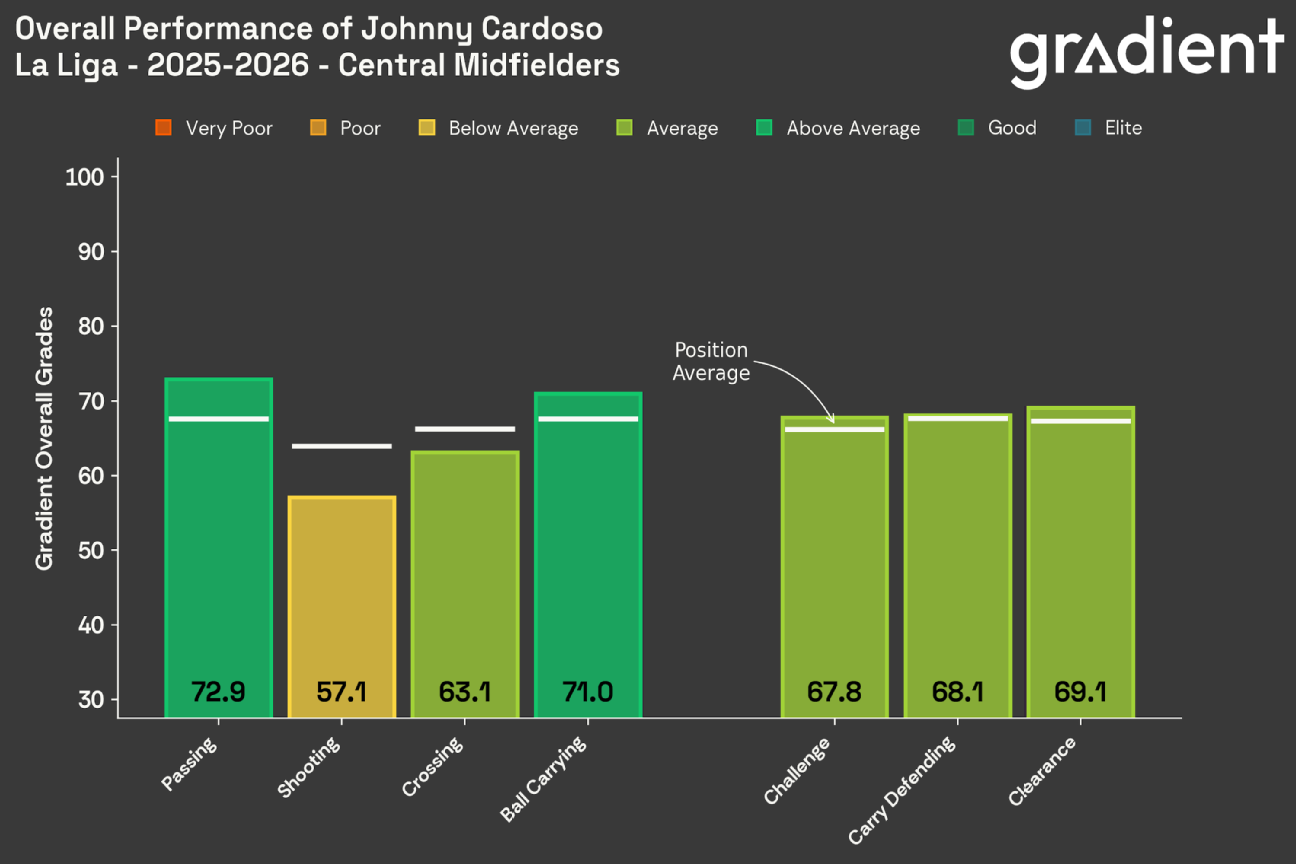
I don’t think we’ll see Cardoso break into the USMNT XI any time soon — the Americans are just too deep in midfield right now, especially if the back three chops off one of the midfield spots from the 4-3-3 — but this should at least put him back into the mix for a spot on the final roster.
He sustained a broken forearm in January — right after he had seemingly established himself as a starter at PSV, finally.
I’d still be quite skeptical over the rumored potential move to Fulham — but only from a Fulham perspective. High-scoring Eredivisie forwards fail in bigger leagues all the time, and most of Pepi’s scoring has come against tired legs, off the bench.
But from a Pepi perspective? He should absolutely move to Fulham, challenge himself and get paid lots of money. The career of a pro soccer player is way too short.
2:56
Did PSV make a mistake by not moving on Ricardo Pepi?
The “Futbol Americas” crew debate if PSV Eindhoven made the right decision by not moving on Ricardo Pepi.
 10. Brenden Aaronson, attacking midfielder, Leeds United
Last time around, Aaronson didn’t look like a Premier League player. He ran around a lot, pressed hard and contributed little else. But back with Leeds for his second shot at England’s top flight, he has nearly matched his total expected goals+assists tally from 2022-23, and there are still 13 games left to play.
Another perfectly timed fullback injury, I guess! After getting hurt at the end of last season, he’s back in Fulham’s lineup.
There are some questions about how he might fit into the USMNT’s new back-three system, but if he’s healthy and finishes the season strong, I’d imagine Pochettino will find a way to get him onto the field.
 12. Timothy Weah, winger, Olympique Marseille
 13. Yunus Musah, midfielder, Atalanta
 14. Alex Freeman, fullback, Villarreal
He made off-the-bench appearances in his past two matches with Villarreal. They’re having a fantastic season (in Spain, at least), so it might be tough to crack the starting lineup, but let’s just take a step back for a second: Alex Freeman hadn’t started an MLS game at this time last year, and now he’s getting minutes for the third-place team in Spain despite only joining the club a couple of weeks ago.
We’re on year four of him scoring fewer goals than his expected-goals totals. That’s worse than it seems, too, as xG is aggregated across all positions, so we’d expect the average forward to score slightly more goals than their xG suggests. He’s only at 0.43 non-penalty goals+assists per 90 minutes in Ligue 1, but maybe ask PSG what they think about his finishing skills?
If we look at all competitions, Balogun’s numbers are pretty much where they were last season: 0.5 goals+assists per 90 minutes. Despite what Spalletti thinks of McKennie, there’s no other American center forward who’s capable of producing at that level across Europe’s Big Five leagues and the Champions League.
Just go back and look at his off-ball movement in those two goals against PSG. No disrespect to Brian McBride, but the USMNT has never had a player like this.
 16. Mark McKenzie, center back, Toulouse
There’s no great way to integrate MLS players into these rankings, and I do think that MLS teams are, on average, rated too highly by Opta’s model. For example, LAFC are rated as roughly equivalent to Serie A’s Fiorentina, even though Transfermarkt puts Fiorentina’s squad value at €247.45 million and LAFC’s at €68.2 million.
At the same time, the opaque-but-sort-of-salary-capped financial structure of MLS doesn’t work quite like the rest of the soccer world does, where most of the talent gets funneled up into the richest and best teams in each league. The assumption that the best players are mostly playing on the best teams doesn’t quite hold.
That said, LAFC were really good last season, and Delgado played a ton of minutes for them. He’s probably a fringe starter for the USMNT if this were 2014.
 18. Aidan Morris, midfielder, Middlesbrough
 19. Cristian Roldan, midfielder, Seattle Sounders
If there’s one MLS player who we can be confident would scale up to better competition, it’s Roldan. He was fantastic for the Sounders at the Club World Cup, and he has been great for the USMNT during the past few windows.
 22. Haji Wright, forward, Coventry City
Coventry are in first place in the Championship, and Haji Wright has the most goals in the Championship. He likely won’t push for a starting spot with the USMNT, but while center forward was a black hole at the last World Cup, it shouldn’t be that way this summer.
24. Jesús Ferreira, forward, Seattle Sounders
 25. Tristan Blackmon, center back, Vancouver Whitecaps
26. Paul Rothrock, attacking midfielder, Seattle Sounders
When I do a Google search for Paul Rothrock’s page on the site FBref, the first result is said page.
The second? It’s a tailored search for the following: “Player Comparison: Paul Rothrock vs. Lamine Yamal vs. Lionel Messi vs. Cristiano Ronaldo vs. Viktor Gyökeres vs. Florian Wirtz.” Good job, Sounders fans.
27. Tate Johnson, fullback, Vancouver Whitecaps
28. Emmanuel Sabbi, winger, Vancouver Whitecaps
 29. Justin Haak, center back, LA Galaxy
30. Jackson Ragen, center back, Seattle Sounders
 31. Joe Scally, right back, Borussia Mönchengladbach
He’s being penalized by the fact that Gladbach stink this season. They’re currently three points off the Bundesliga’s bottom three.
0:58
Joseph Scally finds the back of the net for Borussia Monchengladbach
Joseph Scally finds the back of the net for Borussia Monchengladbach
 32. Matt Freese, goalkeeper, New York City FC
 33. Max Arfsten, wingback, Columbus Crew
 34. Luca Bombino, fullback, San Diego FC
35. Sean Zawadzki, center back or midfielder, Columbus Crew
 36. Roman Celentano, goalkeeper, FC Cincinnati
 37. Noahkai Banks, center back, Augsburg
He should be way higher, but Opta’s skew that rates MLS teams too generously pushes him down the list. Banks has basically been a Bundesliga-average center back — his passing, carrying and challenge grades from Gradient all fall right around league average.
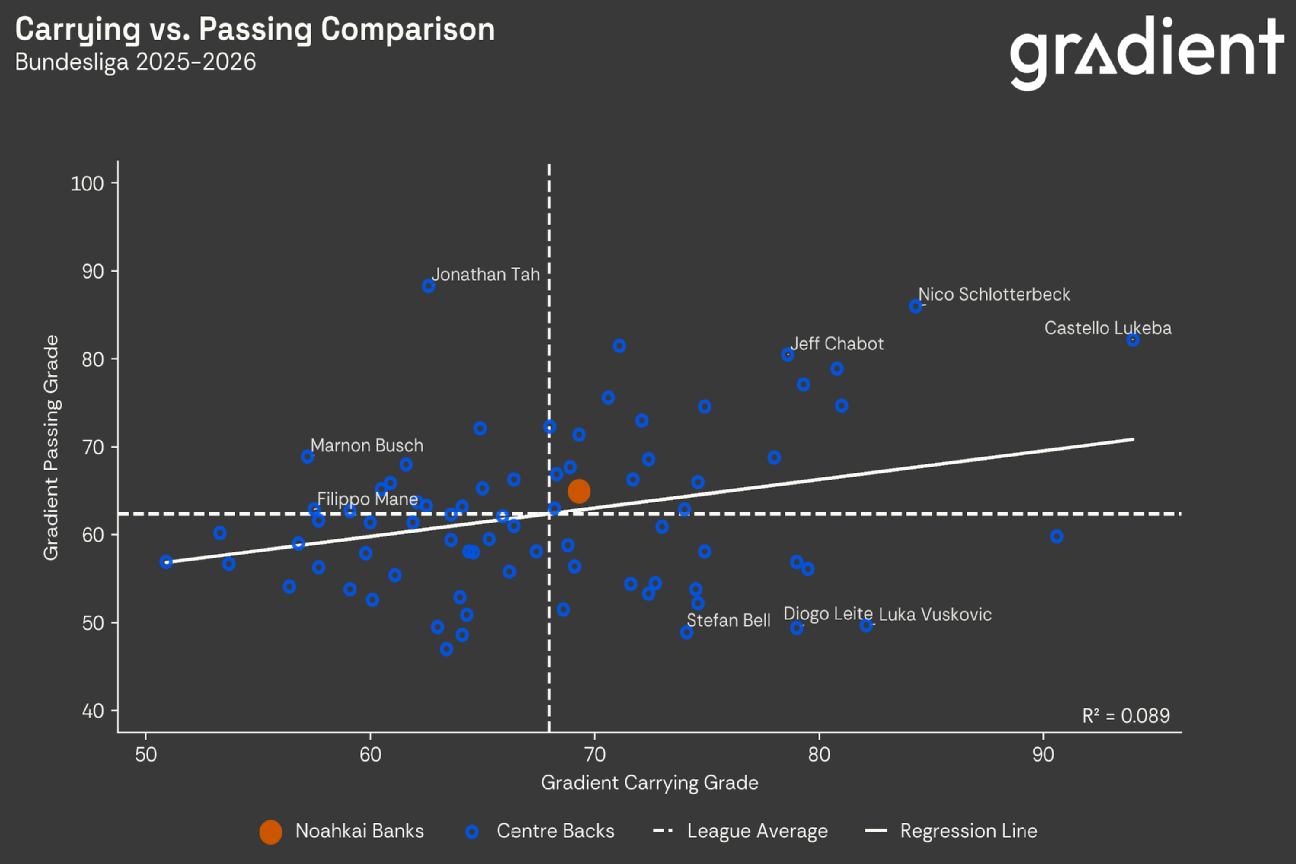
That might not sound or look that exciting — until you realize that he turned 19 in December and most center backs don’t actually reach their primes until they’re 25 or 26.
On top of that, wouldn’t a league-average Bundesliga center back be pretty useful to the USMNT this summer?
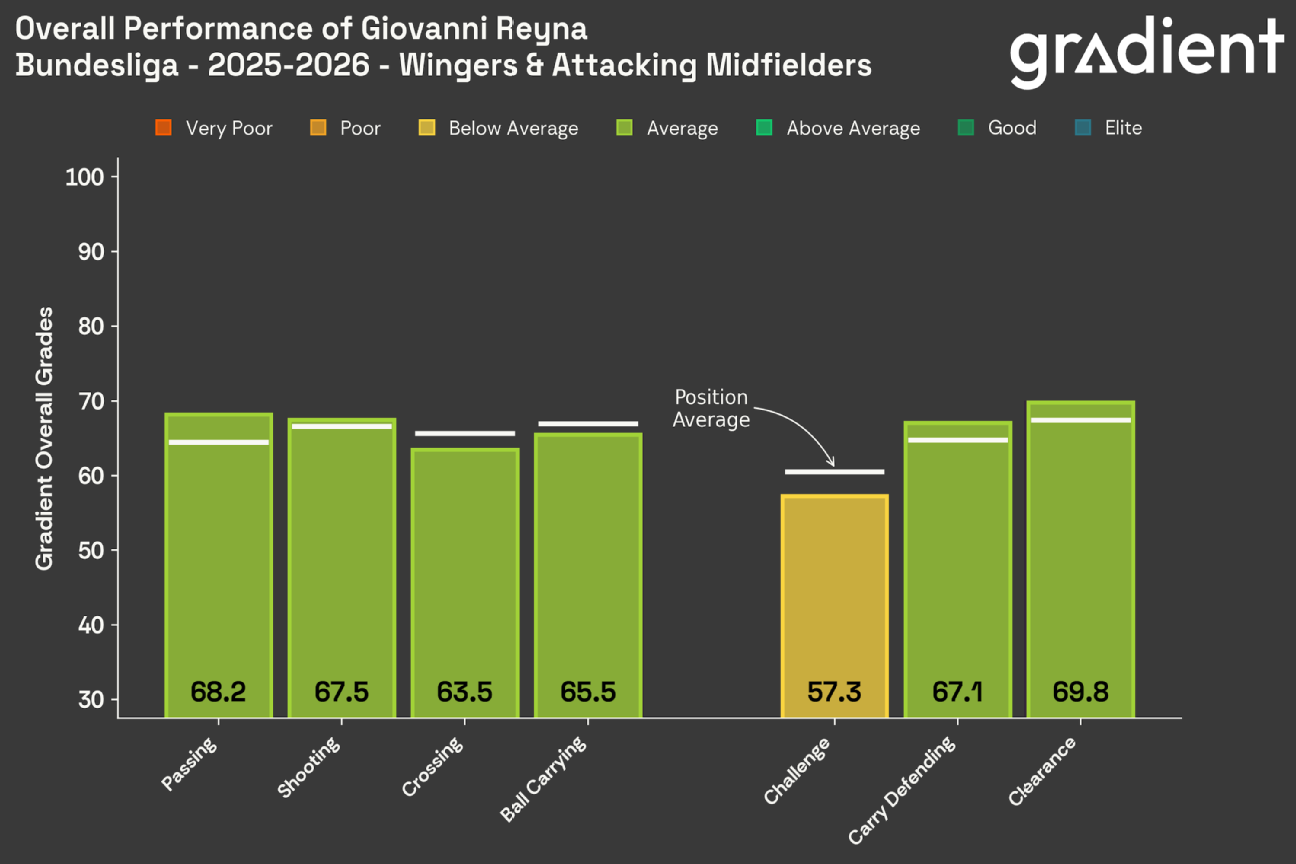
The good: He has started more matches than in any Bundesliga season since 2022-23. The bad: He has only started four matches, and Gladbach, as mentioned earlier, aren’t exactly Manchester City. Reyna has zero goals and zero assists, and Gradient’s more holistic overview of his performance isn’t that much better: You just can’t be an average attacking midfielder who also doesn’t defend. Can he be something more than that for the USMNT? He plays pretty much every minute of every game for the first-place team in Serie B. Although he’s tiny, Gradient’s “athleticism” metric — which controls for player size, sub minutes and position to spit out a 0-100 rating for a player’s combined endurance, explosiveness and speed — puts Busio in the 93rd percentile among midfielders in Italy‘s top two divisions. The USMNT’s midfield is probably too crowded for him to make the World Cup roster, but he’s putting together a really nice season. 38. Patrick Schulte, goalkeeper, Columbus Crew 40. Matko Miljevic, midfielder, Racing Club 42. Miles Robinson, center back, FC Cincinnati
 44. Nathan Harriel, fullback, Philadelphia Union 45. Giovanni Reyna, attacking midfielder, Borussia Mönchengladbach
 46. CJ dos Santos, goalkeeper, San Diego FC 49. Indiana Vassilev, midfielder, Philadelphia Union
 50. James Sands, midfielder, St. Pauli
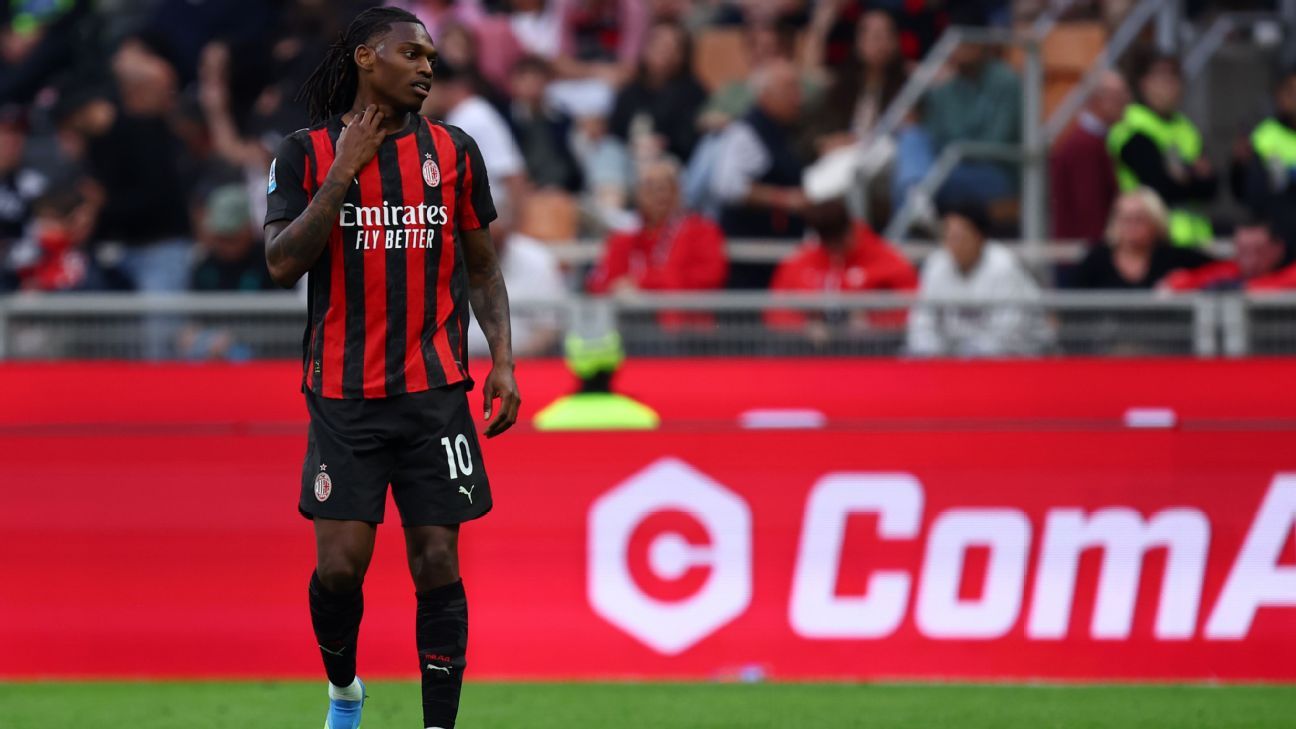
Bayern Munich and Barcelona have seriously considered making a move for AC Milan winger Rafael Leão, while Manchester United, Arsenal and Manchester City are among the clubs keen on Leicester City winger Jeremy Monga. Join us for the latest transfer news and rumors from around the globe.
Transfers home page | Men’s winter grades | Women’s grades
TRENDING RUMORS
– Bayern Munich and Barcelona have seriously considered making a move for AC Milan winger Rafael Leão, as reported by Gazzetta dello Sport. The 26-year-old’s relationship with Milan’s supporters has deteriorated in recent months and an €80 million departure could become a possibility, despite the presence of a €175 million release clause in his contract. Manchester United could be among the Premier League options for the Portugal international, while there is also interest from the Saudi Pro League.
– Around half the teams in the Premier League want to sign Leicester City winger Jeremy Monga, with the list of interested clubs including Manchester United, Arsenal and Manchester City, according to TEAMtalk. Monga, 16, became the second-youngest to play in the Premier League (at 15 years and 271 days old), and the Foxes’ potential relegation to League One has put more focus on his future. While the aforementioned trio of clubs are ready to make a formal offer, Monga’s situation is also reportedly being closely monitored by Liverpool, Tottenham Hotspur, Newcastle United, Aston Villa, Brighton & Hove Albion and Brentford.
– Real Madrid, Barcelona, Manchester United, Chelsea and Manchester City have all shown an interest in Bayern midfielder Aleksandar Pavlovic, but his club have shut down any suggestion of him departing, reports TEAMtalk. Enquiries had been made to the 21-year-old’s camp in recent months, but all interested parties have been told that he is not available. Pavlovic also has no interest in leaving and is fully committed to continuing his development with Bayern.
– Barcelona, Juventus, Galatasaray, Benfica and clubs from the Saudi Pro League are all in the race to sign Manchester City midfielder Bernardo Silva when his contract expires at the end of this season, as reported by Nicolo Schira. Silva, 31, looks set to leave City, which has resulted in a host of clubs showing an interest in signing the Portugal international.
– Bayern Munich aren’t actively looking to sign a center back but still have Chelsea’s Josh Acheampong on their radar, as reported by Christian Falk. Bayern are closely monitoring the 19-year-old’s progress and the situation could develop if Kim Min-Jae leaves in the summer. Even so, the South Korea international would have to go request a move if he is to depart, and is happy with his role in Vincent Kompany’s squad.
EXPERT TAKE
ESPN’s resident scout Tor-Kristian Karlsen looks at Leicester City winger Jeremy Monga.
Monga’s first taste of Premier League football may have initially seemed a showcase, but 12 months on the England U19 international has backed up that early exposure with some proper first-team input.
Primarily used on the right wing, Monga has impressed in the physically demanding Championship this season. He has an excellent first touch that nicely sets up his next action, whether that’s a take-on, step-over(s), sharp body feint, or quick shift of direction that allows him to unbalance defenders in tight spaces. Those highly eye-catching one-vs.-one skills allow him to beat his opponents in varied ways, but one common denominator is the speed with which he executes his actions.
When driving inside, he looks for runners instead of keeping his head down to dribble, but while his decision-making has improved, he is still not able to carry the responsibility of Leicester’s attacking phases on his own.
Off the ball, Monga has shown a decent understanding of space, drifting to receive possession on the turn rather than staying static or sticking to the touchline. That helps him to stay involved and provides passing options when Leicester’s attacking play goes stale.
His defensive tracking is a work in progress and he has to learn how to cope with defensive duels when his tricks don’t come off, but that’s likely to develop with time.
OTHER RUMORS
1:53
Laurens: Chelsea’s project with Rosenior is failing
Julien Laurens slams Chelsea’s performance vs. Manchester City and says he believes Liam Rosenior is out of his depth.
– Bayern Munich winger Michael Olise is still Liverpool’s dream signing to replace Mohamed Salah, although a deal is highly unlikely. (Football Insider)
– Newcastle United left back Lewis Hall has been tracked by Chelsea, Arsenal, Manchester City, Manchester United, Liverpool, Barcelona and Real Madrid. (Caught Offside)
– AFC Bournemouth centrer back Marcos Senesi has turned down offers from Juventus and Borussia Dortmund in recent days, with his priority being to stay in the Premier League. (Nicolo Schira)
– Club Brugge’s Joel Ordonez is among Internazionale’s favored options as they look for a center back, but it would take €35 million-€40 million to sign the 21-year-old. (Calciomercato)
– Celtic and Hull City want to re-sign Andrew Robertson despite Tottenham Hotspur having an understanding with the left back that they will sign him when his Liverpool contract ends. (TEAMtalk)
– Torino are working on a deal to re-sign Matteo Darmian with the defender’s Internazionale contract expiring at the end of the season. (Matteo Moretto)
– Leicester City’s Abdul Fatawu is likely to be the priority option as Leeds United aim to sign a winger. (Football Insider)
– Premier League clubs have shown an interest in Udinese midfielder Arthur Atta after Fulham saw an offer rejected in January. (Nicolo Schira)
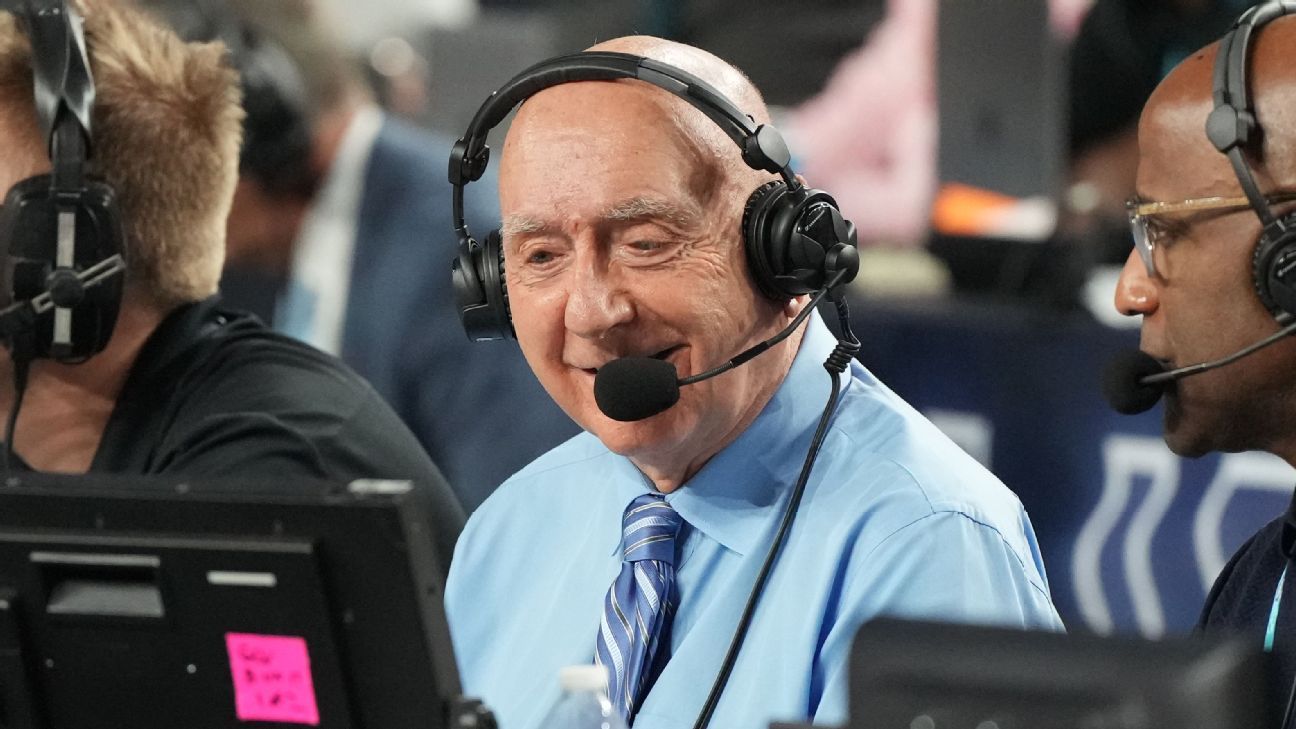
ESPN Hall of Fame broadcaster Dick Vitale has announced he has melanoma in his lung and liver cavity and will be starting immunotherapy soon.
Vitale, one of the preeminent faces of men’s college basketball, has battled four types of cancer in the past few years and most recently underwent surgery in the summer of 2024 after a biopsy of a lymph node in his neck showed cancer.
“I’ve beaten melanoma. I’ve beaten lymphoma. I’ve beaten vocal cord cancer. I’ve beaten lymph node cancer,” Vitale, 86, said in a statement Monday. “I’m four-for-four and I’m fully confident I’m going to make it five-for-five.”
Following a nearly a two-year break to deal with his health, Vitale returned to broadcasting in February of last year after announcing he was cancer-free. He just wrapped up his 46th year covering college basketball at ESPN.
“I am truly overwhelmed by the love, support, prayers and messages I’ve received from so many people” Vitale said. “I’m incredibly blessed to have my family beside me, and my ESPN family — led by Chairman Jimmy Pitaro — has been absolutely terrific. Their support has inspired me to keep fighting and I will do everything in my power to win another battle.
“The best news I can share today is this: I feel fantastic.”
Vitale joined ESPN during the 1979-80 season, just after ESPN’s launch, and called the network’s first major NCAA basketball game on Dec. 5, 1979. He has gone on to call well over 1,000 games, and in September 2024, he was inducted into the Broadcasting+Cable Hall of Fame.
NEWYou can now listen to Fox News articles!
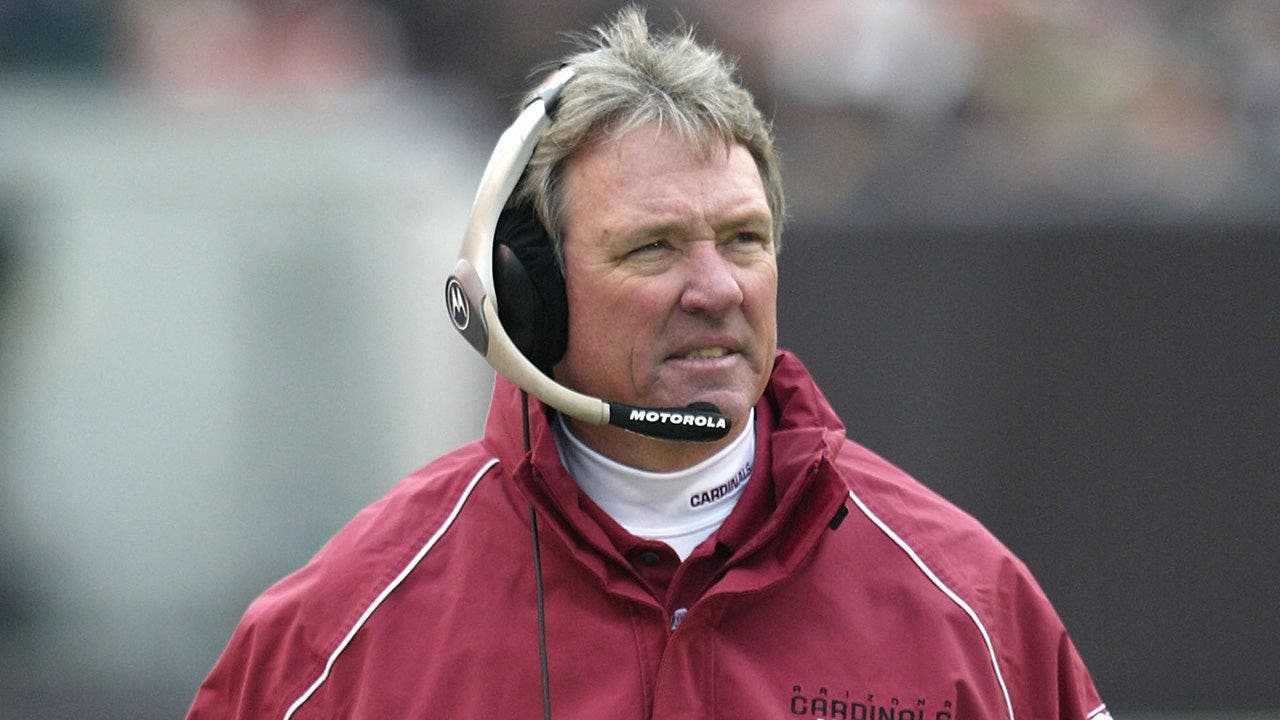
Dave McGinnis, a former Arizona Cardinals head coach and Tennessee Titans assistant coach, died on Monday. He was 74.
The Titans announced the death of McGinnis, who died after being hospitalized for an illness in early March. The Titans’ news release said that he passed away at Ascension St. Thomas Midtown Hospital with his family by his side.
“My heart aches with the loss of Coach Mac, who was so much more than a coach and broadcaster – he was family,” Titans owner Amy Adams Strunk said in a statement.
CLICK HERE FOR MORE SPORTS COVERAGE ON FOXNEWS.COM
Head coach Dave McGinnis of the Arizona Cardinals watches from the sideline during a game against the Pittsburgh Steelers at Heinz Field in Pittsburgh, Pa., on Nov. 9, 2003. The Steelers defeated the Cardinals, 28-15. (George Gojkovich/Getty Images)
Cardinals owner Michael Bidwell also released a statement on McGinnis.
“As Dave often said, he was a ‘ball coach’ through and through, and no one ever filled that role with more passion, enthusiasm and charisma,” Bidwell said. “Coach Mac truly loved the game and everything – and everyone – associated with it, especially his players. He was one of a kind and will be greatly missed.”
McGinnis found himself in an interim head coaching role during the 2000 season with the Cardinals, the team for which he served as defensive coordinator in 1996. He was retained in the head coaching post from 2001-03.
KIM WOOD, NFL’S FIRST FULL-TIME STRENGTH COACH AND WEIGHT-TRAINING PIONEER, DEAD AT 80
In 57 career games, McGinnis went 17-40 with the Cardinals, ultimately being fired after a 4-12 season in 2003.
After he was fired, McGinnis landed with the Titans as a linebackers coach under head coach Jeff Fisher. He would become a mainstay in Nashville, holding that role and eventually being promoted to assistant head coach until 2011.
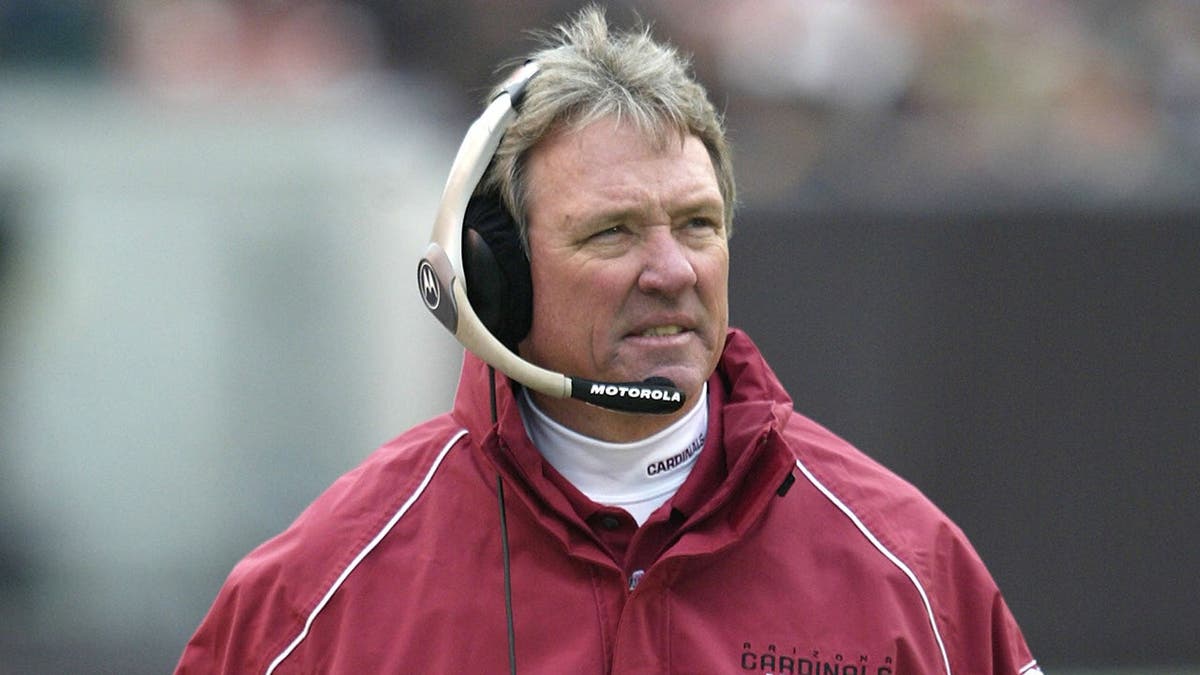
Coach Dave McGinnis of the Arizona Cardinals walks the sideline against the Cleveland Browns at Cleveland Browns Stadium in Cleveland, Ohio, on Nov. 16, 2003. The Browns won the game, 40-6. (Tom Pidgeon/Getty Images)
“Coach Mac gave so much of himself to this organization over the years, and his passion, loyalty and love for the Titans never wavered,” Strunk added. “He cared deeply about the people around him, and that kindness and authenticity left a lasting impact on everyone who knew him. He held a very special place in our family, and his presence in our lives and within this franchise will never be forgotten. We will miss him dearly, and we will always be grateful for the legacy he leaves behind.”
McGinnis’s coaching career began in 1973 when he was an assistant with TCU. He also held posts with Indiana State, Missouri and Kansas State until the 1986 season when he broke into the NFL with the Chicago Bears.
McGinnis served as linebackers coach for Chicago from 1986-95 before getting a promotion with the Cardinals. He also held roles with the St. Louis/Los Angeles Rams before leaving coach after the 2016 campaign.
McGinnis returned to Nashville to join Titans Radio in 2017, where he served as a color announcer for games.
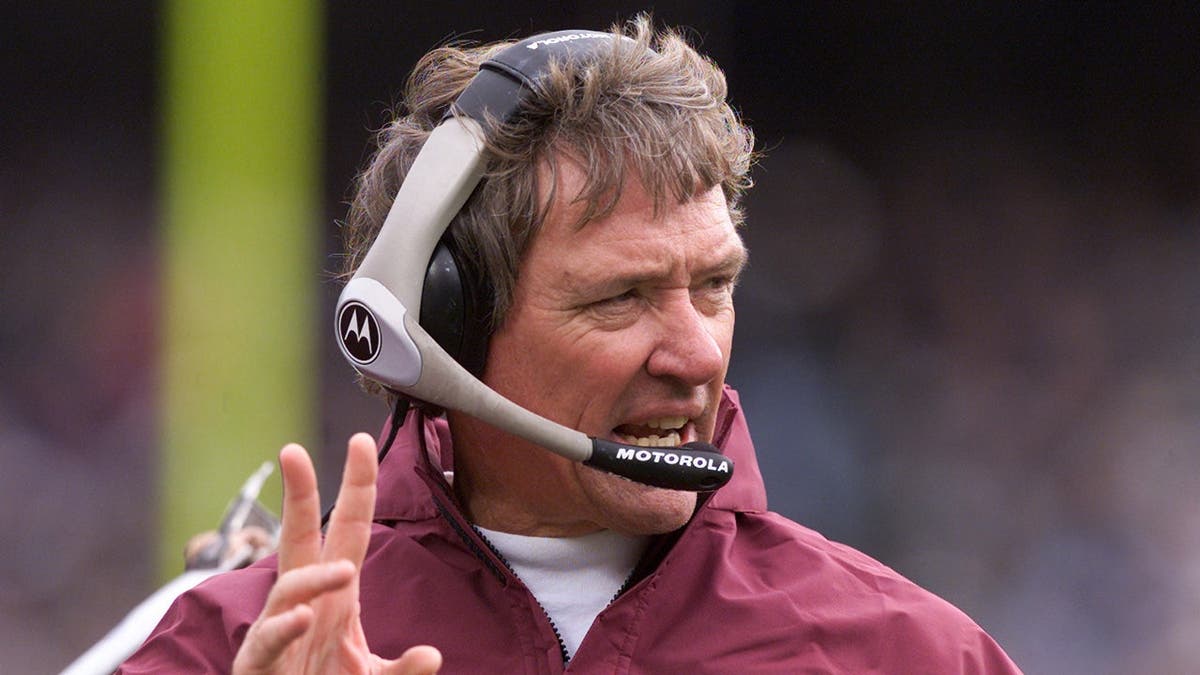
Arizona Cardinals head coach Dave McGinnis stands on the sideline during a game against the Oakland Raiders at Network Associates Coliseum in Oakland, Calif., on Dec. 2, 2001. (Jed Jacobsohn/Allsport)
CLICK HERE TO DOWNLOAD THE FOX NEWS APP
“I love Dave McGinnis, and I don’t know that I’ve met anybody who was created for football, and a football life, more than Coach Mac,” said Burke Nihill, president and CEO of the Titans. “He just loved the game. Obviously, he played it for a long time and coached it for longer, and with everything he has done for us over the years as color commentator and a Titans personality. He lived such a special football life. He was such a special guy.
The Associated Press contributed to this report.
Follow Fox News Digital’s sports coverage on X and subscribe to the Fox News Sports Huddle newsletter.


North India cotton yarn prices steady amid slow demand

Ryan Reynolds ‘unwantedly’ caught in Blake Lively legal mess

Transfer rumors, news: Bayern, Barça eye move for Milan’s Leão

-

 Fashion7 days ago
India’s exports face reset as EU links trade to carbon metrics: EY
-

 Entertainment6 days ago
Queen Elizabeth II emotional message for Archie, Lilibet sparks speculation
-

 Tech6 days ago
As the Strait of Hormuz Reopens, Global Shipping Will Take Months to Recover
-

 Tech6 days ago
Azure customers up in arms over ‘full’ UK South region | Computer Weekly
-

 Entertainment1 week ago
Lamar Odom shocking response to Khloé Kardashian account of his overdose
-

 Sports1 week ago
With Messi goal, Inter Miami open new stadium with dream moment
-

 Tech5 days ago
This AI Button Wearable From Ex-Apple Engineers Looks Like an iPod Shuffle
-

 Fashion6 days ago
CII submits 20-pt agenda to Indian govt to back firms hit by Iran war