

Tech
Toss Your Not-Quite-Clean Clothes on Simone Giertz’s Laundry Chair

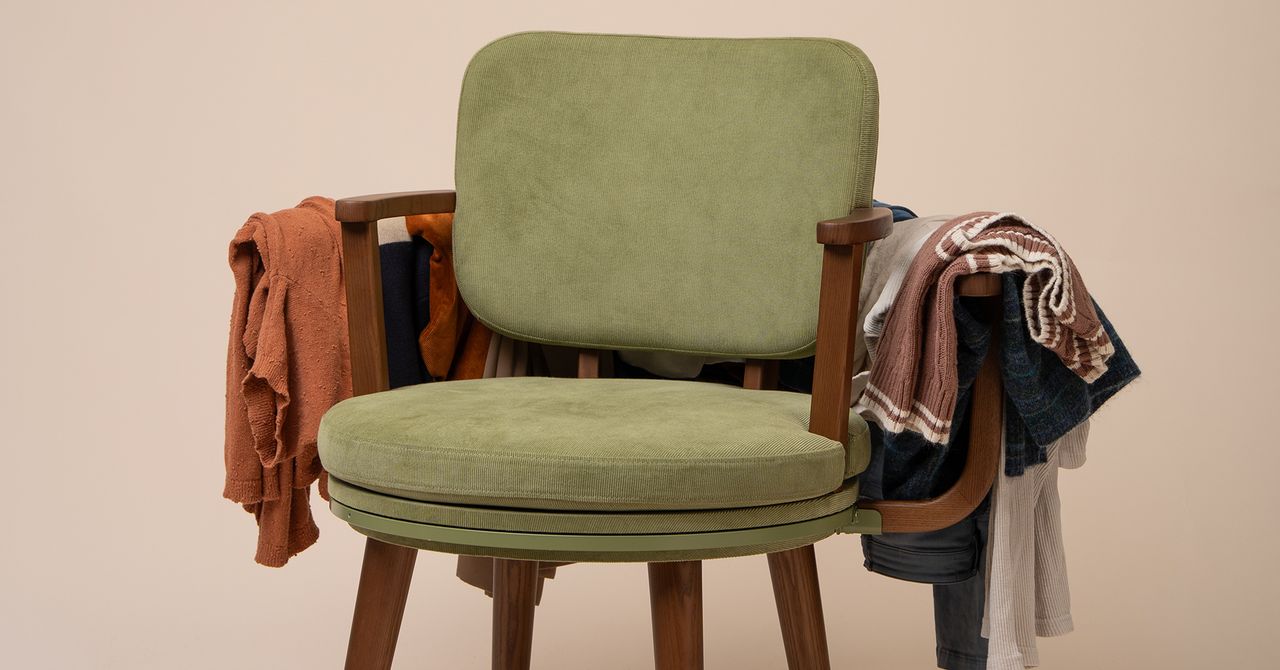
Do you have a shirt or a pair of pants that are not quite clean but also not quite stinky enough to put in the hamper yet? You’ve probably just thrown them on that one chair, right? You know, the chair in your bedroom or living room that seems to have spent more of its life holding a pile of clothes than being a usable seat.
This is the seemingly universal shared experience that inventor and YouTube star Simone Giertz wanted to solve. To do that, she built a Laundry Chair, meant to hold laundry and function as a chair at the same time. No more compromises.
“You can pin it to my reluctance for behavioral change,” Giertz says. “This was one of those projects where I was like, I can’t believe this isn’t already a thing.”
Courtesy of Yetch Studio
After making a video of building the chair more than a year ago, Giertz is turning it into a real product you can buy. It started as a Kickstarter campaign—launched today, and is already funded—though Giertz says the plan was to make the product regardless of whether or not the campaign succeeded. The starting price is $1,100, though there are discounts for backers (the first 50 got free shipping).
“It’s a little bit of a chore thorn in everybody’s side, an eyesore and something you have to deal with,” Giertz says. “I had it on my list of ideas for a long time—something that honored the chair’s job of holding clothes, acknowledged that, and actually tried to do the job properly.”
The Laundry Chair indeed looks like and works as a chair, the key difference being that the arm rests are constructed as a rotatable semicircle. A ball-bearing mechanism lets you smoothly spin the rail around, like a lazy Susan. Turn it around to the front, and you can hang clothes over the bar like you would on a clothesline or drying rack. Spin the rail back around, and the clothes slide neatly behind the chair, out of sight, leaving the seat free. Whether laden with laundry or not, the chair looks quite nice, with a solid hardwood frame and corduroy cotton upholstery.
Giertz has built a following on inventive, wild creations, like a robot that flings soup, or that time she turned a Tesla EV into a pickup truck. Over the years, she shifted her focus from building “shitty robots” to creating genuinely useful projects, like a screwdriver ring or the playfully maddening all-white puzzle with one missing piece.









The UAE has announced that it will leave OPEC and OPEC+ effective May 1, ending a membership that began in 1967—four years before the UAE itself was founded as a country. This signals a turning point in the UAE’s role in global energy.
The government statement, published on state news agency WAM, cited a comprehensive review of the country’s production policy and capacity as the basis for the move, calling it a reflection of “the UAE’s long-term strategic and economic vision and evolving energy profile.”
The decision, it said, is rooted in national interest and a commitment to meeting what it described as the market’s “pressing needs,” a reference to global demand that the UAE believes is being underserved at a time of significant supply disruption.
The statement acknowledged the geopolitical backdrop—including an ongoing conflict with Iran that has severely restricted tanker movements through the Strait of Hormuz, the narrow waterway between Iran and Oman through which roughly a fifth of the world’s crude oil and liquefied natural gas normally passes.
The EIA estimates that Iraq, Saudi Arabia, Kuwait, UAE, Qatar, and Bahrain shut in 7.5 million barrels per day of crude oil production in March, and 9.1 million barrels per day in April.
However, the statement framed the exit as policy-driven rather than reactive, noting that “underlying trends point to sustained growth in global energy demand over the medium to long term.”
A Long-Running Dispute
Tuesday’s announcement was not without precedent. In 2021, the UAE refused to endorse a production agreement to extend cuts to production unless its individual quota was raised, arguing that it had invested billions to expand capacity and was being unfairly constrained by figures set in 2018. A compromise was eventually reached, but the episode exposed a fundamental tension: The UAE wants to produce more, and OPEC’s quota system was holding it back.
That ambition has only grown since. State oil company ADNOC has a stated target of 5 million barrels per day by 2027, up from current production of around 3.4 million. Under the OPEC+ deal, the country has been held to roughly 3.2 million barrels per day while sitting on capacity above 4 million, a gap that made continued membership increasingly difficult to justify.
The UAE stressed that its exit does not signal a retreat from global energy responsibility. It pledged to bring additional production to market “in a gradual and measured manner, aligned with demand and market conditions,” and reaffirmed investment plans across oil, gas, renewables, and low-carbon technologies.
The statement noted that leaving OPEC would make the nation more flexible to respond to market dynamics; OPEC sets limits on production, meaning that the world’s biggest producers can often supply and sell more oil than they actually do.
By limiting supply, the group is able to support prices. This mechanism primarily benefits producers that rely heavily on oil revenue, a description that fits Saudi Arabia far more than the UAE, whose non-oil economy now accounts for roughly 75 percent of GDP.
Market Reaction and Wider Implications
The immediate market response was sharp. Brent crude, the European benchmark, surpassed $100 per barrel for the first time since 8 April, rising to $111 as of writing.
The longer-term implications for OPEC are more consequential. The group has been under strain for months, with several members—including Iraq, Kazakhstan, and the UAE itself—having overproduced their quotas and being required to compensate. The UAE’s departure strips the group of its third-largest producer at a time when supply dynamics are already fragile.
The exit follows Qatar’s departure from the group in 2019, and comes as OPEC prepared for a meeting in Vienna on Wednesday.
“The time has come to focus our efforts on what our national interest dictates and our commitment to our investors, customers, partners and global energy markets,” the statement read.
The UAE said it values more than five decades of cooperation within OPEC and wished the organization success going forward.
This story originally appeared on WIRED Middle East.

The next gadget you put on your head could scan your brain. Neurable, a Boston-based company that embeds its noninvasive brain-scanning technology into hardware to monitor a person’s focus levels, announced on Tuesday that it is transitioning to a licensing platform model. By certifying third parties, Neurable expects its tech to be in a “flood” of consumer gadgets this year and next.
Neurable has until now focused its efforts on a pair of consumer-grade headphones—made in partnership with audio brand Master & Dynamic. It also has a contract with the US Department of Defense to see how its technology can monitor blast overpressure and potentially help diagnose mild traumatic brain injuries in soldiers. With the licensing model, we could see more of Neurable’s tech in everyday head-based wearables.
The headphones use built-in electroencephalography (EEG) sensors to monitor brain waves. That information is sent to a companion app and lets wearers know when they need a “brain break,” nudging them to take a breather before they feel burnt out to maximize productivity. The app also lets users discover their cognitive readiness for the day, their brain age, and other metrics, such as mental recovery, cognitive strain, and anxiety resilience. WIRED staff writer Emily Mullin tested the original headphones in 2024, though she found it difficult to verify the accuracy of Neurable’s algorithms.
Now, HP-owned gaming brand HyperX is releasing a gaming headset with Neurable’s technology, and it’s all about improving human performance while esports gaming. The headphones are purported to help wearers ease into the right state of mind for the best performance. Ramses Alcaide, Neurable cofounder and CEO, tells WIRED that the company has published a white paper showing improved performance among gamers using Neurable’s tech, with reduced response times in first-person shooter games and a small increase in accuracy.
The improvements may sound minor, but milliseconds are precious in the fast-paced world of esports gaming. And Alcaide says it could translate similarly to other fields: It could help a student reduce anxiety before an exam, while athletes could condition their nerves ahead of a race or game. Neurable is hardware-agnostic; Alcaide says it can be embedded in headphones, smart glasses, hats, or helmets. “There’s a whole landscape of technology that touches your head that’s yet to be embedded with our platform,” he says.
He likens it to when Fitbit made the idea of a wrist-worn heart-rate tracker popular. In the beginning, no one knew how fitness wearables would be received, but now no one blinks an eye at one on a wrist. Soon, no one will think twice about brain-scanning tech in headphones—or, at least, that’s the idea. Neurable’s tech is “invisible” in these types of gadgets.
Companies licensing Neurable’s tech can integrate it into existing hardware, Alcaide says, and will control the entire experience from product design to the software experience; these products will be advertised as “Powered by Neurable AI.” The user data still flows to Neurable’s servers for processing, but Neurable sets the data privacy protections. User identifiers are separated from the data, and while partner companies host the user-facing layer, Neurable says it keeps control of the underlying system and data handling. Neurable has previously said its business model is not to sell user data.
“Any time there’s a new transition to technology, there’s always going to be some anxiety,” Alcaide says. “We’ve been very careful when it comes to that transition. We’re protecting the data, being as ethical as possible.”
Neurable is one of many brain-computer interface (BCI) companies in the growing category. Elemind uses EEGs to improve sleep quality, and Sabi wants to turn thoughts into text. Even Apple filed a patent for EEG-sensing AirPods, though they’re not yet available.
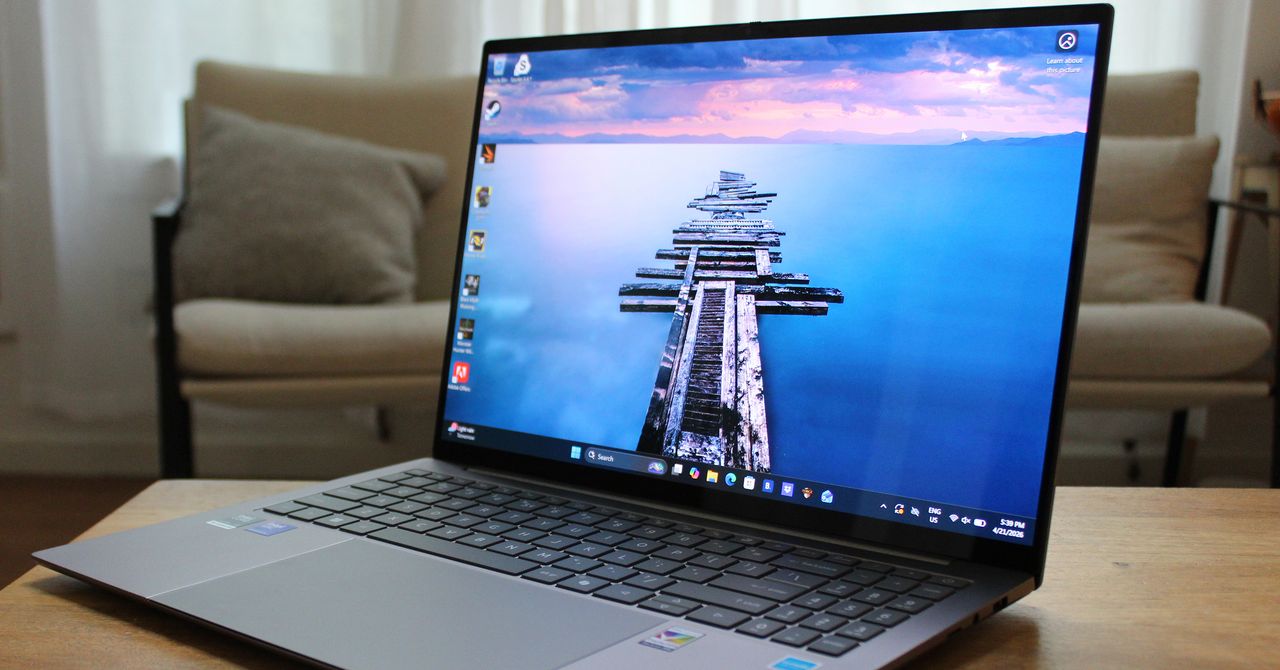
The two USB-C ports are on the left side, alongside HDMI and a USB-A port. The second USB-A port, a microSD card slot, and a headphone jack are on the right. It’s not a nice assortment of ports overall, and I just wish Acer had split the USB-C ports up so the laptop could have a charging port on either side.
Acer is using a top-notch 16-inch OLED touchscreen display on the Swift 16 AI. It has a resolution of 2880 x 1800, a refresh rate of 120 Hz, and color saturation as close to perfect as I’ve seen. Like most OLED laptops, it has a glossy, highly reflective display that maxes out at 315 nits of brightness, according to my testing. It’s nowhere near as bright as IPS or mini-LED displays, but the trade-off in brightness is to achieve that unbeatable contrast that only OLED can deliver.
A Risky Touchpad
Photograph: Luke Larsen
The full-size keyboard and oversized touchpad are definitely the most notable elements of this laptop. The first thing you notice is the touchpad, which is certainly the largest I’ve ever seen. You might think it looks a bit silly, but I always like it when companies leave as little wasted space on a product as possible. I really wanted to like this touchpad, but unfortunately, it could deter most people from buying this product.
On large laptops like the Swift 16 AI, which have a number pad to the right of the keyboard, the touchpad is typically below the keyboard, making it visually off-center. While it’s functional, this arrangement looks odd, and some 16-inch laptops get around this by omitting the number pad entirely. That’s what you see on the MacBook Pro, the Dell XPS 16, and most gaming laptops these days, too.
Rather than removing the number pad, Acer expanded the touchpad and centered it. This makes good use of the space below the keyboard, preserves the number pad, and solves the aesthetic annoyance that typically plagues full-size laptops.


Iran, US allowed Russian superyacht to cross Strait of Hormuz, says source

BCC warns UK govt on economic risks after global shocks

UAE To Exit OPEC After Nearly 60 Years

-

 Sports1 week ago
NCAA men’s gymnastics championship: All-time winners list
-

 Sports1 week ago
WWE WrestleMania 42 Night 2: Live match results and analysis
-

 Politics1 week ago
UK’s Starmer seeks to deflect blame over Mandelson appointment
-

 Fashion1 week ago
UK’s Sosandar returns to profitability amid robust FY26 performance
-

 Entertainment1 week ago
Lee Anderson, Zarah Sultana kicked out of UK Parliament for calling PM ‘liar’
-
 Business1 week ago
How Trump’s psychedelics executive order could unlock stalled cannabis reform
-
 Business7 days ago
Us-India Trade Talks: US–India trade deal: Where do talks stand & what to expect – explained – The Times of India
-
 Business1 week ago
Exercise to test response to offshore energy threat involving vessels and drones