

Politics
Trump says Israel ‘beyond very close’ on Gaza peace deal

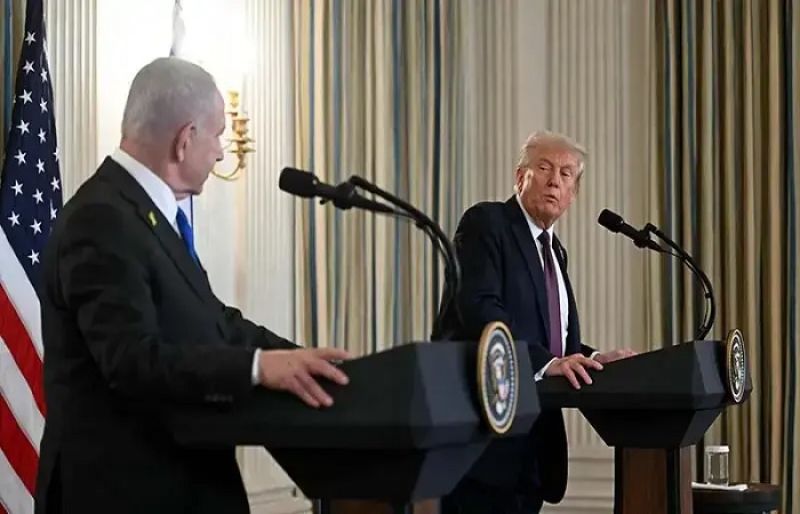

Addressing a press conference, Trump said this was a “big, big day”.
“Things that have been going on for hundreds of years, thousands of years … at minimum, we are very, very close and beyond very close,” Trump said, thanking Netanyahu for his role in the peace process. “We worked well together, and have with many other countries, which is how this situation gets solved.”
Trump said that he was aiming for peace in the Middle East at large, not just the Gaza Strip. He added that he and Netanyahu discussed issues like Iran, the Abraham Accords and ending the Gaza conflict.
“This is part of the bigger picture, which is peace in the Middle East … let’s call it ‘eternal’ peace in the Middle East,” he said.
“After extensive consultation with our friends and partners throughout the region, I am formally releasing our principles for peace,” Trump announced, adding that people “have really liked” them.
“These are done with total consideration and working with the nations we are talking about,” he added. “I want to thank the leaders of many Arab and Muslim nations for their tremendous support in developing the proposal, as well as our allies in Europe.
“The prime minister and the field marshal of Pakistan they were with us right from the beginning. In fact they just put out a statement that they fully believe in this pact,” Trump stated. “They back this 100 per cent.”
The US president also thanked Netanyahu for agreeing to the plan and for “trusting that if we work together, we can bring an end to the death and destruction” in the region.
“If accepted by Hamas, this proposal calls for the release of all remaining hostages immediately, but in no case, more than 72 hours,” Trump said. “The hostages are coming back.”
Trump said this means “an immediate end to the war itself”.
“Under the plan, Arab and Muslim countries have committed … to demilitarise Gaza quickly, decommission the military capabilities of Hamas and all other terror organisations and we are relying on the countries we named and others to deal with Hamas and I’m hearing Hamas wants to get this done too.”
Trump added that as part of the agreement, “terror infrastructure”, including tunnels and weapon production facilities, would be dismantled and local police forces would be trained in the Gaza Strip.
“Working with the new transitional authority in Gaza, all parties will agree on a timeline for Israeli forces to withdraw in phases … no more shooting hopefully,” Trump stated.
“Arab and Muslim nations need to be allowed a chance of fulfilling these commitments of dealing with Hamas. They are the one group I have not dealt with,” he added. “If Hamas rejects the deal, which is always possible … I have a feeling that we’re going to have a positive answer, but if not, as you know Bibi (Netanyahu) you have my full backing to do what you have to do.
The US president emphasised that ultimately, the goal is to eliminate any danger in the reason, which he attributed to Hamas.
“To ensure the success of this effort, my plan calls for the creation of a new international oversight body,” he said, calling it the ‘Board of Peace’ and stating that it would be led by Arab leaders, Israel and Trump himself.
“We’re going to do it right, we’re going to put leaders from other countries on and leaders who are very distinguished,” Trump said. “One of the people who wants to be on the Board is the UK former prime minister Tony Blair.”
Trump said there would be more leaders and that their names would be announced in the coming days.
He added that the World Bank would be charged with training and recruiting a new government made up of Palestinians and “highly qualified experts from around the world”.
“Hamas and other terror organisations will play no role in the governance of Gaza, at all,” he stated.
Earlier, Netanyahu expressed regret for an Israeli attack in Doha to Qatar’s leader in a three-way call with Trump, the White House said.
It added that Netanyahu also expressed regret for Israel violating Qatari sovereignty and “affirmed that Israel will not conduct such an attack again in the future“.
“The leaders discussed a proposal for ending the war in Gaza, prospects for a more secure Middle East, and the need for greater understanding between their countries,” the White House said before a news conference with Trump and the Israeli prime minister.
Ahead of formal consultations, Trump had told his guests: “We have to get the hostages back … This is the group that can do it, more than any other group in the world … so it’s an honour to be with you.”
Trump had also emphasised the urgency of ending the conflict: “We had 32 meetings here, this is the one that’s very important because we’re gonna end something that should’ve probably never started.”
According to reports from Israel’s Channel 12 and US-based Axios, President Trump’s plan envisions an immediate ceasefire and the release of hostages, both alive and deceased; phased Israeli withdrawal from Gaza Governance excluding Hamas but incorporating the Palestinian Authority; deployment of Arab and Muslim peacekeepers to secure Gaza and facilitate Israel’s withdrawal; and internationally supported reconstruction and transition programmes funded by regional contributors.
These details were reportedly shared with Israeli Prime Minister Benjamin Netanyahu, though Israel did not draft the plan.
Meanwhile, White House Press Secretary Karoline Leavitt said in a TV interview that Israel and the Palestinian group Hamas are “very close” to reaching an agreement on a framework deal to end Israel’s bombardment in Gaza and ensure lasting peace in the Middle East.
Leavitt, speaking on Fox News’ ‘Fox and Friends’ programme, said Trump would discuss a 21-point peace plan with Netanyahu at the White House later today.
“Trump will speak to leaders in Qatar, who have served as intermediaries with Hamas,” she said.
“To reach a reasonable deal for both sides, both sides have to give up a little bit and might leave the table a little bit unhappy, but that is ultimately how we are going to end this conflict,” Leavitt added.
PM Shehbaz welcomes Gaza plan
Prime Minister Shehbaz Sharif welcomed US President Donald Trump’s plan to bring the Israeli invasion of Gaza to an end.
His statement came in a post on X as the US president greeted Israeli Prime Minister Benjamin Netanyahu at the White House for talks on the US-led peace plan. Before the meeting, Trump had told reporters he was “very confident” that there would be peace in Gaza.
Asked if all parties were on board with his 21-point plan, he repeated, “very confident”.
Meanwhile, PM Shehbaz posted on X: “I welcome President Trump’s 20-point [sic] plan to ensure an end to the war in Gaza.
“I am also convinced that durable peace between the Palestinian people and Israel would be essential in bringing political stability and economic growth to the region,” the PM wrote.
He added, “It is also my firm belief that President Trump is fully prepared to assist in whatever way necessary to make this extremely important and urgent understanding to become a reality.”
PM Shehbaz also lauded “Trump’s leadership and [his] special envoy Steve Witkoff for their efforts in bringing an end to the nearly two-year-long conflict”.
“I also strongly believe that the implementation of the two-state proposal is essential to ensure lasting peace in the region,” he added.
Earlier in the day, he also spoke to Pakistani journalists in London, where he spoke about Trump’s meeting with Muslims leaders on Gaza in New York last week.
The meeting on the sidelines of the 80th United Nations General Assembly had brought together leaders from Pakistan, Saudi Arabia, Qatar, the United Arab Emirates, Egypt, Jordan, Turkiye, and Indonesia.
During his interaction with journalists in London today, PM Shehbaz “a very constructive discussion took place” at the meeting. He added, “As a result of that meeting, very soon, a positive result may come that in the Gaza war, there may be a ceasefire.”
In less than two years, Israel’s onslaught on Gaza has killed at least 65,549 people and wounded 167,518, besides displacing millions from their areas. Earlier this month, UN investigators said that Israel was committing genocide in Gaza in a bid to “destroy the Palestinians”, accusing Israel’s prime minister and other top officials of incitement.
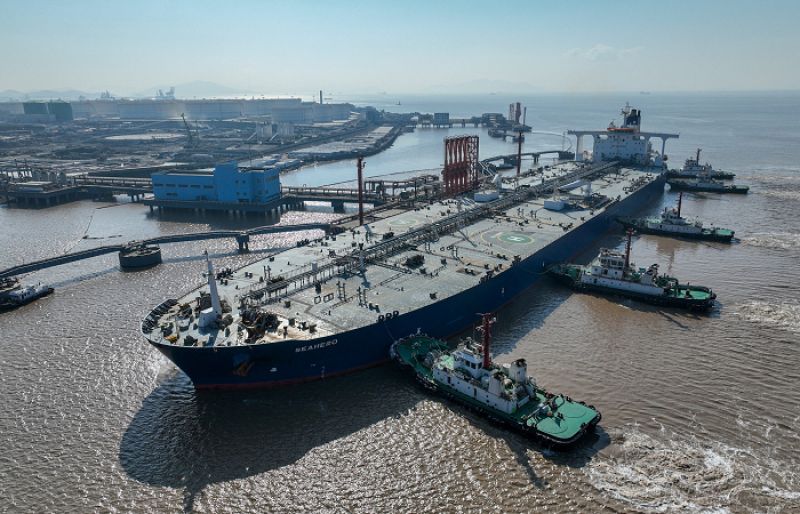

Global oil markets jolted sharply higher on Monday as escalating conflict in the Middle East triggered fears of supply disruption, pushing Brent crude up 13% to above $82 per barrel.
Futures for US benchmark West Texas Intermediate (WTI) also jumped nearly 10%, crossing $70 per barrel in early Asian trading.
The surge follows US and Israeli military strikes on Iran, raising concerns that shipping through the strategically vital Strait of Hormuz could be severely disrupted.
Strait of Hormuz in Focus
Roughly 20% of global oil supply transits through the Strait of Hormuz, making it one of the world’s most critical maritime chokepoints.
While the route is not completely shut, analysts warn that insurance premiums and security risks may effectively halt most commercial traffic.
Major shipping companies have already begun suspending fleet movements through the area.
According to analysts, a prolonged disruption could remove between 8 to 10 million barrels per day (bpd) from global supply — a shock that strategic reserves may struggle to offset.
Amena Bakr of Kpler said oil prices could climb toward $90 per barrel if tensions persist, while some experts caution that prices above $100 cannot be ruled out.
Inflation and Growth Risks
The spike in crude prices has reignited fears of global inflation, particularly in energy-importing nations.
Higher fuel, shipping, and transportation costs could ripple across supply chains, slowing economic growth.
The last time oil crossed $100 per barrel was during the early stages of the Russia-Ukraine war, triggering prolonged inflationary pressure worldwide.
Economists warn that if tensions continue for an extended period, the global economy could face renewed recessionary risks.
US Political Implications
Analysts note that elevated energy prices could pose political challenges in the United States ahead of mid-term elections, especially as President Donald Trump had pledged lower fuel costs.
Some observers suggest Iran may seek to keep crude prices elevated to exert economic pressure amid ongoing geopolitical confrontation.
What’s Next?
Markets remain highly sensitive to developments in the Gulf.
Any formal closure of the Strait of Hormuz or direct targeting of energy infrastructure could push prices significantly higher.
For now, volatility is expected to remain elevated as traders assess the risk of prolonged supply disruption.
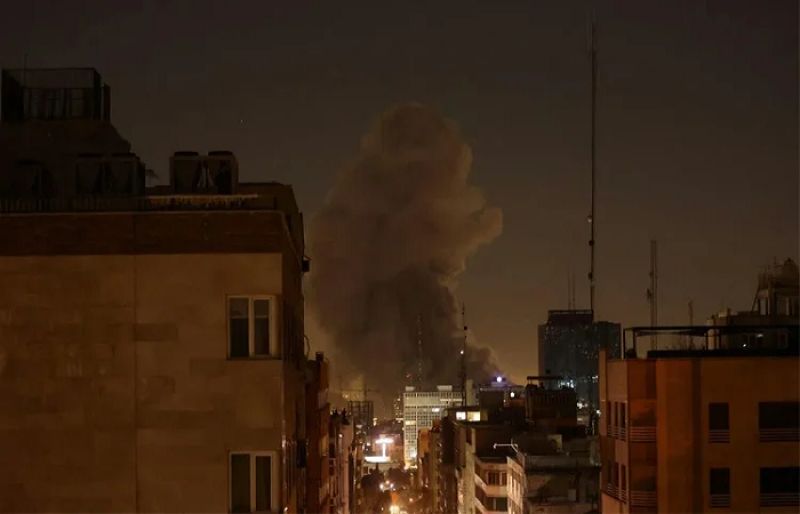

Iranian forces fired missiles and drones across the Middle East, killing people in Israel and the United Arab Emirates, in retaliation for the conflict that began Saturday with the death of Iran’s supreme leader, Ayatollah Ali Khamenei.
The US military expanded targets across Iran on Sunday and said it destroyed the headquarters of the Islamic Revolutionary Guard Corps (IRGC), the elite unit tasked with preserving the theocracy in place since 1979.
“The IRGC no longer has a headquarters,” US Central Command said in a statement.
The Israeli military said it was carrying out “large-scale strikes” in the heart of Tehran on Monday and also bombing across Lebanon against Hezbollah, the armed Shiite Muslim movement closely tied to Iran’s Islamic republic.
An AFP journalist heard explosions in Beirut. Hezbollah, which was weakened by an earlier Israeli offensive, said in a statement that it had fired rockets and drones at Israel “in retaliation for the pure blood” of Khamenei.
Trump and Israeli Prime Minister Benjamin Netanyahu have urged the overthrow of the government in Iran, the sworn foe of Israel and the United States since the 1979 Islamic revolution toppled the pro-Western shah.
Trump, speaking to the New York Times, said the United States and Israel could keep up the level of attacks for four to five weeks.
“It won’t be difficult. We have tremendous amounts of ammunition,” he said, adding he had a shortlist of three unnamed people he favoured to lead Iran after the war.
In a video address, Trump urged Iranian security forces “to lay down your arms and receive full immunity or face certain death.”
“It will be certain death,” he repeated. “It won’t be pretty.”
The Pentagon said that three US service members were killed in the operation and five seriously wounded in the operation it has called “Epic Fury.”
“Sadly, there will likely be more before it ends,” Trump said.
“But America will avenge their deaths and deliver the most punishing blow to the terrorists who have waged war against, basically, civilization.”
Trump, who campaigned denouncing foreign interventions, has done little to explain the case for war to the US public.
Hakeem Jeffries, the top Democrat in the House of Representatives, said the soldiers’ deaths were the result of a “reckless decision” and that there was no threat to “justify this type of pre-emptive military strikes.”
Attacks across Middle East
Iran’s surviving leaders have voiced defiance and said that counter-attacks were justified as self-defence.
In Israel, an Iranian missile attack killed at least nine people and injured dozens more in the central city of Beit Shemesh, after a death the previous day near Tel Aviv.
Three people were also injured on one of the main roads of Jerusalem.
President Masoud Pezeshkian, whose elected role is subordinate to that of the supreme leader, called Khamenei’s killing a “declaration of war against Muslims.”
“Iran considers it its legitimate duty and right to avenge the perpetrators,” Pezeshkian said.
Ali Larijani, the powerful head of Iran’s Supreme National Security Council, warned: “Today we will hit them with a force that they have never experienced before.”
Israel and the United States attacked Iran weeks after authorities ruthlessly crushed mass protests, killing thousands.
The demonstrations, initially sparked by economic anxiety but also including calls for greater social freedoms, were considered one of the most serious threats to the religious state.
Trump called on Iranians to rise up and said, “America is with you.”
Reza Pahlavi, the son of the late shah, cautioned Iranians to stay vigilant in the face of air strikes and await the right moment to return to the streets.
But he also urged “nightly chants” against the Islamic republic.
Cheers were heard as some Iranians celebrated reports of the death of Khamenei, but after state media confirmed his killing, pro-government demonstrations also formed, chanting “Death to America!”
Iran named Ayatollah Alireza Arafi to join Pezeshkian on an interim leadership council to lead the country while a permanent successor is found for the supreme leader.
Mixed support
While many in the Iranian diaspora cheered Khamenei’s death, anger was seen on the streets of Iran’s neighbor Pakistan where officials said 17 people were killed and protesters tried to storm the US consulate in Karachi.
World leaders have given a mixed reaction to the attack, which came two days after Iran and the United States held talks on Tehran’s nuclear program.
British Prime Minister Keir Starmer said Sunday that he would let the United States use UK bases for “defensive” strikes but that his country — a steadfast partner in the US-led wars in Iraq and Afghanistan — “will not join offensive action now.”
Iran’s first retaliatory strikes on Saturday hit all the Gulf states apart from mediator Oman.
On Sunday, Oman’s commercial port of Duqm was hit by two drones, injuring a foreign worker, the Oman News Agency said.
Three ships were also attacked in the Strait of Hormuz on Sunday after Iran had previously declared the strategic waterway was closed, sending global oil prices spiking.
The Revolutionary Guards claimed to strike the aircraft carrier USS Abraham Lincoln, but the Pentagon said the “missiles launched didn’t even come close.”
Trump said that US military strikes had sunk nine Iranian naval vessels and partially destroyed its navy headquarters.
Iran’s retaliatory strikes in the Gulf have killed at least four people and wounded dozens of others.
Inside Iran, the Red Crescent in its last toll issued on Saturday evening said that strikes had killed 201 people and injured hundreds more.
Iran’s judiciary confirmed that Ali Shamkhani, a top adviser to Khamenei, and General Mohammad Pakpour, the head of Revolutionary Guards, were among those killed.
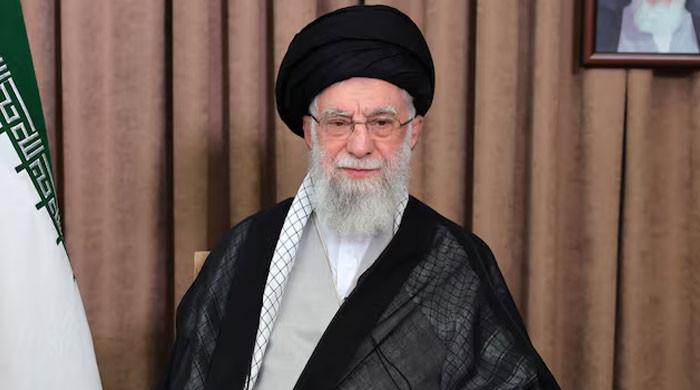
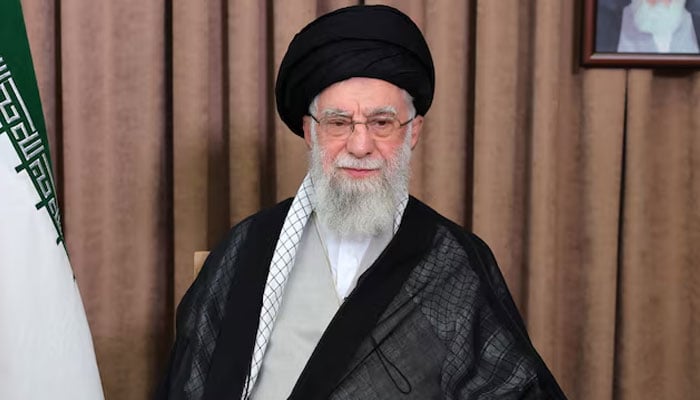
Iran’s Supreme Leader Ayatollah Ali Khamenei was martyred in US and Israeli strikes, state media confirmed, as another wave of attacks hit the country on Sunday.
Several countries, global bodies and prominent groups responded to the assassination of Iran’s supreme leader, urging de-escalation.
Pakistan
Prime Minister Shehbaz Sharif on Sunday denounced the targeting of Iran’s supreme leader in joint strikes by the United States and Israel, saying such actions were a “violation of the norms of international law”.
In a post on X, PM Shehbaz said that it was an age-old convention that the heads of state or government should not be targeted.
“Pakistan also expresses concern over the violation of the norms of international law. It is an age-old convention that the heads of state/government should not be targeted.”
Russia
President Vladimir Putin described Khamenei’s killing as a “cynical murder” that violated “all standards of human morality and international law”.
“Please accept my deep condolences in connection with the murder of the Supreme Leader of the Islamic Republic of Iran, Seyed Ali Khamenei, and members of his family, committed in cynical violation of all norms of human morality and international law.”
China
China said it “strongly condemns” the United States and Israel’s assassination of Iran’s Supreme Leader Ayatollah Ali Khamenei, calling again for a halt to military actions.
The assassination was “a serious violation of Iran’s sovereignty and security, a trampling on the aims and principles of the UN Charter and the basic norms of international relations”, Beijing’s foreign ministry said in a statement.
“China firmly opposes and strongly condemns this,” it added, calling for an “immediate halting of military operations”.
Malaysia
Malaysian Prime Minister Anwar Ibrahim on Sunday “unreservedly” condemned the killing of Iran’s Supreme Leader Ali Khamenei.
“I unreservedly condemn the killing of Iranian Supreme Leader Ali Khamenei. This act places the Middle East on the edge of grave and sustained instability. I extend my condolences to the Islamic Republic of Iran and to the Iranian people at this profoundly difficult momen,” wrote
Indonesia’s Ulema Muslim Clerical Council
“The Indonesian Ulema Council (MUI) expressed its deepest condolences for the death of Iran’s Supreme Leader, Ali Khamenei, as a result of the Israeli-American attack on February 28.
“The United States, which is playing a central role in managing the Palestinian conflict through the BoP (Board of Peace), faces a major question: is this strategy truly aimed at a just peace, or is it actually strengthening an unequal security architecture and burying Palestinian independence? Therefore, the MUI urges the Indonesian government to revoke its membership from the BoP.”
North Korea
North Korea condemned the US and Israeli strikes as an “illegal act of aggression”.
The attacks “constitute a thoroughly illegal act of aggression and the most vile form of violation of sovereignty in their nature”, a Ministry of Foreign Affairs spokesperson said, according to state media.
Iranian president
“The martyrdom of the Supreme Leader at the hands of Israel and the criminal America was a great disaster for our country… America and Israel should know that it will bring them nothing but embarrassment.”

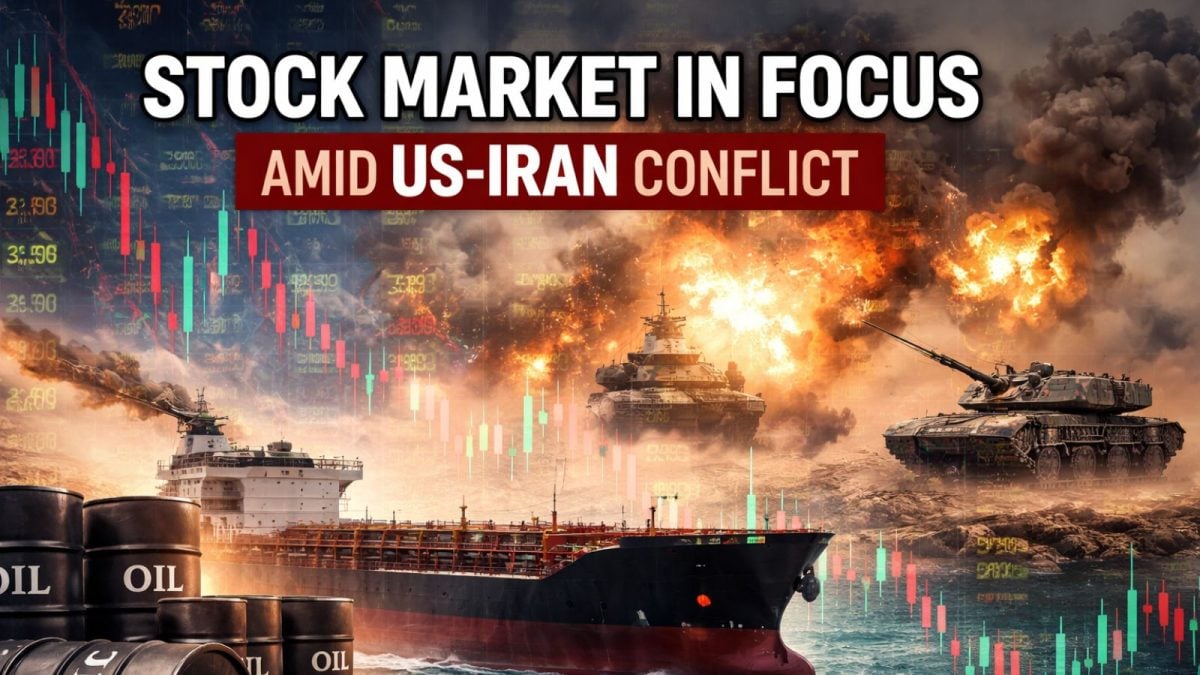
Stock Market News Live Updates: Sensex Down Over 1,000 Points, Nifty Below 24,900; India VIX Jumps Nearly 20%

New Zealand’s apparel imports ease down to $101 mn in Jan 2026

Katie Price laughs off pregnancy claims as Lee Andrews remains overseas

Pakistan carries out precision strikes on seven militant hideouts in Afghanistan

Eye-popping rise in one year: Betting on just gold and silver for long-term wealth creation? Think again! – The Times of India

These Cheap Noise-Cancelling Sony Headphones Are Even Cheaper Right Now

-
 Politics1 week ago
Pakistan carries out precision strikes on seven militant hideouts in Afghanistan
-
Business1 week ago
Eye-popping rise in one year: Betting on just gold and silver for long-term wealth creation? Think again! – The Times of India
-
 Tech1 week ago
These Cheap Noise-Cancelling Sony Headphones Are Even Cheaper Right Now
-

 Sports1 week ago
Kansas’ Darryn Peterson misses most of 2nd half with cramping
-

 Sports1 week ago
How James Milner broke Premier League’s appearances record
-

 Entertainment1 week ago
Viral monkey Punch makes IKEA toy global sensation: Here’s what it costs
-
 Entertainment1 week ago
Saturday Sessions: Say She She performs "Under the Sun"
-
Sports1 week ago
Mike Eruzione and the ‘Miracle on Ice’ team are looking for some company