

Fashion
Two Chinese-backed firms to set up textile-garment units in Egypt

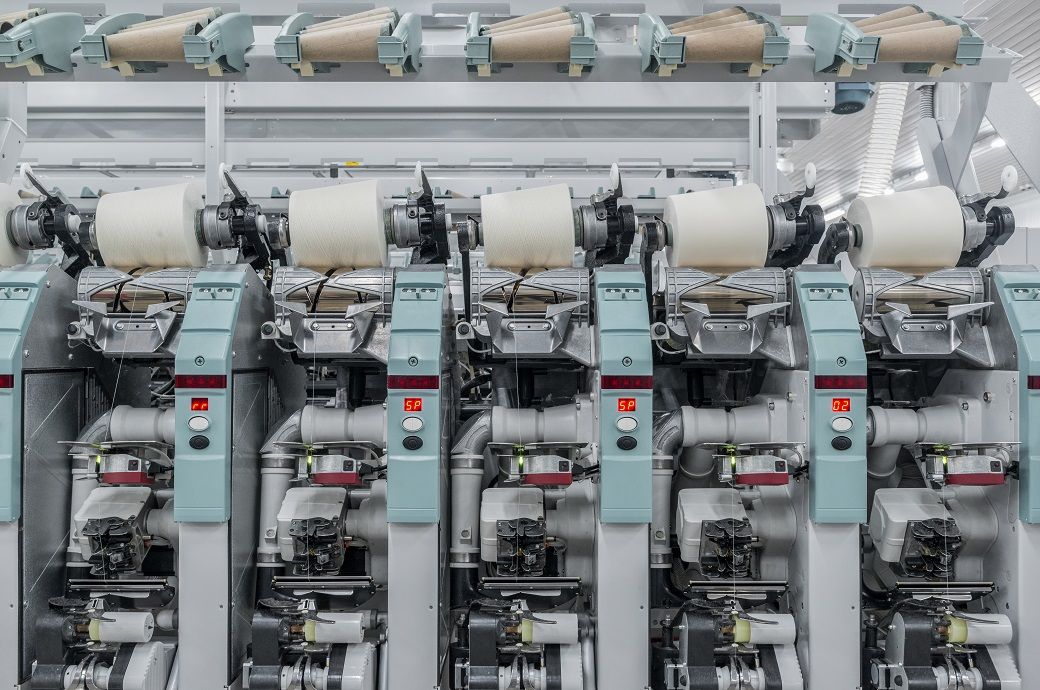
The projects will cover 68,000 square metre and generate 4,600 direct jobs.
Suez Canal Economic Zone (SCZone) chairman Waleid Gamal El-Dein and Ismailia province deputy governor Ahmed Essam El-Din laid the foundation stones.
Foundation stones were recently laid for two projects in Egypt’s West Qantara Industrial Zone by two Chinese-backed Firms.
Hui Zhou Top New Garment will set up an export unit for RMG and sportswear, with production likely to begin in July 2026.
Changzhou Top Credit’s project will manufacture fabrics and textiles, with an expected annual output of over 28,000 tonnes, 80 per cent of which will be exported.
Hui Zhou Top New Garment will set up an integrated, export-oriented factory for readymade and sportswear apparel, with production expected to begin in July 2026. The 28,000-square metre facility valued at $7.2 million will employ 4,000 workers and produce more than 25 million pieces annually, domestic media outlets reported.
With an investment of $13.3 million, Changzhou Top Credit’s project will manufacture fabrics and textiles on a 40,000-sq m site, with an expected annual output exceeding 28,000 tonnes, 80 per cent of which will be exported. The factory will employ 600.
El-Dein said the first phase of the industrial zone’s development has already drawn 44 projects, with total investments worth $1.17 billion and creating 60,165 jobs in less than two years.
Fibre2Fashion News Desk (DS)













Net sales of Upland cotton for the 2025–26 marketing year totalled 131,800 RB (running bales, each weighing 226.8 kg), up sharply from 47,700 RB in the previous week and 16 per cent higher than the prior four-week average. The recovery followed a steep decline in the week ending May 7 when sales had fallen 61 per cent week-on-week and 66 per cent below the four-week average.
US Upland cotton export sales rebounded to 131,800 RB in the week ending May 14, 2026, after the previous week’s sharp fall.
Pakistan led buying, followed by Vietnam and Turkiye, while new-crop sales surged to 216,000 RB.
Shipments stayed below the recent average.
Pima sales improved slightly but remained weak, with India the top buyer and destination.
Pakistan emerged as the largest buyer during the latest reporting week with purchases of 65,300 RB, including reductions of 200 RB. Vietnam followed with 26,100 RB, including 4,500 RB switched from China, 900 RB switched from South Korea, 100 RB switched from Japan, and reductions of 4,400 RB. Turkiye booked 20,100 RB, including reductions of 100 RB, while Malaysia purchased 5,300 RB and China 3,400 RB. These gains were partly offset by reductions of 1,100 RB for Peru and 900 RB for South Korea.
New crop Upland sales for the 2026–27 marketing year rose sharply to 216,000 RB, compared with 29,700 RB in the previous week. Pakistan accounted for the bulk of new crop sales with 206,100 RB, followed by Indonesia and Turkiye at 4,500 RB each, and Mexico at 900 RB.
Upland export shipments remained broadly steady during the week. Exports totalled 289,400 RB, unchanged from the previous week but 11 per cent below the prior four-week average. Vietnam remained the leading destination with 110,800 RB, followed by Turkiye at 28,700 RB, Pakistan at 26,000 RB, Mexico at 22,100 RB, and Bangladesh at 21,200 RB.
Pima cotton sales showed a marginal weekly improvement but remained well below recent average levels. Net sales for the 2025–26 marketing year totalled 9,500 RB, up 2 per cent from the previous week but 52 per cent below the prior four-week average. India remained the largest buyer with 7,600 RB, followed by Pakistan at 1,100 RB, Peru at 500 RB, Thailand at 200 RB, and Vietnam at 100 RB.
New crop Pima sales for the 2026–27 marketing year stood at 7,700 RB, slightly below 7,900 RB in the previous week. Sales were reported for Peru at 4,000 RB and India at 3,700 RB.
Pima export shipments declined further during the week. Exports totalled 9,900 RB, down 18 per cent from the previous week and 19 per cent below the prior four-week average. India was the top destination with 4,600 RB, followed by China at 3,200 RB, Costa Rica at 1,700 RB, Pakistan at 300 RB, and Mexico at 100 RB.
Overall, the latest USDA data indicate a recovery in US Upland cotton export sales after the previous week’s sharp fall, supported mainly by strong buying from Pakistan, Vietnam, and Turkiye. However, export shipments remained below the recent average, while Pima demand continued to show weakness despite India’s sustained buying interest.
Fibre2Fashion News Desk (KUL)

Though the European Union (EU) Corporate Sustainability Due Diligence Directive (CSDDD), which came into effect last year, requires RMG factories in the country to generate 35 per cent of their power from renewable energy sources by 2035 for smooth Western exports, just 3 per cent of electricity used by Bangladesh RMG factories comes from renewable sources now, according to the study conducted by Mapped in Bangladesh (MiB), an initiative of the Centre for Entrepreneurship Development (CED) at BRAC University.
Bangladesh garment units are quite far from meeting clean energy consumption targets due to high renewable energy costs, limited rooftop space, and policy bottlenecks that are slowing adoption across the sector, a study revealed.
Eighty-eight per cent of respondents cited high installation costs as a barrier to renewable energy adoption, while 42 per cent pointed to high maintenance costs.
The country’s RMG sector remains heavily dependent on conventional energy despite the 2035 deadline, with 61.5 per cent of used energy coming from the national grid and 35.5 per cent from captive generation.
Eighty-eight per cent of respondents cited high installation costs as a barrier to renewable energy adoption, while 42 per cent pointed to high maintenance costs.
Twenty-eight per cent of respondents said a lack of awareness was a factor, while 16 per cent blamed unfavourable policies. Fourteen per cent cited limited space in smaller factories.
At 0.9 per cent, renewable energy adoption is significantly lower in Narayanganj compared with 3.6 per cent in Gazipur, domestic media outlets reported citing the study.
As Bangladesh is moving towards a more ambitious renewable energy transition through the Renewable Energy Policy 2025 and updated climate commitments, the RMG sector is central to this, given its high electricity consumption and importance to export earnings and industrial growth, the study noted.
Around four-fifths of RMG factories receive less than 1 per cent of their total energy from renewable sources, while only 5 per cent source more than 10 per cent.
Larger factories show greater diversification in energy use, while small and mini factories remain heavily dependent on grid electricity. In these smaller units, renewable energy use remains below 1 per cent.
The study suggested setting up an RMG green finance window for solar and energy-efficient technologies, introducing energy grading for industrial equipment, and developing factory-level energy and carbon reporting systems.
It also recommended using carbon credits and carbon exchanges to finance verified emission reductions, forming an RMG energy transition taskforce and creating an independent monitoring body to track progress.
The study was conducted through a survey of 878 factories in Gazipur and Narayanganj.
Fibre2Fashion News Desk (DS)

The company’s revenue increased 32 per cent year on year (YoY) to $1.945 billion in Q1 of 2026, or 26 per cent on a constant currency basis. Amer Sports said all four regions delivered healthy double-digit revenue growth, while momentum continued into the second quarter.
Amer Sports raised its 2026 revenue, margin and EPS guidance after Q1 revenue grew 32 per cent to $1.945 billion, driven by strong double-digit growth across all regions.
Technical Apparel rose 33 per cent, Outdoor Performance 42 per cent, and Ball & Racquet Sports 13 per cent.
The operating profit increased 50 per cent, while adjusted EPS rose 47 per cent to $0.38.
“Our excellent momentum continued in the first quarter of 2026, as our unique portfolio of technical sports and outdoor brands are creating white space and taking share globally,” said CEO of Amer Sports James Zheng. “All segments, geographies, and channels performed extremely well in Q1, led by exceptional Salomon Softgoods growth, a strong Arc’teryx omni-comp, and solid Wilson Tennis 360 growth.”
Segment growth led by Outdoor Performance
Technical Apparel revenue rose 33 per cent to $885 million, or 28 per cent on a constant currency basis, driven by broad-based strength across regions, categories and channels. The segment recorded omni-comp growth of 19 per cent, Amer Sports said in a press release.
Outdoor Performance revenue increased 42 per cent to $714 million, or 33 per cent on a constant currency basis, supported by strong momentum in Salomon Softgoods. Ball & Racquet Sports revenue grew 13 per cent to $347 million, or 10 per cent on a constant currency basis, led by Wilson Tennis 360.
The gross margin improved by 210 basis points (bps) to 59.9 per cent, while adjusted gross margin rose 200 bps to 60 per cent. Selling, general and administrative expenses increased 33 per cent to $856 million, while adjusted SG&A expenses rose 34 per cent to $841 million.
Operating profit increased 50 per cent to $321 million, while adjusted operating profit rose 46 per cent to $339 million. Operating margin improved by 200 bps to 16.5 per cent and adjusted operating margin rose 160 bps to 17.4 per cent.
By segment, adjusted operating margin in Technical Apparel increased 250 bps to 26.4 per cent. Outdoor Performance margin expanded 480 bps to 20.4 per cent, while Ball & Racquet Sports margin declined 370 basis points to 3.6 per cent.
Net income attributable to equity holders increased 22 per cent to $165 million, or $0.29 diluted earnings per share. Adjusted net income attributable to equity holders rose 47 per cent to $218 million, or $0.38 adjusted diluted earnings per share.
Year-on-year inventories increased 33 per cent to $1.688 billion. The company ended the quarter with net cash of $539 million and cash and cash equivalents of $684 million.
CFO of Amer Sports Andrew Page said that the company had a strong start to the year, with sales growth, margin expansion and EPS growth. “The investments we have been making behind our biggest opportunities are paying off in terms of both sales growth and margin expansion,” he added.
FY26 guidance raised on strong momentum
For full-year 2026, Amer Sports now expects reported revenue growth of 20-22 per cent, including a 200-250 bps benefit from favourable foreign exchange impact at current exchange rates. Gross margin is expected at 59-59.5 per cent, while operating margin is projected at 13.4-13.7 per cent. Fully diluted EPS is forecast at $1.18-1.23.
For the second quarter of 2026, the company expects reported revenue growth of 22-24 per cent, including a 200-250 bps foreign exchange benefit. Gross margin is expected at around 59.5 per cent, operating margin at 6-7 per cent, and fully diluted EPS at $0.08-0.1.
Fibre2Fashion News Desk (SG)


Stewart McLean’s death a ‘shocker’ as police launches homicide probe

Who Are The 10 Test Indy 500 Drivers Of All time?

US, Iran likely to announce draft of peace deal within 24 hours: report

-

 Entertainment1 week ago
Where Pete Davidson, Elsie Hewitt stand after breakup: Details revealed
-

 Entertainment1 week ago
Emilia Clarke recalls near-death incident while filming ‘Game of Thrones’
-

 Politics1 week ago
Rising diesel costs from Iran war strain US school budgets
-

 Entertainment1 week ago
Drake drops highly anticipated "Iceman" album, plus two surprise albums
-

 Politics1 week ago
UK’s Starmer faces survival battle as potential rivals circle
-

 Tech1 week ago
Greg Brockman Officially Takes Control of OpenAI’s Products in Latest Shakeup
-

 Tech6 days ago
Why Is Your Grill So Dumb? The Best Grills Set Temp Like an Oven
-
 Business1 week ago
UK borrowing costs rise and pound falls as leadership drama continues