

Tech
Two-step flash Joule heating method recovers lithium‑ion battery materials quickly and cleanly

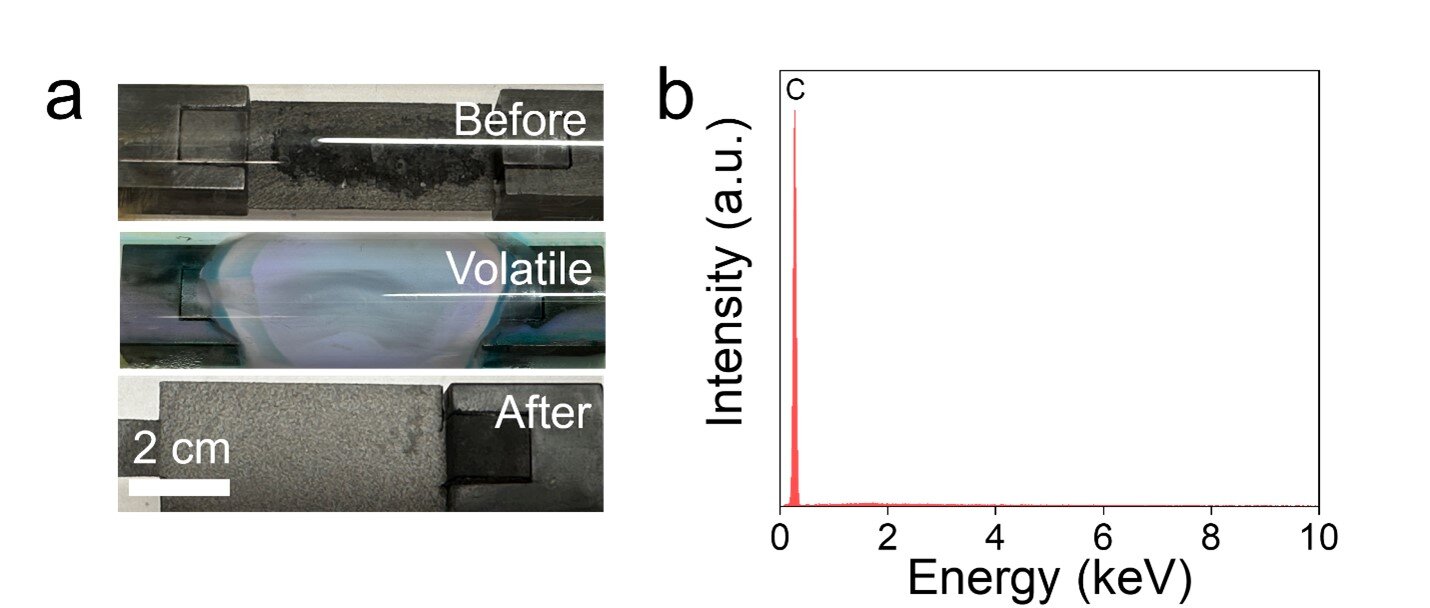
A research team at Rice University led by James Tour has developed a two-step flash Joule heating-chlorination and oxidation (FJH-ClO) process that rapidly separates lithium and transition metals from spent lithium-ion batteries. The method provides an acid-free, energy-saving alternative to conventional recycling techniques, a breakthrough that aligns with the surging global demand for batteries used in electric vehicles and portable electronics.
Published in Advanced Materials, this research could transform the recovery of critical battery materials. Traditional recycling methods are often energy intensive, generate wastewater and frequently require harsh chemicals. In contrast, the FJH-ClO process achieves high yields and purity of lithium, cobalt and graphite while reducing energy consumption, chemical usage and costs.
“We designed the FJH-ClO process to challenge the notion that battery recycling must rely on acid leaching,” said Tour, the T.T. and W.F. Chao Professor of Chemistry and professor of materials science and nanoengineering. “FJH-ClO is a fast, precise way to extract valuable materials without damaging them or harming the environment.”
Quick, controlled heating
The rapid increase in the use of lithium-ion batteries in electric vehicles and consumer electronics has intensified the need for sustainable recycling technologies. Existing recycling methods are often costly and inefficient while producing significant amounts of wastewater.
To tackle these challenges, the research team developed a two-step process that uses brief bursts of heat and air instead of harsh chemicals. First, the battery materials are briefly heated with chlorine gas, which breaks them down. They then undergo a second heating in air, transforming most of the metals into forms that can be separated from lithium. Because lithium does not form an oxide as easily as other metals, it remains as the chloride, which can be easily extracted using water.
Previous methods required lengthy processes and strong acids. The FJH-ClO approach, however, uses fast, controlled heating and simple reactions to make the separation process cleaner and faster.
Holistic recovery
Tests have shown that the new process can recover nearly all valuable materials from used batteries, including lithium, cobalt and graphite, with high purity. Early analyses suggest that even at a small scale, it may require about half as much energy, 95% fewer chemicals and significantly lower costs compared to existing methods.
These results establish a scalable, acid-free approach for the comprehensive recovery of lithium-ion battery materials, offering both environmental and economic advantages while setting a new standard for sustainable battery recycling.
“It’s rewarding to see a process that’s both scientifically sound and practically useful,” said Shichen Xu, the study’s first author and a Rice postdoctoral researcher. “That balance is what makes real-world impact possible.”
Future implications
This process paves the way for large-scale implementation and integration into the battery supply chain. It provides a foundation for recovering valuable materials while reducing the need for virgin mining.
With the FJH-ClO process already proven at the laboratory scale, the researchers plan to scale the process through their startup, Flash Metals U.S., a division of Metallium Ltd.
“This is more than just a lab experiment,” Tour said. “It’s a blueprint for how the industry can meet the demand for battery materials without further straining the planet.”
Co-authors of this study include Justin Sharp, Qiming Liu, Jaeho Shin, Haoxin Ye, Kaiwen Yang, Carter Kittrell, Haojie Zhu, Carolyn Teng, Bowen Li, Shihui Chen and Karla Silva from Rice’s Department of Chemistry; Ralph Abdel Nour from its Applied Physics Program and Smalley-Curl Institute; and Khalil JeBailey, Boris Yakobson and Yufeng Zhao from its Department of Materials Science and NanoEngineering.
More information:
Shichen Xu et al, Holistic Recovery of Spent Lithium‐Ion Batteries by Flash Joule Heating, Advanced Materials (2025). DOI: 10.1002/adma.202517293
Citation:
Two-step flash Joule heating method recovers lithium‑ion battery materials quickly and cleanly (2025, November 17)
retrieved 17 November 2025
from https://techxplore.com/news/2025-11-joule-method-recovers-lithiumion-battery.html
This document is subject to copyright. Apart from any fair dealing for the purpose of private study or research, no
part may be reproduced without the written permission. The content is provided for information purposes only.













US Border Patrol agents are raising money by selling coins that commemorate last year’s wave of immigration enforcement “operations” across the country, along with other merchandise. The funds are for nonprofit organizations that list Border Patrol buildings as their address in IRS paperwork. At least two of the organizations have dedicated US Customs and Border Protection email addresses.
The front side of one coin for sale reads, “NORTH AMERICAN TOUR 2025,” along with the acronyms for US Border Patrol and the acronym for “fuck around and find out”—a phrase that was initially popularized by the far-right group the Proud Boys and has been used by various Trump officials. In the center, the coin depicts a gas mask, a riot control smoke grenade, and a pepper ball launcher. On the other side, the coin appears to have a portrait of Border Patrol’s now retired commander-at-large, Gregory Bovino, with his arm raised in a salute, along with the text “COMING TO A CITY NEAR YOU!” It lists seven cities, many of which actually saw federal enforcement surges in 2025: Chicago, Los Angeles, Memphis, Phoenix, Portland, Charlotte, and Atlanta.
The coin is for sale by Willcox Morale Welfare and Recreation, a nonprofit that the IRS most recently declared tax-exempt during the Biden administration and whose address on IRS paperwork matches that of the Willcox Border Patrol Station in Arizona. A request for comment sent to Willcox MWR’s dedicated CBP email address went unanswered.
Employees of the Department of Homeland Security, the parent agency for Border Patrol, are allowed to start private, not-for-profit employee associations within DHS, so long as they get formally recognized by the agency and follow certain rules. According to DHS policies, officially recognized groups can fundraise using government property and create merchandise with the agency’s name and logos–but they have to receive advance approval from the agency.
Willcox MWR is just one of several groups across the country that cater to Border Patrol agents and refer to themselves as MWRs, a reference to the US military’s “morale, welfare and recreation” programs. The groups tend to throw holiday events and retirement parties, and sometimes raise money for the families of agents going through hard times, including those not getting paid during the current shutdown.
Many MWRs also sell customized medallions known as “challenge coins” that commemorate specific teams or events. While anyone, including CBP alumni, can design and sell coins, current DHS employees are not supposed to use government resources to sell ones that use the agency’s seals or logos without permission, or ones that the agency considers inappropriate or unprofessional.
CBP did not provide comment about its relationship to Willcox MWR or any other nonprofit mentioned in this story, nor whether the agency had green-lit the “North American Tour” coin design, ahead of publication.
Under Willcox MWR’s Facebook post about the “North American Tour” coin, someone named Juan Diego commented, “Sign up SDC BK5 MWR for 10.”
“Shoot us an email,” someone managing the Willcox MWR account replied, giving out what appeared to be a dedicated cbp.dhs.gov email address for the group.
SDC BK5 MWR, also a registered nonprofit, lists an address on its website that matches that of a government facility in Chula Vista, California. It says on its site that it was started by San Diego Sector Border Patrol agents and sells custom merchandise “designed to raise funds for morale and relief efforts.”
Diego did not respond to a request for comment.
The SDC BK5 MWR website has listings for over 200 different products in addition to the North American Tour coin. One of those listings was a “Chicago Midway Blitz” challenge coin in the shape of a gas mask that doubles as a bottle opener. Embossed around the edges of the coin are the names of several municipalities and neighborhoods caught up in DHS’s immigration enforcement surge of the same name last fall. Like the North American Tour coin, it features the US Border Patrol logo and the acronym for “fuck around and find out.” Opponents of the Trump administration’s immigration enforcement activity in Illinois are unamused.

Tired of taking your action camera on an adventure, only to get home and find out you missed the action with a bad angle? One option is to switch to a 360-degree action cam, so you can capture all of the action and then edit down to just the good stuff later. One of our favorite options, the DJI Osmo 360, is currently available for just $390 on Amazon, a $209 discount from its usual price, and it comes with a selfie stick and an extra battery.
The DJI Osmo 360 achieves its impressive all-around video quality by leveraging a pair of 1/1.1-inch sensors, larger than some other offerings, and by supporting 10-bit color. You can really see that in the camera’s output, with colors that are vivid and bold, to the point that you may need to dial them back a bit in post if you want something more natural. With support for up to 50 frames per second at 8K when recording in 360 degrees, or 120 fps at 4K when shooting with only one sensor, you’ll have plenty of material to work with. In our testing, it ran for just shy of two hours at 30 fps, which is also around the time the internal storage had filled up anyway.
If you plan on catching any serious discussions with your Osmo 360, you’ll be pleased to know it connects directly to DJI’s line of wireless lavalier microphones, including the excellent and frequently discounted DJI Mic 2 and Mic Mini. If you want to mount it to something other than the included 1.2-meter selfie stick, it has both DJI’s magnetic attachment system and a more traditional ¼”-20 tripod mount. The DJI Mimo app lets you control the camera and adjust any settings, and there’s even a simple editor for on-the-fly production. For desktop users, DJI Studio has even more in-depth settings and editing options, in case you don’t want to pay for Premiere.
The DJI Osmo 360 is one of our favorite action cameras, and is particularly appealing at the discounted price point, but make sure to check out our full review for more info, or head over to our full roundup to see what else is available.

On day six of its mission, Artemis II is closing in on the far side of the moon. Meanwhile, the historic journey has not been without fascinating and curious stories, from the images and videos that its four crew members have shared with the world to the inevitable unforeseen events—including a tricky toilet situation.
A few hours before the crew begins its lunar flyby, here’s how things are going on Artemis II.
When Will They Reach the Far Side of the Moon?
While Artemis II won’t actually land on the moon (that won’t happen until Artemis IV), that does not make this mission any less compelling. Once the Artemis II astronauts finish flying over the dark side of the moon, they will have the historic distinction of being the humans who have traveled the farthest from Earth.
They will also test all the systems needed for future lunar missions, validating life support, navigation, spacesuits, communications, and other human operations in deep space.
But when are they supposed to reach this far-off point? First, the Orion capsule reached what is known as the moon’s “sphere of influence” on Sunday night. This is the point where the moon’s gravitational force is stronger than the force of the Earth.
At present, Orion is circling the moon. Once the capsule is on the dark side of the moon, approximately 7,000 kilometers from the surface, communications with Earth will be interrupted. For six hours, they will be able to view the far side of the moon, something no human being has ever seen with their own eyes—not even the astronauts of the Apollo program, as this region of the moon was always too dark or difficult for them to reach.
That six-hour flyby of the dark side of the moon is expected to begin Monday, April 6, at 2:45 pm EDT and 7:45 pm London time.
After that, the capsule will use the moon’s gravity to propel itself back to Earth. Splashdown, when the astronauts reach Earth, is scheduled for April 10 in the Pacific Ocean, not far from the coast of California, the tenth day of the mission.
Remember that you can follow the live broadcast of the Artemis II mission from NASA’s official channels.
What Has Happened so Far?
Since its successful launch on April 1 from Kennedy Space Center, the Artemis II crew has shared several spectacular photos, such as the featured image in this post, which shows mission specialist Christina Koch looking down at Earth through one of Orion’s main cabin windows.
This incredible photo of a Earth, taken on April 2, went viral on social media, referencing the famous “Blue Marble” image captured by the Apollo 17 astronauts in 1972.
View of Earth taken by astronaut Reid Wiseman from the window of the Orion spacecraft after completing the translunar injection maneuver on April 2, 2026.Photograph: Reid Wiseman/NASA/Getty Images


UNC set to hire Michael Malone as next men’s basketball coach after firing Hubert Davis: report

Iran conveys its response to US ceasefire proposal to Pakistan

Border Patrol Agents Sold Challenge Coins With ‘Charlotte’s Web’ Characters in Riot Gear

-

 Sports1 week ago
USMNT handed reality check by Doku, Belgium ahead of World Cup
-

 Sports1 week ago
2026 NCAA men’s hockey tournament: Schedule, results
-
Uncategorized4 days ago
[CinePlex360] Please moderate: “Trump signals p
-
Uncategorized1 week ago
[CinePlex360] Please moderate: “Further tariff
-

 Entertainment3 days ago
Joe Jonas shares candid glimpse into parenthood with Sophie Turner
-

 Tech3 days ago
Our Favorite iPad Is $50 Off
-

 Sports1 week ago
Man City show why they are worthy WSL title winners as tired United wilt
-

 Entertainment1 week ago
Demystifying the PTI