

Politics
UAE leaves Opec and Opec+ in huge blow to global oil producers’ group

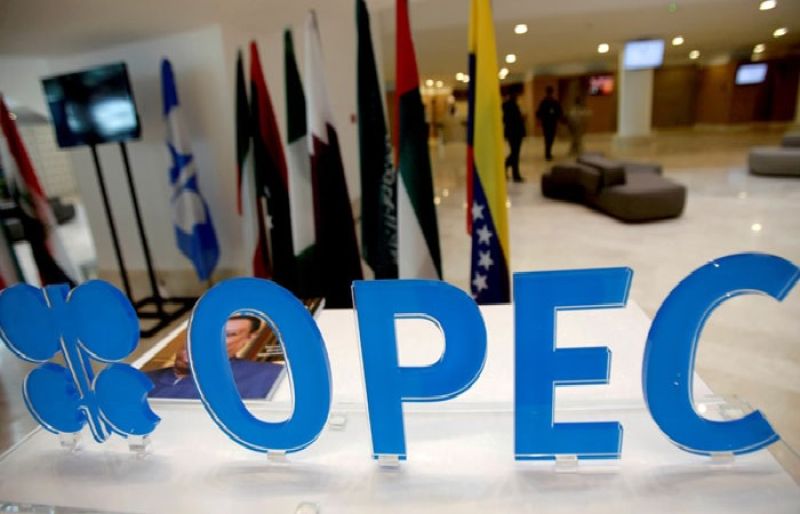
The United Arab Emirates said on Tuesday it quit Opec and Opec+, dealing a heavy blow to the oil exporting groups, at a time when the Iran war has caused a historic energy shock and unsettled the global economy.
The stunning loss of the UAE, a longstanding Opec member, could create disarray and weaken the group, which has usually sought to show a united front despite internal disagreements over a range of issues from geopolitics to production quotas.
Opec Gulf producers have already been struggling to ship exports through the Strait of Hormuz, a narrow chokepoint between Iran and Oman through which a fifth of the world’s crude oil and liquefied natural gas normally passes, because of Iranian threats and attacks against vessels.
But the UAE exit from Opec represents a big win for US President Donald Trump, who has accused the organisation of “ripping off the rest of the world” by inflating oil prices.
Trump has also linked US military support for the Gulf with oil prices, saying that while the US defends Opec members, they “exploit this by imposing high oil prices”.
The move came after the UAE, a regional business hub and one of Washington’s most important allies, criticised fellow Arab states for not doing enough to protect it from numerous Iranian attacks during the war.
Anwar Gargash, the diplomatic adviser for the UAE president, criticised the Arab and Gulf response to the Iranian attacks in a session at the Gulf Influencers Forum on Monday.
“The Gulf Cooperation Council countries supported each other logistically, but politically and militarily, I think their position has been the weakest historically,” Gargash said.
“I expect this weak stance from the Arab League and I am not surprised by it, but I haven’t expected it from the (Gulf) Cooperation Council and I am surprised by it,” he said.
Oil prices hit $110
Stocks fell and oil rose on Tuesday as investors assessed the stalemate in the Iran conflict and worried the AI boom was losing momentum, while the dollar climbed.
The US was reviewing Tehran’s latest proposal to resolve the war. A US official said President Donald Trump was unhappy with the plan as it did not address Iran’s nuclear programme.
The two-month-long conflict is at an impasse and energy and other supplies are still failing to cross through the critical Strait of Hormuz, pushing oil prices above $110 a barrel on Tuesday.
Brent crude oil LCOc1 rose 3% to $111.40 a barrel, a three-week high, while US oil CLc1 was up 3.8% at $100.
Oil prices have steadily climbed in recent days as hopes have ebbed for an imminent peace deal, pushing up bond yields around the world.
Futures for the US benchmark S&P 500 stock index ESc1 fell 0.7% on Tuesday, while those for tech-focused Nasdaq dropped 1.3%.
“Earnings season has helped markets look through the disruption, but the longer key oil flows remain constrained, the greater the risk that higher energy costs begin to bite,” said Matt Britzman, senior equity analyst at Hargreaves Lansdown.
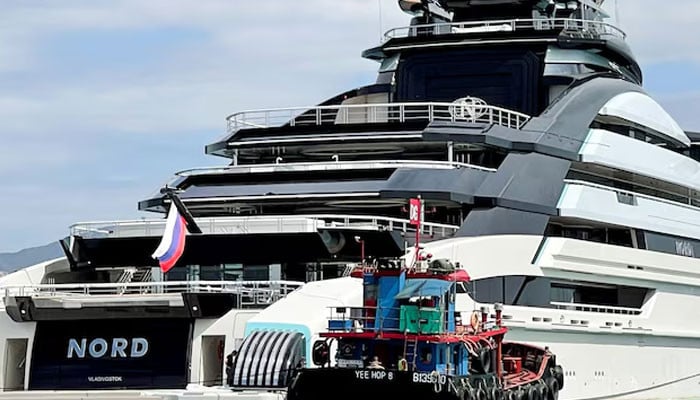
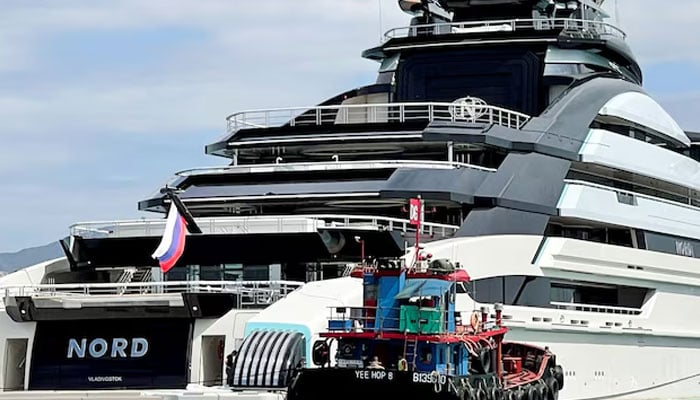
A superyacht owned by Russian billionaire Alexey Mordashov was able to transit the blockaded Strait of Hormuz after undergoing maintenance in Dubai because neither Iran nor the United States objected, a source close to Mordashov said on Tuesday.
It has been unclear how the multi-deck pleasure vessel, worth over $500 million, gained permission to sail on Saturday through the commercially important waterway at the heart of the US-Iran conflict, where traffic has been severely restricted since February.
Sailing under a Russian flag, the yacht, called Nord, crossed the strait on an approved route in compliance with international maritime law, the source said.
“Iran did not interfere with the movement of the yacht, as it is a civilian vessel of a friendly country conducting a peaceful transit. The American side also raised no questions regarding the yacht’s movement, as it did not call at Iranian ports and has no connection to Iran,” the source said.
Just a few, mainly merchant vessels, have been passing daily through the crucial waterway at the entrance to the Gulf as Washington and Tehran maintain an uneasy ceasefire. This represents a fraction of the average 125 to 140 daily passages before the Iran war began on February 28. In response, the US has imposed a blockade of Iranian ports.
Russia is a longstanding ally of Iran. Iranian Foreign Minister Abbas Araqchi travelled to St Petersburg on Monday for a meeting with Russian President Vladimir Putin, after discussions with peace mediators in Pakistan and Oman over the weekend.
After crossing the Strait, Nord has been located near the coast of Oman since Sunday, according to LSEG data.
- Iranian plan would set aside nuclear issue until war ends.
- Trump unhappy with delaying deal on nuclear programme.
- Iran demands blockade be lifted before any negotiations begin.
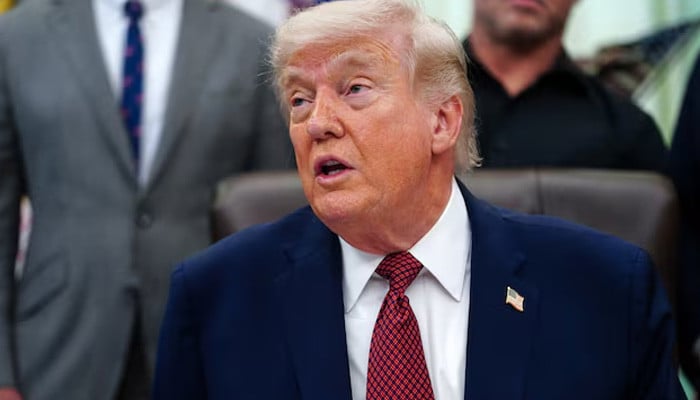
Donald Trump said Iran had informed him it was in a “state of collapse” and was figuring out its leadership situation, as efforts to end the conflict appeared at an impasse on Tuesday, with the US president unhappy at the latest plans from Tehran.
Iran’s most recent proposal on resolving the two-month war would set aside discussion of its nuclear programme until the conflict was concluded and disputes over shipping from the Gulf were resolved.
Trump wants nuclear issues dealt with from the outset, a US official briefed on Trump’s Monday meeting with his advisers said.
In a post on Truth Social on Tuesday, Trump said: “Iran has just informed us that they are in a ‘State of Collapse’. They want us to ‘Open the Hormuz Strait,’ as soon as possible, as they try to figure out their leadership situation (Which I believe they will be able to do!). Thank you for your attention to this matter!”.
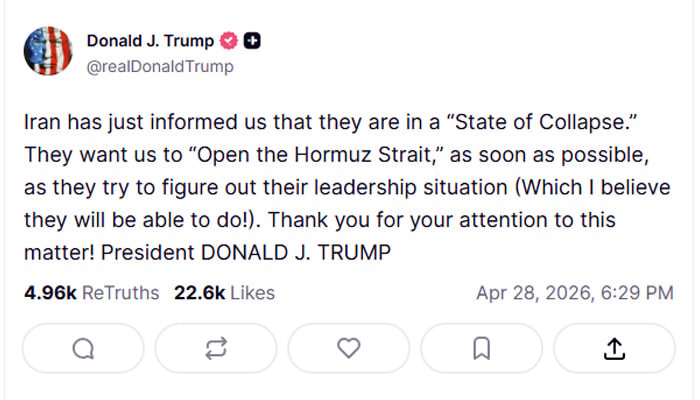
It was not clear from Trump’s social media post how Iran might have communicated that message.
Gulf leaders meet in Saudi Arabia
Meanwhile, Gulf leaders met in person in Saudi Arabia on Tuesday for the first time since their states became a front in the Iran war. A Gulf official said the meeting aimed to craft a response to the thousands of Iranian missile and drone attacks they faced since the US and Israel launched the war on Iran on February 28.
Attacks have subsided since a ceasefire on April 8, though Gulf capitals remain wary of resumed conflict.
Iran’s previous nuclear deal with the United States and other powers in 2015 sharply curtailed its nuclear programme, which it has long maintained is for peaceful, civilian purposes. But that deal fell apart when Trump unilaterally withdrew in his first term in office.
Hopes of reviving peace efforts in a conflict that has killed thousands, thrown energy markets into turmoil and disrupted global trade routes, have receded since Trump last weekend scrapped a visit by his special envoy Steve Witkoff and son-in-law Jared Kushner to mediator Pakistan.
Iranian Foreign Minister Abbas Araqchi shuttled in and out of Islamabad twice during the weekend. He also visited Oman and on Monday went to Russia, where he met President Vladimir Putin and received words of support from a longstanding ally.
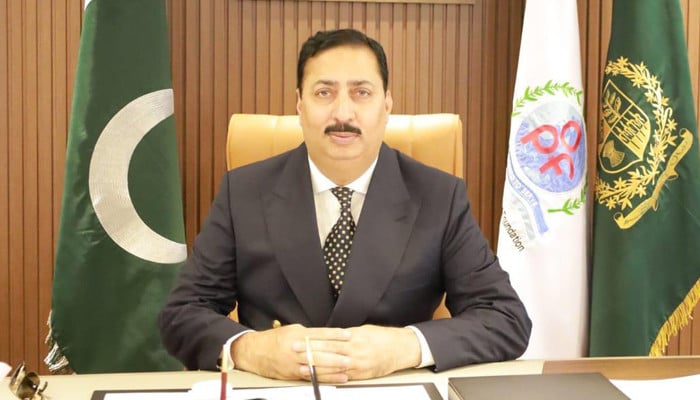
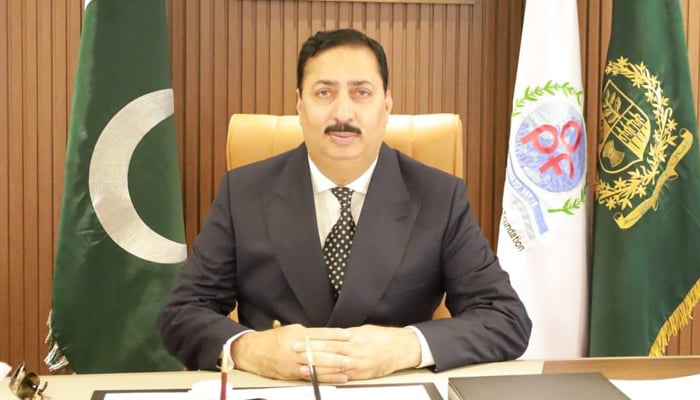
LONDON: Chairman of the Overseas Pakistanis Foundation (OPF) Syed Qamar Raza has written to Deputy Prime Minister and Foreign Minister Ishaq Dar clarifying that some misinformation was spread after the Pakistan High Commission signed a contract with Gerry’s for consular and visa services in the United Kingdom.
In his letter, Raza informed the DPM Dar that during his ongoing visit to the UK, he held consultations with prominent community leaders, who expressed overall satisfaction with the planned system of consular services, which will be provided through Gerry’s Visa, alongside the Pakistan High Commission in London and the Nadra Pak ID platform.
The OPF chief noted that earlier concerns had been raised within the community over the possible discontinuation of direct consular services by the High Commission, which had led to fears that overseas Pakistanis would be forced to rely solely on Gerry’s.
However, Raza clarified that the Pakistan High Commission will continue to offer consular services in parallel with Gerry’s and Pak ID. He said this clarification has been widely welcomed by the community.
The OPF chairman recommended that the High Commission should actively promote this position to ensure clarity and prevent misinformation among overseas Pakistanis.
Raza added that he was sharing the “true sentiments of the community” with the government and had also forwarded input from local representatives, including Cllr Tariq Dar, for consideration.
Earlier this week, the Pakistan High Commission in London said it awarded a contract to Gerry’s Visa Services Ltd to provide additional consular facilitation services across the United Kingdom, marking a significant step towards greater convenience for the British Pakistani diaspora.
The decision, approved by the Ministry of Foreign Affairs in Islamabad, followed a fully transparent competitive bidding process conducted in strict accordance with Public Procurement Regulatory Authority (PPRA) regulations, the High Commission said in a statement.
Only locally registered UK companies were eligible to participate, and the entire selection process, which included rigorous due diligence and compliance with all regulatory requirements, took four months to complete, it said.
The new arrangement is expected to particularly benefit Pakistani nationals living in far-flung areas of the UK who previously faced difficulties and high costs in travelling to the High Commission in London or its consulates.
The statement said: “By offering these additional facilities, the initiative will save applicants both time and transportation expenses. Gerry’s International will also extend the services to weekends, providing further flexibility for the community. Regular consular services will continue uninterrupted at the Pakistan High Commission in London and the consulates in Birmingham, Manchester, Bradford, and Glasgow.”
It has been clarified that the role of the new facilitation centres is strictly limited. They will only handle the processing and data entry of passport applications, visa applications, NICOP applications, and the collection of documents for attestation. Powers of Attorney, land-related matters, and all other services will remain the exclusive responsibility of the High Commission and its four consulates.
All decision-making on applications will continue to rest solely with the Government of Pakistan, including the relevant authorities such as Nadra, IMPASS, Mofa, MOI, or the Pakistani Missions.

FTSE 100 edges higher but US tech stocks wobble

Structural issues from higher military RMG localisation: S Korean SMEs

Iran, US allowed Russian superyacht to cross Strait of Hormuz, says source

-

 Sports1 week ago
NCAA men’s gymnastics championship: All-time winners list
-

 Sports1 week ago
WWE WrestleMania 42 Night 2: Live match results and analysis
-

 Politics1 week ago
UK’s Starmer seeks to deflect blame over Mandelson appointment
-

 Fashion1 week ago
UK’s Sosandar returns to profitability amid robust FY26 performance
-

 Entertainment1 week ago
Lee Anderson, Zarah Sultana kicked out of UK Parliament for calling PM ‘liar’
-
 Business1 week ago
How Trump’s psychedelics executive order could unlock stalled cannabis reform
-
 Business1 week ago
Us-India Trade Talks: US–India trade deal: Where do talks stand & what to expect – explained – The Times of India
-
 Business1 week ago
Exercise to test response to offshore energy threat involving vessels and drones