

Politics
US strike sinks Venezuela vessel, 11 killed in first Caribbean operation under Trump

- Trump shares video showing speedboat exploding.
- US officials say boat was carrying illegal narcotics.
- Strike comes amid increased deployment to Caribbean.
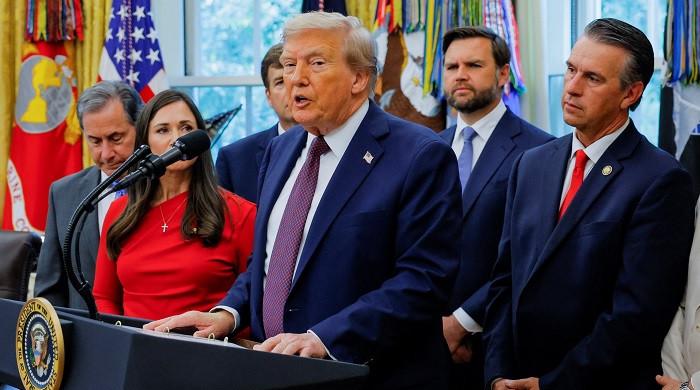
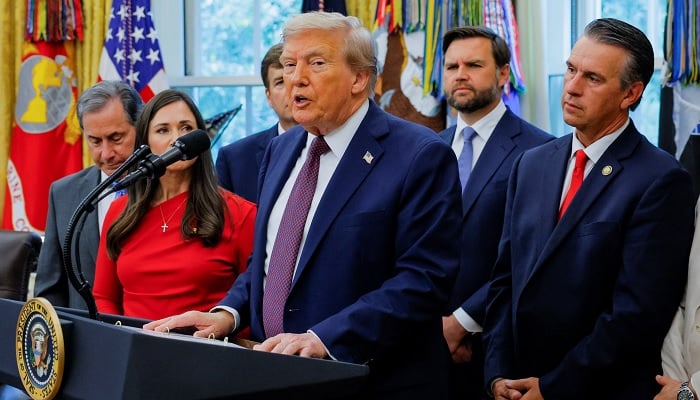
The US military killed 11 people on Tuesday in a strike on a vessel from Venezuela allegedly carrying illegal narcotics, President Donald Trump said, in the first known operation since his administration’s recent deployment of warships to the southern Caribbean.
Trump told reporters at the White House: “We just, over the last few minutes, literally shot out a boat, a drug-carrying boat, a lot of drugs in that boat.”
“And there’s more where that came from. We have a lot of drugs pouring into our country, coming in for a long time … These came out of Venezuela,” Trump said.
He later shared a video on his Truth Social platform that appeared to show footage from overhead drones of a speedboat at sea exploding and then on fire.
“The strike resulted in 11 terrorists killed in action. No US Forces were harmed in this strike,” Trump said.
He added that the US military had identified the crew as members of the Venezuelan gang Tren de Aragua, which the US designated a terrorist group in February. He repeated allegations that Tren de Aragua is being controlled by Venezuela’s President Nicolas Maduro, accusations that Caracas denies.
The Venezuelan Communications Ministry did not immediately respond to a request for comment.
The Pentagon has not released specifics about the attack, including what kind of drugs were on board, the quantity, or how the strike was carried out.
The decision to blow up a suspected drug vessel passing through the Caribbean, instead of seizing the vessel and apprehending its crew, is highly unusual and evokes memories of the US fight against militant groups like al Qaeda.
The United States has deployed warships in the southern Caribbean in recent weeks to follow through on a pledge by Trump to crack down on drug cartels.
Tuesday’s strike appeared to be the first such military operation in the region to that effect.
Seven US warships, along with one nuclear-powered fast attack submarine, are either in the region or expected to be there soon, carrying more than 4,500 sailors and Marines.
While US Coast Guard and Navy ships regularly operate in the Southern Caribbean, the current buildup exceeds the usual deployments in the region.
In the naval force are warships, including USS San Antonio, USS Iwo Jima, and USS Fort Lauderdale. Some can carry aerial assets like helicopters, while others can also deploy Tomahawk cruise missiles.
The US military has also been flying P-8 spy planes in the region to gather intelligence, US officials have said. They have been flying over international waters.
Speaking to reporters, Secretary of State Marco Rubio said: “These particular drugs were probably headed to Trinidad or some other country in the Caribbean.”
“Suffice it to say that the president is going to be on offence against drug cartels and drug trafficking in the United States.”
Trump’s singling out of Maduro has raised alarms in Caracas that their government might be the real target.
Last month, the United States doubled its reward for information leading to the arrest of Maduro to $50 million, accusing him of links to drug trafficking and criminal groups.
Venezuelan officials have repeatedly said that Tren de Aragua is no longer active in their country after they dismantled it during a prison raid in 2023.
- No immediate reports of casualties after melee.
- Interior minister says details on gunshots unclear.
- Military personnel deployed to assist Senate security.
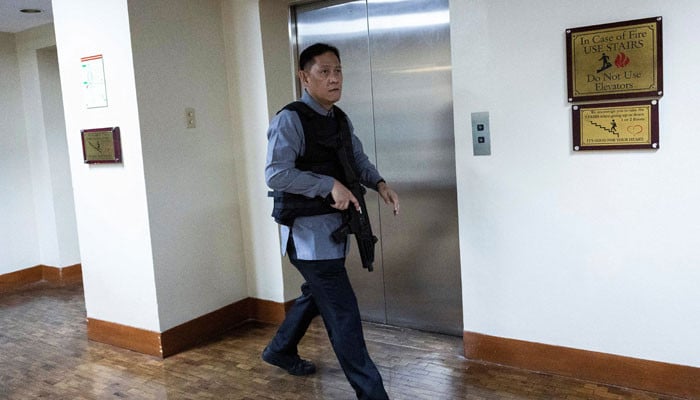
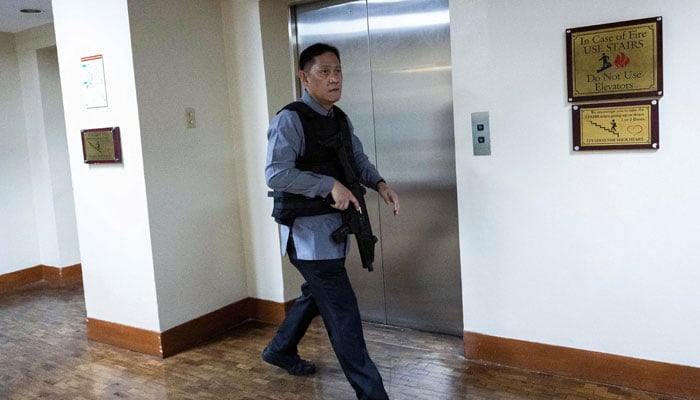
MANILA: Gunshots broke out at the Philippine Senate on Wednesday and people ran for cover after a top politician wanted by the International Criminal Court said his arrest was imminent and security forces entered the building.
There were no immediate reports of casualties, however, Senate Secretary Mark Llandro Mendoza told reporters following the chaos at the legislature in the capital Manila.
Senator Ronald dela Rosa, a former police chief who was the main enforcer of ex-Philippine President Rodrigo Duterte’s bloody “war on drugs”, had earlier urged people to mobilise to prevent his arrest and handover to the ICC.
The Hague-based court on Monday unsealed an arrest warrant for dela Rosa on charges of crimes against humanity, the same that 81-year-old Duterte is accused of as he awaits trial in the ICC following his transfer last year.
Dela Rosa, 64, has denied involvement in illegal killings.
“I am appealing to you, I hope you can help me. Do not allow another Filipino to be brought to The Hague,” he said in a video on Facebook from his Senate office, where he has taken refuge since Monday when placed under legislative protection.
Senate Secretary Mendoza said law enforcement officers believed to be from the National Bureau of Investigation had attempted to enter the Senate and fired as they retreated.
But NBI Director Melvin Matibag told GMA News that no agents had been deployed.
“I spoke with the (justice) minister and he told me to await instructions. We have no preparations whatsoever,” he said.
More than 10 military personnel in camouflage fatigues arrived, some carrying assault rifles, Reuters journalists saw.
The chief of the military’s public affairs office Xerxes Trinidad told Reuters the Senate had requested help to “assist them in securing the facility”.
Interior Minister Jonvic Remulla said it was unclear who fired shots and security footage would need to be checked. He said dela Rosa was safe and he assured him no arrest would be made.
Duterte’s top lieutenant
The office of the prosecutor at the ICC referred requests for comment to the court. The court’s press office did not immediately respond to a request for comment.
Dela Rosa was Duterte’s top lieutenant overseeing a fierce crackdown during which thousands of alleged drug dealers were slain, with human rights groups accusing police of systematic murders and cover-ups.
Police reject the allegations and say the more than 6,000 killed in anti-drugs operations were all armed and had resisted arrest.
Activists say the real death toll may never be known, with users and small-time peddlers gunned down almost daily in mysterious slumland killings blamed on vigilantes and turf wars.
The Senate was heavily guarded throughout Wednesday, with lines of police deployed to keep the peace as protesters gathered, some calling for the arrest of dela Rosa, better known in the Philippines as “Bato”, or “rock”.
His ally, Senate President Alan Peter Cayetano, said he had spoken to President Ferdinand Marcos Jr, who had assured him no government personnel had been involved in Wednesday’s incident.
Dela Rosa, who returned to the Senate on Monday for the first time since disappearing from public view in November, has appealed to Marcos not to hand him over to the ICC.
He has also filed an emergency petition with the Supreme Court urging it to block any attempt to transfer him to The Hague. The court in a statement on Wednesday gave all parties to the petition 72 hours to respond.
Dela Rosa insists any transfer to the ICC would be illegal, as the country is no longer a signatory to the Rome Statute.
Duterte unilaterally withdrew the Philippines from the ICC in 2018 when its prosecutor announced a preliminary examination into his anti-drugs campaign had started. The ICC says alleged crimes committed while a country was a member are under its jurisdiction.
Duterte is set to become the first Asian former head of state to go on trial at the ICC, a court he repeatedly dared to pursue him during a succession of public speeches, saying he was ready to “rot in jail” to protect his people from the drugs scourge.
He maintains his innocence, according to his legal team.
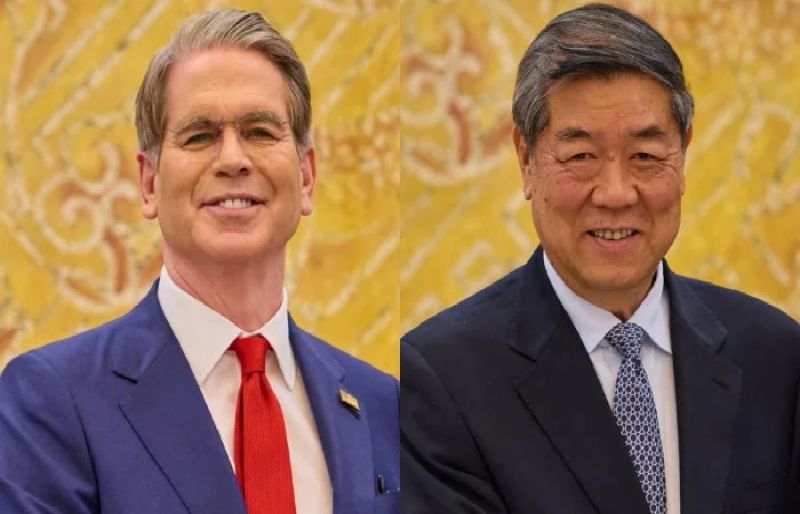
US Treasury Secretary Scott Bessent and Chinese Vice Premier He Lifeng started talks in South Korea on Wednesday to lay the groundwork ahead of this week’s summit of the leaders of the world’s two biggest economies in Beijing.
Bessent and He began the talks at Incheon airport after each met South Korean President Lee Jae Myung at the presidential Blue House, Reuters witnesses said.
The discussions are expected to cover a range of issues to prepare for talks in Beijing between US President Donald Trump and Chinese President Xi Jinping that are set to run from Thursday to Friday.
The talks between Bessent and He were likely to be exploratory with limited immediate outcomes, said Kim Tae-hwang, a professor of international trade at Myongji University in Seoul.
“Both sides are essentially in a holding pattern ahead of the summit, sounding each other out, rather than seeking breakthroughs,” he said.
China’s lead trade negotiator, Vice Commerce Minister Li Chenggang, and Vice Finance Minister Liao Min were among the officials accompanying He.
At the Beijing summit, the leaders are expected to agree to set up forums to ease mutual trade and investment, while China is expected to announce purchases related to Boeing aeroplanes, American agriculture and energy, US officials have said.
Beijing also wants the United States to relax curbs on exports of advanced semiconductors, and has raised concerns about a bill to keep critical chip-making equipment from China.
They are considering extending a truce on China’s export curbs on rare earths at the summit, but Chinese customs data shows Beijing is still throttling shipments of the materials vital for defence and manufacturing.
The summit talks may also encompass the Iran war, as China, which maintains ties with Iran, is a major buyer of its oil.
Trump said on Tuesday, however, he did not think he would need China’s help to end the conflict, even as hopes for a lasting peace deal dwindled and Tehran tightened its grip over the Strait of Hormuz.
Neither side has strong incentives to make early concessions, however, said Kim, the academic, adding that the United States is unlikely to ease curbs on key technologies such as semiconductors.
China, in turn, buoyed by relatively resilient growth and trade performance, is under less pressure to offer significant compromises, he said.
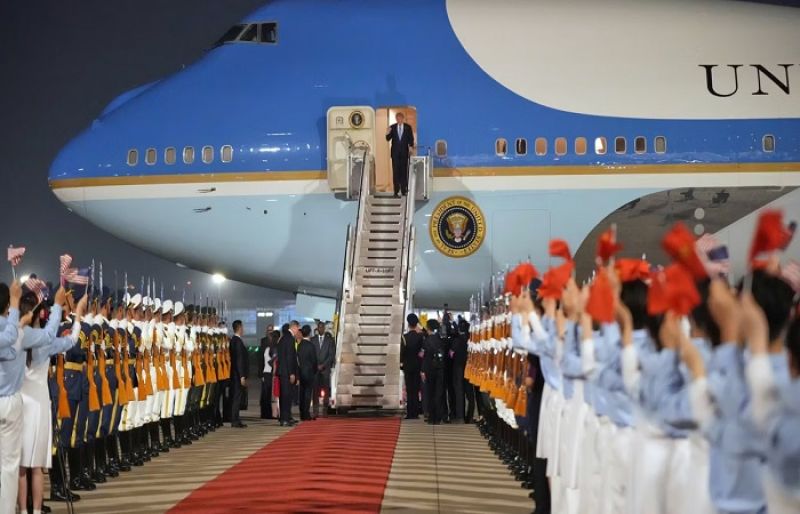
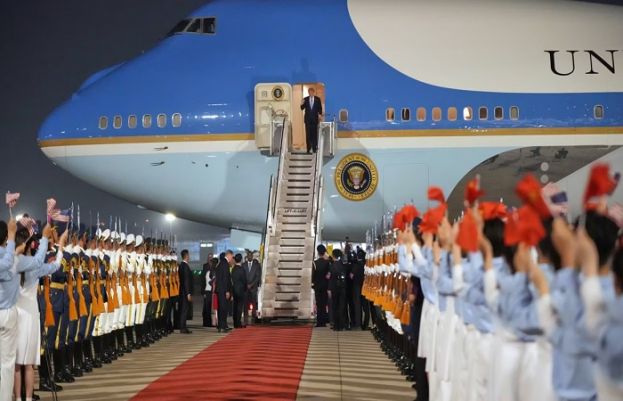
President Donald Trump landed in Beijing accompanied by an entourage that included Nvidia’s Jensen Huang and Elon Musk on Wednesday after pledging to urge China’s Xi Jinping to “open up” to US business at the start of their two-day summit.
Trump embarks on the first visit by a US president to China in nearly a decade eager to snag some deals, maintain a fragile trade truce with the world’s second economy, and prop up public approval ratings bruised by his war with Iran.
The CEOs accompanying Trump are drawn mainly from companies seeking to resolve business issues with China, such as Nvidia, which has struggled to get regulatory permission to sell its powerful H200 artificial intelligence chips there.
Trump asked Huang at the last minute to join the trip, said a source familiar with the matter who spoke on condition of anonymity, and he was spotted boarding Air Force One during a refuelling stop in Alaska en route to Beijing.
“I will be asking President Xi, a Leader of extraordinary distinction, to ‘open up’ China so that these brilliant people can work their magic,” he said in post on Truth Social, referring to the CEO delegation.
“I will make that my very first request.”
Asked about Trump’s post, Guo Jiakun, a spokesperson for China’s foreign ministry, said Beijing stands ready to “expand cooperation, manage differences and inject more stability and certainty into the turbulent world”.
As Trump prepared for the pomp-filled occasion, his trade negotiator Scott Bessent wrapped up three hours of preparatory talks with Chinese officials in South Korea. China’s official Xinhua news agency described them as “candid, in-depth and constructive”, but officials did not offer any detailed summary.
Trump’s two days of meetings will include a grand reception at The Great Hall of the People, a tour of Unesco heritage site Temple of Heaven and a state banquet.
Apart from trade, the talks will cover a host of sensitive subjects from the Iran war to US arms sales to Taiwan.
Trump is widely expected to encourage China to convince Tehran to make a deal with Washington to end the conflict, though he has said he did not think he would need its help.
China reiterated on Wednesday its strong opposition to US arms sales to Taiwan, with the status of a $14-billion package awaiting Trump’s approval still unclear.
Bessent preps in South Korea
While Trump rubbed shoulders with executives aboard Air Force One, Bessent held his latest round of trade negotiations with Chinese Vice Premier He Lifeng at a VIP reception room at South Korea’s Incheon airport.
The talks ran about three hours to end just before 4 p.m. (0700 GMT), a U.S. official said.
The two sides are eager to maintain a truce struck last October in which Trump suspended triple-digit tariffs on Chinese goods and Xi backed away from choking global supplies of rare earths, vital in making items from electric cars to weapons.
They are also expected to discuss forums to support mutual trade and investment and dialogue on AI issues, while Washington looks to sell Boeing BA.N airplanes, farm goods and energy to China to cut a trade deficit that has long irked Trump, U.S. officials have said.
Beijing, for its part, wants the U.S. to ease curbs on exports of chipmaking equipment and advanced semiconductors.
Trump enters the talks with a weakened hand.
Courts have hemmed in his ability to levy tariffs at will on exports from China and other countries.
The Iran war has also boosted inflation at home and escalated the risk that Trump’s Republican Party will lose control of one or both legislative branches in November’s midterm elections.
Though the Chinese economy has faltered, Xi does not face comparable economic or political pressure.
“The Trump administration needs this meeting more than China does, as it needs to show to American voters that deals are signed, money is made,” said Liu Qian, founder and CEO of Wusawa Advisory, a Beijing-based geopolitical advisory firm.
While Trump has lauded his personal rapport with Xi and respect for China, several Beijing residents told Reuters they viewed his visit with a mixture of hope and suspicion.
“I don’t know if he’s genuinely sincere,” Lou Huilian, a 44-year-old who works in the oil trade said outside a metro station as she headed to work on Wednesday.
“But speaking as a Chinese person, and as someone working in trade, I just hope some good policies can come out of this.”


Overworked AI Agents Turn Marxist, Researchers Find
Petrol and diesel prices may rise if Middle East crisis persists, says RBI Governor Sanjay Malhotra – The Times of India

OpenAI Brings Its Ass to Court

-

 Tech5 days ago
A new frontier: Identity stack evolves for agentic systems | Computer Weekly
-

 Tech5 days ago
‘Orbs,’ ‘Saucers,’ and ‘Flashes’ on the Moon: Pentagon Drops New UFO Files
-

 Tech5 days ago
Nick Bostrom Has a Plan for Humanity’s ‘Big Retirement’
-
 Business1 week ago
India among most resilient large EMs, better placed for future global shocks; policy reforms & strong buffers help: Moody’s – The Times of India
-

 Tech6 days ago
What Microsoft Executives Really Thought About OpenAI in 2018
-

 Sports5 days ago
Shaheen Afridi achieves landmark feat during opening Test against Bangladesh
-

 Fashion5 days ago
New orders in German manufacturing up 5% MoM in Mar 2026: Destatis
-
 Tech6 days ago
The Canvas Hack Is a New Kind of Ransomware Debacle