

Business
Why hackers are targeting the world’s shipping

Emma WoollacottTechnology reporter
 Getty Images
Lawyer Henry Clack sadly knows a lot about Nigerian criminal gangs.
Mr Clack, a solicitor at London-based commercial law firm HFW, has to deal with them when he is representing global shipping firms that have found themselves victims of cyber attacks.
“Of the cases which HFW have been involved in, the most common counterparties that we’ve encountered are Nigerian organised criminal organisations,” he says.
“They have been responsible for perpetrating several high value ‘man-in-the-middle’ frauds in recent years.”
This type of fraud involves a hacker being able to intercept the communication between two parties, such as emails. The criminal then impersonates both in order to try to steal sensitive information, such as log-in details or financial data, or even to take control of a company’s computer system.
The cyber criminals then demand money to give back what they have stolen, or to give up their command of a firm’s computers.
HFW’s data shows that such hacking is a growing problem for the shipping sector, both attacks on ships and ports. It says that between 2022 and 2023 the cost of dealing with an attack doubled to an average of $550,000 (£410,000).
Meanwhile, in cases where cyber security experts cannot easily remove the hackers, HFW says the average cost of a ransom payment is now $3.2m.

 Henry Clack
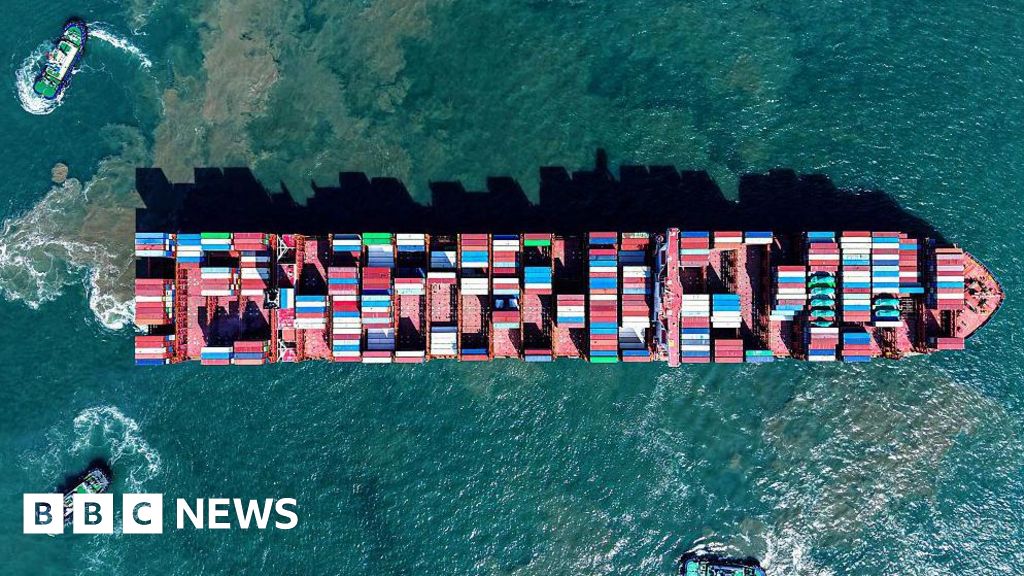
Around 80% of world trade is carried by sea, and disruption can greatly increase shipping firms’ costs, and leave them short of capacity.
This, says John Stawpert, manager for environment and trade in the marine department of the International Chamber of Shipping (ICS), makes the maritime industry a prime target for cyber attacks, from both criminal gangs and hostile countries.
“Cyber security is a major concern for the shipping industry, given how interconnected the world is. Shipping has been listed as one of the top 10 targets for cyber criminals globally,” he says.
“The impact can be quite significant if cyber criminals manage to disrupt your operations or, for example, carry out a ransomware attack.”
And the rate of attacks is rocketing. A research group at the Netherlands’ NHL Stenden University of Applied Sciences compiled data on shipping cyber attacks over the last few years, and found that the number shot up from just 10 in 2021 to at least 64 last year.
Many incidents, says Jeroen Pijpker of the university’s Maritime IT Security research group, are linked to the governments of four countries – Russia, China, North Korea and Iran.
“What we saw with one example was that equipment was being shipped to Ukraine, and then on a Telegram channel we see people giving information about what kind of targets to attack to get some kind of disruption in the logistical chain [of that delivery].”
Other attacks are purely for financial extortion, be it gangs from Nigeria or elsewhere.
 Getty Images
One reason for the recent rapid rise in cyber attacks is that there are now simply more routes for hackers to use.
Over the last few years, the industry has become more digital, while new communication technologies, Elon Musk’s Starlink satellite service, for example, have meant that ships have become more connected to the outside world. And therefore more hackable.
In one incident last year, a US Navy chief was relieved of her duties after she had installed an unauthorised satellite dish on her combat ship, so that she and other officers could access the internet.
Meanwhile, much of the official digitisation in the maritime industry has happened in a piecemeal way, and involves technology that can go rapidly out of date. The average cargo ship, says Pijpker, is around 22-years-old, and shipping companies can’t afford to have them out of the water too often to update.
Digitisation has brought other risks, too, including GPS jamming and “spoofing”.
“GPS spoofing means sending the navigation system a false location, and this means that the ship takes a completely different route – it can even be damaged physically if it gets into shallow waters,” says Ark Diamant of security firm Claroty.
In May it was widely reported that a container ship called MSC Antonia had run aground in the Red Sea after a suspected GPS spoofing attack.
While no suspect was accused in the reporting, Yemen’s Houthi rebels have physically attacked other cargo ships in the area. Other examples of GPS targeting in the Baltic Sea have been blamed on Russia.
 Getty Images
Defending against GPS jamming and spoofing is difficult and expensive, but “anti-jam” technology is available.
Meanwhile, another weakness for cargo ships is the increased use of sensors to monitor their emissions. These often transmit the data, so offer hackers another possible line of entry and attack.
The good news is that the industry is working to tighten up security. In 2021, the International Maritime Organization (IMO) regulator added new cyber security provisions to its global safety management code for merchant shipping.
“These provisions brought into law more specific cyber risk management requirements to be incorporated into the ship safety management system, to address deliberate cyber-attacks, and to prescribe risk management practices into the operation of compliant merchant ships,” explains Tom Walters, another shipping specialist at HFW.
Ship management systems are now required – rather than simply advised – to include increasingly stringent cyber security measures, ranging from basic security hygiene to more technical operational and IT measures.
“Personally, I think the industry is in a good place to deal with the threat – certainly compared with six or seven years ago,” says Mr Stawpert.
“There’s hugely increased awareness across the industry of cyber attacks and cyber crime, and that will increase over the coming years.”
Back at law firm HFW, how exactly do they communicate with the criminal gangs? Henry Clack says it is via electronic text, and kept as brief as possible.
“When it does happen, it is more often than not in the context of ransomware ransom negotiations. Communication is via online messaging services, maybe one message, no more than a couple of sentences, each day.”

Last Updated:
Warner Bros Discovery signed a SUD 11 billion deal with Paramount Skydance Friday morning, as revealed in a global town hall audio clip.




Warner Bros signs USD 110 billion deal with Paramount (Image for representation)
Warner Bros Discovery (WBD.O) signed a SUD 110 billion deal with Paramount Skydance (PSKY.O) Friday morning, the two companies announced, marking one of the most consequential media mergers in recent history.
“Netflix had the legal right to match the PSKY offer. As you all know, they ultimately decided not to do that. That then resulted in a signed agreement with PSKY as of this morning. So that’s where everything stands,” Bruce Campbell, Warner Bros’ chief revenue and strategy officer, said, as quoted by news agency Reuters.
The companies revealed that the deal is expected to close in the third quarter of 2026.
The deal was inked as Netflix declined to match Paramount’s latest USD 31-per-share offer, pulling out of the bidding war for Warner Bros. Discovery’s studio and streaming assets.
According to the Reuters report, citing sources, Warner Bros received the contracts from Paramount on Saturday and within the following two days, it announced that Paramount’s offer was superior.
The deal was immediately approved by board of directors of both media giants, said the companies in a joint statement.
The deal is “subject to customary closing conditions, including regulatory clearances and approval by WBD shareholders, with a vote expected in the early spring of 2026″, the statement read.
Interestingly, Paramount Skydance is headed by David Ellison, the son of Silicon Valley billionaire Larry Ellison, a close ally of President Donald Trump.
“By bringing together these world-class studios, our complementary streaming platforms, and the extraordinary talent behind them, we will create even greater value for audiences, partners and shareholders — and we couldn’t be more excited for what’s ahead,” David Ellison said in a statement.
NOT A ‘MUST HAVE’
In a stunning move hours later, Netflix announced it would not match Paramount Skydance’s latest offer to acquire Warner Bros Discovery. Netflix co-CEOs Ted Sarandos and Greg Peters asserted that “this transaction was always a nice to have at the right price, not a ‘must have’ at any price.”
TRUMP YET TO COMMENT
At one point, President Donald Trump said he might weigh in on the agreement. However, he told NBC News in early February that he would not be “involved” in the proceedings.
Then, last week, he issued a warning to Netflix, saying it would “pay the consequences” if it did not fire board member Susan Rice, an ex-official of the Biden administration.
During a podcast, Rice had said the entities that “take a knee” to the President would be “held accountable” when Democrats return to the office.
Meanwhile, the President is yet to comment on the deal.
 Click here to add News18 as your preferred news source on Google.
Follow News18 on Google. Join the fun, play games on News18. Stay updated with all the latest business news, including market trends, stock updates, tax, IPO, banking finance, real estate, savings and investments. To Get in-depth analysis, expert opinions, and real-time updates. Also Download the News18 App to stay updated.
Washington D.C., United States of America (USA)
February 28, 2026, 07:48 IST
Read More
Business
UAE makes history: Central Bank launches world’s first sovereign financial cloud with AI for secure digital finance – The Times of India

In a bold leap that could redefine how modern financial systems operate, the Central Bank of the United Arab Emirates (CBUAE) has announced the launch of what it calls the world’s first sovereign financial cloud services infrastructure, a secure and AI-powered digital backbone designed specifically for the nation’s financial sector. This initiative, developed in partnership with Core42 (a subsidiary of AI and technology group G42), aims to position the UAE at the forefront of secure, sovereign digital finance and bolster its reputation as a global hub for innovative financial services.The platform, known as the Sovereign Financial Cloud Services Infrastructure (SFCSI), is set apart from traditional cloud environments by its focus on data sovereignty, integrated cybersecurity and unified multi-cloud management, all underpinned by advanced artificial intelligence and real-time analytics. In practical terms, this means the UAE’s financial sector will be able to process, analyse and automate critical banking functions with unprecedented speed and regulatory control, securely within national borders.
What makes the UAE’s sovereign financial cloud revolutionary
Unlike most cloud services, which are operated by global providers and often host data far from the jurisdictions that regulate them, the SFCSI is built on a fully isolated and centralised infrastructure that ensures critical financial data remains within the UAE’s legal and security perimeter. Governments and regulators see this as key not just for privacy but for economic and strategic sovereignty in a world where data and finance increasingly intersect.This approach mirrors broader global trends toward digital sovereignty, where countries aim to protect sensitive infrastructure from foreign interference, whether from geopolitical tensions or shifting international data laws. By embedding regulatory controls and governance tools directly into the cloud platform itself, the CBUAE is seeking to reduce reliance on foreign systems and strengthen confidence in the nation’s financial resilience.Core42’s involvement is not just as a technical builder; the partnership brings integrated artificial intelligence and advanced analytics directly into the financial backbone. This allows licensed financial institutions and the CBUAE to automate operational processes intelligently, analyse real-time data for risk and performance insights, improve decision-making with predictive models and enhance customer service through automated, data-driven workflows.In a world where financial services are rapidly becoming more complex and interconnected, AI integration at the infrastructure level offers both competitive edge and stronger defences against threats like fraud, system failure or cyber-attacks. The new system also provides a single management framework for multiple cloud services, giving licensed financial institutions the flexibility to administer a range of cloud environments, including private and hybrid setups, seamlessly and securely. This capability is particularly valuable for institutions that need to balance agility and innovation with strict regulatory compliance.
Implications for the UAE and global financial landscape
For the UAE’s banks, insurers and fintech startups, the SFCSI represents a foundational piece of digital transformation. Regulatory oversight will be more immediate and nuanced, while institutions can scale new digital products, from personalised banking apps to smart payment systems, without compromising on security or compliance.Officials from the CBUAE emphasised that the platform will serve the entire licensed financial sector, reinforcing not just operational resilience but also long-term sustainable growth as financial services evolve. The central bank’s leadership views this as a pivotal step in strengthening the nation’s competitiveness on the world stage.The UAE’s move toward a sovereign financial cloud resonates with a broader global push for digital control over critical infrastructure. Various countries are debating how to balance openness to global technology with the need to protect sensitive financial and governmental data, a tension that’s only grown more pronounced as cyber threats increase and geopolitical competition around tech intensifies. By being among the first to embed sovereign control, AI capabilities and cloud innovation at this scale, the UAE is signalling that it intends to lead in secure, regulated digital finance, not just participate in it.While this cloud platform is targeted at the financial sector, its development aligns with the UAE’s wider strategy of integrating AI and digital infrastructure across governance, public services and enterprise systems. The inclusion of AI, real-time analytics and automation at a national infrastructure level could help catalyse further technological development in related fields such as central bank digital currencies (CBDCs), national payments innovation and cross-border financial integration.
What UAE’s sovereign financial cloud platform means for everyday users and institutions
For banks and financial firms, the SFCSI offers a more efficient way to innovate and comply with regulations, potentially making services faster, more secure and easier to tailor to customer needs. For consumers and businesses, the shift could translate into:
- More secure banking services with enhanced protections.
- Better digital experiences built on real-time insights.
- Faster product rollouts as institutions leverage automated, AI-powered infrastructure.
- Greater confidence in data privacy and national sovereignty
The rollout of such an infrastructure may also attract international finance players, tech investors and startups looking to base operations in a secure, innovation-friendly jurisdiction. The Central Bank of the UAE (CBUAE) has unveiled what it calls the world’s first sovereign financial cloud services infrastructure, developed with technology partner Core42.The Sovereign Financial Cloud Services Infrastructure (SFCSI) is designed to ensure data sovereignty, robust cybersecurity, AI integration, and unified multi-cloud management for the UAE’s financial sector. Built with advanced AI and analytics, it will enhance automation, real-time decision-making and innovation within licensed financial institutions. The move reinforces the UAE’s ambitions to be a global leader in secure, digital finance, aligning with broader global trends toward sovereign digital infrastructure.

Rodney Benson, a media professor at New York University, called the deal “concerning”, would leave America’s largest media companies further concentrated in the hands of conservatives. Many of those owners, including the Ellison family, have separate, non news-related business interests that depend on government contracts or regulation and are therefore particularly vulnerable to pressure, he adds.

Warner Bros Discovery Inks USD110 Billion Deal with Paramount Skydance

Georgetown guard KJ Lewis (ankle) out for rest of season

Neil Sedaka, singer whose hits included “Laughter in the Rain,” dies at 86

-

 Tech1 week ago
A $10K Bounty Awaits Anyone Who Can Hack Ring Cameras to Stop Sharing Data With Amazon
-
 Business1 week ago
US Top Court Blocks Trump’s Tariff Orders: Does It Mean Zero Duties For Indian Goods?
-

 Fashion1 week ago
ICE cotton ticks higher on crude oil rally
-

 Tech1 week ago
Donald Trump Jr.’s Private DC Club Has Mysterious Ties to an Ex-Cop With a Controversial Past
-
 Business7 days ago
Eye-popping rise in one year: Betting on just gold and silver for long-term wealth creation? Think again! – The Times of India
-

 Entertainment1 week ago
The White Lotus” creator Mike White reflects on his time on “Survivor
-

 Politics6 days ago
Pakistan carries out precision strikes on seven militant hideouts in Afghanistan
-

 Politics1 week ago
US Supreme Court strikes down Trump’s trade tariff measures