

Business
Gold prices keep rising, and jewelry companies are sounding the alarm


Gold prices held steady on Thursday, hovering near the record high hit the day before, helped by expectations of further U.S. rate cuts and political uncertainty.
David Gray | Afp | Getty Images
Amid global economic turbulence, the prices of precious metals have been climbing higher and higher.
The price of gold in particular has skyrocketed over the past year, rising more than 50%. For midsize jewelry companies aiming to offer fine gold necklaces, earrings and more at lower price points than legacy luxury jewelry brands, gold futures could be spelling trouble.
Though gold is often subject to market fluctuations, investors have been increasing their holdings over the past year over recession fears and market uncertainty, according to Goldman Sachs. Gold is on pace for its third straight year of double-digit gains, even hitting record highs this week during the government shutdown.
On Tuesday, gold prices hit $4,000 an ounce for the first time in history — and they’re showing no signs of slowing down.
Analysts from UBS wrote last week that lower interest rates, weakness in the dollar and political uncertainty will only continue to drive the price of gold higher.
“We now expect inflows for this year to be 830 metric tons, which is almost double our initial forecast of 450 metric tons at the start of the year,” the UBS analysts wrote in a note. “The key risk for gold is better U.S. growth and if the Fed is forced to raise rates due to inflation-related upside surprises.”
A Goldman Sachs report from late last month predicted the climb, forecasting that the price of gold will rise 6% through the middle of 2026 to $4,000 per troy ounce, a unit of measurement used for precious metals. The report categorized buyers of gold into two groups: conviction buyers, who purchase the metal consistently, and opportunistic buyers, who jump in “when they believe the price is right.”
The analysts said they expect central banks to continue buying gold for three more years.
“Our rationale is that emerging market central banks remain significantly underweight gold compared to their developed market counterparts and are gradually increasing allocations as part of a broader diversification strategy,” analyst Lina Thomas wrote.
And according to July survey data from the World Gold Council, roughly 95% of central banks expect global gold holdings to rise in the next year.
Gold futures
That uncertainty comes on top of an already turbulent global economy reeling from changing tariff policies from President Donald Trump. Though he made clear in August that gold will not be tariffed and that bars from Switzerland will not be subject to the country’s 39% tariff, Trump’s steep rates on other countries have been disrupting the global supply chain.
For jewelers, the rising price of the precious metal may be a cause for concern. Large retailers like Pandora and Signet have signaled that they are exploring price hikes or alternative manufacturing methods to counteract the hit they’re taking from gold.
And some jewelry companies that aim to offer gold products at lower price points, like Mejuri, are feeling the pressure too.
Mejuri, which aims to sell gold and luxury jewelry at more affordable levels than its competitors, announced last month that the company was being forced to raise its prices due to the rising cost of gold, silver and tariffs.
“While we’ve been doing everything we can to absorb the impact and preserve the quality and craftsmanship you expect from us, you’ll see some prices update on Monday, September 29th,” Mejuri wrote in an email to customers. “We’re tackling these shifts head-on: streamlining our supply chain, strengthening sourcing and designing with pricing in mind.”
The company said it’s also innovating new products like 10 karat solid gold to keep offering quality jewelry at affordable prices. Mejuri declined to comment.
‘A fear indicator’
With the price of gold rising and showing no signs of stopping, some jewelry companies are being forced to be innovative with their pricing and products.
In its second-quarter earnings report in August, Pandora said it faced an 80-basis point hit due to higher prices of gold and silver and that it planned some price adjustments to offset those headwinds. And on Signet’s most recent earnings call in early September, the company said it had seen more than 30% increase in the cost of gold.
BaubleBar, which specializes in fine jewelry, offers a large selection of “demi-fine” gold pieces, which co-founder Daniella Yacobovsky said has allowed the company to somewhat avoid the brunt of the pressure from gold prices.
The company’s demi-fine jewelry features a thick, high-quality 18k gold plated over a sterling silver base, which allows BaubleBar to avoid the costs associated with solid gold jewelry. The brand’s demi-fine earrings range from anywhere between $50 to $150.
“We’ve actually seen a really huge increase in interest in demi-fine,” Yacobovsky told CNBC. “I think that it offers people a really fantastic alternative to solid gold. … You’re going to get a really fantastic quality similar to that for a lower price point.”
Still, Yacobovsky said it’s concerning that significant events affecting the global economy are happening at higher rates than even five years ago. She said she hasn’t seem something as volatile as the skyrocketing price of gold in the industry “for a long time.”
The key, she said, will be for businesses to capitalize on their ability to make smart choices.
For Alexis Bittar, CEO of his eponymous jewelry company, the smart choice meant leaning into gold-plated pieces, which allows the company to save costs over solid gold, and raising prices slightly to match the products that are coming in.
But the company is not repricing any of its existing products, Bittar said.
“You’re constantly juggling between the tariff and the acceleration of the gold prices, so you’re staying within a price point that you’re known for,” Bittar said. “From the consumer side, they’re not really caring. They vaguely know the prices of gold are going up … but mentally, they have an unconscious price point that they’re looking to spend, and when you start to way exceed it, you’re pricing people out.”
Bittar said his company is seeing a “cautious” consumer, but that any pullback in spending is likely more related to solid gold than plated gold, and that the wealthy consumer base is more willing to pay higher prices than lower- or middle-income shoppers.
Even for ear piercing company Rowan, which also offers gold jewelry, the rapidly changing industry may be spelling trouble. CEO Louisa Schneider told CNBC that it’s hard to imagine any other industry whose raw material costs have risen as dramatically as gold.
Rowan Piercing Studio’s Suburban Square location in Ardmore, PA.
Courtesy: Rowan
Because ear piercing requires some level of surgical steel or titanium for ideal healing, Rowan often uses 14k gold to coat those materials, leaving the company “somewhat insulated” from the rising price of gold because it is required to uphold certain health and safety standards.
Still, Schneider said Rowan had to raise prices on some of its gold pieces in the beginning of the third quarter, which she said customers are willing to pay for because the company specializes in employing trained nurses for the piercings.
“This is a fear indicator. So that, from my standpoint, is quite concerning,” Schneider said. “Our expectation is that we do not see a significant reduction in the current pricing – if anything, we expect that gold will continue to be quite expensive. So we will continue to hedge ourselves and to work really closely with our vendors.”
Schneider said she’s seeing an “inflection point” in the price of gold and that it’s a cause for concern for all jewelry companies, but especially those that are unable to raise their prices to counteract the costs because they sell to non-luxury consumers who are less flexible with price changes.
Ultimately, she said this serves as a warning sign for the broader economy, even if it might not be hitting Rowan too hard.
“The demand is not coming from consumers that want to wear gold or industries that require gold as a component of manufacturing,” Schneider said. “This is coming from a hoarding of gold given an uncertainty around the U.S. dollar, and that’s unlike anything that we’ve seen.”
Correction: A previous version of this story misstated Signet’s sales.





Business
Rs 20,000 crore gold, silver rush: What will people buy this Akshaya Tritiya? – The Times of India
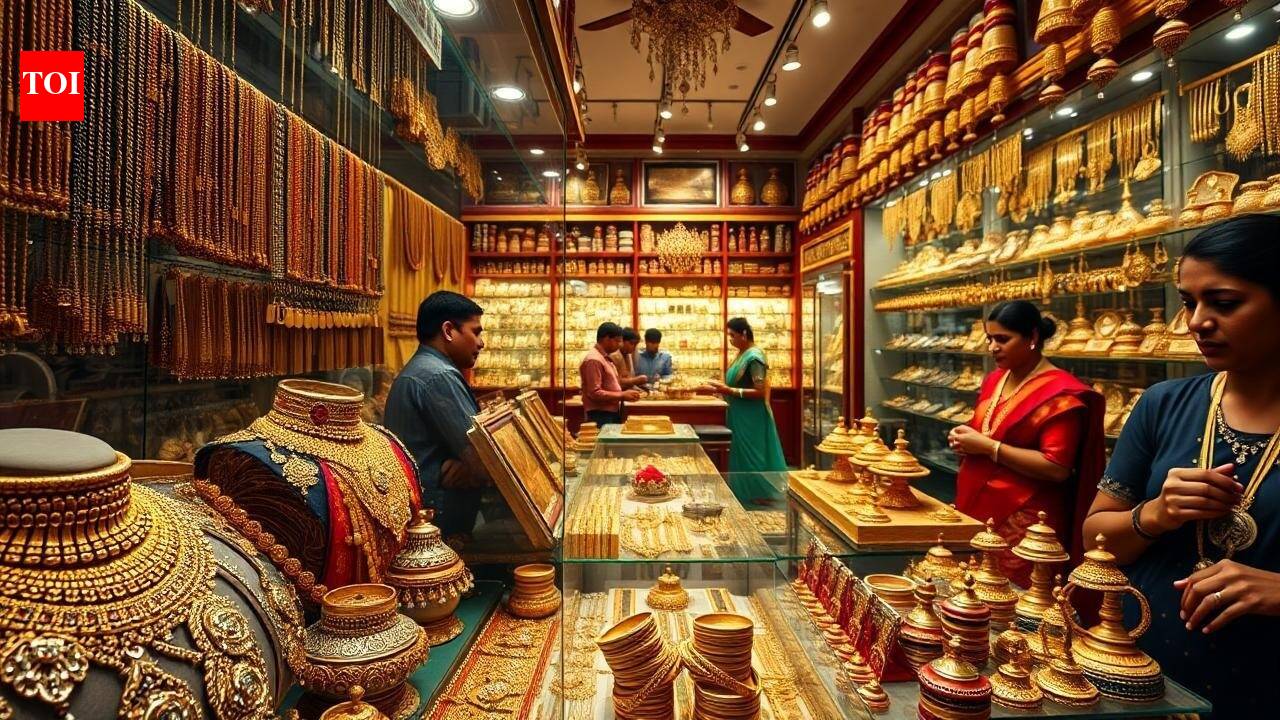
This Akshaya Tritiya, India’s gold and silver markets are heading for bumper purchases, with overall trade likely to cross Rs 20,000 crore even as record-high prices reshape buying patterns. The estimate, shared by the Confederation of All India Traders (CAIT), is higher than last year’s Rs 16,000 crore, signalling growth in value despite a sharp rise in bullion rates.Prices for the yellow metal have surged sharply over the past year, going from Rs 1,00,000 per 10 grams, to Rs 1.58 lakh. Meanwhile, silver has shown a steeper rally, jumping from Rs 85,000 per kilogram to Rs 2.55 lakh per kilogram. According to CAIT, this sharp escalation has not weakened demand, but is instead prompting consumers to make more deliberate and value-oriented purchases.Praveen Khandelwal, member of parliament from Chandni Chowk and secretary general of CAIT told ANI, “Akshaya Tritiya has traditionally been one of India’s most auspicious occasions for purchasing gold… While gold continues to dominate, the nature of purchasing is evolving significantly in response to steep price escalation.”Commenting on customer preference, CAIT national president BC Bhartia highlighted, “There is a clear shift towards lightweight, wearable jewellery, alongside a stronger focus on silver and diamond products. Attractive incentives such as reduced making charges and complimentary gold coins are also helping sustain consumer interest.”Despite the increase in overall trade value, the quantity of metals being sold tells a different story. Pankaj Arora, National President of the All India Jewellers and Goldsmith Federation (AIJGF), an associate of CAIT, explained that the projected Rs 16,000 crore gold trade amounts to nearly 10,000 kilograms (10 tonnes) at current rates. The value, spread across an estimated 2 to 4 lakh jewellers, translates to average sales of only 25 to 50 grams per jeweller, “clearly indicating a sharp decline in volume”.Meanwhile for silver, the estimated Rs 4,000 crore trade corresponds to around 1,56,800 kilograms (157 tonnes), resulting in average sales of about 400 to 800 grams per jeweller during the festival period. “These figures underline a critical shift: while the value of business is expanding due to rising prices, actual consumption is contracting,” Khandelwal said.This gap between value and volume is also reshaping consumer’s buying pattern, with smaller items and lightweight jewellery gaining popularity. At the same time, jewellers are facing challenges due to fluctuating prices, especially when it comes to managing inventory.Even so, festive demand remains steady, with markets witnessing healthy footfall. “Consumers are now adopting a more cautious and pragmatic approach, balancing traditional beliefs with financial discipline,” Khandelwal added.At the same time, it’s not just about physical gold anymore as consumers are increasingly exploring alternatives like digital gold, Sovereign Gold Bonds and gold ETFs, drawn by the promise of liquidity, safety and flexibility when prices are volatile.CAIT and AIJGF have urged jewellers to comply with mandatory hallmarking standards, including HUID certification, and advised buyers to verify the purity and authenticity of their purchases.

Lauren Elcock is among the young Londoners who say rising rents are forcing them to quit the capital.
Source link
As governments across the world restricted the movements of their citizens during Covid lockdowns from 2020, people spent more time online. We bought more online and socialised more online, and this brought us closer to the people who want to scam us. At the same time, realistic video impersonations, voices, websites, and texts became more commonplace, and scammers increased their use of social media including WhatsApp.

Rs 20,000 crore gold, silver rush: What will people buy this Akshaya Tritiya? – The Times of India

Prince Harry corrects blunder before peace with King Charles suffers again
The cost of rising rents: Working four jobs and pushed on to benefits

-

 Entertainment6 days ago
Palace left in shock as Prince William cancels grand ceremony
-

 Sports6 days ago
The case for Man United’s Fernandes as Premier League’s best
-

 Politics1 week ago
Chinese, Taiwanese will unite, Xi tells Taiwan opposition leader
-

 Entertainment1 week ago
Dua Lipa hits major career high ahead of wedding with Callum Turner
-
 Business1 week ago
100% road tax waiver for electric cars, new rules for 2, 3 and 4 wheelers – what Delhi govt’s draft EV policy says – The Times of India
-
 Business6 days ago
UK could adopt EU single market rules under new legislation
-
 Business1 week ago
The FAA wants gamers to apply for air traffic control jobs
-

 Sports1 week ago
Lamar Jackson hits back at critics with faithful message on social media