

Business
Best Buy hikes sales forecast as shoppers upgrade tech, splurge on devices


A Best Buy store in Pinole, California, US, on Monday, Nov. 24, 2025. Best Buy Co. is expected to release earnings figures on November 25.
David Paul Morris | Bloomberg | Getty Images
Best Buy hiked its full-year forecast Tuesday, as it topped Wall Street’s quarterly sales expectations and customers turned to the retailer to upgrade laptops and splurge on new gaming consoles and smartphones.
The consumer electronics retailer said it now expects revenue of between $41.65 billion to $41.95 billion for the full year, higher than its previous range of $41.1 billion to $41.9 billion. It expects adjusted earnings per share of $6.25 to $6.35, compared with its prior range of $6.15 to $6.30.
Best Buy said it expects full-year comparable sales, a metric that tracks sales online and at stores open at least 14 months, to range between a 0.5% rise to a 1.2% increase, compared with its previous expectations for a 1% decline and a 1% climb.
On the company’s earnings call, CEO Corie Barry said Best Buy saw “better-than-expected” sales in the quarter because of strong results across computing, gaming and mobile phones, as well as growth in wearables and headphones. She said sales rose across both its website and stores.
She said customer shopping behavior in the most recent three-month period was about the same as what Best Buy has seen for the past several quarters.
“Customers remain resilient, but deal focused and attracted to more predictable sales moments,” such as back-to-school sales and Best Buy’s October sale that coincided with Amazon’s Prime Day event, she said.
And she said, “while customers continued to be thoughtful about big ticket purchases in the current environment, they are willing to spend on high priced point products when they need to or when there is technology innovation.”
Here’s how the retailer did for the three-month period that ended Nov. 1 compared with what Wall Street was expecting, according to a survey of analysts by LSEG:
- Earnings per share: $1.40 adjusted vs. $1.31 expected
- Revenue: $9.67 billion vs. $9.59 billion expected
Shares were up about 6% in afternoon trading on Tuesday. As of Monday’s close, Best Buy’s stock has dropped by about 12% this year. That compares with the 14% gains of the S&P 500 during the same period.
Best Buy has been waiting for some of the key catalysts that tend to drive its business, such as higher housing turnover that leads to appliance purchases, the tech innovations that spark demand for devices and expert advice, and the increased willingness by inflation-weary consumers to splurge on discretionary items.
Some of that tech innovation appears to be gaining momentum with sales of the Nintendo Switch 2, new iPhones and AI-enabled laptops. The company called out those merchandise categories as strengths in the most recent three-month period.
Best Buy’s net income for the fiscal third quarter fell to $140 million, or 66 cents per share, from net income of $273 million, or $1.26 per share, in the year-ago period. Adjusting for one-time items, including stock-based compensation and restructuring charges, Best Buy reported earnings of $1.40.
Revenue rose from $9.45 billion in the year-ago quarter.
Best Buy’s comparable sales increased 2.7% year over year. That was the company’s highest comparable sales growth in four years, Barry said.
In the U.S., the metric jumped 2.4%, as shoppers bought computers, gaming systems and mobile phones, but purchased fewer appliances and home theaters.
Getting ready for the holidays
Best Buy’s annual revenue has dropped for the past three years. With the updated guidance, the company expects annual revenue to be slightly higher than last year’s total of $41.53 billion.
Still, like other retailers, Best Buy said it’s continuing to see shoppers spend selectively and seek out value, and anticipates that will carry into the holiday season, Barry said on a call with reporters.
“We absolutely are seeing people make trade offs,” she said.
For instance, she said, some customers are buying TVs in the middle or lower tier of its price range rather than premium TVs. However, she said Best Buy’s reputation as a specialty retailer with many different brands and price points is helping it attract more low-income and younger customers.
As the holiday season heats up, Barry said the company is ready for key sales days like Black Friday and Cyber Monday and will have “deals across the spectrum for whenever people want to shop.”
Even so, the retailer gave a cautious outlook for the holiday quarter, saying it expects sales trends to decelerate from the previous quarter. Bilunas said the company expects comparable sales during the period to range from a 1% decline to a 1% increase.
On the company’s earnings call, he said Best Buy is seeing “positive growth” in the fourth quarter and a roughly similar trend to the third quarter, but faces tougher year over year comparisons and may see waning trends in some categories like gaming and wearables. In gaming, Nintendo Switch 2 sales haven’t been as strong as they were closer to the June launch.
“Obviously, the holiday is never easy to predict,” he said.” What we do believe is that we have a range of scenarios and the range we’ve provided gives us a great place to plan and plan our business operationally.”
Higher tariffs will be a complicating factor for the rest of the year, both in how they affect the company’s costs and consumer spending. On the company’s earnings call, Bilunas said higher tariffs so far haven’t had a meaningful impact on Best Buy’s prices or its sales. He said growth is coming from more unit sales.
Compared to other industries, he said, consumer electronics are a very promotional category and that’s muted the impact on average selling prices, he said.
Trying out Meta glasses, Sharkninja appliances
At Best Buy’s stores, the company has tried to give customers more reasons to try products by adding more vendor demos, Barry said on the company’s earnings call. For example, she said more than 50 of its locations have immersive showcase areas for Meta’s latest AI-enabled glasses, and demand for in-person demos has outpaced available appointments.
It has launched most of its pilot showrooms with Ikea, which it is testing in 10 stores across Texas and Florida. And other vendors, including Breville and Sharkninja, are also showing off items for home baristas and chefs or customers looking for health and beauty devices in its stores, she said.
Barry said “very early reads are positive and we are excited to monitor customer response during the holidays.”
To help drive growth, Best Buy also launched a third-party marketplace in mid-August to expand the brands and the items that it sells. About three months into the launch, the company has more than 1,000 sellers and 11 times more individual items available for online customers than it did before, Barry said on the earnings call.
So far, she said the company is seeing higher sales in categories like accessories and small appliances. She said customer return rates for marketplace items have run lower than first-party purchases, and more than 80% of marketplace product returns by customers have been at stores.
As the marketplace grows, she said it’s driving higher profits and creating new opportunities for Best Buy to sell online ads.
Despite the positive signs, some of Best Buy’s categories, including appliances, continue to lag.
Chief Financial Officer Matt Bilunas said the appliance category is “probably the most difficult one that we have in the market today.” He said historically, the company has sold new premium appliances and sets of appliances.
With the slower housing market, he said the company is seeing more shoppers replace a product that’s broken rather than buy a washer and dryer pair, and promotions haven’t been as effective. To speed up sales, Best Buy plans to increase its labor in the department, speed up deliveries to better compete with rivals and even make some items available same day, he said.
“And hopefully as housing and different things change, then the market starts to swing back to something that might be a little bit more normal,” he said.






As governments across the world restricted the movements of their citizens during Covid lockdowns from 2020, people spent more time online. We bought more online and socialised more online, and this brought us closer to the people who want to scam us. At the same time, realistic video impersonations, voices, websites, and texts became more commonplace, and scammers increased their use of social media including WhatsApp.
Business
NaBFID signs pact with PDCOR to expand advisory support for state projects – The Times of India

The National Bank for Financing Infrastructure and Development (NaBFID) has signed a Memorandum of Agreement with Projects Development Company of Rajasthan Limited (PDCOR) to strengthen advisory services for state and city-level infrastructure projects.The agreement will also allow both institutions to jointly explore financing and transaction advisory opportunities, including transaction structuring, commercial and technical due diligence, and support for financial closure of projects undertaken by state governments and urban local bodies across India, according to PTI.“This collaboration seeks to enhance access to long-term institutional finance for State Governments and Urban Local Bodies, while strengthening the infrastructure advisory and financing ecosystem,” Rajkiran Rai G., Managing Director of NaBFID, said.He added that the partnership would help both institutions jointly pursue project advisory opportunities, develop replicable financing frameworks, accelerate financial closures and mobilise capital across the infrastructure value chain.Monika Kalia, DMD-CFO, NaBFID, said the tie-up would leverage the strengths of both organisations to provide much-needed advisory support to states and urban local bodies for impactful urban infrastructure projects.Dileep Chingapurath, Chief Executive Officer, PDCOR, said the agreement would address the long-felt need for end-to-end professional support to structure and mobilise sustainable financing solutions, particularly for state governments and their agencies.“Through this collaboration, both institutions aim to enhance the quality of project preparation, mobilise institutional capital more effectively and accelerate the implementation of sustainable infrastructure projects across states and municipalities,” he said.NaBFID is a Development Financial Institution focused on long-term infrastructure financing, while PDCOR is an undertaking of the Government of Rajasthan.
Business
Explained: On way to 4th largest, how India slipped to 6th rank & what it means for 3rd largest economy dream – The Times of India
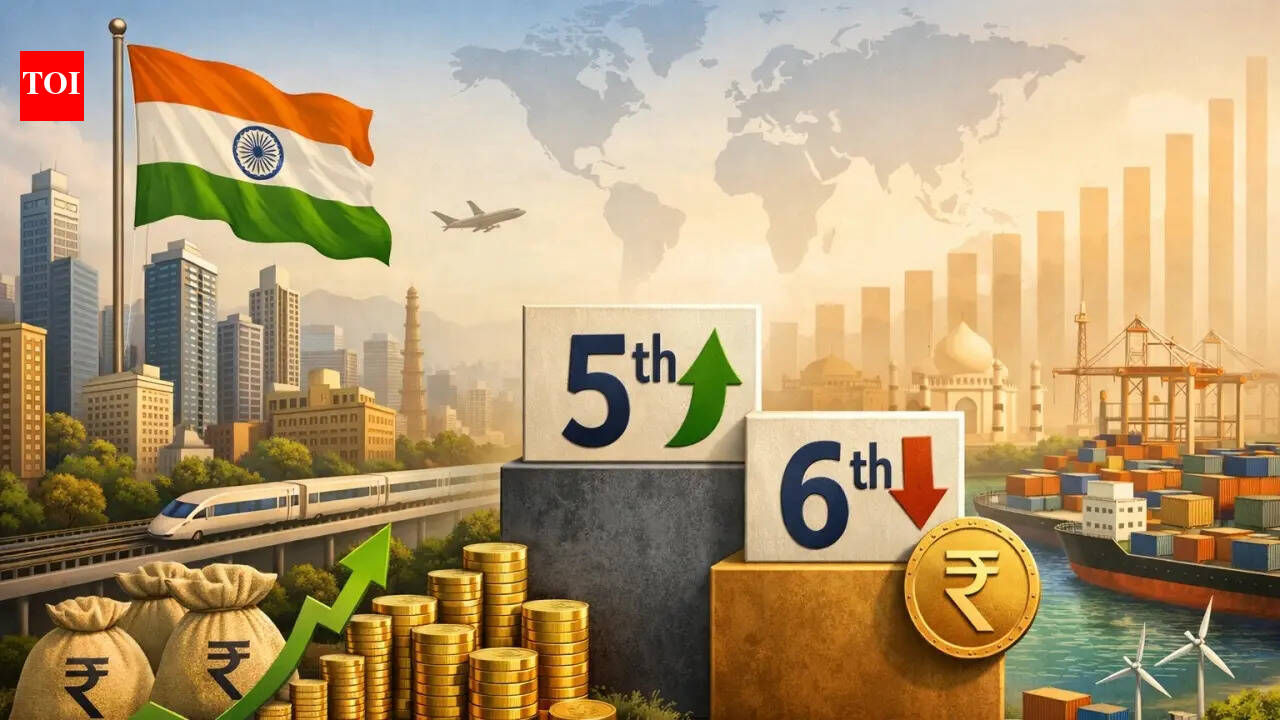
In April 2025 when the International Monetary Fund (IMF) released its World Economic Outlook, India was seen overtaking Japan to become the world’s fourth largest economy by the end of 2025-26. One year later, India has slipped to the sixth position on the largest economies rankings, with the United Kingdom reclaiming its spot as the fifth largest economy.In fact, IMF’s latest World Economic Outlook (April 2026) sees India sitting at the sixth spot this financial year too. This projection comes even as India has grown better than expected in FY26 and is seen retaining its tag of being the world’s fastest growing major economy.What has led to the sudden fall? Why has India dropped to the sixth position, falling behind the UK, instead of overtaking Japan to become the fourth largest economy? And what does this setback mean for its dream of becoming the third largest economy by the end of this decade? We decode:
Data drive: India projected as 4th largest, but fell to 6th spot
First let’s look at some IMF data to see which way the Indian economy was headed in April 2025, and what the April 2026 outlook data suggestsAs per April 2025 estimates of IMF, India’s economy would have been at $4601.225 billion at the end of FY 2025-26, overtaking Japan which was estimated at $4373.091 billion. The UK at the 6th spot was projected to have a nominal GDP of $4040.844 billion.However, as per the April 2026 estimates, India’s economy had a nominal GDP of $4,153 billion at the end of FY 2025-26, with the UK overtaking it with $4,265 billion GDP. Japan’s GDP is seen at $4,379 billion.As the above estimates show, India’s GDP estimates have seen a drop over one year, while UK’s nominal GDP has grown better than expected. Japan has been steady.So, what went wrong? Blame the rupee and GDP data itself!
Rupee Depreciation Blow & New GDP Series
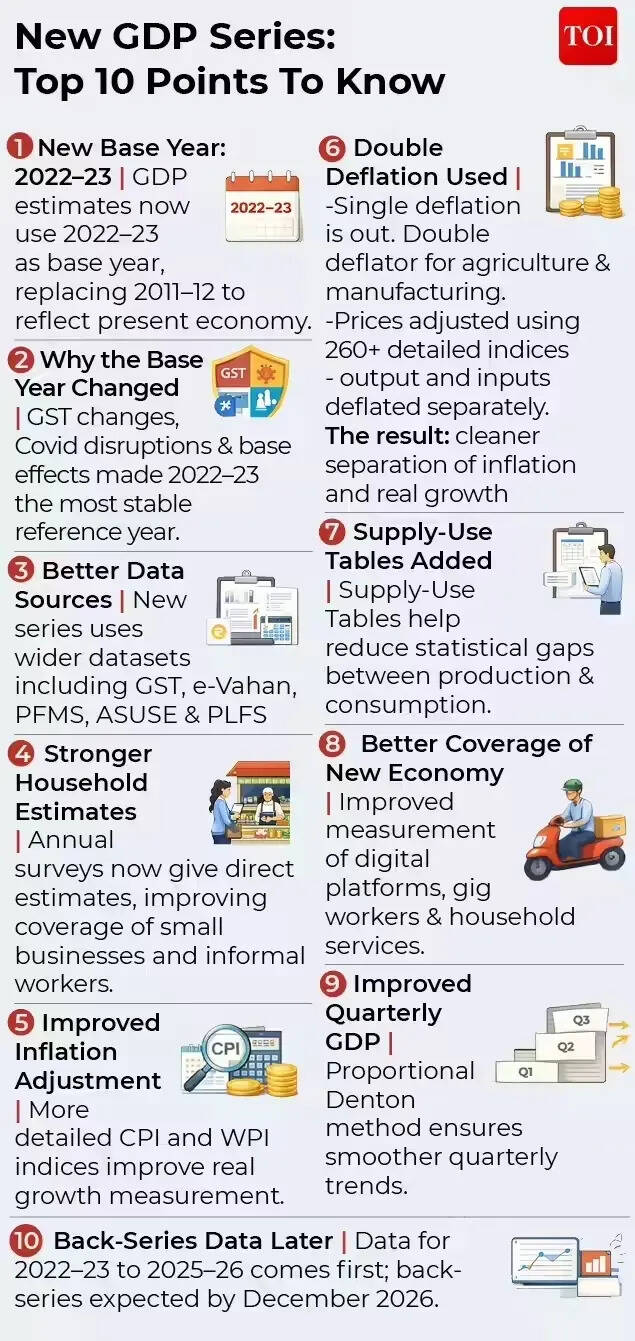
The first thing to understand is that IMF’s data on the size of a country’s nominal GDP is in dollar terms. Hence, with global rankings based on dollar‑denominated GDP, they are highly sensitive to exchange rate movements. The biggest party pooper for India’s dream of becoming the fourth largest has been the rupee’s slide. The Indian currency has depreciated more than expected over the last year, dropping from 84.57 versus the US dollar in 2024 to 88.48 in 2025, as per IMF data. The IMF estimates see it at 92.59 this year.Several factors have contributed to the rupee’s decline, including capital outflows, uncertainty related to India-US trade deal up until February, and the recent Middle East conflict which has raised crude oil prices and India’s import bill. Also, the RBI while actively managing volatility in the forex market, is not targeting any particular level of the rupee.Arun Singh, Chief Economist, Dun & Bradstreet India says that India’s recent slip to sixth place in global GDP rankings does not reflect a weakening of the economy, but is largely the result of currency conversion effects and a one‑time statistical revision.The rupee’s depreciation from 2024 to 2026, has mechanically compressed India’s GDP in dollar terms, effectively halving apparent growth despite strong domestic expansion, says Arun Singh.According to Ranen Banerjee, Partner and Leader, Economic Advisory Services, PwC India, GDP in US dollar terms would shave off with rupee depreciation. “We have had almost 7-8% depreciation over the last few months owing to the conflict and portfolio outflows. Thus, in effect in US dollar terms, it is close to shaving out almost a year’s nominal GDP,” he tells TOI.And it’s not just about the Indian economy. The United Kingdom which has overtaken India to bag the 5th spot again also has economic factors working in its favour. UK’s GDP growth at 0.5% has recently beaten forecasts of 0.1% by a wide margin. Not only that, its currency – pound – has actually appreciated against the US dollar.The second factor that has impacted the rankings is India’s adoption of a new base year for its latest GDP series. As per the new data, which also makes use of a more refined methodology, the size of India’s nominal GDP in rupee terms has gone down. Sample this: As per the older base year of 2011-12, India’s GDP at the end of 2025-26 would have been Rs 35,713,886 crore. But under the new series, it is estimated to be Rs 34,547,157 crore. The new calculation methodology and base year revision presents a more accurate picture of the size of the Indian economy.Hence the currency effect has been compounded by a one‑time downward revision following India’s shift to a new GDP base year, which has lowered reported nominal levels without affecting real activity.
Does India’s drop to 6th indicate fundamental weakness?
Experts are confident that India’s growth story is intact and fundamentally strong, a fact that is reflected in projections of it continuing to be the world’s fastest growing major economy. They see technical factors behind the current slip, rather than any deterioration in economic fundamentals.It’s also interesting to note that while India will be the sixth largest economy in FY27, in the upcoming financial year, it is likely to overtake both the UK, and Japan to bag the fourth spot.Arun Singh of Dun & Bradstreet India explains this resilience with numbers:IMF World Economic Outlook (April 2026) data show that India’s GDP at current prices in domestic currency rose strongly from ₹318 trillion in 2024 to ₹346.5 trillion in 2025 and further to ₹384.5 trillion in 2026, translating into robust nominal growth of about 8.9% in 2024–25 and nearly 11% in 2025–26, among the fastest globally. In contrast, other large economies recorded more moderate domestic nominal growth – around 5% in the US, roughly 4% in China, 3–5% in the UK, 3–3.5% in Germany, and lower or volatile growth in Japan – underscoring India’s strong underlying momentum. In times of global economic turmoil, while GDP growth is expected to take some hit, most agencies and experts have pegged India’s growth to be strong. Incidentally, the IMF has even marginally raised its GDP growth forecast for FY27 to 6.5% despite the ongoing Middle East conflict.
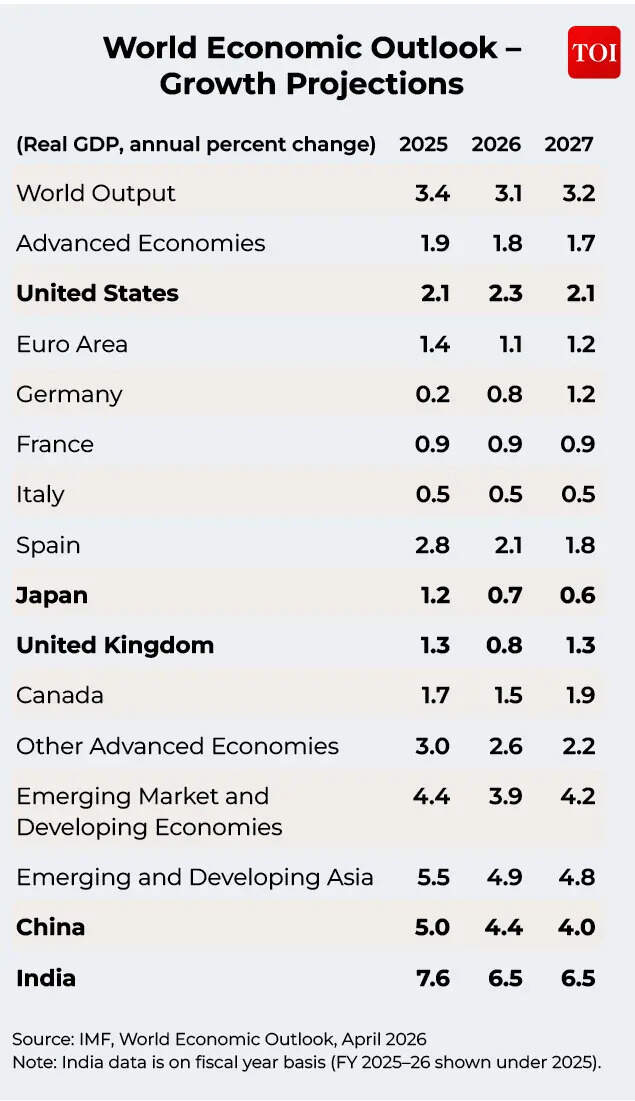
“In India, growth for 2025 is revised upward by 1.0 percentage point relative to October, to 7.6 percent, reflecting the better-than-expected outturn in the second and third quarters of the fiscal year and sustained strong momentum in the fourth quarter,” IMF said in its latest outlook. “For 2026, growth is revised upward moderately by 0.3 percentage point (0.1 percentage point relative to January) to 6.5 percent, led by positive contributions from the carryover of the strong 2025 outturn and the decline in additional US tariffs on Indian goods from 50 to 10 percent, which outweigh the adverse impact of the Middle East conflict. Growth is projected to stay at 6.5 percent in 2027,” it added.
Will India become 3rd largest anytime soon?
The rupee depreciation and the nominal GDP revision has also pushed back India’s dream of becoming the third largest economy by the end of this decade. In the October 2025 estimates, IMF had said that India will overtake Germany to become third largest by FY30. However, the April 2026 projections see it reaching the third rank only by FY 2030-31.Experts point to the rupee’s depreciation versus the dollar to note that the road ahead is likely to be uncertain. Madan Sabnavis, Chief economist, Bank of Baroda is confident that India will continue to do well in the coming years.“We will definitely improve in terms of GDP growth which will be higher than that of other countries especially UK and Japan which are just above us. However, the rupee value will finally determine how India gets placed on the global scale,” he told TOI.Ranen Banerjee of PwC India sees rupee beginning to get support with the conflict containment, relatively lower oil prices and portfolio flow reversals with valuations getting attractive in recent times. “Thus, we should not be experiencing any further sharp depreciation of the rupee in the immediate term provided the conflict does not escalate and oil prices relatively softening from their highs and come down to a range of $85-90 a barrel,” he says.For Arun Singh of Dun & Bradstreet, looking ahead, India’s relative position in US dollar‑based GDP rankings will remain highly sensitive to currency movements rather than domestic growth dynamics. “Continued global dollar strength or capital‑flow volatility may cause periodic slippage in rankings despite robust fundamentals. Sustaining external macro stability and limiting undue rupee volatility will be crucial for India’s strong growth performance to translate more fully into higher global economic rankings,” Arun Singh told TOI.The Indian economy, largely driven by domestic fundamentals, is not immune to external shocks. High US tariffs of 50% from August 2025 to early February, and the ongoing US-Iran war have spelt back-to-back shocks for the economy. Even as experts stress on the resilience of the growth story, the vulnerability to higher crude oil prices, and other global supply chain disruptions is a reality. In such a scenario, India may well have to contend with fluctuating world rankings, while banking on its strong GDP growth to tide over disruptions.

Scams have grown more sophisticated, but people are fighting back

Netflix star targeted by imposters after suspicious social media activity

Everything to know about venue, guest list, dress, more

-

 Politics1 week ago
Indian airlines hit hardest after Dubai limits foreign flights until May 31
-

 Entertainment6 days ago
Palace left in shock as Prince William cancels grand ceremony
-

 Politics1 week ago
Chinese, Taiwanese will unite, Xi tells Taiwan opposition leader
-

 Sports6 days ago
The case for Man United’s Fernandes as Premier League’s best
-

 Entertainment1 week ago
Dua Lipa hits major career high ahead of wedding with Callum Turner
-
 Business1 week ago
The FAA wants gamers to apply for air traffic control jobs
-
 Business6 days ago
UK could adopt EU single market rules under new legislation
-

 Sports1 week ago
Lamar Jackson hits back at critics with faithful message on social media