

Politics
Israel launches attack on Iran – says defence minister

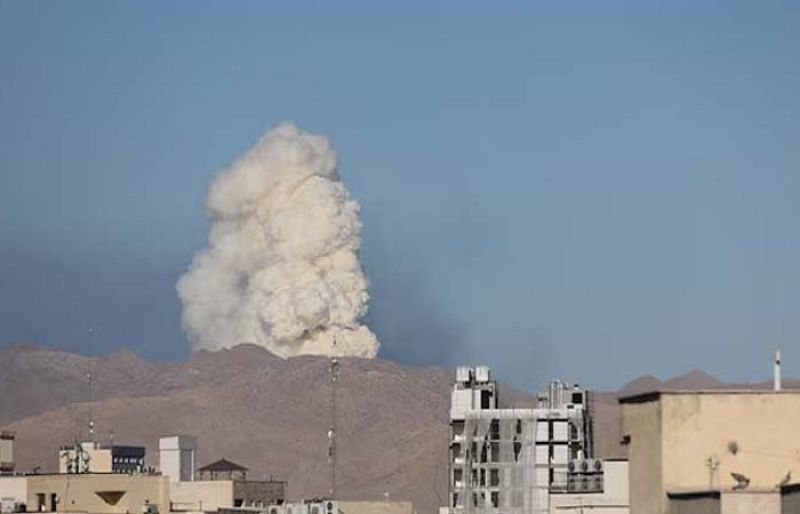

Israel has launched what it has called “pre-emptive attack” against Iran. In a statement this morning, Israeli Defence Minister Israel Katz has declared a “special and permanent state of emergency” across Israel.
Three explosions have been heard in downtown Tehran, according to Iranian media.
The Fars News Agency says it has received reports that several missiles have hit the Republic area of the Iranian capital.
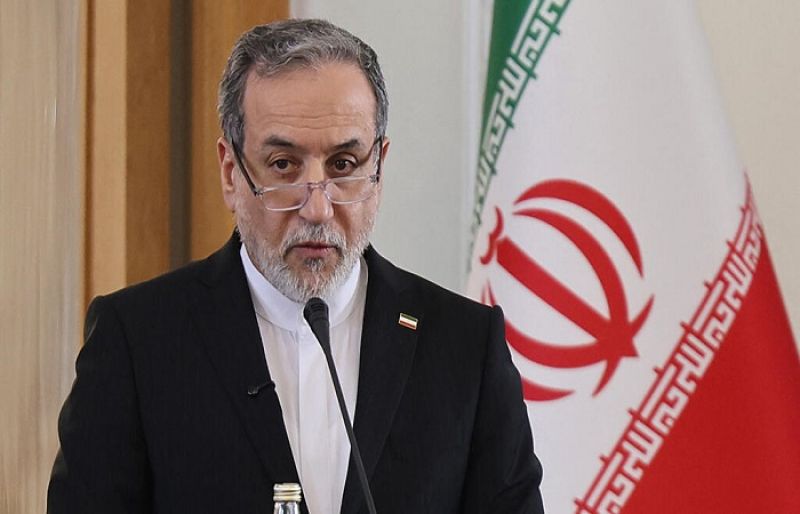

Iran’s Foreign Minister Abbas Araghchi said on Saturday that “regime change” in the Islamic Republic of Iran is an “impossible mission.”
He made the remarks in an interview with American satellite broadcaster NBC News, hours after the Israeli regime and the United States launched another unprovoked war of aggression against the country.
The aggression came in the middle of indirect nuclear talks between Tehran and Washington, mediated by the Omani government, with Araghchi leading the Iranian side.
Iran’s top diplomat said the Islamic Republic is a “great nation with a magnificent civilization” that has endured for thousands of years.
“We know how to defend ourselves and we will survive,” he told the US news channel, adding that the moment the aggression stops, Iran will also stop defending itself.
The Israeli regime and the United States carried out fresh aggression against Iran early on Saturday, targeting multiple cities, including the capital, Tehran.
Many casualties are feared, most of them civilians, including children.
Iranian armed forces responded with coordinated retaliatory operations, targeting multiple military and intelligence sites in the occupied territories as well as US military bases scattered across the Persian Gulf region.
Iran had previously warned the Persian Gulf countries against allowing their soil to be used in any act of aggression against the country.
Araghchi said he had been in contact with his counterparts from the Persian Gulf countries and explained that Iran does not intend to attack them, rather, the attacks on US bases in the region are a “defensive measure.”
“We could not simply sit back and watch,” Iran’s foreign minister asserted.
He dismissed the rumors about the assassination of top Iranian government officials or military commanders, saying they are all “safe and alive.”
Araghchi also questioned the US rationale of engaging in diplomacy and then attacking in the middle of talks, especially when they had made “big progress” in the recent round of talks held in Geneva on Thursday.
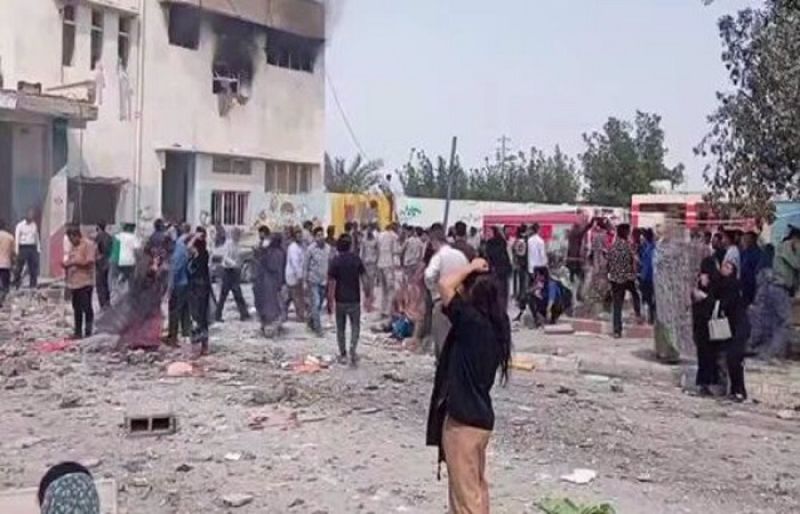
Iranian Foreign Minister Abbas Araghchi has condemned the massacre of dozens of innocent schoolgirls in an Israeli attack against an elementary school in the southern province of Hormozgan, stressing that the vicious crime will not go unanswered.
“The destroyed building is a primary school for girls in the south of Iran. It was bombed in broad daylight, when packed with young pupils,” he wrote on the social media platform X on Saturday evening, posting a photo of the bombed-out school.
He added, “Dozens of innocent children have been murdered at this site alone.”
The top Iranian diplomat pointed out that these crimes will not go unpunished.
Local officials said at least 82 schoolgirls lost their lives and 92 others were injured in the joint US-Israeli aggression against the Shajareye Tayyebeh School in Minab.
Minab’s governor, Mohammad Radmehr, said rescue and aid operations were underway at the school and that the security situation in the city was under control.
The attack on the school was part of the joint US-Israeli aggression against Iran, which began early on Saturday.
As in the June aggression, the offensive was launched amid diplomatic talks on Tehran’s nuclear program.
The Iranian armed forces launched massive missile strikes in retaliation, targeting the Israeli-occupied territories and American military bases across the region.
The Israeli-American aggression came in the middle of indirect nuclear talks between Tehran and Washington, mediated by the Omani government.
Earlier on Saturday, in an interview with NBC News, asserted that “regime change” in the Islamic Republic of Iran is an “impossible mission.”
Iran’s top diplomat said the Islamic Republic is a “great nation with a magnificent civilization” that has endured for thousands of years.
“We know how to defend ourselves and we will survive,” he told the US news channel, adding that the moment the aggression stops, Iran will also stop defending itself.
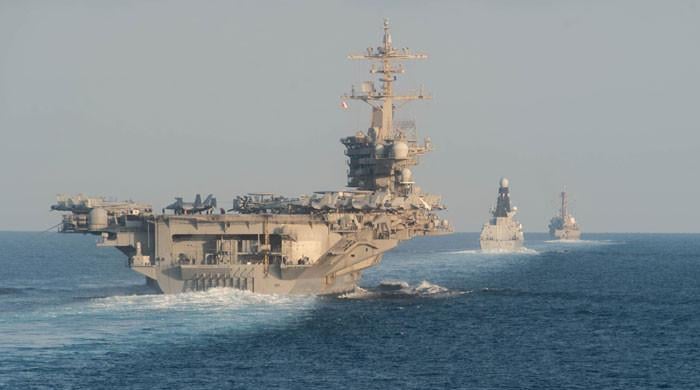
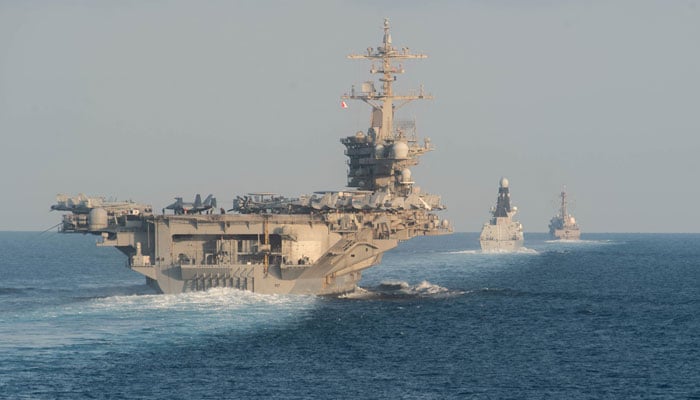
The Strait of Hormuz is a strategic route for seaborne oil that has long been used by Iran as a geopolitical bargaining chip, with Tehran repeatedly threatening to close it during times of crisis.
A senior naval commander of Iran’s Revolutionary Guards in late January again threatened its closure in the event of an attack, as US President Donald Trump warned of military action should the Islamic republic fail to cut a deal to curb its nuclear programme.
Despite its frequent warnings of a blockade, Tehran has never acted on them, though it closed part of the strait briefly for “safety” reasons during recent military drills.
Here are the key points to know about the waterway.
Gateway to the Gulf
The Strait of Hormuz links the Gulf to the Indian Ocean and is situated between Iran and Oman’s Musandam exclave, situated at the tip of a peninsula.
Its narrowness, at around 50 kilometres (30 miles), and shallow waters, at no more than 60 metres (200 feet) deep, make it vulnerable to being sealed off militarily.
The strait is dotted with sparsely inhabited or desert islands, which are strategically important, notably the Iranian islands of Hormuz, Qeshm and Larak.
Also among them are the disputed islands of Greater Tunb, Lesser Tunb and Abu Mussa, which lie between the UAE and Iran and provide a vantage point over the Gulf, and have been under Iranian control since 1971.
Oil transit hotspot
The strait is a vital corridor connecting the oil-rich Gulf with markets in Asia, Europe, North America and elsewhere.
According to the US Energy Information Administration (EIA), the Strait of Hormuz is “one of the world’s most important oil chokepoints”.
About one-fifth of global oil and petroleum product consumption flows through the strait, averaging 20 million barrels per day in 2024, according to the EIA.
Around one-fifth of global liquefied natural gas trade also transited the Strait of Hormuz in 2024, primarily from Qatar, it said.
Saudi Arabia and the UAE have infrastructure to bypass the strait, potentially mitigating disruption, but their transit capacity remains very limited — around 2.6 million barrels a day.
“Large volumes of oil flow through the strait, and very few alternative options exist to move oil out of the strait if it is closed,” the EIA warned.
More than 80% of the oil and gas moving through the strait is destined for markets in Asia, according to the EIA.
China, a key backer of Tehran, buys more than 90% of Iran’s oil exports, according to the analysis firm Kpler.
Military presence
Iran’s Revolutionary Guard, the ideological arm of the Islamic republic’s military, controls naval operations in the Gulf and the Strait of Hormuz.
Tehran has repeatedly criticised the presence of foreign powers in the region — home to the US Fifth Fleet in Bahrain and the Middle East’s largest US base in Qatar.
In 2023, Western naval forces operating in the Gulf warned ships sailing in the strait against approaching Iranian waters to avoid the risk of seizure.
There have been a series of such incidents since 2018, when US president Donald Trump pulled out of a landmark nuclear deal with Iran and reimposed crippling sanctions on the Islamic republic, sending tensions soaring.
Oil transit was disrupted in 1984 during the Iran-Iraq War when both sides attacked each other’s shipping, damaging or destroying more than 500 vessels in the so-called “Tanker War”.
And after Tehran laid mines in the strait, the frigate USS Samuel B. Roberts struck one in April of 1988 and nearly sank.
In July of that year, an Iran Air Airbus A300 flying the Bandar Abbas-Dubai route was shot down by two missiles fired from a US frigate, killing 290 people.
The crew of the USS Vincennes said it had mistaken the airliner for an Iranian fighter jet with hostile intent.
Maritime incidents
The Strait of Hormuz is frequently the scene of ship seizures and attacks.
Incidents multiplied after the United States withdrew in 2018 from the international agreement on Iran’s nuclear programme.
In 2019, unclaimed attacks on ships in the Gulf region, a downed drone and seized tankers raised fears of an escalation between Tehran and Washington.
On July 29, 2021, an attack in the Gulf of Oman on a tanker operated by a company owned by an Israeli billionaire killed two people. Israel, the United States, Britain and Romania accused Tehran, which denied any involvement.
In April 2024, the Revolutionary Guards seized the Portuguese-flagged container ship MSC Aries, accusing its owner of being “linked to Israel”.
In early February, a US-flagged tanker was approached and challenged by Iranian gunboats in the strait, before continuing on its way, US Central Command said.


King Charles’ ‘trusted’ hand hosts Central Asian leaders in London

US-Israeli ‘regime change’ project in Iran ‘impossible mission’: FM Araghchi

Iran FM says school massacre in latest Israeli aggression ‘will not go unanswered’

A $10K Bounty Awaits Anyone Who Can Hack Ring Cameras to Stop Sharing Data With Amazon
US Top Court Blocks Trump’s Tariff Orders: Does It Mean Zero Duties For Indian Goods?

Donald Trump Jr.’s Private DC Club Has Mysterious Ties to an Ex-Cop With a Controversial Past

-
 Tech1 week ago
A $10K Bounty Awaits Anyone Who Can Hack Ring Cameras to Stop Sharing Data With Amazon
-
Business1 week ago
US Top Court Blocks Trump’s Tariff Orders: Does It Mean Zero Duties For Indian Goods?
-
 Tech1 week ago
Donald Trump Jr.’s Private DC Club Has Mysterious Ties to an Ex-Cop With a Controversial Past
-

 Fashion1 week ago
ICE cotton ticks higher on crude oil rally
-

 Entertainment1 week ago
The White Lotus” creator Mike White reflects on his time on “Survivor
-
 Politics7 days ago
Pakistan carries out precision strikes on seven militant hideouts in Afghanistan
-
 Business1 week ago
Eye-popping rise in one year: Betting on just gold and silver for long-term wealth creation? Think again! – The Times of India
-

 Sports1 week ago
Brett Favre blasts NFL for no longer appealing to ‘true’ fans: ‘There’s been a slight shift’