

Fashion
India’s textile sector to gain from petrochemical duty easing


The relief covers a wide basket of chemicals, polymers, and intermediates used in fibre production and textile processing, with concessional duty rates expected to lower the effective cost of key inputs. This is particularly significant as upstream feedstocks such as PTA, MEG, and polyester melt have remained volatile due to crude-linked movements.
Sanjay K Jain, chairman of the ICC National Textile Committee told Fibre*Fashion, “The decision would create a positive sentiment. Both pricing and availability should improve for the industry.” He noted that the trickle-down impact would be visible across textiles as many of these inputs are core raw materials.













All customs dossiers will then be processed through a single clearance team.
Vietnam’s Hai Phong region’s customs department will launch a pilot centralised customs clearance model from June 1 to cut clearance times by 30-50 per cent and lower logistics and compliance costs.
Customs dossiers will then be processed through a single clearance team.
Administrative procedures and inconsistent implementation of regulations are the major challenges for businesses, EuroCham Vietnam said.
Deputy president of the Hai Phong Business Association Vu Ngoc Lam called on customs authorities to provide more detailed guidance for companies on electronic documentation, declaration classification, supplementary declarations, cargo release procedures and tax and fee payments under the new system, according to a domestic media outlet.
He also urged the authorities to maintain dedicated support channels for businesses and strengthen data connectivity among customs agencies, ports, shipping lines, logistics firms, warehouses and import-export enterprises.
Administrative procedures and inconsistent implementation of regulations across localities remain major challenges for businesses, Nguyen Hai Minh, deputy president of the European Chamber of Commerce in Vietnam, said.
Fibre2Fashion News Desk (DS)
Industrial activity stayed strong in many segments. The index of eight core industries witnessed an uptick. Manufacturing PMI also rose marginally as cost pressures and geopolitical spillovers kept growth momentum in new orders and output slow.
India’s economic activity in April showed resilience notwithstanding deceleration in some of the indicators, and the economy showed strength despite geopolitical and trade related uncertainties, an article in the RBI Bulletin said.
Industrial activity was strong in many segments.
However, financial conditions, crude oil prices and capital flows continue to pose challenges to the external sector outlook.
However, financial conditions, crude oil prices and capital flows continue to pose challenges to the external sector outlook, the article said.
Early results of listed private non-financial companies for the fourth quarter (Q4) of fiscal 2025-26 (FY26) also showed an improvement in business performance over the previous quarter, with aggregate sales and operating profit recording a double-digit growth.
The merchandise trade deficit widened in April this year over March, with rising import bill primarily on account of crude oil and gold imports. The trade deficit also registered an increase albeit marginally vis-a-vis April 2025.
The available high-frequency indicators of economic activity in April generally suggest sustained demand, notwithstanding challenges in a few sectors.
India is witnessing a trade reconfiguration amidst the emerging geopolitical situation, the article titled ‘State of the Economy’ noted. Its trade through the Strait of Hormuz that had declined sequentially in March went up in April this year.
Despite significant increase in input cost, operating profit growth of manufacturing companies remained broadly stable during Q4 FY26. However, the operating profit margin softened during the quarter.
However, the near-term outlook is somewhat clouded by supply side pressures, the article noted.
It said though headline inflation remains firmly within the tolerance band, the pass-through to domestic prices needs to be monitored.
Fibre2Fashion News Desk (DS)
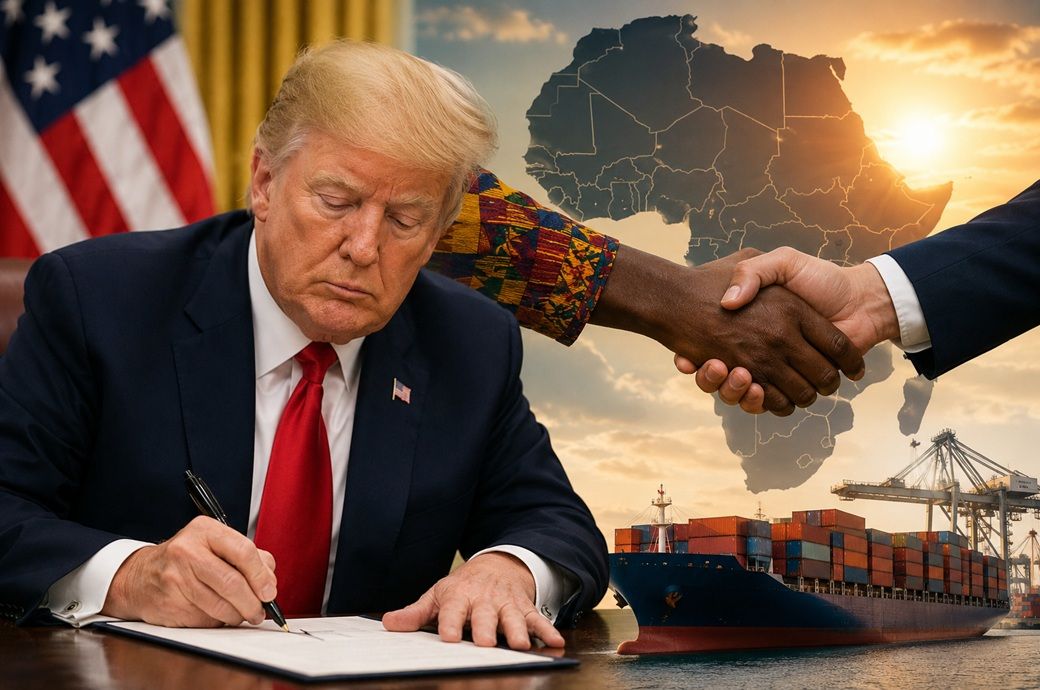
The extension follows a brief lapse in the programme in September 2025, which had caused uncertainty for African exporters dependent on US market access.
Exporters in many African nations have regained duty-free access to the US after the African Growth and Opportunity Act (AGOA) was extended till 2026 end by a US presidential proclamation.
The extension follows a lapse in the programme in late 2025, which had caused uncertainty for African exporters dependent on US market access.
Gabon was reinstated as an AGOA beneficiary, reversing its 2023 removal.
It was restored in February 2026 when Trump signed the Consolidated Appropriations Act, extending AGOA retroactively to the end of 2026.
The latest presidential proclamation on May 19 formally implemented the extension and updated US tariff schedules. Gabon has been reinstated as a beneficiary of AGOA after making sufficient progress on governance and eligibility, reversing its 2023 removal.
The announcement is a big relief for African economies that depend heavily on AGOA-linked trade, particularly in labour-intensive sectors like garments, where duty-free access significantly improves competitiveness in the US market.
But the limited extension continues uncertainty over the long-term future of the programme.
Fibre2Fashion News Desk (DS)


Kyle Fletcher shows up to AEW Double or Nothing, beats down Konosuke Takeshita after international title win

Xi lauds Pakistan’s constructive role in Middle East mediation in meeting with PM Shehbaz

Vietnam launches Hai Phong customs pilot from June 1

-

 Tech1 week ago
Why Is Your Grill So Dumb? The Best Grills Set Temp Like an Oven
-

 Tech1 week ago
This Solar-Powered Smart Sprinkler Keeps My Lawn Watered Without Any Power Cables
-

 Fashion5 days ago
US cotton planting advances to 41%, concerns persist in Texas
-

 Fashion4 days ago
ICE cotton sees mixed trend as rain forecasts weaken sentiment
-

 Fashion1 week ago
Turkiye’s current account deficit expected to widen in 2026: Minister
-

 Entertainment1 week ago
Princess of Wales praised as ‘step ahead’ of royal family
-

 Fashion1 week ago
India’s Pearl Global’s FY26 revenue crosses $521 mn milestone
-

 Fashion7 days ago
Nigeria Kwara Garment Factory, KWS Garment Production Village ink pact