

Business
Asia shares find hope in tech resilience, oil off peak | The Express Tribune

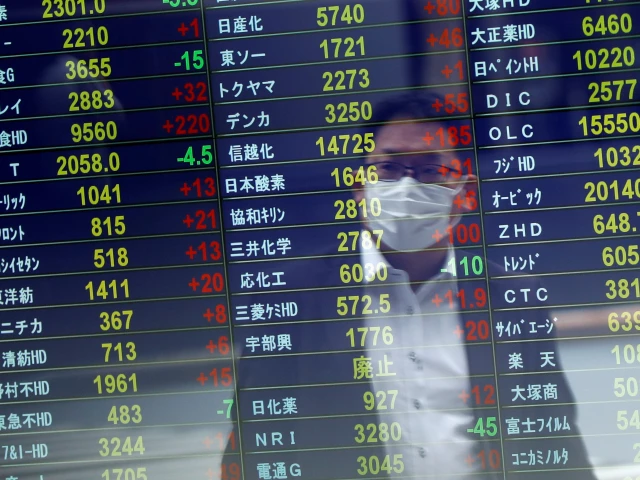
Asia rallies as oil pulls back from peak, tech earnings lift spirits and Japan steadies yen
Asian shares rallied in relief on Friday as oil prices came off the boil and upbeat company earnings pulled investors into tech stocks, while Japan’s first yen-buying intervention in two years steadied the battered currency.
Apple amplified the cheer by beating forecasts and providing an upbeat outlook for sales, though it did warn of chip supply constraints. Its shares rose 2.7% in extended trading, adding to gains of 10% in both Caterpillar and Alphabet as they beat expectations.
Hopes for ever-rising profits saw the S&P 500 climb more than 10% for all of April, while Nasdaq surged 15% in its best performance since 2020. S&P 500 futures were up 0.2% on Friday, with Nasdaq futures firming 0.1%.
Read: Trump approval sinks to new low as war with Iran drives cost-of-living concerns
April was also a barnstormer for Asia, with Japan’s Nikkei up 16% for the month, Taiwan gaining 23% and South Korea almost 31%.
Market holidays limited the reaction across Asia on Friday, with the Nikkei up 0.6% and Australian shares adding 0.9%. MSCI’s broadest index of Asia-Pacific shares outside Japan edged 0.3% higher.
Asia does remain acutely vulnerable to higher energy prices, importing most of its oil and gas, and oil flows remain badly disrupted through the vital Strait of Hormuz.
Iran said on Thursday it would respond with “long and painful strikes” on Unites States’ positions if Washington renewed attacks and restated its claim to the strait.
That saw Brent crude firm 0.6% to $111.70 a barrel, though that was well off Thursday’s four-year peak of $126.41. US crude rose 0.1% to $105.10 a barrel.
Japan drawns a line fpr Yen
Currency markets had also come alive after sources said Japanese authorities had intervened on Thursday to sell dollars for yen, initially sending the greenback sliding five whole yen to a two-month low of 155.50.
Yet buyers were back on Friday, lifting the dollar to 157.29 in a sign Tokyo may still have to do more if it really wants to draw a line at the 160.00 yen barrier.
“The cost is likely to be in the tens of billions of dollars based on history,” said Tim Baker, a macro strategist at Deutsche Bank, referring to the size of the intervention.
“We’re not convinced USD/JPY will keep falling, or even stay here for long,” he argued. “The cross may well be high relative to rates, but it’s actually low relative to a simple model that includes rates, equities and oil.”
Japan imports all its oil and the rise in crude prices is set to sharply widen the country’s trade deficit.
The burst of dollar sales indirectly lifted the euro to $1.1726 and away from a three-week trough of $1.1655. The pound firmed as far as a 10-week high at $1.3591. Both currencies were supported by hawkish commentary from their respective central banks.
Read More: European shares steady as investors eye US-Iran talks, central banks
The Bank of England warned that the fallout from the Iran war could lead to “forceful” rate rises if energy prices kept climbing, and one board member voted for an immediate hike. European Central Bank President Christine Lagarde said they were debating whether to lift rates and noted that data over the next six weeks would decide the issue.
“The messages conveyed during the press conference leave us with a distinct perception that the consensus among governors is that they will hike policy rates at the next meeting on June 11,” said analysts at Citi in a note. “We find no reason to alter our expectation of back-to-back rate hikes in June and July.”
That follows a hawkish shift from the Federal Reserve on Wednesday that saw markets give up on any hope for a rate cut there this year. The pivot left US 10-year Treasury yields up 8 basis points on the week at 4.390%, but off a top of 4.436%.
Elsewhere in commodity markets, gold was flat at $4,612 an ounce, having been stuck in a tight trading range for more than a month now.





Business
Middle East conflict drags on: Is Iran’s economy approaching breaking point? What analysts are saying – The Times of India

Weeks of conflict have worsened Iran’s economic pressures, deepening strain on its financial system even as the Islamic Republic continues to function under a standoff in the Gulf following a truce and ongoing maritime restrictions.The situation has left Iran in a stalemate with the United States and Israel, with ceasefire talks stalled while key Gulf routes remain disrupted. Despite damage to infrastructure, industries and oil exports, analysts, quoted by Reuters, say Iran is still managing internal supplies and limited external trade.“I think that they have calculated a longer runway than I think economists or Western policymakers are anticipating,” said Sanam Vakil, head of the Middle East programme at Chatham House. Vakil added that Iran is relying on its internal control mechanisms and what it describes as a “resistance economy”.“They are quite known to use repressive capacity. They’re relying on people using their savings,” she said, highlighting Tehran’s approach of prioritising domestic resources and cross-border trade through land routes.The economic impact remains difficult to fully assess due to limited official data and communication restrictions, though reports suggest significant pressure on businesses, inflation and employment conditions.However, key indicators point to partial resilience. Authorities have not imposed broad restrictions on withdrawals, fuel rationing or delayed salary payments, while food availability in urban markets remains stable.Shipping data indicated that reduced crude movement from Gulf terminals, with analysts estimating that export constraints could become more severe over time depending on how long restrictions persist.A senior official at Iran’s central bank told Reuters that the country holds significant gold reserves that could be deployed if required, while also claiming Iran has long experience in sustaining imports under sanctions conditions.In the agricultural sector, analysts say Iran remains relatively resilient due to diversified supply routes and improving domestic output, which could reduce near-term import dependency. “Iran is the largest food importer in the region. But it is also important to note that Iran is the least food insecure country in the region,” said Ishan Bahnu, head agricultural commodities analyst at Kpler.Trade through neighbouring countries including Turkey, Iraq and Pakistan has continued, while Russia has also increased shipments across the Caspian Sea, bypassing Gulf shipping routes.On the domestic front, however, economic stress is visible. Businesses reported rising costs, supply disruptions and weakening demand. “Rising prices of basic goods, especially products like ours that are directly linked to people’s tables definitely put pressure on people,” said Abbas Smaeelzade, a rice and grain seller, adding that his sales have fallen sharply since the conflict escalated.Meanwhile, mechanic Hossein Amiri said customer activity has dropped significantly. “Our business has basically come to a standstill,” he said, warning of further deterioration if conditions persist.Concerns also remain over potential social unrest, with analysts noting that prolonged economic pressure could heighten instability risks. As Vakil said, a resolution would require easing sanctions to improve Iran’s access to overseas funds and international trade. She added that Tehran needs greater ability to use foreign currency holdings abroad, expand oil exports and restore normal trade channels.

Ben Johns comes over to the right side to hit a dink shot against Anna Bright and Hayden Patriquine in the 2026 PPA Carvana Mesa Cup finals match of the Pro Mixed Doubles Division at Arizona Athletic Grounds on February 22, 2026 in Mesa, Arizona.
Bruce Yeung | Getty Images
Pickleball Inc., the new parent company of Major League Pickleball and the PPA Tour, said Friday it has raised a record $225 million in new investment, as the paddle sport continues its rapid growth trajectory.
The latest investment comes from Apollo Global Management’s newly created sports fund, Apollo Sports Capital, and Dundon Capital Partners, owned by billionaire Tom Dundon. Dundon is an owner of the Portland Trail Blazers NBA team and the Carolina Hurricanes NHL team and was an early investor in pickleball.
The fresh funds bring the total investment in Pickleball Inc. to $315 million, as investors continue to look at emerging sports as a place to park their money. The raise values Pickleball Inc. at $750 million, according to a person familiar with the matter, who asked to remain unnamed because they were not authorized to speak publicly about the company’s valuation.
The deal also includes rolling up several pickleball assets under the Pickleball Inc. umbrella, creating what the company called the largest pickleball ecosystem to date.
Pickleball Inc. will take on a portfolio of pickleball assets previously owned by Dundon, including Pickleball Central, a leading site for pickleball equipment founded in 2006. The portfolio also includes PickleballTournaments.com, software that powers thousands of tournaments across all levels of play, as well as Just Courts, a pickleball court installer.
Pickleball Inc.’s newly merged business verticals combined generated over $140 million in 2025 revenue, the company said.
In a release, MLP and PPA Tour CEO Connor Pardoe called the new investment a “seismic day” for pickleball’s rapidly growing business at all levels.
“This investment allows us to fully integrate the sport into one cohesive ecosystem – uniting professional pickleball, consumer goods, technology, and media under a single, unified platform,” Pardoe said.
Dundon and the Pardoe family will remain majority shareholders in the business after the investment.
Pickleball has exploded in popularity in recent years, with more than 24 million U.S. players participating in 2025, making it the fastest growing sport in the country over the last three years, according to the Sports & Fitness Industry Association’s Annual Report.
At the professional level, the MLP and PPA Tour have seen major growth with a combined $30 million in sponsorship revenue in 2025 and $60 million in combined top line revenue for 2025, according to the United Pickleball Association, which operates both leagues. The MLP and PPA Tour are projecting $74 million in combined revenue in 2026.
The new capital for Pickleball Inc. will be used to further integrate the pickleball business at all levels of play and create a streamlined pickleball ecosystem, the company said.
“This capital raise will allow us to expand our focus into new and scalable opportunities like content, media, and the development of infrastructure to support our fast growing events,” MLP Commissioner Samin Odhwani said in a statement. “The continued and dynamic year-over-year growth data has proven without doubt that pickleball is no longer an emerging sport, and is instead quickly becoming the next tier one sport in America.”
Business
Gross GST collections hit record high of Rs 2.43 lakh crore in April 2026 despite US-Iran war concerns – The Times of India

GST collections: The gross Goods and Services Tax (GST) collections touched a new high in April, reflecting continued strength in economic activity even in the midst of the ongoing Middle East conflict.According to government data released on Friday, gross GST revenue for the month reached a record Rs 2.43 lakh crore, registering an 8.7% increase over Rs 2.23 lakh crore collected in April last year.After accounting for refunds, net GST collections stood at Rs 2.11 lakh crore, up 7.3% from the corresponding period a year earlier.Refund disbursements during the month rose sharply, climbing 19.3% year-on-year to Rs 31,793 crore.As a result, net GST revenue for April 2026 came in at Rs 2,10,909 crore.Robust revenues from imports played a major role in driving GST collections during the month. Gross receipts from imports climbed sharply by 25.8% to Rs 57,580 crore, while gross domestic GST collections recorded a comparatively moderate increase of 4.3%, reaching Rs 1.85 lakh crore.The net GST revenue from imports surged 42.9%, significantly outpacing the marginal 0.3% rise in net domestic collections.The April performance follows a strong showing in March, when net GST collections stood at Rs 1.78 lakh crore, up 8.2% from a year earlier. Gross collections in that month had also crossed the Rs 2 lakh crore mark.For the full financial year 2025-26, gross GST revenue increased 8.3% year-on-year to Rs 22.27 lakh crore. Net GST collections for the year rose 7.1% to Rs 19.34 lakh crore.Major contributors such as Maharashtra, Karnataka and Gujarat continued to account for a substantial share of total collections.


US’ Gap partners with Victoria Beckham on timeless wardrobe essentials
Middle East conflict drags on: Is Iran’s economy approaching breaking point? What analysts are saying – The Times of India

Graduation Gifts That Aren’t Totally Cringe

-

 Sports1 week ago
PSL 11: Hyderabad Kingsmen opt to field after winning toss against Multan Sultans
-
 Business1 week ago
Trump administration in advanced talks for a rescue package for Spirit Airlines, source says
-

 Entertainment1 week ago
Anne Hathaway shares major news about ‘Princess Diaries 3’
-
 Business1 week ago
Gold prices in Pakistan Today – April 23, 2026 | The Express Tribune
-

 Entertainment1 week ago
Mike Vrabel to miss Patriots’ final NFL draft day —here’s why
-

 Fashion1 week ago
Canada forms new advisory committee to strengthen US trade relations
-
 Business1 week ago
Oil surges past 4% as Iran keeps Hormuz locked – SUCH TV
-

 Fashion1 week ago
US CBP to soon launch electronic system for importers to claim refunds