

Business
Argentina’s President Milei divided his nation but won over Trump

 Ione WellsSouth America Correspondent
 BBC
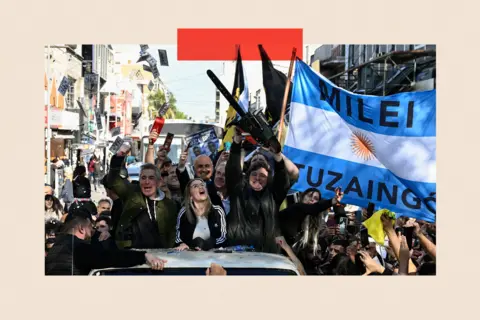
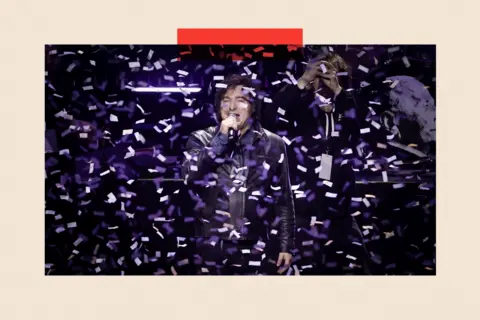
BBCBuenos Aires, September 2023. Hundreds of people crowded around to wave flags and film on their phones. The man with unruly hair and sideburns in the centre of them, clad in a black leather jacket, hoisted a roaring chainsaw above his head.
This was an election rally taking place in the San Martín area of the Argentine capital a month before the presidential election – and the metaphor was explicit.
The candidate Javier Milei believed the state was far too bloated, with annual debts that were bigger than Argentina’s entire annual economic output.
Rather than ‘trimming the fat’, as some politicians delicately put it, he said he would take a chainsaw to ministries, subsidies and the ruling political class he derided as “la casta” – the caste.
 Getty Images
Milei had form for stunts. In 2019, he dressed up in a “libertarian superhero” costume, purporting to be from Liberland – a land where no taxes are paid. In 2018, he smashed a piñata of the Central Bank on live television.
According to official data, inflation in 2023 topped 211% annually – Milei took office in December of that year. Roughly 40% of the population lived in poverty. Years of high public spending, and a reliance on printing more money and borrowing to cover deficits, had left the country in a cycle of debts and inflation.
Yet nearly two years on, the headline figures are vastly different: Argentina recorded its first fiscal surplus in 14 years and inflation, which had hit triple figures annually, has tumbled to roughly 36%.
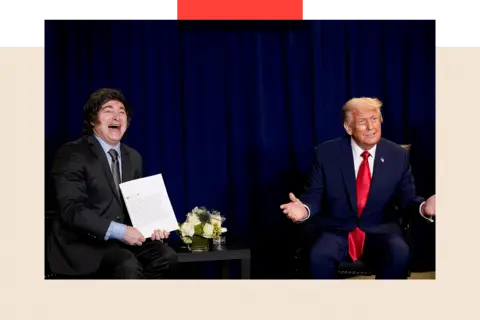
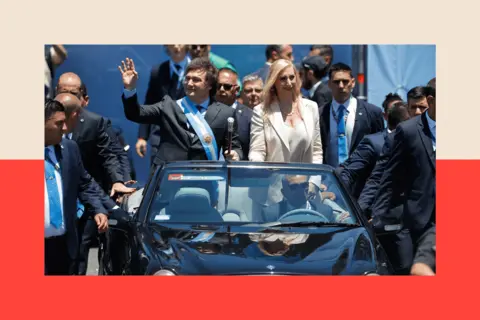
The UK Conservative party leader Kemi Badenoch called the measures Milei has taken a “template” for a future Conservative government. And in the US, President Donald Trump described Milei as “my favourite president”.
They will meet in Washington on Tuesday.
 Reuters
Foreign investors regained confidence in Argentina too. Although that recently slipped, Washington’s decision last week to swap $20bn (£15bn) in dollars for pesos, effectively propping up Argentina’s currency with International Monetary Fund (IMF) backing, is a sign Milei’s fiscal shock therapy has appeased international lenders. Trump and Milei’s meeting will hail the deal.
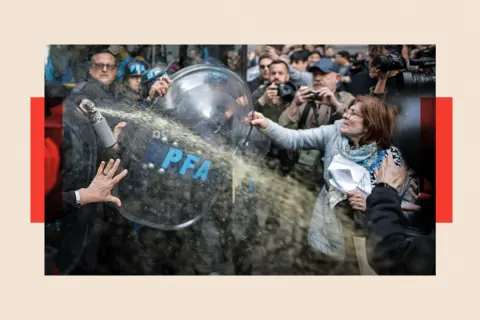
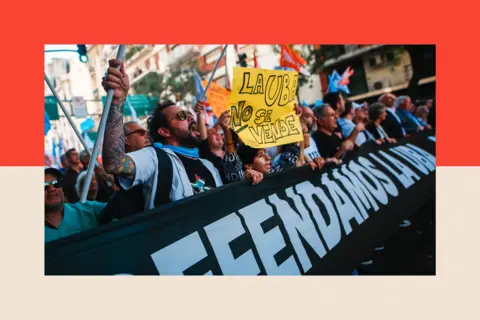
Yet for all the international praise, this is just one side of the story. On the streets there have been heated protests over Milei’s reforms, with police firing tear gas, rubber bullets and a water cannon during clashes.
“He said in his campaign that this adjustment would be paid for by ‘la casta’ – the wealthy, the politicians, the evil businessmen,” says Mercedes D’Alessandro, a left-wing economist and senate candidate.
But, she argues, the result was less money for pensioners and hospitals. “The adjustment in the end was directed at the working classes, not the caste.”
 Reuters
Milei’s critics argue that the price of his changes have been recession, job losses, weaker public services and declining household budgets. And now some economists say the country could be about to enter a recession.
Milei has created a paradox.
On paper, his chainsaw has achieved some of the macroeconomic successes he set out to do. But Milei has lost political support and that has spooked the markets, which in turn has destabilised his economic project.
With midterm elections looming on 26 October, Argentina is about to deliver its verdict: will Milei be punished for doing what he set out to do — and could losing political support completely unravel his economic gains?
Argentines feeling the cost
Around 700 miles from the capital in the Misiones province, tea farmer Ygor Sobol looks anxious. “We’re all going backwards economically,” he says. “I had to close the payroll. Now I am completely without employees.”
For three generations his family has grown yerba mate, a drink popular with Argentines, but since Milei deregulated his industry by scrapping minimum prices, he says that his crops have become worth less than the cost of producing them.
Now, Mr Sobol says he can’t afford to do basic tasks like cleaning and fertilising his plantation. And with the business making a loss, he’s deciding what his family will have to go without too.
 Shutterstock
Argentina’s multibillion dollar textile industry is also affected. Luciano Galfione, chairman of a non-profit for the sector Fundacion Pro Tejer, describes “daily” closures and job losses.
Unlike Trump’s approach of raising tariffs to promote “America First”, Milei cut tariffs and other criteria for imports.
“I have environmental controls, labour controls – we don’t pay people $80 (£60) a month, or have 16-hour work days that might be allowed in places like Bangladesh or Vietnam. This creates an unequal playing field,” Mr Galfione argues.
He believes that boosting imports has battered domestic producers. “Our sector lost more than 10,000 direct jobs. If you add indirect jobs, there are many more.”


Mr Galfione also blames rising costs of utilities, health and schools for reducing the disposable income of average people, and in turn making them less likely to buy clothes.
And yet amid it all, Milei is adamant that his measures will improve the lives of ordinary Argentines.
‘Everything was a huge mess’
In the run-up to the election Milei had said there was no alternative to big cuts.
As well as the soaring inflation, vast government subsidies had kept energy and transport prices down. Public spending was high, even before the Covid-19 pandemic. Price controls set fixed prices for certain goods. Argentina, still, owes £31bn in debt to the IMF.
“The demand for public spending was brutal,” argues Ramiro Castiñeira, an economist at the consultancy Econométrica who supports Milei.
“Society seemed willing to live with so much inflation. Or didn’t recognise that inflation was a product of so much public spending.”
 EPA – EFE/REX/Shutterstock
Inflation ate away the peso currency’s purchasing power. Many ordinary Argentines handed over disproportionate sums of pesos to illegal street traders to buy dollars, fearing their money would lose value overnight.
“Everything was a huge mess,” explains Martin Rapetti, an economics professor at the University of Buenos Aires and executive director of think tank Equilibria.
“People felt money slipping like water through their fingers.”
For many economists, drastic change (even if painful) was essential to restore credibility. And Milei promised radical change.
He went viral for ripping government ministries such as Culture and Women off a whiteboard while shouting ‘afuera!’ – ‘out!’
Among other austerity measures, he halved government ministries, cut tens of thousands of public jobs, slashed budgets including for education, health, pensions and infrastructure, and removed subsidies – spiking utility and transport prices.
His initial devaluing of the peso by 50% caused inflation to spike but then it fell as people spent less and demand fell.
 EPA/Shutterstock
‘Echoes of Thatcherism’
When I met him in April 2024 at his office, there were sculptures of him with a chainsaw on display and coasters showing Margaret Thatcher’s face. Thatcher is loathed by many people in Argentina owing to the Falklands War, but Milei told me he admired her and that she was “brilliant.”
Last month one British newspaper described Milei’s own approach as having “echoes of Thatcherism”.
Miguel Boggiano, an economist on Milei’s economic advisory board, is full of praise for Milei getting inflation down and reducing the deficit. “When you bear in mind the starting point, that’s a huge accomplishment,” he says.
 Reuters
He believes this will help alleviate poverty in the long-run and enable lower taxes, but also help people to plan their own spending more easily with inflation currently fluctuating less.
But Alan Cibils, an independent economist and former professor, warns reduced inflation is only a success if it is sustained over time which he believes will not be the case.
The outsider advantage
Javier Milei is not a career politician. Before becoming president he had two years experience as a deputy in Argentina’s Congress.
“Being so detached kind of shields him,” Prof Rapetti observes, citing a lack of “signs of empathy in public life”.
On 7 September Milei’s party lost unexpectedly badly in the Buenos Aires provincial elections. His convoy was pelted with rocks on the campaign trail. The markets panicked: foreign investors sold off pesos and bonds of Argentine government debt.
 EPA – EFE/REX/Shutterstock
Financial markets had generally supported his economic programme. But the midterm elections were upcoming and the £15bn of debt repayments are due next year.
Trump’s £15bn currency swap lifeline has provided some stability: Argentine bonds and the peso rose in value in response to the announcement. But D’Alessandro argues that though US intervention might solve a wider problem, nothing will change in “people’s real lives”.
“We’re going to continue with no investment in hospitals, education, social programmes. This money from the United States is not going to improve Argentina’s infrastructure.”
Flawed leader or model for other countries?
Some of Milei’s supporters – like Mr Boggiano – believe there is something else at play in the round criticism of the president: In this view much of it comes down to the opposition trying to “break” what Milei has done, in order to get back into power.
“Once everyone starts to believe stability is here to stay, investment will come back,” says Mr Boggiano. “I think Milei will become a model for other countries.”
Others are unsure. “There is some stability which helps things not to explode,” said Mr Cibils. “But I think that stability is also a mirage.”
Milei had also kept inflation under control by spending the country’s reserves on propping-up the peso so it didn’t crash. Meanwhile, Argentina owes $20bn of debt next year.
One former central bank economist, who wished to speak anonymously, warns Milei’s strategy of keeping inflation down could unravel if Argentina can’t pay its debts.
“If at the end of the day we have a financial crisis that partially undoes all the effort, then it’s a failure. If it ends with social unrest, any good done will be reversed,” says the economist.
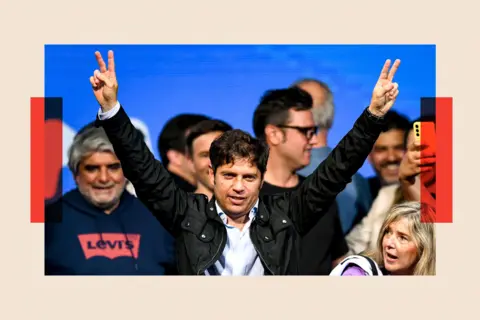
The left-wing governor of Buenos Aires, Axel Kicillof, has been touted as a future presidential candidate, long ahead of the elections in 2027. He has spoken in favour of the welfare state. Some investors are calculating whether this could mean a return to the days of big spending.
 Getty Images
As to the question of whether Milei has succeeded, the answer largely depends how you define success – and who it is for.
Many workers see shuttered factories, rocketing bills, and a vanishing safety net.
Meanwhile, some investors see a success story of fiscal discipline, tamed inflation, an ally in Washington and simply a “normalisation”.
But even as leaders abroad watch Milei’s experiment with fascination, politics may explain why few are unlikely to copy it.
If normal people lose faith in what he is doing, markets will also lose confidence that his programme is sustainable – and that could wipe out even the ‘macro’ successes.
“He has no political expertise, and I think you need it,” Prof Rapetti argues.
Still, he believes it is too early to judge: “We are in the middle of his term… The story hasn’t finished.”
Top picture credit: WPA Pool/Getty Images, Bloomberg via Getty Images

BBC InDepth is the home on the website and app for the best analysis, with fresh perspectives that challenge assumptions and deep reporting on the biggest issues of the day. And we showcase thought-provoking content from across BBC Sounds and iPlayer too. You can sign up for notifications that will alert you when a BBC InDepth story is published – find out how to sign up here.
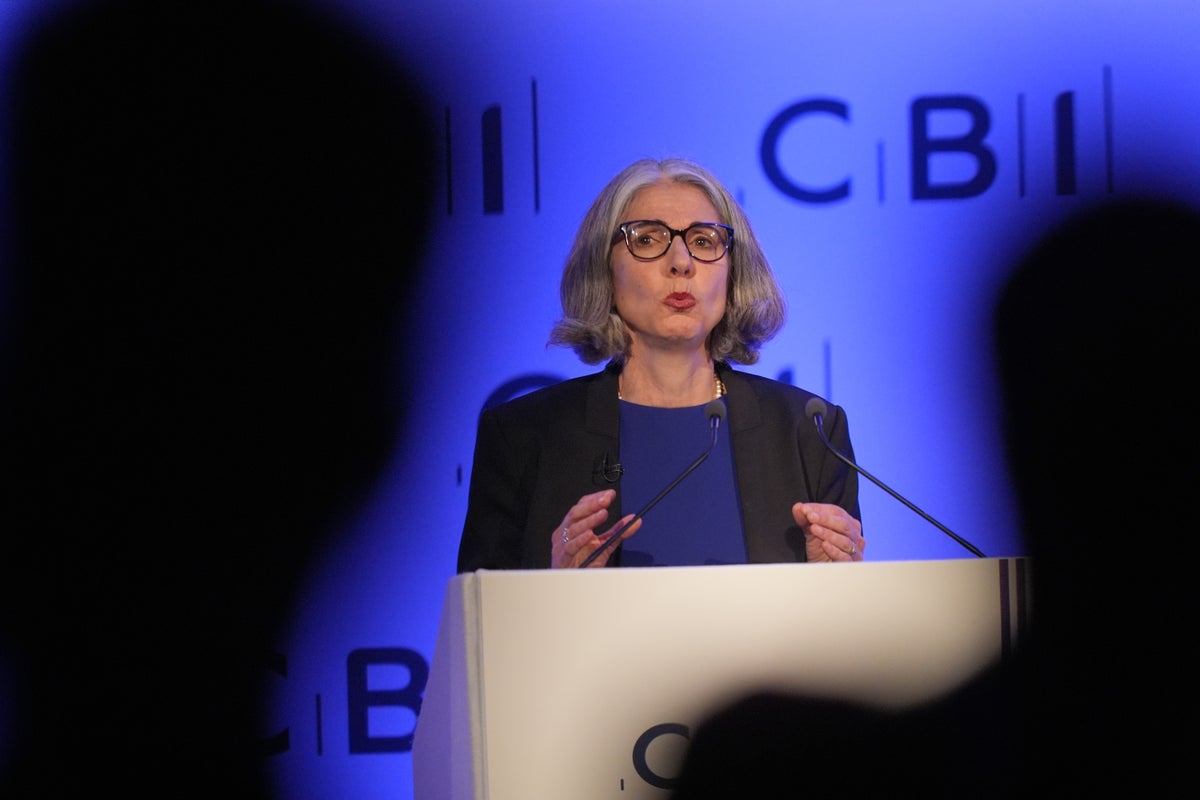
The UK must not “cut ourselves off” from trade opportunities in China despite security and business risks, the head of the Confederation for British Industry has warned.
CBI chief Rain Newton-Smith highlighted that British businesses see increased trade with Chinese firms as an opportunity to drive growth.
Her remarks came as business leaders were questioned by MPs on Parliament’s Business and Trade Select Committee regarding the UK’s economic relationship with China.
Last December, Prime Minister Sir Keir Starmer admitted China poses security threats to the UK but urged for greater business ties.
Ms Newton-Smith, chief executive of one of the UK’s largest business groups, was positive about the Government’s engagement with China.
“You can’t have a growth strategy without a strategy for China,” she said.
“China has the biggest contribution to global growth, is the third largest trading partner, and the world’s largest consumer market.
“The UK is second largest exporter of trade and services.
“We are mindful as all businesses are of security risks but it is really important that we have a strategy towards China.
“This Government has increased the economic engagement with China and including business within this does help us as a country.”
She added: “If we think about the future economy, there is a huge market in China and I think we mustn’t cut ourselves off from some of the opportunities there, even if in some areas there are difficult conversations and negotiations that need to be had.”
Peter Burnett, chief executive of the China-Britain Business Council, told the committee: “There are risks associated with technology advancement, AI, industrial development that they need to assess.
“Increasingly you will find them saying that they need to engage more in China to understand those risks and to develop some of the technologies along some of those risks themselves.”
Business
Trump says he’d be disappointed if Fed pick doesn’t cut rates; Warsh vows to be ‘independent actor’ – The Times of India
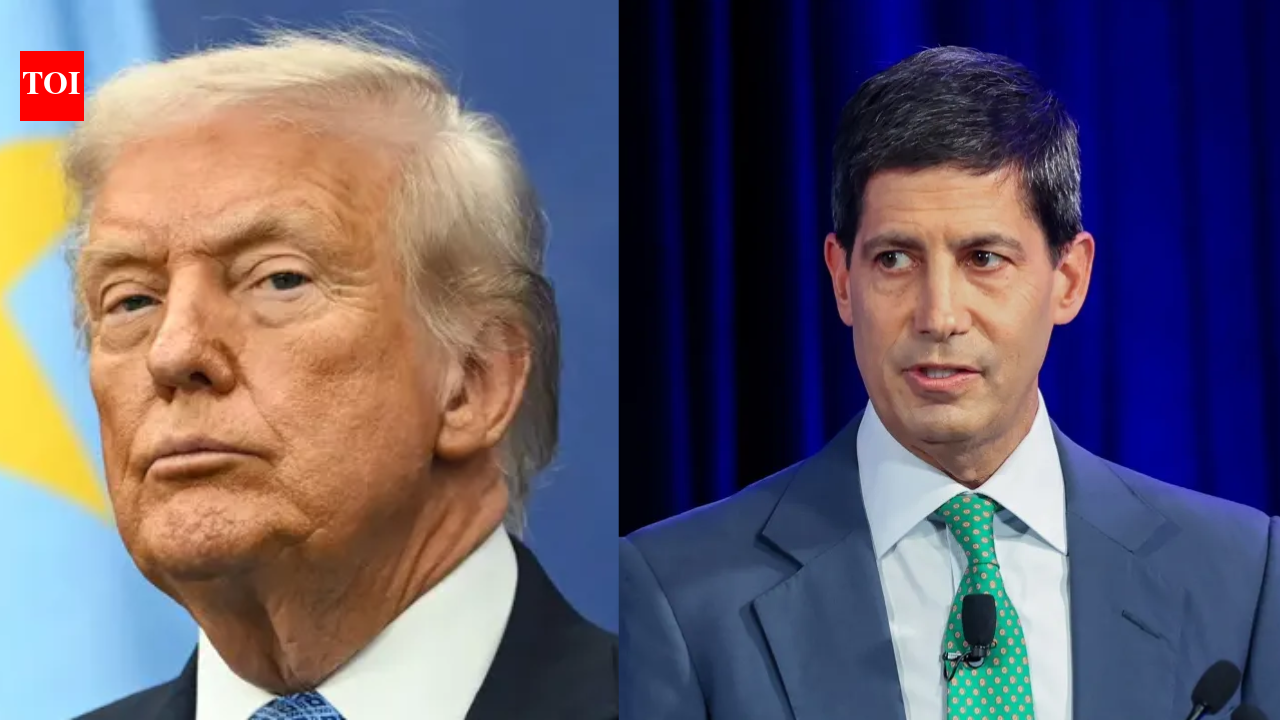
US President Donald Trump on Tuesday said he would be disappointed if his nominee for Federal Reserve chair, Kevin Warsh, does not cut interest rates right away after taking office if confirmed by the Senate. Trump, during an interview with CNBC’s “Squawk Box,” also said “we have to find out” about the construction costs of the new Federal Reserve building.Warsh, a former Federal Reserve official and financier, is currently facing Senate confirmation hearings where he has stressed his independence from political pressure.“The president never once asked me to commit to any particular interest rate decision, and nor would I agree to it if he had,” Kevin Warsh said under questioning by the Senate Banking Committee, as quoted by LA Times. “I will be an independent actor if confirmed as chair of the Federal Reserve.”Warsh told lawmakers that fighting inflation would be one of his main priorities if confirmed.“Congress tasked the Fed with the mission to ensure price stability, without excuse or equivocation, argument or anguish,” Warsh said. “Inflation is a choice, and the Fed must take responsibility for it.”The comments come as investors closely watch his confirmation hearing, with inflation remaining at 3.3% annually and global tensions, including the war in Iran pushing up gas prices, adding pressure on the economy. Higher inflation typically leads the Federal Reserve to keep interest rates steady or raise them rather than cut them, as rate changes affect mortgages, auto loans, and business borrowing.Democrats on the Senate Banking Committee accused Warsh of shifting his stance on interest rates over time, supporting higher rates under Democratic presidents and lower rates during Trump’s presidency.Warsh, if confirmed, would take over at a time when inflation pressures make it difficult for the Federal Reserve to cut rates, even as Trump continues to push for lower borrowing costs. Trump has repeatedly urged rate cuts and has long clashed with current Fed chair Jerome Powell over monetary policy. Powell has also been the subject of a Department of Justice criminal probe after refusing Trump’s requests for faster rate cuts. Trump told CNBC that he does not plan to pressure the Justice Department to end that probe.
NEW DELHI: Nestle India reported a 26% increase in net profit to Rs 1114 crore on its highest ever domestic sales of Rs 6,445 crore for the fourth quarter ended March 31, 2026, led by premiumisation, penetration and higher ad spends.“This performance was powered by double-digit volume growth, driven by over 50% increase in advertising spends, whilst delivering a healthy EBITDA margin of 26%’’, Manish Tiwary, chairman and managing director, Nestlé India said.Total sales and domestic sales for the quarter increased by 23% each, while all product groups contributed to the performance, he said.For FY26, total sales increased by nearly 15% to Rs 23,071 crore, while the net profit jumped nearly 7% year-on-year to Rs 3545 crore. The company on Tuesday also declared a final dividend of Rs 5 per equity share.The West Asia conflict is likely to have a limited impact on most packaged food companies’ Q4 performance, as it was confined to March. However, companies have flagged higher input costs driven by the rise in crude oil prices.Elaborating on the commodities outlook, he said “Edible oil prices are firm and have moved higher in line with global crude oil prices, supported by increased diversion to biodiesel’’.Meanwhile, unseasonal rains have impacted wheat production, resulting in a delayed harvest and lower quantity and quality.Commenting on coffee prices, the company said it expects prices to continue to trend lower, supported by a favourable crop in Vietnam and the forthcoming crop in Brazil.


Trump repeats call for Congress to rein in college sports

Reese Witherspoon breaks silence after AI support controversy

Duke lands John Blackwell, top guard in transfer portal

-

 Fashion6 days ago
France’s LVMH Q1 revenue falls 6%, shows resilience amid Iran war
-

 Sports1 week ago
The case for Man United’s Fernandes as Premier League’s best
-

 Entertainment1 week ago
Palace left in shock as Prince William cancels grand ceremony
-
 Business1 week ago
UK could adopt EU single market rules under new legislation
-

 Entertainment6 days ago
Is Claude down? Here’s why users are seeing errors
-

 Fashion1 week ago
Energy emerges as biggest cost driver in textile margins
-
 Business1 week ago
Delta Air Lines unveils first new Delta One suite in premium cabin arms race
-
 Fashion1 week ago
Asia claims largest share of markets on Kearney FDI Confidence Index