

Business
As holidays approach, value players Walmart and T.J. Maxx are drawing the cash-strapped and the wealthy


Sign at the entrance to a Walmart in Venice, Florida(L), and a T.J. Maxx store in Pinole, California.
Getty Images
As more major retailers post earnings, one theme is clear: Value players are winning both the wealthy and the cash-strapped.
Walmart and TJX, T.J. Maxx’s parent company, stood apart from the pack this week by hiking their full-year forecasts and expressing optimism about the start of the holiday season. Both said sales have grown as they win shoppers across the income spectrum, in the same week other major U.S. retailers Home Depot, Lowe’s and Target cut their profit outlooks and said they saw consumer reluctance to make large purchases.
In an interview with CNBC, Walmart CFO John David Rainey said the big-box retailer has seen “value-seeking and choiceful” spending patterns by consumers for the past several quarters. He said “it stands to reason, if there’s a little incremental strain on the consumer, they’re only going to become more so, they’re going to look for more value.”
And TJX CEO Ernie Herrman said the company, which includes Marshalls and Home Goods, has seen a “strong start” to the holiday quarter and is “convinced that consumers will continue to seek out value.”
Shares of both Walmart and TJX rose on Thursday, even as the three major U.S. stock indexes turned negative.
The performance of the two retailers, which are both strongly associated with compelling deals, jumps out at a moment when investors, industry watchers and economists are trying to predict retail sales during the critical holiday season and the outlook for the U.S. economy next year. Their performance could bode well for other off-price chains, such as Ross and Burlington, and value-focused players, including Dollar General, Dollar Tree, Five Below and Costco, which will report their most recent earnings in the coming weeks.
In recent months, a mix of factors have made it difficult to gauge how retailers and the broader economy will fare in the months ahead. That includes jitters about the job market following major layoffs at companies including Amazon, Verizon, UPS and Target, and concerns that the stock market has been propped up by artificial intelligence companies, contributing to the risk of an bubble. A prolonged government shutdown also muddied the waters by delaying the release of recent jobs and inflation data.
There have also been contradictions between what consumers say and do. Consumer sentiment has tumbled to nearly the lowest level ever, even as retail sales grew stronger in October, according to the CNBC/NRF Retail Monitor.
That’s led to murky holiday expectations. For example, the National Retail Federation predicted that holiday sales will grow by 3.7% to 4.2% year over year and top $1 trillion for the first time, while consulting firm PwC said consumers plan to cut their holiday spending average by 5% compared to the year-ago holiday season.
Home Depot, Lowe’s and Target put their thumbs on the scale this week. All three lowered their full-year profit forecasts and spoke of pressure on their businesses as customers hesitate to take on bigger projects or make pricier purchases.
For Home Depot and Lowe’s, the lack of consumer confidence may prolong a period of conservative spending driven by lower housing turnover. For more than two years, they have seen customers take on smaller home improvement projects rather than splurges like remodels and renovations that cost more or require financing. That pattern has held, even though they cater to U.S. consumers who typically own a home and have benefitted from home equity gains.
Lowe’s CEO Marvin Ellison said even homeowners are “not immune” to feeling shaken by news headlines about the government shutdown, higher tariffs and other policy changes that could hit their wallets — which could encourage price-sensitivity and procrastination on purchases. He said the home improvement retailer has focused on ways it can move the needle with its own strategies, such as expanding its merchandise assortment and attracting more home professionals as customers.
Target, which has faced some struggles of its own making, expects shoppers will watch prices and make trade-offs during the holiday season, such as spending more on gifts and less in other areas like decor or food, Chief Commercial Officer Rick Gomez said on a call with reporters. The retailer has cut prices on 3,000 food and home essentials and tried to attract shoppers with low opening price points, such as $1 Christmas tree ornaments.
At Walmart, Rainey told CNBC the company has “been gaining [market] share among all income cohorts, but as we noted for several quarters, they’re more pronounced in the upper-income segment.”
For TJX, Herrman said the company’s focus on value is a competitive edge. He said on the company’s earnings call that it’s blend of “brand, fashion, quality and price sets us apart from many other retailers and has served us extremely well through many kinds of retail and economic environments over the course of our nearly 50-year history.”
In a research note, retail analyst and Telsey Advisory Group CEO Dana Telsey said TJX’s repeated earnings beats “highlight the strength of its value-focused proposition, which continues to resonate with consumers amid an increasingly price-sensitive environment.”
Customers of all incomes are coming to TJX’s stores and website, but lower-income shoppers drove sales growth in most of its geographies in its latest quarter, CFO John Klinger said on an earnings call.
While Walmart and TJX have weathered cracks in the economy better than many other retailers, they’re not immune to economic weakness.
Walmart’s Rainey said that despite its strong sales forecast for the year, the retailer has spotted “pockets of moderation” among low-income shoppers as they feel more pinched than other customers. On the company’s earnings call on Thursday, he referred to the sharp disparity in wage growth between high- and low-income U.S. consumers.
He also told CNBC that the retailer noticed a pullback by customers who stopped receiving Supplemental Nutrition Assistance Program, or SNAP, benefits during the government shutdown. But Rainey said, “that’s starting to rebound now that people are receiving those funds again.”
“We’re seeing the same things that that others are, and we’re keeping a watchful eye on it,” he said on the company’s earnings call. “But again, I think Walmart is better insulated than just about anybody.”






Citigroup initiated its coverage of Pine Labs with a buy rating and a target price of Rs 235. Analysts said that India’s payments fintech is on a monetization improvement trajectory, with leading players increasingly entrenched in respective core areas of leadership. While product, services and distribution build-outs into comprehensive plays will continue across the fintech ecosystem, large players don’t face significant disruption risks owing to: Across-the-board profitability push; rising regulatory costs and compliance requirements; and stickiness borne out of integration into enterprise business workflows. Further, while consumer payments have seen flux in competitive positioning in the past decade, there have been relatively fewer changes in positioning and leadership within segments in merchant payments.BoFA Securities has initiated its coverage of Groww (Billionbrains Garage Ventures) with a buy rating and a target price of Rs 235. Analysts said Groww is well positioned to capitalize on India’s retail investing tailwinds and they expect compounded annual growth rate (CAGR) for revenue at 30% over FY26-FY28. The company produces best-in-class profitability with further upside from operating leverage. Analysts have valued Groww at 39x FY28E price-to-earnings. They, however, said that the near-term risks for the stock are a weak capital market performance and the expiry of the six-month lock-in of shares post-IPO.Elara Capital initiated its coverage of Jindal Saw with a buy rating and a target price of Rs 280. Analysts said earnings recovery is expected over FY27–FY28, driven by water, and oil & gas demand. The company’s order book is at an all-time high, indicating strong visibility. They also feel Jal Jeevan Mission spending revival to drive domestic pipe demand, while the global pipeline capex is supported by energy security concerns. Analysts also pointed out that exports are rising, with diversification reducing dependence on domestic capex. The company’s capacity expansion to support margins and operating leverage. They feel the stock’s valuations are attractive, with rerating potential driven by execution and growth.Jefferies has downgraded Indus Towers to underperform from buy with a target price cut to Rs 375 from Rs 530. Analysts downgrade the stock due to site-renewal risks bunched up over second half of 2026 (H2CY26) and first half of 2027 (H1CY27) which could impact revenues and growth. Elevated capex levels due to higher growth and maintenance capex which will impact earnings growth as well free cash flow and payouts. They cut Indus Towers’ revenue and profit after tax (PAT) estimates by 2-6% to factor renewal risks post which stock offers 3% EPS growth and a 4% yield. They said risks on growth outlook should weigh on re-rating potential too.Kotak Institutional Equities has a buy on Ujjivan SFB with a target price of Rs 72. Analysts said that the RBI has returned Ujjivan SFB’s application for a universal bank license, citing need for further loan portfolio diversification. While the outcome is clearly not favourable, the regulator has flagged no concerns relating to governance, compliance or operational soundness. Analysts said their investment thesis did not factor in any benefit from a potential transition to a universal bank. Hence, they maintained a buy but remained watchful of any sharp changes in asset mix strategy in response to RBI’s feedback.(Disclaimer: Recommendations and views on the stock market, other asset classes or personal finance management tips given by experts are their own. These opinions do not represent the views of The Times of India)

The better-than-expected GDP data comes as Asian countries have been hit hard by the impact of the conflict.
Source link
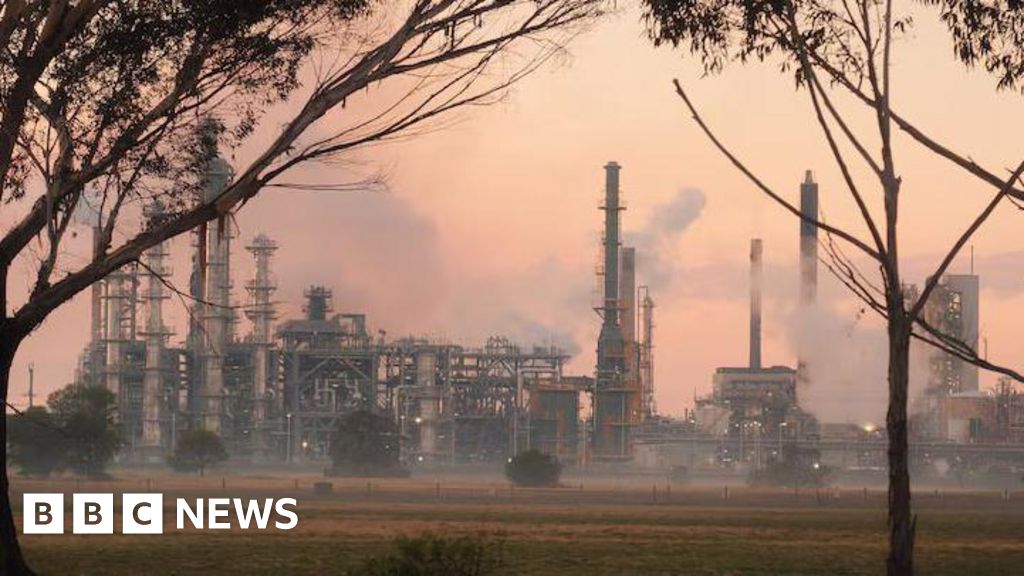
The fire has deepened fears over the nation’s petrol supplies amid a global crunch.
Source link


Switzerland’s apparel imports grow double-digit in Jan–Feb 2026

No vote after NCAA urges further study of age eligibility changes to college sports

Taylor Swift on bond with Dakota Johnson: ‘Curious’

-

 Fashion1 week ago
India’s exports face reset as EU links trade to carbon metrics: EY
-

 Entertainment1 week ago
Lamar Odom shocking response to Khloé Kardashian account of his overdose
-

 Entertainment1 week ago
Queen Elizabeth II emotional message for Archie, Lilibet sparks speculation
-

 Tech1 week ago
Azure customers up in arms over ‘full’ UK South region | Computer Weekly
-

 Tech1 week ago
As the Strait of Hormuz Reopens, Global Shipping Will Take Months to Recover
-

 Fashion1 week ago
CII submits 20-pt agenda to Indian govt to back firms hit by Iran war
-

 Tech7 days ago
This AI Button Wearable From Ex-Apple Engineers Looks Like an iPod Shuffle
-

 Politics6 days ago
Indian airlines hit hardest after Dubai limits foreign flights until May 31