

Politics
Bangladesh says at least 287 killed during Hasina-era abductions

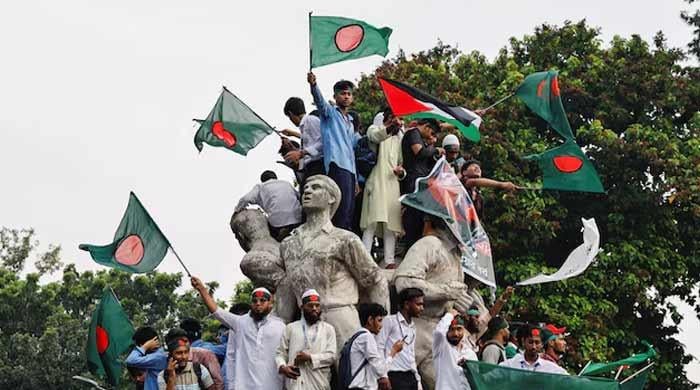

A Bangladesh commission investigating disappearances during the rule of ousted prime minister Sheikh Hasina said on Monday at least 287 people were assumed to have been killed.
The commission said some corpses were believed to have been dumped in rivers, including the Buriganga in the capital, Dhaka, or buried in mass graves.
The government-appointed commission, formed after Hasina was toppled by a mass uprising in August 2024, said it had investigated 1,569 cases of abductions, with 287 of the victims presumed dead.
“We have identified a number of unmarked graves in several places where the bodies were presumably buried,” Nur Khan Liton, a commission member, told AFP.
“The commission has recommended that Bangladesh seek cooperation from forensic experts to identify the bodies and collect and preserve DNA samples from family members.”
In its final report, submitted to the government on Sunday, the commission said that security forces had acted under the command of Hasina and her top officials.
The report said many of those abducted had belonged to the country’s largest party, Jamaat-e-Islami, or the Bangladesh Nationalist Party (BNP), both in opposition to Hasina.
In a separate investigation, police in December began exhuming a mass grave in Dhaka.
The grave included at least eight victims of the uprising against Hasina, bodies all found with bullet wounds, according to Criminal Investigation Department (CID) chief Md Sibgat Ullah.
The United Nations says up to 1,400 people were killed in crackdowns as Hasina attempted to cling to power.
She was sentenced to death in absentia in November for crimes against humanity.
“We are grateful for finally being able to know where our brother is buried,” said Mohamed Nabil, whose 28-year-old sibling Sohel Rana was identified as one of the dead in the grave in Dhaka.
“But we demand a swift trial for the police officials who shot at the people during the uprising.”
- Bangladesh, India face strain in diplomatic ties since Hasina’s ouster.
- Hossain directs 3 missions in India to close their visa sections.
- Bangladesh Deputy HC in Kolkata restricts visa services.
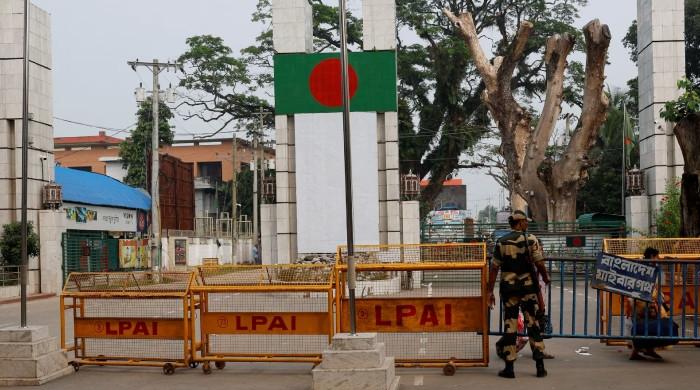
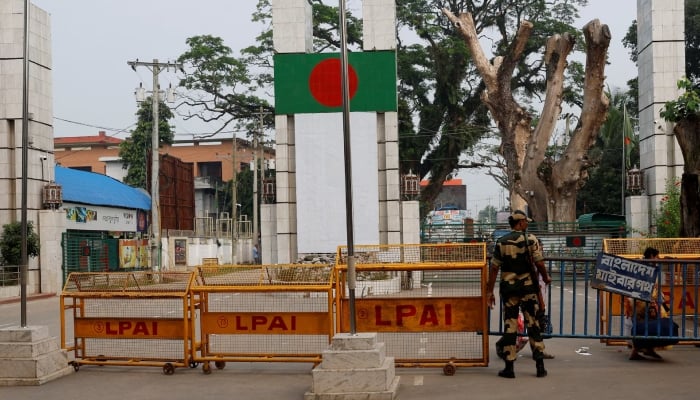
Bangladesh’s interim government has directed its key diplomatic missions in India, including the High Commission in New Delhi, to suspend visa services citing security concerns, a move that underscores the continuing strain in Dhaka’s relations with New Delhi.
Foreign Affairs Adviser M Touhid Hossain said at a media briefing at his office on Thursday that he had instructed Bangladesh’s three missions in India to temporarily close their visa sections, The Star Daily reported on Friday.
“What I have done is that I have asked our three missions [in India] to keep their visa sections closed for the time being. It’s a security issue,” Hossain said.
The remarks came after Bangladesh’s Deputy High Commission in Kolkata overnight restricted visa services, following similar steps taken earlier by missions in New Delhi and Agartala. However, business and work visas were kept outside the scope of the restriction.
Bangladesh also maintains diplomatic missions in Mumbai and Chennai, where visa services continued to operate.
India had previously imposed restrictions on visas for Bangladeshi nationals after August 5, 2024, citing security concerns.
Ties between Dhaka and New Delhi have remained strained since the Awami League government of then prime minister Sheikh Hasina was ousted following violent, student-led street protests in July and August 2024.
It may be noted that the Dhaka-Delhi ties further strained after the former refused to send its national cricket team to India for the upcoming T20 World Cup 2026, on the basis of “security concerns”.
The Bangladesh Cricket Board (BCB) requested the International Cricket Council (ICC) to shift Bangladesh matches outside India.
In its detailed letter to the ICC, Bangladesh board also noted that the fears were not limited to the players, but the provision of visas to media officials, fans, and other stakeholders is also part of the concerns. BCB also cited the government’s stance on the issue.
The venues became contentious after fast bowler Mustafizur Rahman was removed from the Indian Premier League (IPL) squad amid deteriorating diplomatic relations between the two countries, although no official reason was provided.
Following the incident, the Bangladesh government banned the broadcast of the IPL in the country, and the BCB formally wrote to the ICC stating it would not play its T20 World Cup matches in India.
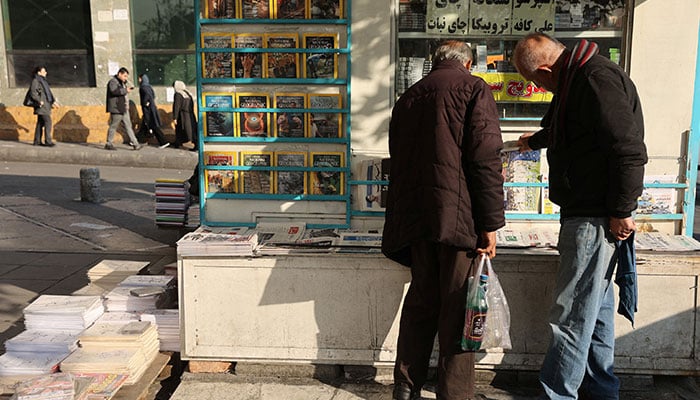
- Protests over economic hardships continue Iran.
- Demonstrators gathered in Tehran, Mashhad, Isfahan.
- State media say situation was calm in most parts of Iran.
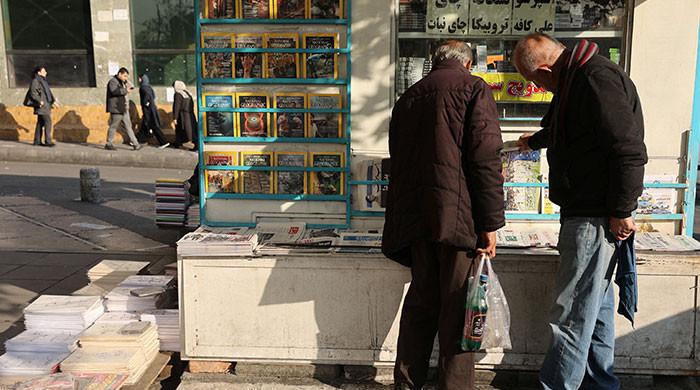
DUBAI: People across Iran were left cut off from the outside world on Thursday after a nationwide internet blackout as reported by internet monitoring group NetBlocks.
The outage came as fresh protests over rising prices and economic hardship continued in several cities, with demonstrators once again taking to the streets to voice their anger.
No further information on the internet outage was immediately available.
Witnesses in the capital Tehran and major cities of Mashhad and Isfahan told Reuters that protesters gathered again in the streets on Thursday, chanting slogans against the Islamic Republic’s clerical rulers.
Reza Pahlavi, the exiled son of Iran’s late Shah toppled in the 1979 Islamic Revolution, called in a video post on X on Wednesday for more protests.
Posts on social media, which could not be independently verified by Reuters, said demonstrators chanted pro-Pahlavi slogans in several cities and towns across Iran.
Iranian state media, however, said cities across the country were calm.
The current protests, the biggest wave of dissent in three years, began last month in Tehran’s Grand Bazaar with shopkeepers condemning the rial currency’s free fall.
Unrest has since spread nationwide amid deepening distress over economic privations arising from soaring inflation driven by mismanagement and Western sanctions, and curbs on political and social freedoms.
President Masoud Pezeshkian warned domestic suppliers against hoarding or overpricing goods, state media reported earlier on Thursday.
“People should not feel any shortage in terms of goods’ supply and distribution,” he said, calling upon his government to ensure adequate supply of goods and monitoring of prices across the country.
Tehran remains under international pressure with US President Donald Trump threatening to come to the aid of protesters if security forces fire on them, seven months after Israeli and US forces bombed Iranian nuclear sites.


Tremors from an earthquake centred near the China–Tajikistan border were felt in several parts of Pakistan, including the twin cities of Islamabad and Rawalpindi, on Friday.
According to the National Seismic Monitoring Centre of the Pakistan Meteorological Department (PMD), the earthquake registered a magnitude of 5.8 on the Richter scale.
The quake struck at a depth of 159 kilometres beneath the surface, the NSMC said, adding the epicentre was located in the border region between Tajikistan and China.
Apart from the federal capital and the neighbouring city of Rawalpindi, tremors were also felt in parts of Khyber Pakhtunkhwa (KP), including Swat, Shangla, Buner and surrounding districts, where people felt buildings shake and many stepped outside as a precaution.
There were no immediate reports of deaths or significant damage.
The tremor originated from an earthquake in the Tajikistan–Xinjiang border area which measured 6.1 on the Richter scale.

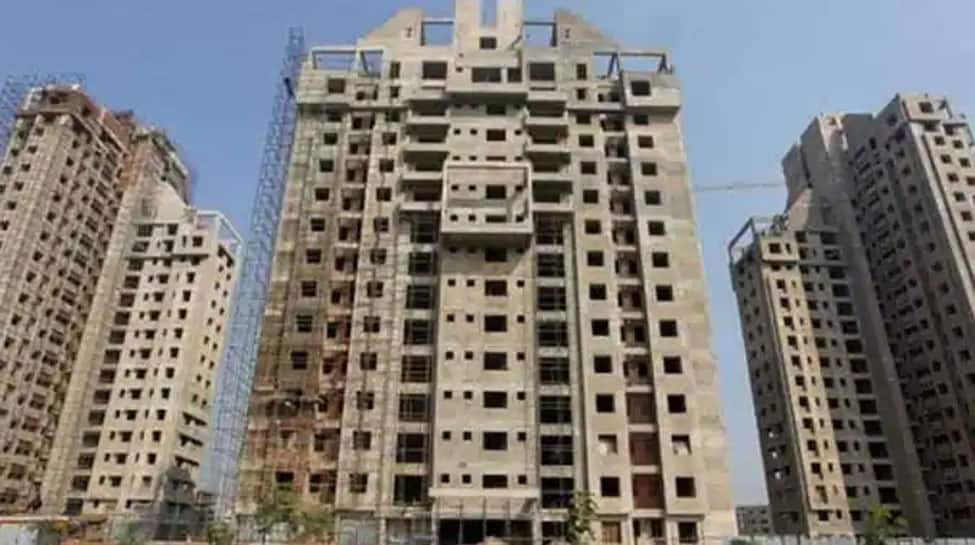
Bought 3BHK Flat Without Any Fancy Job Or Inheritance; CA Explains Real-Life Story Of Surat Man

Bangladesh’s key missions suspend visa services in India amid strained ties

Miami beats Ole Miss behind Carson Beck’s game-winning touchdown to reach CFP National Championship Game

-

 Sports4 days ago
VAR review: Why was Wirtz onside in Premier League, offside in Europe?
-
 Politics4 days ago
China’s birth-rate push sputters as couples stay child-free
-
 Business4 days ago
Aldi’s Christmas sales rise to £1.65bn
-

 Entertainment4 days ago
Minnesota Governor Tim Walz to drop out of 2026 race, official confirmation expected soon
-

 Sports4 days ago
FACI invites applications for 2026 chess development project | The Express Tribune
-
 Business4 days ago
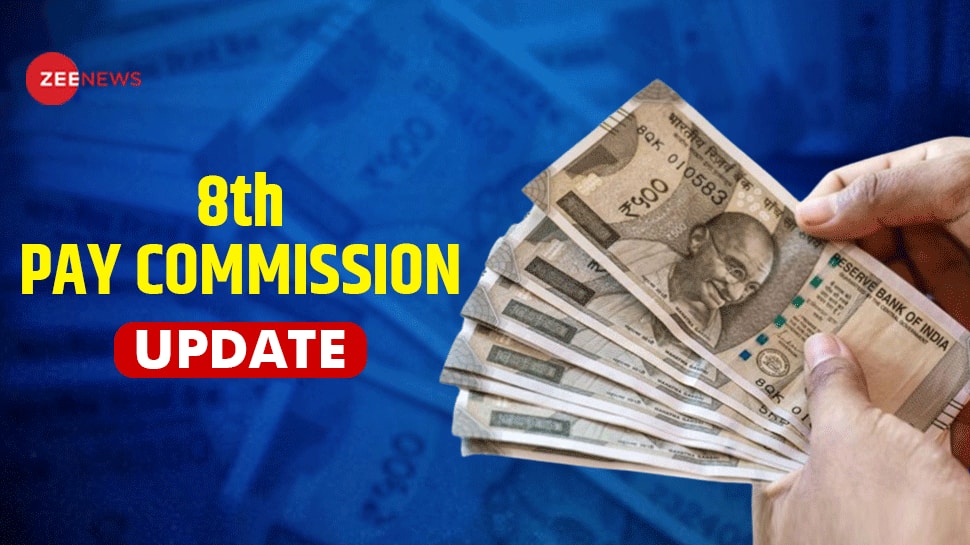
8th Pay Commission: From Policy Review, Cabinet Approval To Implementation –Key Stages Explained
-
Sports1 week ago
Tom Wilson’s New Year’s Eve: Two goals, a fight, a win and an Olympic nod
-

 Sports4 days ago
Steelers escape Ravens’ late push, win AFC North title