

Business
Bank of England warns of AI bubble risk

Archie MitchellBusiness reporter
 PA Media
The Bank of England has warned of a “sharp correction” in the value of major tech companies with growing fears of an artificial intelligence (AI) bubble.
It said share prices in the UK are close to the “most stretched” they have been since the 2008 global financial crisis, while equity valuations in the US are reminiscent of those before the dotcom bubble burst.
The central bank’s financial stability report warned valuations are “particularly stretched” for companies focused on AI.
In its report the Bank also announced plans to lower the amount of capital High Street banks need to hold in a bid to boost lending and spur economic growth.
It marks the first reduction in the amount lenders need to hold since the 2008 financial crisis, and followed stress tests showing they would be able to withstand a crisis scenario with unemployment doubling, house prices plummeting and the economy contracting by 5%.
AI bubble fears
The Bank said the growth of the AI sector in the next five years would be fuelled by trillions of dollars of debt, raising financial stability risks if the value of the companies falls.
It cited industry figures forecasting spending on AI infrastructure could top $5tn (£3.8tn) and said much of this would be funded by AI firms themselves, but around half would come from outside sources, mostly through debt.
“Deeper links between AI firms and credit markets, and increasing interconnections between those firms, mean that, should an asset price correction occur, losses on lending could increase financial stability risks,” it said.
The Bank of England is the latest institution to sound the alarm over a potential crash in the value of AI firms reminiscent of previous incidents such as the dotcom bubble.
Jamie Dimon, the chief executive of US bank JP Morgan, told the BBC in October he was “far more worried than others” about the risk of a serious market correction in the coming years.
The International Monetary Fund and the Organization for Economic Co-operation and Development have also warned of price corrections.
The dotcom booms refers to a period in the late 1990s, during which the values of early internet companies surged on a wave of optimism for what was then a new technology, before the bubble burst in early 2000 – with many share prices collapsing.
This led to some companies going bust, resulting in job losses.
A drop in share prices can also hit the value of people’s savings including their pension funds.
Fears over an AI-related stock market correction come as Chancellor Rachel Reeves used her Budget to encourage savers to pile cash into stocks and shares by reducing the amounts which can be saved in cash Isas.
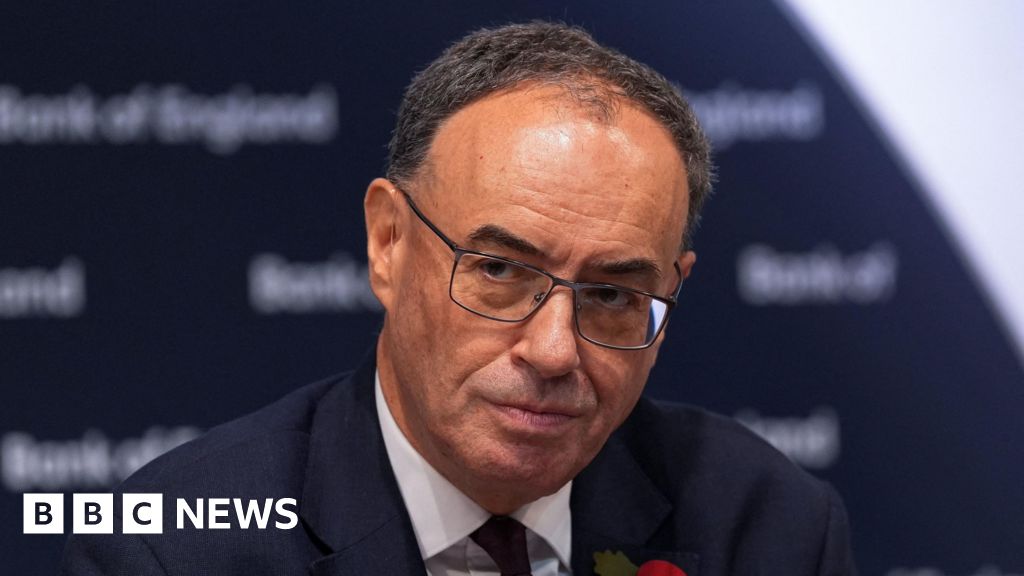
Bank of England governor Andrew Bailey has previously raised fears about a potential financial crash, warning after the collapse of two US companies that “alarm bells” were ringing.
On Tuesday he said the AI sector in the US is “very concentrated”, making up a large portion of the value of the country’s stock market.
But he added: “There is a difference to the dotcom situation in that these companies have got positive cash flows, they are not created on hope.
“But, as we see, and we saw last week in the debate about whether Google is moving onto Nvidia’s patch, it doesn’t mean to say everybody is going to win, it doesn’t mean to say everyone is going to win equally.
“It is important to be clear it is not inconsistent, quite consistent in fact that AI turns out to be the next general purpose technology in terms of prompting productivity growth across economies. I hope it is, but we’ll see.”
Global risks
The central bank also said the risks to financial stability had risen during 2025, citing geopolitical tensions, global trade wars and rising borrowing costs for governments.
It said growing tension between countries had specifically raised the prospect of cyber-attacks and other disruptions.
After assessing High Street lenders’ ability to cope in a crisis situation, the Bank has proposed lowering the benchmark for Tier 1 capital requirements for firms to 13% from the 14% level it has been at since 2015. The requirement refers to the buffer banks must hold in case of any losses from risky lending.
The central bank said this would still give firms a £60bn buffer against their minimum requirements so they would be able to continue lending to households and companies.
The Bank’s Financial Policy Committee said lowering the threshold would make it easier for lenders to offer loans to households and businesses. The changes are due to come into force in 2027.
Elsewhere in the financial stability report, the Bank warned homeowners coming off fixed-rate mortgages in the next two years face a £64 increase in their monthly repayments.
The central bank said the typical owner-occupier coming off a fixed rate would see an 8% jump in their bills as the impact of higher interest rates continues to bite.
In total, 3.9 million people, or 43% of mortgage holders, are expected to refinance at higher rates by 2028, the Bank said.
But a third will see their monthly payments fall in that period, it added, with interest rates having fallen significantly since a spike in 2022.
The Bank of England’s base rate, which influences the cost of borrowing for individuals, including mortgages, has fallen from 5.25% in 2024 to its current 4%.

Last Updated:
Gold is sold at a discount in Dubai due to Middle East conflict disrupting flights. Traders offer up to $30 per ounce less than London prices.




Dubai Gold Selling Cheaper As Iran War Grounds Flights
Gold is being sold at a discount in Dubai as the widening conflict in the Middle East disrupts flights and hampers the movement of bullion from one of the world’s key trading hubs.
According to a Bloomberg report, traders in Dubai are offering discounts of up to $30 per ounce compared to the global benchmark price in London. The unusual price cut comes as shipments remain stranded due to flight disruptions triggered by the escalating conflict involving Iran and Israel.
Dubai is a key global centre for refining and exporting gold to markets across Asia, including India. However, partial airspace restrictions and heightened security risks have slowed the movement of bullion out of the region.
Why Gold Is Being Sold Cheaper
Gold is typically transported in the cargo holds of passenger aircraft. With several flights from the UAE restricted amid regional tensions, traders are struggling to move bullion to international markets.
At the same time, insurance and freight costs have surged, making shipments more expensive and uncertain. Many buyers have therefore stepped back from placing new orders, unwilling to bear high logistics costs without assurance of timely delivery.
To avoid paying prolonged storage and financing costs while shipments remain stuck, some traders are offering gold at discounted prices.
Although transporting bullion by road to airports in neighbouring countries such as Saudi Arabia or Oman is theoretically possible, logistics firms are reluctant due to the risks and complications of moving high-value cargo across land borders during a conflict.
What It Means For India
India, one of the largest buyers of gold shipped from Dubai, could face short-term supply disruptions if the situation continues.
Renisha Chainani, head of research at Augmont Enterprises Ltd., said several cargo shipments have already been delayed, creating temporary tightness in the availability of physical bullion in India.
However, industry experts as reported by Bloomberg say the immediate impact may remain limited as domestic inventories are currently comfortable after heavy imports earlier this year.
Chirag Sheth, principal consultant for South Asia at Metals Focus, said Bloomberg that India has ample stocks for now, but warned that prolonged disruptions could eventually affect supply if the conflict continues for several months.
Meanwhile, global gold prices have surged this year amid geopolitical uncertainty, with spot gold recently trading above $5,000 per ounce.
 Click here to add News18 as your preferred news source on Google.
Follow News18 on Google. Join the fun, play games on News18. Stay updated with all the latest business news, including market trends, stock updates, tax, IPO, banking finance, real estate, savings and investments. To Get in-depth analysis, expert opinions, and real-time updates. Also Download the News18 App to stay updated.
March 08, 2026, 10:03 IST
Read More

Some seven in 10 British adults without a full driving licence say learning to drive is currently unaffordable, according to a survey.
The figure is even higher among younger people, with 76% of 18 to 29-year-olds without a licence saying driving lessons are financially out of reach, the poll for car insurer Prima found.
Overall, 38% said the cost of driving lessons was the biggest deterrent to learning to drive.
Some 32% were put off by the price of buying a car and 15% said the cost of car insurance was the main barrier to learning to drive.
Almost half (45%) said they would consider learning to drive if it became significantly cheaper.
Nick Ielpo, UK country manager at Prima, said: “For a growing number of people, driving is no longer a symbol of freedom – it’s a financial stretch too far.
“Between lessons, buying a car and insuring it, the upfront and ongoing costs are pricing many people out before they even start.”
Find Out Now surveyed 1,134 adults who do not hold a full driving licence between January 21 and 23.

Go Digit General Insurance on Saturday said it has received a demand notice of about Rs 170 crore for short payment of goods and services tax (GST) for nearly five years. The company has received an order copy from the Office of the Commissioner of GST & Central Excise, Chennai South Commissionerate on March 6, confirming GST demand of Rs 154.80 crore levying penalty of Rs 15.48 crore and Interest u/s 50 of CGST Act, 2017 for the period July 2017 to March 2022, the insurer said in a regulatory filing. The company is in the process of evaluating the legal advice on the implications and would file an appeal, it said.


Special loan facility for Feb wages in Bangladesh’s export units

Let girls fly

Why have 1,000 ships at times lost their GPS in the Mideast?

LPGA legend shares her feelings about US women’s Olympic wins: ‘Gets me really emotional’

India Us Trade Deal: Fresh look at India-US trade deal? May be ‘rebalanced’ if circumstances change, says Piyush Goyal – The Times of India

Pakistan’s semi-final qualification scenario after England defeat New Zealand

-
 Sports1 week ago
LPGA legend shares her feelings about US women’s Olympic wins: ‘Gets me really emotional’
-
Business1 week ago
India Us Trade Deal: Fresh look at India-US trade deal? May be ‘rebalanced’ if circumstances change, says Piyush Goyal – The Times of India
-

 Fashion1 week ago
South Korea’s Misto Holdings completes planned leadership transition
-
 Entertainment1 week ago
Pakistan’s semi-final qualification scenario after England defeat New Zealand
-

 Entertainment1 week ago
Bobby J. Brown, “The Wire” and “Law & Order: SUV” actor, dies of smoke inhalation after reported fire
-
 Business1 week ago
Greggs to reveal trading amid pressure from cost of living and weight loss drugs
-
 Business1 week ago
CNBC To Merge TV And Digital News Operations, Nearly A Dozen Jobs To Be Cut: Report
-

 Entertainment1 week ago
What’s new in Pokémon? Every game, update, surprise from 30th anniversary event