

Business
Brent holds near $114 a barrel as Middle East tensions rage on | The Express Tribune


Brent crude futures eased 93 cents, or 0.8%, to $113.51 per barrel after settling up 5.8% on Monday
Iran renewed attacks on the United Arab Emirates on Tuesday, causing oil loading at the port of Fujairah to be at least partly halted after the third attack in four days. FILE IMAGE: PIXABAY
Brent crude futures retreated on Tuesday but held near $114 a barrel following fresh hostilities in the Middle East, while investors monitored developments in the US-Israeli conflict with Iran.
The US and Iran launched new attacks in the Gulf on Monday as they wrestled for control over the Strait of Hormuz with duelling maritime blockades, shaking a fragile truce.
Brent crude futures eased 93 cents, or 0.8%, to $113.51 per barrel at 0719 GMT after settling up 5.8% on Monday. US West Texas Intermediate (WTI) crude fell $2.16, or 2%, to $104.26, after gaining 4.4% in the previous session.
“Prices continue to trade in a highly volatile range, driven largely by ongoing tensions in the Strait of Hormuz,” said Phillip Nova’s senior market analyst Priyanka Sachdeva.
“While prices have eased slightly in recent sessions, this is not due to any real improvement in fundamentals, but rather a temporary relief after the US launched ‘Project Freedom,” she added.
Read: Oil prices jump 6% on UAE, vessel attacks
The US on Monday launched a new operation aimed at reopening the strait to shipping. Maersk later said the Alliance Fairfax, a US-flagged vehicle carrier, exited the Gulf via the Strait, accompanied by the US military.
“It shows that limited safe passage is possible under current conditions and helps chip away at some of the worst-case supply disruption fears,” said Tim Waterer, chief market analyst at KCM Trade, in an email.
“However, it’s still very much a one-off event rather than a full reopening,” he added.
Still, Iran launched attacks in the Gulf on Monday to counter US moves for control over the Strait of Hormuz, which connects the Gulf to wider markets and typically carries oil and gas supply equal to about 20% of global demand every day.
Read more: Truce hangs by a thread as Hormuz heats up
Several commercial vessels were reportedly struck in the area, while a key oil port in the United Arab Emirates was set ablaze after an Iranian strike. Trump’s attempt to use the US Navy to free up shipping is the war’s biggest escalation since a ceasefire was declared four weeks ago.
“Markets may find some relief today following President Trump’s overnight comments suggesting the conflict could continue for another two to three weeks,” said ING analysts in a client note.
However, there is considerable scepticism in the market on this view, given the recent escalation and the repeated extensions of projected timelines for ending hostilities since the conflict began, they added.



Business
Govt lists 40 sub-sectors for faster FDI clearance from border nations-check details – The Times of India
The government has identified 40 sub-sectors, including rare earth magnets and printed circuit boards, for expedited clearance of foreign direct investment (FDI) proposals from countries sharing land borders with India, PTI reported.Under the revised framework, proposals from countries such as China, Pakistan, Bangladesh, Nepal, Bhutan, Myanmar and Afghanistan in these sectors will be processed within 60 days, as per the updated standard operating procedure (SOP).The move follows a decision taken in March to fast-track FDI approvals in specified manufacturing sectors from these countries.However, the government has clarified that majority ownership and control of the investee entity must remain with resident Indian citizens or Indian-owned entities at all times.The 40 identified sub-sectors fall under six broad categories –capital goods manufacturing, electronic capital goods and electronic components, polysilicon and ingot-wafer production, advanced battery components, rare earth permanent magnets, and rare earth processing.These include manufacturing of insulation items, castings and forgings for thermal, hydro and nuclear power plants, machine tools, display components such as LCD and LED panels, camera modules, electronic capacitors, speakers and microphones, lithium-ion batteries, wearables, and rare earth metal and magnet processing facilities.The SOP also introduces detailed reporting norms for investments involving entities with direct or indirect ownership from land-bordering countries.“The reporting under these guidelines will be governed under the Foreign Exchange Management (Mode of Payment and Reporting of Non-debt Instruments) Regulations, 2019, and the information will be accessible by the Reserve Bank of India (RBI),” the DPIIT said.The responsibility for reporting lies with the Indian investee company, which must submit required details to the DPIIT before receiving foreign capital.“The reporting is to be made prior to the inward remittance of foreign capital. In cases which do not involve foreign capital inward remittances, the reporting is to be made prior to execution of the relevant transactions, including issuance/transfer of capital instruments, as the case may be,” it added.Investors will be required to disclose details such as shareholding patterns, beneficial ownership, organisational structure, promoters, board composition, key managerial personnel and control rights.The Indian entity will also need to provide incorporation details and disclose existing or proposed shareholding linked to entities from land-bordering countries.

Ferrari technicians inspect supercars on the production line inside the company’s factory in Maranello, Italy, October 2, 2025. REUTERS/Remo Casilli/File Photo
Remo Casilli | Reuters
DETROIT — Ferrari on Tuesday beat Wall Street’s first-quarter earnings expectations and reconfirmed its guidance for the year, weeks ahead of the sports car maker revealing its first all-electric vehicle.
Here’s how the company performed in the first quarter compared with average estimates compiled by LSEG:
- Earnings per share: 2.33 euros (US $2.72) adjusted vs. 2.27 euros expected
- Revenue: 1.85 billion euros vs. 1.81 billion euros expected
Ferrari’s revenue was up more than 3% compared with 1.79 billion euros during the first quarter of 2025, while its operating profit and adjusted earnings increased 1.1% and 4.2% year-over-year, respectively.
The company’s 2026 guidance includes 7.5 billion euros in net revenues and an adjusted operating profit of at least 2.22 billion euros, or 9.45 euros adjusted EPS. Its industrial free cash flow is targeted at 1.5 billion euros or more for the year.
Those results were despite deliveries being down 4.4% year-over-year to 3,436 units, as the sports car maker said it slowed production to “ease the execution of the planned model change-over.”
The company said deliveries “were not impacted by the surge of hostilities in the Middle East, as Ferrari leveraged its geographical allocation flexibility, bringing forward certain deliveries to other regions.”
Ferrari’s results come weeks before the scheduled debut of the Luce, its first fully electric vehicle, on May 25.
“With only twenty days to the world premiere of the Ferrari Luce, the sense of anticipation has never been so high. The Ferrari Luce brings together so much extraordinary technologies and the passion of so many people. It is the evidence of how tradition and innovation can come together to create something unique,” Ferrari CEO Benedetto Vigna said in a statement Tuesday.
Business
India among most resilient large EMs, better placed for future global shocks; policy reforms & strong buffers help: Moody’s – The Times of India

Amid the ongoing Middle East conflict, a recent report by Moody’s Ratings says that recent global shocks have shown India’s resilience among emerging economies to withstand pressures. The report credits the resilience to timely policy measures and the buildup of robust buffers.“India and Thailand are the sovereigns better placed to manage future global shocks. In both cases, the key policy choices that support stability were made well before the recent stress period,” Moody’s says.In its latest study on emerging-market sovereigns, the agency notes that India has ranked among the more resilient economies since 2020, based on multiple indicators such as sovereign bond spreads, domestic yield movements, and exchange-rate stability.The report highlights the following points of strength:Monetary policy frameworks are clear and predictable, inflation expectations are better anchored, and exchange rates are allowed to adjust when needed. This reduces the risk that currency moves turn into persistent inflation or force abrupt policy shifts.
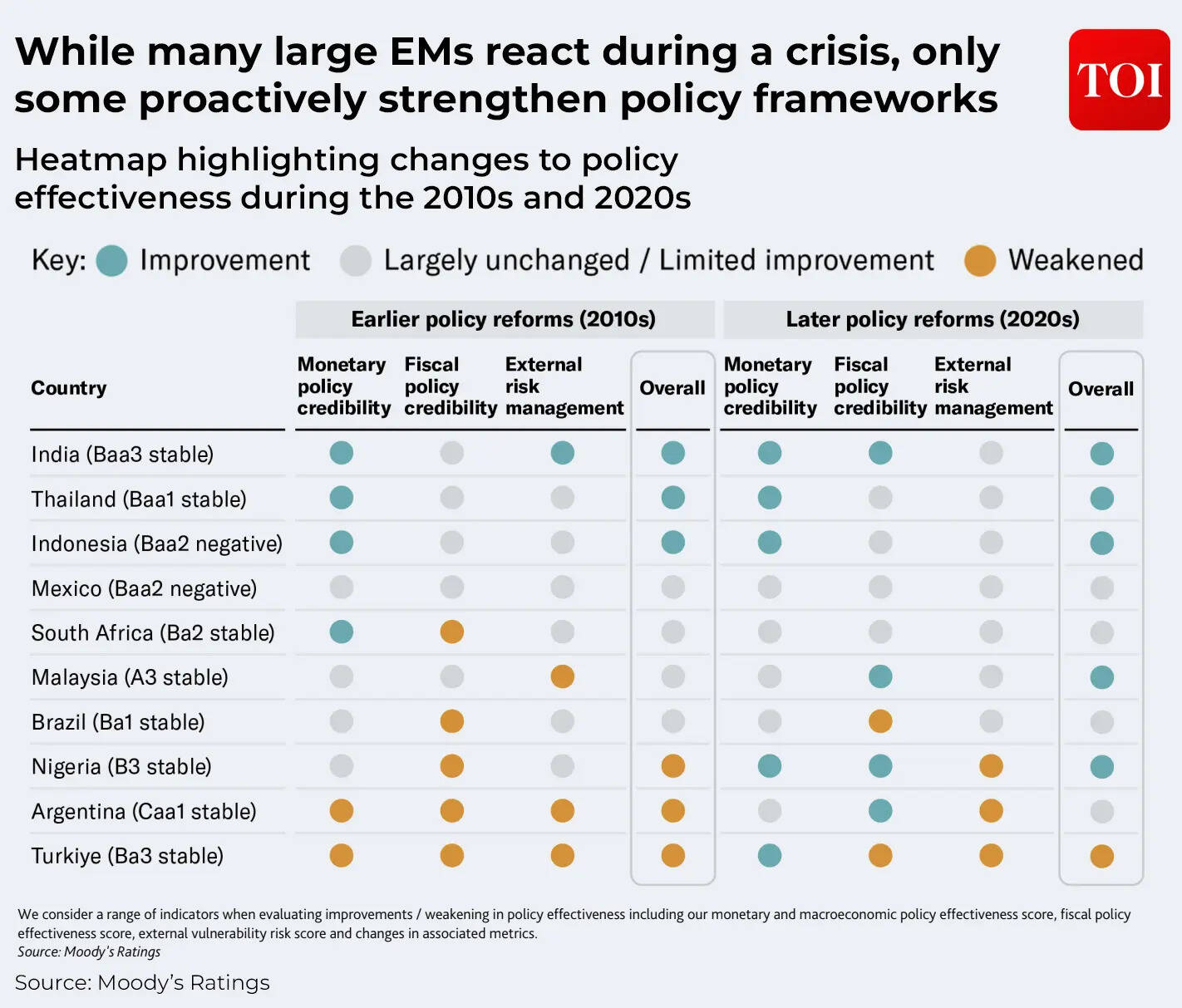
Both countries should also enter future periods of stress with strong and accessible buffers. India’s reliance on domestic funding is balanced by deep local markets and sizeable reserves, the report says.However it notes that India’s relatively high debt burden and weak fiscal balance limit the amount of space available to respond to successive shocks, while Thailand’s rising debt burden risks reducing resilience over time.The report points out that India has consistently demonstrated notable strength during periods of global volatility. Movements in credit spreads have been limited and short-lived, currency depreciation has remained controlled, and fluctuations in local bond yields have been orderly. These factors have helped the country retain uninterrupted access to financial markets even during turbulent phases.
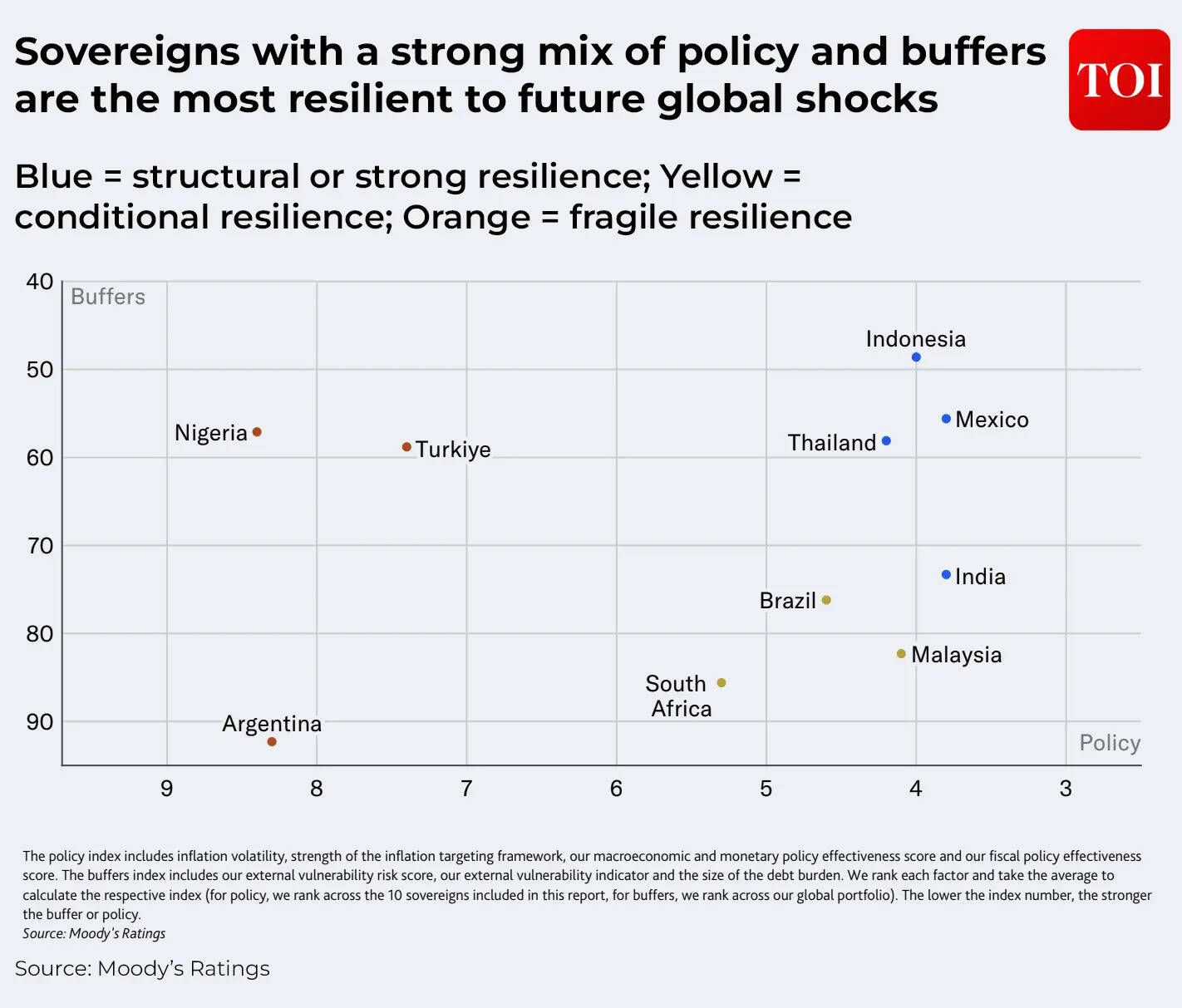
It underscores the role of India’s sizeable foreign-exchange reserves, which have helped stabilise the currency and maintain investor confidence during episodes of global stress, setting it apart from more vulnerable peers.Another key factor has been the presence of a transparent and consistent monetary policy framework. The adoption of inflation targeting well before recent global disruptions has ensured that inflation expectations remain anchored, thereby improving the economy’s ability to absorb external shocks.When compared with relatively more fragile economies such as Türkiye, Argentina and Nigeria, India has largely managed shocks through adjustments in prices rather than prolonged financing stress. This has been supported by deeper domestic financial markets and stronger policy credibility.


Dolly Parton shares health update after canceling Las Vegas residency

US-Iran talks progressing with Pakistan’s efforts, says Araghchi amid Hormuz tensions

Nylon chips & CPL drop over 5% in final week of April, chain follows

-

 Tech1 week ago
A Brain Implant for Depression Is About to Be Tested in Humans
-
 Business1 week ago
‘I had £20,000 stolen and had to fight a 13-month fraud reporting rule to get it back’
-

 Tech1 week ago
Almost 90% of women leave tech industry within 10 years | Computer Weekly
-

 Sports1 week ago
Pro wrestling star Steph De Lander reveals how colleague’s advice helped lead her to title triumph at ACW
-
 Business1 week ago
Pakistan’s oil market is fuelling the crisis | The Express Tribune
-

 Entertainment1 week ago
Norway joins Type 26 Frigate Programme to boost NATO naval power
-

 Tech1 week ago
This Ambitious Laptop Doesn’t Leave Much Room for Your Hands
-

 Entertainment1 week ago
Melania Trump says ABC should ‘take a stand’ on late-night host Kimmel