

Tech
Engineers send a wireless curveball to deliver massive amounts of data

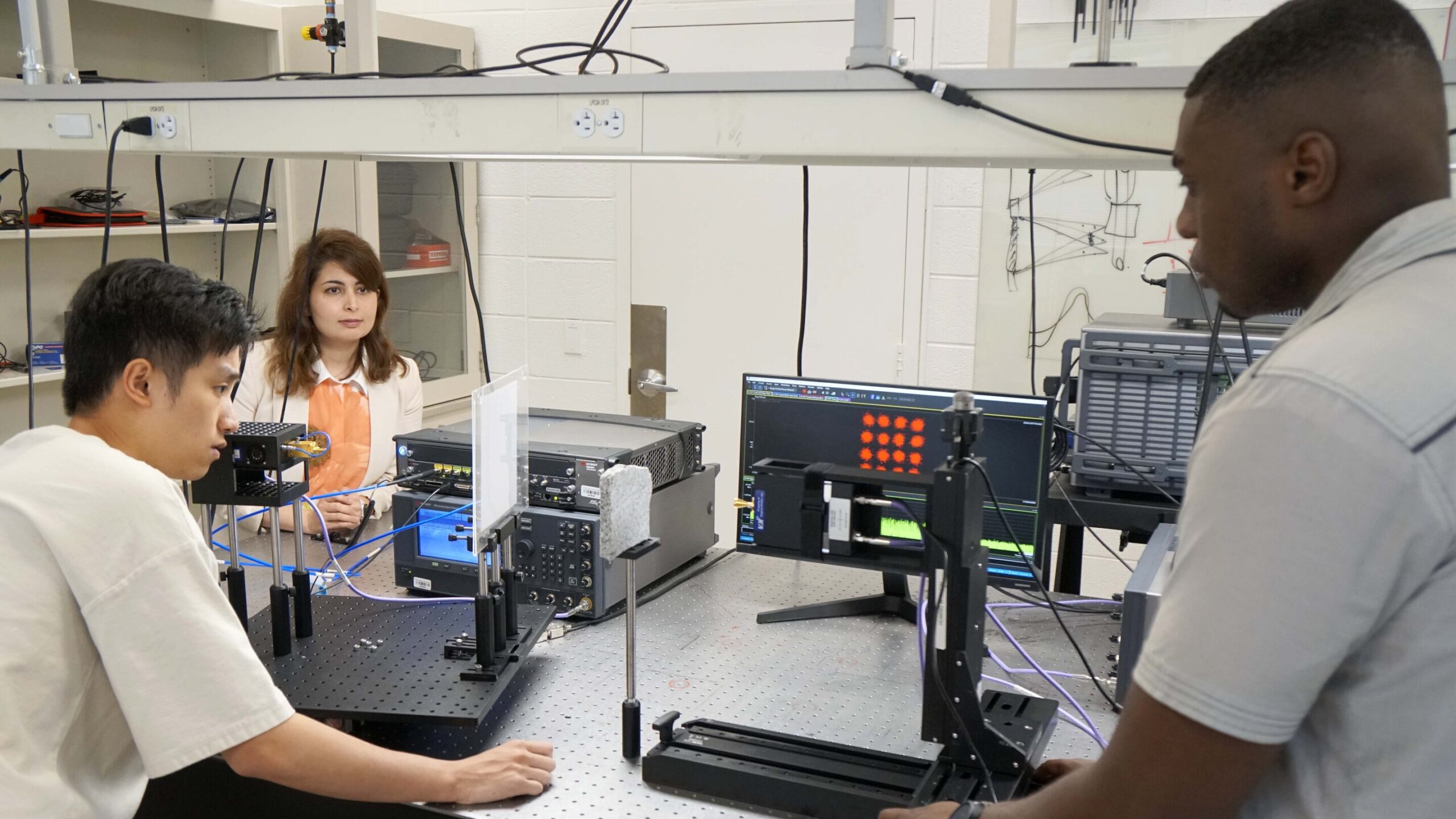
High frequency radio waves can wirelessly carry the vast amount of data demanded by emerging technology like virtual reality, but as engineers push into the upper reaches of the radio spectrum, they are hitting walls. Literally.
Ultrahigh frequency bandwidths are easily blocked by objects, so users can lose transmissions walking between rooms or even passing a bookcase.
Now, researchers at Princeton Engineering have developed a machine-learning system that could allow ultrahigh frequency transmissions to dodge those obstacles. In an article in Nature Communications, the researchers unveiled a system that shapes transmissions to avoid obstacles coupled with a neural network that can rapidly adjust to a complex and dynamic environment.
Lead researcher Yasaman Ghasempour, an assistant professor of electrical and computer engineering at Princeton, said the work is an important step toward deploying data transmission in the sub-terahertz band, which is at the upper end of the microwave spectrum.
Transmissions in the sub-terahertz band have the potential to handle 10 times the data of current wireless systems. This kind of fast transmission would be important for uses such as virtual reality systems or fully autonomous vehicles.
“As our world becomes more connected and data-hungry, the demand for wireless bandwidth is soaring. Sub-terahertz frequencies open the door to far greater speeds and capacity,” Ghasempour said.
Sub-terahertz beams are easily blocked, but can bend with special transmitters
Ultra-high frequency signals like those in the sub-terahertz band are transmitted in defined beams, unlike lower frequency radio waves, which can span over wider areas. This makes the signals easy to block, particularly indoors and in areas with lots of moving people and objects.
Engineers have successfully tested systems using reflectors to bounce signals around obstacles. But these systems rely on reflectors that may not be available or practical in many situations.
Ghasempour’s team proposed using a special transmission technique to dodge obstacles. The researchers were able to bend transmission beams by transmitting a signal that curves around the obstruction. In doing this, they used an idea first proposed in 1979 for a kind of radio wave called Airy beams that allow engineers to shape transmissions like a curveball. When correctly controlled, the beams can maneuver through a complex and moving field of objects.
“This is for complex indoor scenarios where you don’t have a line of sight,” said Haoze Chen, a graduate student at Princeton and the paper’s lead author. “You want the link to adapt to that.”
Unlike static systems, the new system allows the transmitters to adapt to changes in real time. By adjusting the exact curvature properties on the fly, the transmitter can steer signals around new obstacles as they appear, maintaining a strong connection even in crowded, constantly changing environments.

Chen said that most work with Airy beams has focused on creating the beams and exploring their underlying physics.
“What we are doing is not only generating the beams but finding which beams work best in the situation,” he said. “People have shown that these beams can be created, but they have not shown how the beams can be optimized.”
The system learns to dodge obstacles by training like an NBA All-Star
Finding the best curved beam is a difficult problem, particularly in a cluttered and shifting environment. The standard method of aiming beams—scanning a room for the best transmission path—does not work for bendable transmissions.
“For Airy beams, this is impractical,” Chen said. “There are infinite ways of curving depending on the degree of the curve and where the curve happens. There is no way a transmitter can scan through.”
To solve the problem, the researchers took a cue from human athletes. Basketball players don’t pull out a calculator every time they take a shot. They rely on past experience to learn what force and direction works for different situations. To generate that type of response, the researchers designed a neural net, a computer system that mimics the brain.
Like basketball players, neural nets require a lot of training before they can perform. But Chen said training the system by transmitting actual beams was very time-consuming. Instead, co-author Atsutse Kludze designed a simulator that allowed the net to train virtually for different obstacles and different environments.
The math behind Airy beams is difficult, and Kludze, a doctoral student in Ghasempour’s lab, had to create a system that applied the underlying physics to almost any scenario.
Neural net calibrates curves with perfect precision
Throwing a lot of data at the neural net is not effective. Instead, the researchers use principles from physics to create and train the neural net. Once the system was trained, the neural net was able to adapt incredibly quickly.
The researchers said they tested their scheme with experiments, which were focused on understanding the technology and developing ways to control the transmissions.
“This work tackles a long-standing problem that has prevented the adoption of such high frequencies in dynamic wireless communications to date,” Ghasempour said.
“With further advances, we envision transmitters that can intelligently navigate even the most complex environments, bringing ultra-fast, reliable wireless connectivity to applications that today seem out of reach—from immersive virtual reality to fully autonomous transportation.”
More information:
A Physics-Informed Airy Beam Learning Framework for Blockage Avoidance in sub-Terahertz Wireless Network, Nature Communications (2025). DOI: 10.1038/s41467-025-62443-0
Citation:
Engineers send a wireless curveball to deliver massive amounts of data (2025, August 18)
retrieved 18 August 2025
from https://techxplore.com/news/2025-08-wireless-curveball-massive-amounts.html
This document is subject to copyright. Apart from any fair dealing for the purpose of private study or research, no
part may be reproduced without the written permission. The content is provided for information purposes only.










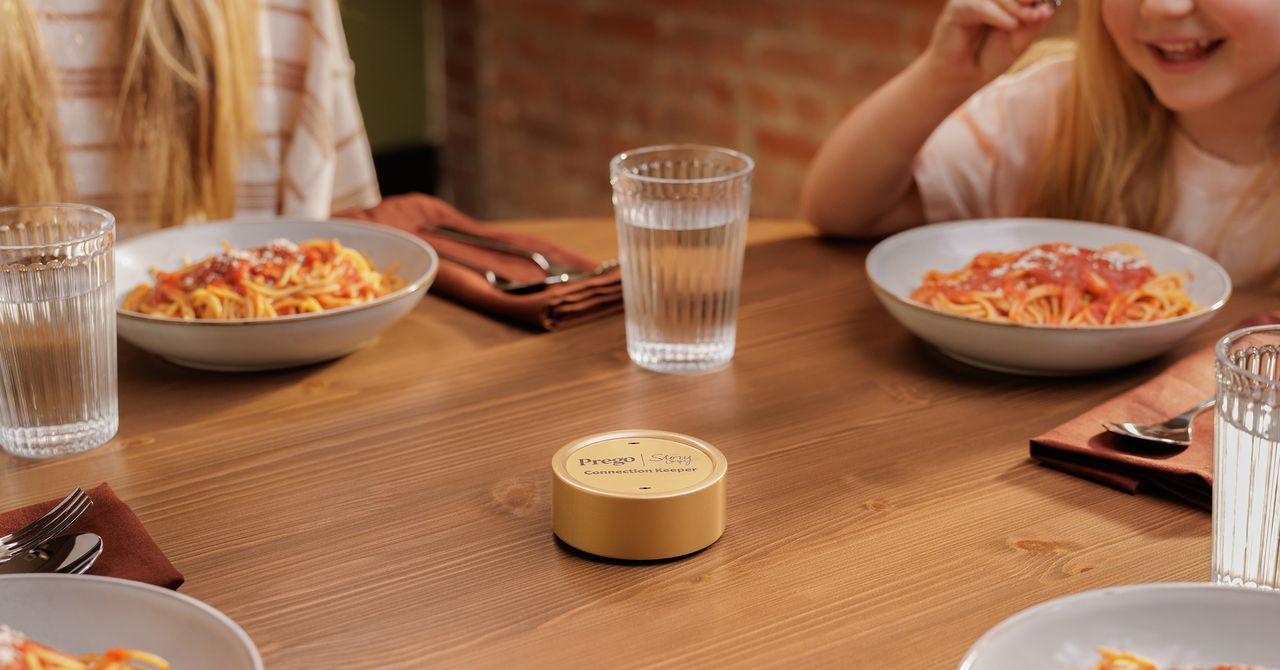
Prego, the pasta sauce company, is getting into hardware with a device that sits on your table and records dinner conversations. No, this isn’t April Fools’.
The Connection Keeper is a round puck that houses two microphones for recording around the table. The recorder was developed in partnership with StoryCorps, the 20-year-old nonprofit that has recorded conversations with more than 720,000 people about their lives.
The Connection Keeper is more of a publicity stunt than a readily available product. Fewer than 100 will be made. The pucks look more like a tuna can than what you’d associate with the pasta sauce brand—small and meant to be tucked aside so as not to attract attention. The whole goal here, Prego and StoryCorps say, is to advocate for keeping people off their phones during dinner.
“Everything now is AI, and everyone has their phones on the table,” says Elyce Henkin, a managing director of StoryCorps studios and brand partnerships. “It interrupts the conversation and the flow. We wanted to get rid of that and go back to the basics and have everyone talking to each other.”
The pucks come packaged with cards inspired by StoryCorps, designed to prompt conversations between family members. Some are aimed at kids; some are aimed at parents or other family members.
The device doesn’t record automatically. Press a button, and the device begins recording CD-quality audio. Push the button again to stop. It records all the audio on a 16-GB microSD card that can hold up to eight hours of audio at a time. Those recordings can then be saved on a StoryCorps microsite or the family’s own storage. There is no cloud connection, no Wi-Fi, and no artificial intelligence features whatsoever.
The more communal element of the project is that StoryCorps will allow users to share their recordings on its website (or keep them private). Anything that has been voluntarily shared will also be physically preserved as a recording along with the larger StoryCorps collection within the US Library of Congress.
Prego is a US company, named after the Italian word for “you’re welcome.” I’ll tell you this from experience growing up in an Italian-American extended family: The Connection Keeper is going to have a hell of a time keeping track of a conversation at a table full of loud uncles and your wine-drunk grandma, who all talk at the same time.
“I think it’s how a lot of families are,” Henkin says. “What StoryCorps does is that it reminds us of our similarities and the humanity that’s in us all, even though we are all different. I imagine that if someone were to go through and listen to the collection, there would be rowdy moments, and there would be kids laughing and moms saying, ‘Don’t eat with your mouth full.’ That’s all part of the truth of it.”
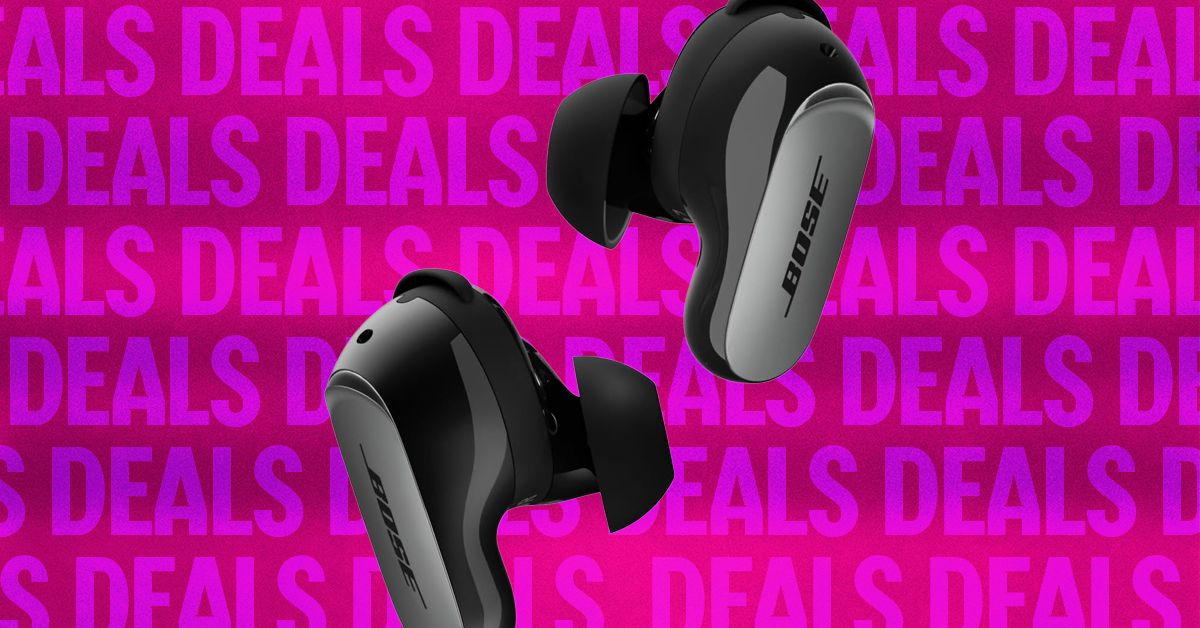
Bose’s QuietComfort Ultra 2 earbuds are the best noise-canceling earbuds you can buy. Right now, they’re $50 off, which matches the best price we tend to see outside of special events like Black Friday and Cyber Monday. If you want to wait until November, they might hit $200 again, but otherwise $250 is a very fair deal—especially since they pop back up to $300 regularly. The discounted price applies to all five color options, including Black, Deep Plum, Desert Gold, Midnight Violet, and White Smoke (another rarity, as usually only the vivid colors go on sale).
Sometimes you just need to quiet the world. Whether it’s to play 10 hours of Coconut Mall on a loop to help you lock in and meet your Friday deadlines (thanks to my colleague Julia Forbes for that suggestion); muffle the crying babies, sniffling neighbors, and mysterious, potentially concerning clunking noises on an airplane; or to help you better appreciate the mix on Space Laces’ Vaultage 004 EP, active noise cancellation makes a huge difference to your listening experience.
The Bose QuietComfort Ultra 2 earbuds also have some of the best active noise cancellation you can find. They sound great out of the box, thanks to a custom sound profile based on the shape of your ears, but you can customize the EQ by using the app. The app also allows you to tweak touch controls and spatial audio.
The battery life lasts for about six hours, or 24 with the charging case. And while the noise cancellation can’t be beaten, these also have a pass-through feature called Aware mode, which filters in outside noise but smooths the loudest bits. That means you’ll be able to hear what’s going on, but you won’t be startled. True-crime podcast listeners, this one’s for you.
In fact, just about the only drawback we can find is that these might not be ideal for folks with super-small ears. Otherwise, they’re great all around, with solid call quality, excellent sound overall, and a sleek aesthetic. We think they offer good value at full price, so an extra $50 off is especially nice.
If you’re in the market for new headphones, but these don’t exactly fit what you’re looking for, we have plenty of other recommendations. Check out our guides to the Best Wireless Earbuds, Best Headphones for Working Out, Best Noise-Canceling Headphones, and Best Open Earbuds for additional hand-tested picks.
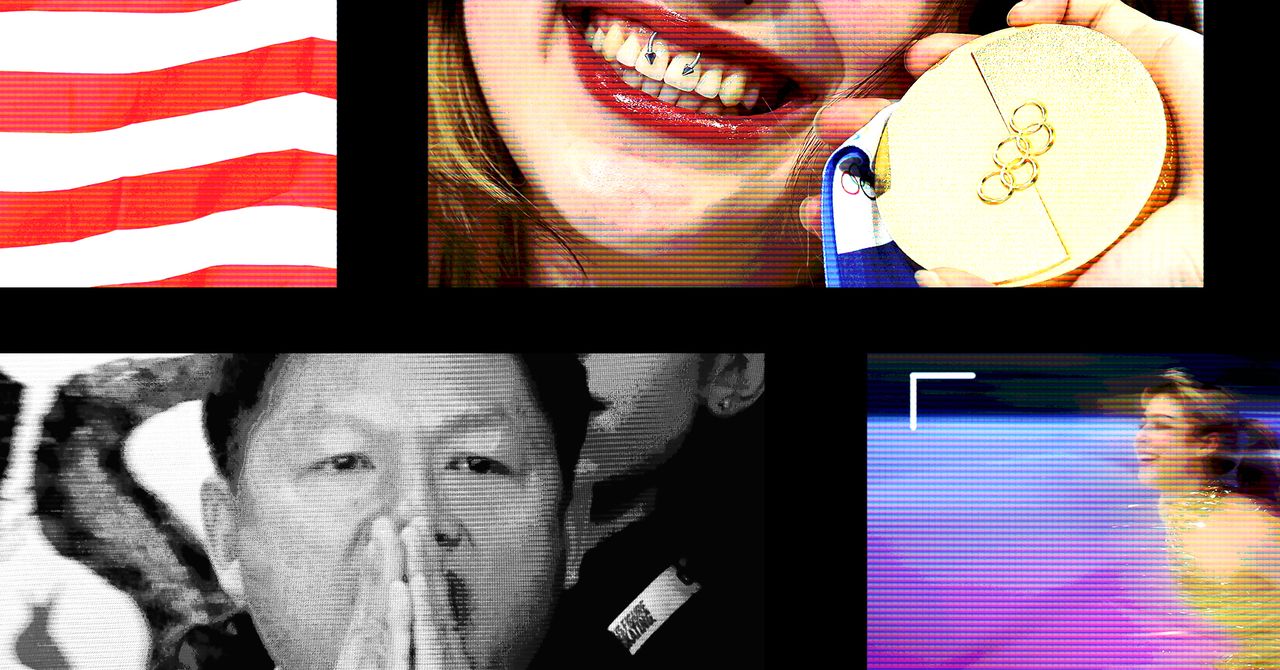
On November 16, 2021, Matthew Ziburis sat in his car in a residential neighborhood in the Bay Area stalking an “enemy,” as he put it. A veteran of both the US Army and Marine Corps, Ziburis had previously served in Iraq. But on this mission, he was working at the behest of China’s government. The targets that autumn day were American citizens: Arthur Liu and his teenage daughter, Alysa.
Arthur’s personal story was an exemplar of the American Dream. As a university student, he took part in the 1989 pro-democracy movement in China. After the crackdown at Tiananmen Square that year, he fled to the United States, settling in California. Arthur poured a small fortune and an equal amount of energy into molding Alysa into a figure skating phenom. As a national champion at age 13, she bantered along with Jimmy Fallon on The Tonight Show, and was at the time on track to represent America at the Winter Olympics the following year in Beijing.
Ziburis was surveilling the Liu home when he called Arthur, falsely claiming that he was a member of the US Olympic Committee who needed to discuss upcoming travel to Beijing, Arthur says. Ziburis was adamant that Arthur fax him copies of his and his daughter’s passports as part of a travel “preparedness check,” Liu tells WIRED. This struck Arthur as odd. In his many years dealing with sports bodies, he had never fielded such a request. Alysa’s agent did not respond to a request for comment.
Ziburis’ surveillance of Arthur and Alysa Liu that November day five years ago was just one episode in a bizarre saga that spanned from California to Beijing, touched New York City mayors and members of the US Congress, and has seen two people plead guilty and two more awaiting trial.
Unbeknownst to Ziburis, as he sat outside Aurthur and Alysa’s Northern California home, he too was being watched.
Ziburis had allegedly been dispatched to Northern California by Frank Liu, a self-styled fixer in the Chinese community from Long Island, New York, who was in turn receiving orders from a person in China named Qiang Sun. According to US authorities, Sun was working at the behest of the Chinese government. A concerned private investigator who once worked for Frank Liu had alerted the FBI to Frank’s escapades and was assisting authorities. Law enforcement was already on to Ziburis by the time he arrived. Anthony Ricco, Ziburis’ lawyer, did not respond to requests for comment.
Officers watched as Ziburis surveyed Arthur’s home and visited his law office. The heavy-set man sulking around Arthur’s office also caught the attention of a neighbor, who approached Ziburis and asked him if he needed help, Arthur says. Apparently concerned, the FBI called Arthur to warn him that Ziburis was heading to his home. By then, in part because of the harassment, Arthur and Alysa were boarding a plane to fly out of California. “It was like a movie,” Arthur says.
Alysa’s showing in Beijing in 2022 was disappointing. Burned out, she retired from the sport. Then in February, after returning to the ice after a two year hiatus, Alysa became the first US women’s figure skater to win Olympic gold since 2002—intentionally without her father by her side.
Despite her much-publicized complicated relationship with Arthur, Alysa’s success—punctuated by her signature pierced smile, racoon-tail dye job, and palpable joy for her sport—has reignited interest in the long-running case of transnational repression against her and her father. Human rights advocates and researchers have documented in recent years the lengths Beijing has taken to suppress critical voices, even those residing abroad or whose perceived transgressions date back decades.


‘A win-win for both nations!’ Three-day India-US trade talks to begin this week – The Times of India

Germany’s BOSS secures landmark Australian Open partnership

PCB imposes one-year PSL ban on Dasun Shanaka over contractual breach

-

 Fashion4 days ago
France’s LVMH Q1 revenue falls 6%, shows resilience amid Iran war
-

 Sports1 week ago
The case for Man United’s Fernandes as Premier League’s best
-

 Entertainment1 week ago
Palace left in shock as Prince William cancels grand ceremony
-
 Business1 week ago
UK could adopt EU single market rules under new legislation
-

 Entertainment5 days ago
Is Claude down? Here’s why users are seeing errors
-

 Fashion1 week ago
Energy emerges as biggest cost driver in textile margins
-

 Sports1 week ago
Lamar Jackson hits back at critics with faithful message on social media
-
 Business1 week ago
Delta Air Lines unveils first new Delta One suite in premium cabin arms race