

Tech
Everpure’s Evergreen One for AI brings Exa flash and GPU-based service-level agreements | Computer Weekly


Everpure has announced Evergreen One for AI, a performance-backed consumption model for artificial intelligence (AI) that extends to use of its FlashBlade//Exa high-performance storage. Meanwhile, the company – known as Pure Storage until recently – has announced the beta release of its Datastream automated AI pipeline appliance.
Evergreen One for AI differs from existing flexible capacity offers in the Everpure range by providing use of FlashBlade//Exa and service-level agreements (SLA) based on graphics processing unit (GPU) count. The aim here is to ensure that the storage environment provides the throughput to keep GPU resources fully utilised.
FlashBlade//Exa, Everpure’s highest-performance platform, was previously excluded from the Evergreen One consumption model.
Exa aims at AI and high-performance computing (HPC) workloads that demand extremely high throughput, likely in customers between large enterprise users of AI and the hyperscalers.
At its launch, FlashBlade//Exa introduced an architecture to the Pure product line in which metadata and bulk storage are disaggregated with different hardware and protocols in use.
Kaycee Lai, vice-president for AI with Everpure, said Evergreen One for AI shifted the financial and operational risk away from the customer. “Specifically, we have an offering which we call Evergreen One for AI,” he said. “The big difference for AI is that we set the performance level of the offering based on the number of GPUs that you have … it is an SLA-backed performance guarantee.”
Evergreen One and Flex are Pure Storage’s pay-as-you-go procurement models, while Forever involves upfront purchase with built-in upgrades.
Automating the RAG pipeline
Everpure also announced the beta availability of Datastream. First previewed in late 2024, Datastream is a “single SKU” appliance that integrates Nvidia GPUs with Everpure storage. It is designed to tackle the “data readiness” challenge, said Lai. This refers to the oft-cited statistic that data teams spend 80% of their time preparing unstructured data for use.
The appliance automates the retrieval-augmented generation (RAG) pipeline, which includes ingest, curation and vectorisation of data. By providing an integrated hardware and software stack, Everpure aims to provide an “easy button” for enterprises building chatbots or autonomous agents, he said.
The software capability behind Datastream was built in-house, though it can connect to third-party data sources including Dell, HP and NetApp environments, as well as cloud-resident data. This flexibility allows the appliance to act as a central hub for AI readiness regardless of where the data lives.
“Today, people run RAG pipelines … they do the chunking, the embedding, the indexing to make sure that the data is going to be accurate and relevant so that chatbot agents can consume them in a specific format,” said Lai. “That takes up about 80% of most data teams’ time because there’s no standard tool.”
Underpinning performance
To support these launches, Everpure revealed new benchmarks intended to validate its hardware under AI stress. In MLPerf 2.0 testing, the company claimed the top spot for checkpointing – a critical function for saving the state of a model during long training runs – reporting results up to two times better than competitors such as Huawei and Vast.
The company also cited Spec Storage AI image benchmarks, where it outperformed NetApp’s AFX platform by approximately 20%, he said.

We recommend an electric kettle for tea lovers, though they can come in handy for just about anybody, and this is one of our top picks. It has an insulated, double-walled body, four preset programs (for oolong, white, and green tea, along with a button for boil), along with an auto shutoff and “keep warm” mode. It also has a really cute look, with a matte finish that’s available in adorable colors like cornflower blue and sage green. We also love that the buttons on the touch-activated display only appear when the kettle is in use, so it looks super sleek and unobtrusive on countertops when it’s turned off. —Brenda Stolyar
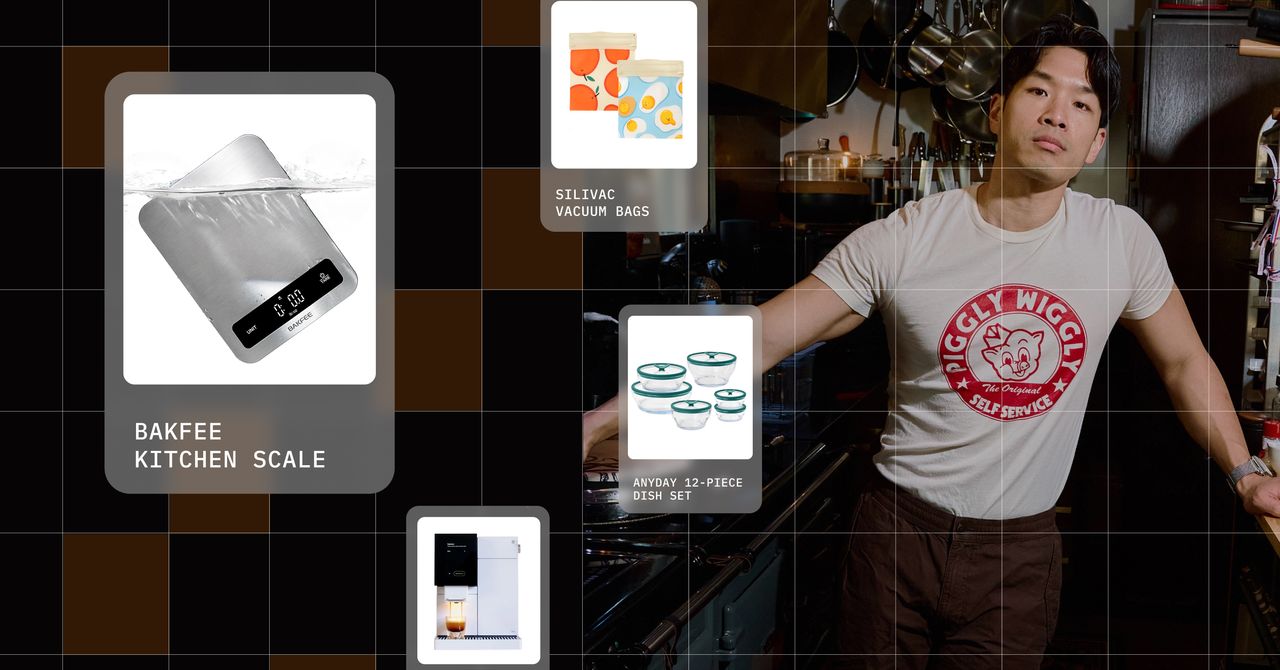
When I ask influencer chef Jon Kung to name the purchase they regret most, there’s no deliberation. “In my early twenties, I bought this used SMEG fridge,” the 42-year-old Chinese American TikTok creator tells me. “It’s got this giant British flag on it, and I still have it. I’ve stuck Sex Pistols, Ozzy Osbourne, and Spice Girls stickers on the sides to try to make it a little better.”
It’s become a conversation piece at the dinner parties Kung hosts at home. Every holiday season, Kung whips up their Chinese takeout feast; it’s a seven-course spread that maps their upbringing across Los Angeles, Hong Kong, Toronto, and Detroit—mapo tofu, pumpkin and lotus root curry, superior stock wonton noodle soup, crab rangoons, Balinese crab fried rice, mushroom lo mein, and, for the grand finale, Cantonese roast duck with cherry duck sauce. And, obviously, dessert.
That layered, third-culture palate is exactly what has made Kung one of the most compelling food personalities of his generation, with over 2 million online followers. (They also published a cookbook, Kung Food, with over 100 recipes.) Whether they’re demystifying global ingredients for a Western audience or sharing meal prep tips, Kung’s perspective remains the same: good food should feel like home.
I caught up with Jon Kung over Zoom to talk about their favorite cooking techniques and kitchen gear.
Wash Your Rice
When I ask Kung what they wish they had that doesn’t already exist, they don’t hesitate: “A rice cooker that also washes your rice.”
“It’s so important to wash your rice, especially if you’re making Asian rice. Italians don’t wash their rice because they need that starch for risotto, but in almost any other culture, you have to wash your rice. Also, I don’t think people know there are bug eggs in rice. They’re called rice weevils, and unless you’re buying that super expensive prewashed rice, there are lots of bugs in rice.”
For now, you’ll need to wash your rice by hand, but if you need a rice cooker, King likes the same Japanese rice cookers the WIRED Reviews team swears by: “Zojirushi rice cookers are fantastic, specifically the ones that have pressure options, because they keep rice fresh for so long.”
Drip Coffee Done Right

“I switch between a drip coffee and an Americano when I make it for myself,” says Kung. “I used to do a Chemex pour-over, but recently I switched to the super automatic Terra Kaffe. It’s kind of awesome.” (Our reviewers also really like the Terra Kaffe.)
Skip the Combination Pans
“Combination pans—the ones that are a mix between nonstick and stainless steel—just end up being garbage versions for both jobs,” says Kung. “I would rather people just get one ceramic nonstick pan and one stainless steel pan.”

When anthropology researcher Ashley McDermott was doing fieldwork in Kyrgyzstan a few years ago, she says many people voiced the same concern: Children were losing touch with their indigenous language. The Central Asian country of 7 million people was under Russian control for a century until 1991, but Kyrgyz (pronounced kur-giz) survived and remains widely spoken among adults.
McDermott, a doctoral student at the University of Michigan, says she also heard that some kids in rural villages where Kyrgyz dominated had spontaneously learned to speak Russian. The adults largely blamed a singular force: YouTube.
McDermott and a team of five researchers across four universities in the US and Kyrgyzstan have released new research they believe proves the fears about YouTube’s influence are valid. The group simulated user behavior on YouTube and collected nearly 11,000 unique search results and video recommendations.
What they found is that Kyrgyz-language searches for popular kid interests such as cartoons, fairy tales, and mermaids often did not yield content in Kyrgyz. Even after watching 10 children’s videos featuring Kyrgyz speech to demonstrate a strong desire for it, the simulated users received fewer Kyrgyz-language recommendations for what to watch next than, surprisingly, bots showing no language preference at all. The findings show YouTube prioritizes Russian-language content over Kyrgyz-language videos, especially when searching or browsing children’s topics, according to the researchers.
“Kyrgyz children are algorithmically constructed as audiences for Russian content,” Nel Escher, a coauthor who is a postdoctoral scholar at UC Berkeley, said during a presentation at the school last week. “There is no good way to be a Kyrgyz-speaking kid on YouTube.”
McDermott recalls one frustrated Kyrgyzstani mother in 2023 explaining that she paid the internet bill a day late each month to regularly have one day without internet and, thus, YouTube at home.
YouTube, which has “committed to amplifying indigenous voices,” did not respond to WIRED’s requests for comment. The researchers are attempting to meet with YouTube’s parental controls team to discuss the potential for language filters, according to Escher.
The researchers say their work is the latest to show how online platforms can reinforce colonial culture and influence offline behavior. Under Soviet control, people in Kyrgyzstan had to learn Russian to succeed. Today, many adults are fluent in both Russian and Kyrgyz, with Russian remaining important for commerce. Kids are required to learn at least some Kyrgyz in school. But many spend several hours a day online, and watching YouTube is the leading activity, McDermott says. Quoting from Russian language videos is common, whether creators’ refrains like “Let’s do a challenge,” adaptations of American words such as “cringe,” or parroting accents and syntax.
In one of the researchers’ experiments, they searched for several subjects which are spelled the same in Russian and Kyrgyz, including Harry Potter and Minecraft. The results were predominantly Russian. Overall, just 2.7 percent of the videos the research team analyzed appeared to even include ethnically Kyrgyz people.
YouTube “socializes youth to view Russian as the default language of entertainment and technology and to view Kyrgyz as uninteresting,” the researchers wrote in a self-published paper accepted to a social computing conference scheduled for October.
The researchers say there is ample Kyrgyz-language children’s content for YouTube to promote. In 2024, the 35th-most viewed channel on YouTube across the world was D Billions, a Kyrgyzstan-based children-focused content studio with a dedicated Kyrgyz-language channel that has nearly 1 million subscribers.


Turkiye’s apparel exports slip 7.2% in Q1 on soft demand

AAFA marks 50th American Image Awards with future focus

US stock markets today (May 1, 2026): Wall Street heads for fresh records; Apple rallies as oil prices cool – The Times of India

-
 Business1 week ago
Gold prices in Pakistan Today – April 23, 2026 | The Express Tribune
-

 Fashion1 week ago
Canada forms new advisory committee to strengthen US trade relations
-

 Entertainment1 week ago
Mike Vrabel to miss Patriots’ final NFL draft day —here’s why
-
 Business1 week ago
Oil surges past 4% as Iran keeps Hormuz locked – SUCH TV
-

 Tech1 week ago
5 AI Models Tried to Scam Me. Some of Them Were Scary Good
-
 Business1 week ago
France Ends Airport Transit Visa Requirement for Indian Travellers | Business – The Times of India
-

 Fashion1 week ago
India’s T&A exports fall 14% in March, FY26 down 2.21%
-

 Tech1 week ago
They Wanted to Join Raya. They’ve Been on the Waiting List for Years