

Sports
Fixing what’s wrong with Liverpool, Barcelona, Juventus, more

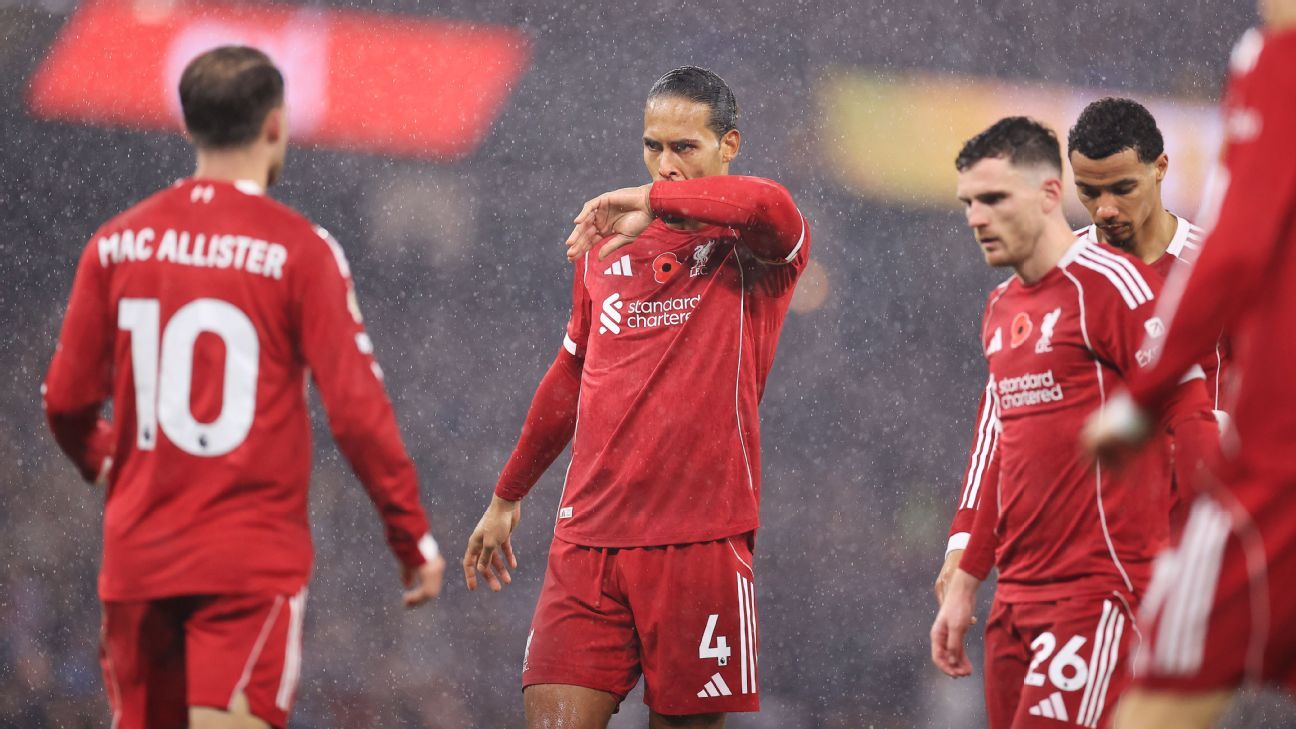
Everybody has an opinion, especially when it comes to Liverpool. The defending Premier League champions have lost five of six in league play to fall to eighth in the table, and they’ve lost seven of 10 in all competitions.
Mohamed Salah is suddenly looking his age, expensive signing Florian Wirtz isn’t producing and expensive signing Alexander Isak has struggled with both fitness and finishing, the Premier League might be evolving more quickly than manager Arne Slot, the customary players-only meeting didn’t seem to accomplish much, and there are plenty of signs that players are still grieving and struggling with the summer death of teammate Diogo Jota.
It almost seems like regression is inevitable at times. Manchester City collapsed for most of the winter last season after winning the league in 2023-24, and following Liverpool’s best seasons under Jurgen Klopp, they had plenty of bumpy patches: two wins in seven, one in seven and two in eight in 2020-21 (after winning the Premier League) and one win in seven and zero in five in 2022-23 (after nearly winning the Treble). But with struggle comes a chorus of famous former players. It’s “crisis time,” per Roy Keane. It’s “crisis mode,” per Jamie Carragher. They don’t have leadership, per Wayne Rooney. The toxicity of the situation can become all-consuming. Everything is bad, nothing is working, nothing is salvageable.
– A week of World Cup miracles: Best stories, celebrations from qualifying
– Ian Darke’s Premier League stars: Haaland, Caicedo, Zubimendi
– Modern classics: 25 of the best kits from the 21st century
Here’s where stats can offer some clarity. What’s actually going wrong — or at least, most wrong — at Anfield? What do Slot and Liverpool need to most urgently address to steer out of the skid? And while we’re here, what do stats say about some of Europe’s other struggling squads?
Let’s find out.
 Liverpool
Current Premier League standing: eighth (1.64 points per game, down from 2.21 last season)
Biggest statistical weakness: defense. It’s always been about the defense. To be sure, the attack has regressed despite Liverpool spending hundreds of millions of pounds on some of the brightest attacking talent in the world. They were comfortably first in goals scored and xG created last season, and now they’re sixth in both categories. But they’re ninth in xG allowed (13.9) and 12th in actual goals allowed (17), and that’s what most needs addressing.
From a pressure standpoint, Liverpool are hitting the same notes as last season. They rank sixth in the league in passes allowed per defensive action, second in combined progressive passes and progressive carries allowed and third in high turnovers forced; last year they were fourth, third and sixth, respectively. But they’re bombing in two categories: transition defense and set pieces. They were fourth in xG allowed from counterattacks last season, and they’re currently 17th, allowing 87% more per match.
Perhaps predictably, they’ve fallen from third to eighth in xG allowed per shot. Meanwhile, after allowing just nine goals from set pieces last season (eighth in the league), they’ve already allowed a shocking seven this season (18th), including three from long throws.
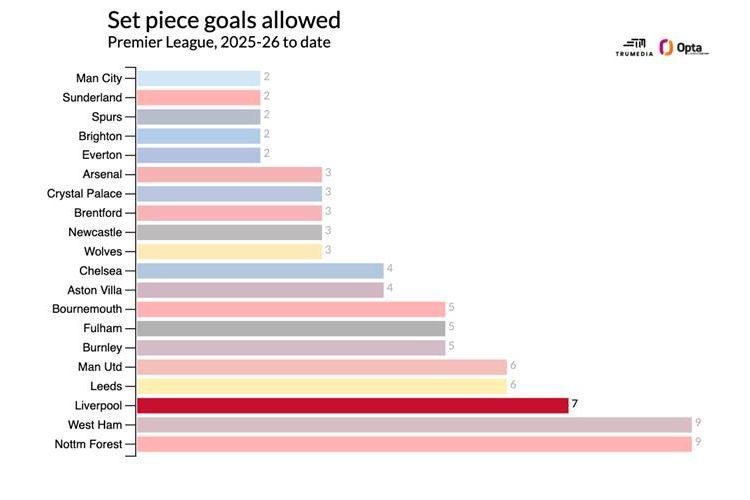
Combine that with a downturn in goalkeeper performance. In terms of goals prevented* they’ve gone from +0.10 per match from Alisson and Caoimhín Kelleher last season to -0.26 per match from Alisson and Giorgi Mamardashvili this season — and you get a pretty clear picture. Liverpool have allowed at least two goals in seven of 11 league matches, and while they won the first two such matches with late heroics, they’ve lost the past five.
When they allow one or fewer goals, they’re a perfect 4-for-4 in the wins department. But they’ve managed to do so only four times.
(*Goals prevented is a StatsPerform measure that compares the postshot xG value of your opponents’ shots on target to the number of actual goals you allow.)
1:59
Nicol: Arne Slot should bench Mohamed Salah
Steve Nicol explains why he thinks Liverpool’s Arne Slot should bench Mohamed Salah.
Critiques about the attack have always been correct to some degree. Salah has only four goals (three, minus one penalty) and two assists in 11 league matches when, at the same time last season, he had eight and six, respectively. Meanwhile, both Isak and Wirtz have been cursed by the xG gods. Wirtz has attempted shots worth 1.3 expected goals and completed passes worth 1.2 expected assists but has zero actual goals or assists, while Isak, managing only 253 league minutes thus far, has attempted shots worth 0.9 xG with no goals.
That part will change. But Liverpool’s defense is more of a structural problem.
Current LaLiga standing: second (2.33 points per game, up from 2.32)
Biggest statistical weakness: continuity. Of the nine teams in this piece, eight have regressed in terms of domestic points per play. Barcelona are actually doing just fine in that regard — they’re on the same pace as last season, when they won LaLiga. Their Champions League form has been dented by a loss to Paris Saint-Germain and a wild 3-3 draw at Club Brugge, but their main problem domestically has been the fact that Real Madrid appear to have improved quite a bit: After netting 84 points last season, Barca’s hated rivals are on pace for 98. That will certainly dampen the vibes.
You know what else will? Injuries.
Lamine Yamal (second in last year’s Ballon d’Or voting) played 83.7% of Barca’s LaLiga minutes last season and is at 58.6% in 2025-26. Raphinha (fifth), meanwhile, has gone from 83.2% to 35.6%, and Robert Lewandowski (17th) has gone from 78.4% to 41.6%. These three were unreal last season, combining for 89 goals and 44 assists in all competitions. About one-third of the way through 2025-26, they’re at 16 and seven, respectively. Players like Fermín López (six goals and four assists), Ferran Torres (seven and one) and loanee Marcus Rashford (six and seven) have held things down, but Barca’s attack has gone from otherworldly to merely very good.
1:49
Yamal situation ‘playground stuff’ from Barcelona and Spanish FA
Julien Lauren believes the Lamine Yamal situation could be “easily figured out” if both Barcelona and the Spanish FA “speak to each other” to sort it out.
In a roundabout way, maybe this is encouraging. Barca are hitting similar notes as last season despite a total lack of continuity up front. For that matter, they’ve gotten fewer minutes from injury-prone midfielders Pedri and Gavi as well, and after seven players played at least 70% of league minutes last season, they’re at only five so far this year.
Of course, Real Madrid have suffered their own injury issues and are still setting a higher bar; Barca aren’t keeping up. And while domestic opponents haven’t been able to adjust particularly well to Hansi Flick’s high defensive line in their second year of exposure to it, it has been an issue in the Champions League, where they’re 30th out of 36 teams in xG allowed per shot, 22nd in xG allowed from counterattacks and 18th in goals allowed.
Still, getting and keeping the right personnel on the pitch would help immensely. Unfortunately, that’s something over which you don’t have a ton of control.
Current Premier League standing: 14th (1.09 points per game, down from 1.74)
Biggest statistical weakness: goals. A pretty important stat. Newcastle play a more direct style than most of England‘s richest clubs, and it has generally served them pretty well. If done well, you won’t attempt as many shots as your possession-hungry peers, but you’ll attempt as many or more good shots. Newcastle averaged 2.4 shots per game worth at least 0.2 xG; only Liverpool averaged more. They attempted 26.9% of their shots with fewer than two defenders between the ball and goal, lowest in the league.
This season, following a well-publicized and stretched-out divorce with Isak, they added forwards Nick Woltemade and Yoane Wissa before the transfer deadline. Woltemade has had some bright, creative moments, scoring six goals in all competitions (far more than Isak, if nothing else). But he’s averaging 1.6 shots per 90 minutes in all competitions — dreadfully low for a center forward — and Wissa has yet to play because of injury. Consequently, despite solid work from left-sided attackers Anthony Gordon and Harvey Barnes (eight goals and three assists in all comps), Newcastle’s attack has disappeared.
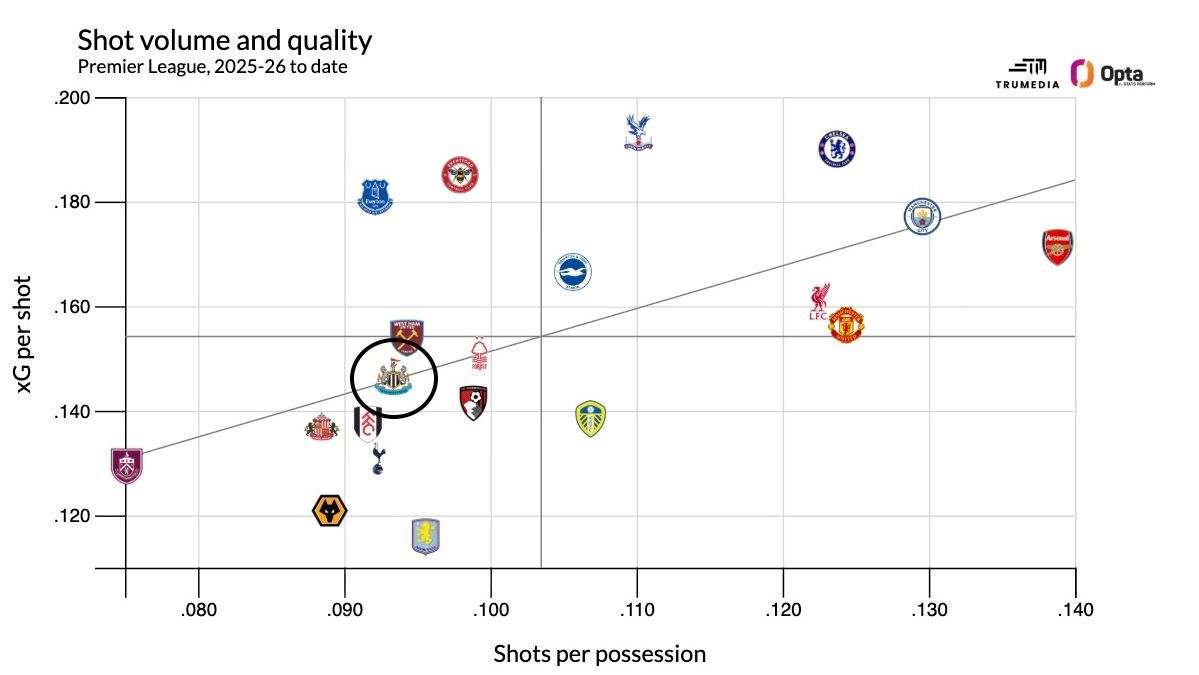
When your attacking numbers are far closer to West Ham’s than Arsenal‘s, something has gone awry. Newcastle have scored just 11 goals in league play (17th), and while they’ve probably been privy to some bad finishing luck, they’re just 12th in xG created, too. They’re averaging just 1.5 shots per game worth at least 0.2 xG (10th), and only 20% of their shots have been attempted with fewer than two defenders in the way (10th). Despite their attempted directness, they’re allowing more counterattacking opportunities than they’re creating.
Injuries are playing a role here — only four players have seen the pitch for more than 71% of Newcastle’s league minutes, and 21 have started at least once. But injuries are playing a role for lots of teams, and Newcastle are currently far closer to the relegation zone (two points above) than they are to a spot in the top five (six points behind).
Unless the attack peps up a bit, making up ground will be awfully difficult.
Current Serie A standing: sixth (1.73 points per game, down from 1.84)
Biggest statistical weakness: shot quality. Like plenty of fired managers, Igor Tudor was done in at least a bit by some bad bounces. In his last four matches in charge at Juventus, against a solid run of opponents (AC Milan, Como, Real Madrid and Lazio), his charges allowed just four goals. But they scored zero despite creating shots worth 4.4 xG. While they probably deserved four or five points from those matches, they managed only a 0-0 draw with Milan.
In their first four matches without Tudor — one with interim Massimo Brambilla, three with new hire Luciano Spalletti — both the schedule and the xG gods eased up. Against Udinese, Cremonese, Sporting CP and Torino, Juve scored six goals and managed two wins and two draws. But they still suffered from poor finishing — those six goals came from shots worth 7.9 xG — and their shot quality still lacked a bit. For the season they rank just 16th in Serie A in xG per shot (0.12).
Forwards Dusan Vlahovic, Jonathan David and Loïs Openda, who are paid millions of euros to put the ball in the net, are attempting just 3.5 shots per 90 minutes between them, and even worse, they’re averaging just 0.11 xG per shot. Juve’s creative players — mainly Kenan Yildiz and Andrea Cambiaso — have not been able to get them involved, and with just four goals from their 5.7 combined xG, they haven’t finished the opportunities they’ve gotten either.
Juve are in decent shape overall: Thanks primarily to wins over lower-rung opponents, they’re only three points outside Serie A’s top four. The early signs under Spalletti have been encouraging, but until their scorers both earn and finish better scoring opportunities, climbing the table will be difficult.
Current LaLiga standing: eighth (1.42 points per game, down from 1.84)
Biggest statistical weakness: defensive regression to the mean. They play a reliable style of ball in Bilbao: Defend first, defend second, defend third, and maybe score a goal on the counter at some point. They haven’t allowed more than 50 goals in a LaLiga season since 2012-13, and they’ve allowed under 40 in four of the last six years.
Last season, however, they were a little too good in this regard. Giving up just 29 goals in 38 matches allowed them to finish fourth and earn their first Champions League bid in 11 seasons. But these 0.76 goals per match (first in the league) came from an average of 1.01 xG (second); even by the standards of Athletic and goalkeeper Unai Simón, that’s too much of a disparity. And sure enough, the xG gods have come for what they’re owed this year. They’re allowing lower overall shot quality — 0.85 xG per match (first) — but opponents are turning that into 1.1 goals (fifth).
The attack, meanwhile, has been beset by injuries. Primary attackers Iñaki Williams (only 62.7% of minutes this season), Nico Williams (49.7%) and Oihan Sancet (39.5%) aren’t seeing much of the pitch, and Athletic have scored just four open-play goals in 12 league matches. They’re seventh in the league, already eight points off the top-four pace, and Champions League play hasn’t gone any better. They beat Qarabag but have lost three other matches by a combined 8-1.
Randomness isn’t fixable, unfortunately, and if they continue defending well, their league form should stabilize. But a return to the Champions League next season is looking unlikely.
Current Serie A standing: 13th (1.18 points per game, down from 1.95)
Biggest statistical weakness: absolute offensive stagnation. Replacing Roma-bound Gian Piero Gasperini was always going to be a tall task. With his swashbuckling attacking identity, his Atalanta teams overachieved against their spending numbers for many times in recent seasons, and manager Ivan Juric came into the job with a high bar to clear. That Atalanta have lost only three of their 15 matches in all competitions certainly suggests things could be going worse, but settling for an incredible eight draws in that span held them back, and two of those three losses came in the first nine days of November. On the 10th day, Juric was fired.
Juric’s Atalanta matched Gasperini’s shot volume — they were fifth in Serie A in shots per possession last season, and they’re fifth again this year — but the good shots have vanished. They’ve fallen from third to 12th in xG per shot. Lower shot quality can produce streakiness, and in their past eight matches in all competitions they’ve managed just four goals from shots worth 11.2 xG. Take Lazar Samardzic‘s two goals out of the equation, and everyone else has two goals from 10.6 xG.
That is, of course, unsustainably terrible, and new hire Raffaele Palladino, most recently of Fiorentina, will likely enjoy a new-manager bump simply thanks to progression toward the mean. But as with Juve, shot quality desperately needs to improve, and unlike Juve, they’re now nine points off the top-four pace.
Current Premier League standing: 19th (0.82 points per game, down from 1.71)
Biggest statistical weakness: set pieces and no margin for error. Looking at full-season stats for a team that has already careened from a successful counterattacking manager (Nuno Espirito Santo) to a possession-and-pressing guy (Ange Postecoglou) back to a counterattacker (Sean Dyche) is probably a fool’s errand, and it’s probably not surprising to learn that looking at Forest’s full-season numbers offer us almost no hint of style or quality.
That said, set pieces have been a rampant problem this season, and they haven’t improved so far in Dyche’s short tenure. They were a life hack for Forest’s rousing seventh-place finish (and Champions League near-qualification) last season — they scored 17 set-piece goals (first) and produced a +8 scoring margin from them (third). This season, they’ve scored just two set piece goals (17th) and allowed nine (20th) for a minus-7 margin (also 20th).
1:03
Dyche frustrated at lack of VAR intervention vs. Man United
Sean Dyche reacts to Nottingham Forest’s 2-2 draw vs. Manchester United in the Premier League.
In Dyche’s three league matches, they’re one of only seven teams to score zero times, and they’ve allowed three, including both goals in a 2-2 draw with Manchester United. The simple fact that they’ve earned four points and scored five goals suggests solid improvement under Dyche, but this aspect is still dragging them down, and they still have the second-fewest points in the league — behind even Nuno’s new team, a previously hapless West Ham.
Current Bundesliga standing: 17th (0.50 points per game, down from 1.53)
Biggest statistical weakness: a total lack of shot attempts. With the endlessly enthusiastic Bo Henriksen in charge, Mainz were the Bundesliga’s Nottingham Forest, positioned for a shocking Champions League berth last season until fading late. Like Athletic Club, they got as far as they did in part due to good fortune on defense — they were 10th in xG allowed (1.46 per game) but third in goals allowed (1.26) — and that allowed them to get by with an attack that was slightly above average at best. The defense has regressed a little (1.59 xG allowed), but the fortune has completely vanished (1.80 goals allowed).
You can get by in the Bundesliga with a mediocre defense, but it certainly exposes your attack. Without Eintracht Frankfurt-bound Jonathan Burkardt (18 goals from shots worth 14.8 xG last season), and with predictable regression to the mean from Paul Nebel (10 goals from 5.8 xG last year, one from 1.4 this year), Mainz are creating almost nothing on the attacking end. They are last in the league in shots per possession (0.08), and despite playing a pretty direct style, they’ve attempted only 14.5% of their shots with fewer than two defenders between the ball and goal (second worst).
Granted, this isn’t incredibly different from last season, when they ranked 17th in shots per possession. But now neither the defense nor Nebel is overachieving.
With an xG differential that ranks 11th in the league, they’re likely to eventually move up the table moving forward. Despite sharing the lowest point total in the league with Heidenheim, current Opta projections give them only a 13% chance of finishing in an automatic relegation spot. But good fortune covered up some weaknesses last year, and that fortune is well gone.
 Fiorentina
Current Serie A standing: 20th (0.45 points per game, down from 1.71)
Biggest statistical weakness: finishing (and set pieces). Stop me if you’ve heard this one before. A team that seemingly overachieved in the table last season isn’t getting the same breaks this time around.
Fiorentina finished sixth in Serie A in 2024-25, their best league campaign in nine years, but they did it with an unsustainably brilliant run of finishing: They scored 60 goals from shots worth only 49.7 xG, a 21% overachievement. Important creatives like left back Robin Gosens and midfielders Yacine Adli and Rolando Mandragora got in on the goal-scoring act a little too well, scoring 13 goals from shots worth 5.5 xG.
This season, with Adli off to Al Shabab, Mandragora and Gosens have scored a much more normal three goals from 2.7 xG, but the team’s overall finishing has vanished. Fiorentina have generated 15.5 xG (fifth) — they’re first in the league in xG per shot! — but have scored just nine goals (14th), a 42% underachievement. Star center forward Moise Kean is enduring an incredible slump, with two goals from shots worth 5.7 xG, and Fiorentina have endured a pair of 0-0 draws, a 1-1 draw, a 1-0 loss and three 2-1 losses. In one of those draws, against Torino, Kean somehow missed a tap-in header worth 0.98 xG.
Like Forest, Fiorentina have also collapsed in the set pieces department: They allowed seven set piece goals last season and have already matched that in 2025-26. Their underlying numbers are solid enough that they probably aren’t a genuine threat for relegation — Opta puts their odds at only 15% — but worse fortune, worse finishing and worse set piece defense have all but relegated them from a shot at another European competition next season.
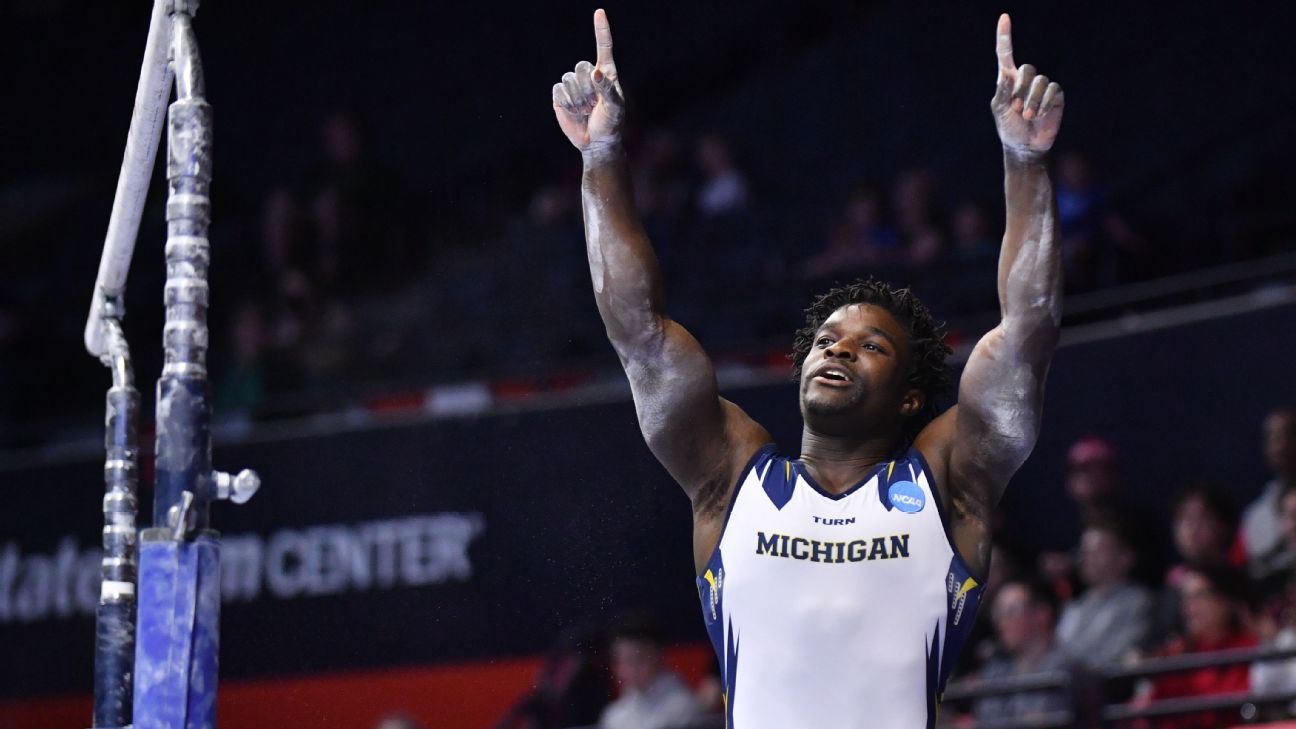
CHAMPAIGN, Ill. — Michigan’s Fred Richard won his second straight all-around individual crown Saturday night, and Cooper Kim and Jun Iwai each won individual titles to lead Stanford to its sixth NCAA men’s gymnastics championship since 2019.
Richard took home silver in the floor and parallel bars as he ran away with his third all-around individual national championship with a score of 83.598. Nebraska’s Max Odden (78.698) was second, 0.432 ahead of third-place Kristian Grahovski of Ohio State.
Stanford had 329.825 points, second-place Oklahoma finished with 328.495 and Michigan — the defending national champion — was third with 324.857. Asher Hong (14.300) took silver and Nick Kuebler (14.166) bronze on the rings in the final rotation to seal it for the Cardinal. Asher Cohen finished with a 14.500 to become the first Nebraska gymnast to win the rings since Jim Hartung in 1982.
Stanford claimed the program’s 11th national gymnastics championship; the Cardinal have won at least one NCAA team title for 50 straight seasons, since the men’s water polo team beat UCLA 13-12 for the national championship on Nov. 28, 1976. The next longest active streak is North Carolina’s seven straight years with at least one team title.
Iwai had a 14.433 on the vault, tied with Nebraska’s Tyler Flores for first. Landen Blixt of Michigan was third (14.366).
Flores, Nathan Roman (14.800 on the parallel bars) and Kelton Christiansen (14.400, high bar) each won individual titles for the second-place Sooners.
Kim scored a 14.466 to win gold on the floor to beat Richard (14.400). Kuebler and Tate Costa of Illinois finished third with 14.166.
Brandon Dang (Illinois) won the pommel horse with a score of 14.700, Michigan’s Aaronson Mansberger was second (14.566) and Colby Aranda of Oklahoma finished third with 14.133 points.
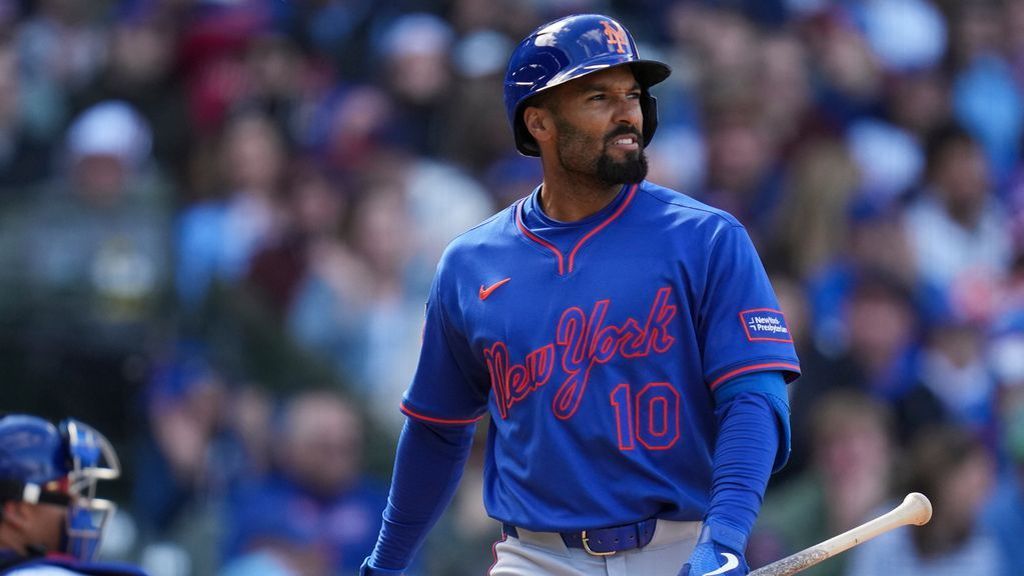
CHICAGO — The New York Mets will have to defy the odds if they plan on making the postseason this year after dropping their 10th consecutive game on Saturday, a 4-2 loss to the Chicago Cubs.
Only three teams in the divisional era (since 1969) have made the postseason after a double-digit losing streak — including last year’s Cleveland Guardians.
“No one is going to feel sorry for us,” Mets manager Carlos Mendoza said after the latest defeat. “We have to keep going. We haven’t been playing good baseball. We have 5½ months ahead. We have the opportunity to write our own story.”
The Mets say they can’t point to any single thing which has led them to their longest April losing streak in franchise history. They certainly aren’t hitting enough, scoring just 18 runs during the streak, the fewest for them over 10 games since June 3-5, 2018.
They’re also making bad pitches, like the one reliever Brooks Raley made to pinch hitter Carson Kelly in the sixth inning Saturday. Kelly deposited Raley’s first pitch cutter into the left-field bleachers for a three-run home run, breaking a 1-1 tie. The Cubs cruised to victory from there.
“We haven’t been able to put together a complete game,” Mendoza said. “It’s either the offense or starting pitching, like not making [that] pitch, not making a play, not getting a big hit. Just having a hard time playing a complete game right now.”
Mendoza’s job is seemingly safe after president of baseball operations David Stearns said Friday he thought his third-year manager was doing a good job and is putting players in a position to succeed. Of course, things can change if the losses continue to pile up for the Mets, who missed the postseason last year after a disastrous second half.
The team is trying not to focus on the negative this early in the season.
“It’s a big boy league,” infielder Marcus Semien said. “There is no time to dwell on tonight. Tomorrow is a new day … It’s as simple as showing up tomorrow with a good attitude. Hopefully other guys see a smile on my face when I show up.”
Semien and Mendoza offered up few solutions to the team’s plight, though getting All-Star Juan Soto back from a calf injury should help. But that won’t happen for a few more days. With DH Jorge Polanco (wrist) on the shelf as well, the Mets will need others to step up.
A late winter overhaul by Stearns led to a positive feeling about the team entering this season. But those additions, like Saturday’s starter Freddy Peralta, haven’t produced enough. Third baseman Mark Vientos did hit a long home run in the loss but New York’s offense was mostly quiet the rest of the day.
Mendoza was asked how he thought Mets fans were feeling right now.
“They have the right to be pissed and frustrated,” he said. “They care. Just like we do. … I understand how they’re feeling. I’d be pissed too, if I was a fan. I’m pissed. They’re pissed.”
The 10-game losing streak is the longest in April since the 2023 White Sox. The loss has the Mets 6½ games behind the Atlanta Braves in the NL East, an unusually large deficit for this time of year.
“It’s frustrating to lose baseball games and when you lose this many in a row, it compounds,” Semien said. “The game does not own you any wins. You have to go out and get it.”
The Mets rank in the bottom half of the league in most offensive and pitching categories, including home runs. They’ve hit just 15 this season, only ahead of the San Francisco Giants for fewest in the National League. Their starting pitching isn’t much better, ranking 21st in ERA.
The team is hoping Sunday will bring them different results.
“We have to do something to get in the W column,” Semien said. “No one is showing up thinking about how it’s going to happen again. We’re thinking about how we’re going to win.”
Mendoza added: “Were putting ourselves in a hole right now. There is only one way to [get out of] it. Come back tomorrow, ready to go.”
ESPN Research contributed to this report.

NEWYou can now listen to Fox News articles!
Seth Rollins was supposed to be going up against Gunther at WrestleMania 42 on Saturday night but he wasn’t expecting a freight train to run through him.
Rollins appeared to be in the driver’s seat toward the end of the match. He hit Gunther with a pedigree on the announce table and followed up with a storm. All he had to do was get Gunther back in the ring and finish the job. As the referee tended to Gunther, a wild Bron Breakker appeared.
CLICK HERE FOR MORE SPORTS COVERAGE ON FOXNEWS.COM
Bron Breakker performs during WrestleMania 42 Night 1 at Allegiant Stadium in Las Vegas, Nev., on April 18, 2026. (WWE)
Breakker ran down the side of the entrance ramp at Allegiant Stadium in Las Vegas at full speed and tore through Rollins with a gnarly spear. He rolled Rollins back in the ring, spat on him and waited for Gunther to finish the job.
Gunther put Rollins in a sleeper hold, forcing “The Revolutionary” to tap out.
WWE STARS REVEAL WHAT MAKES WRESTLEMANIA SO SPECIAL: ‘IT’S THE SUPER BOWL OF PRO WRESTLING’

Gunther has his arm raised by the referee after defeating Seth Rollins during their match on night one of WrestleMania 42 at Allegiant Stadium in Las Vegas, Nev., on April 18, 2026. (Ethan Miller/Getty Images)
Gunther walked to the back as the winner. Breakker was hung around to pick apart the scraps.
Breakker sprinted back down the ramp and hit Rollins with another crushing spear, stunning the crowd.
Breakker has been out of action for a few weeks with an injury, likely costing him a match of some kind at WrestleMania 42. Nevertheless, he still had bad blood with Rollins as their rivalry turned up a notch.
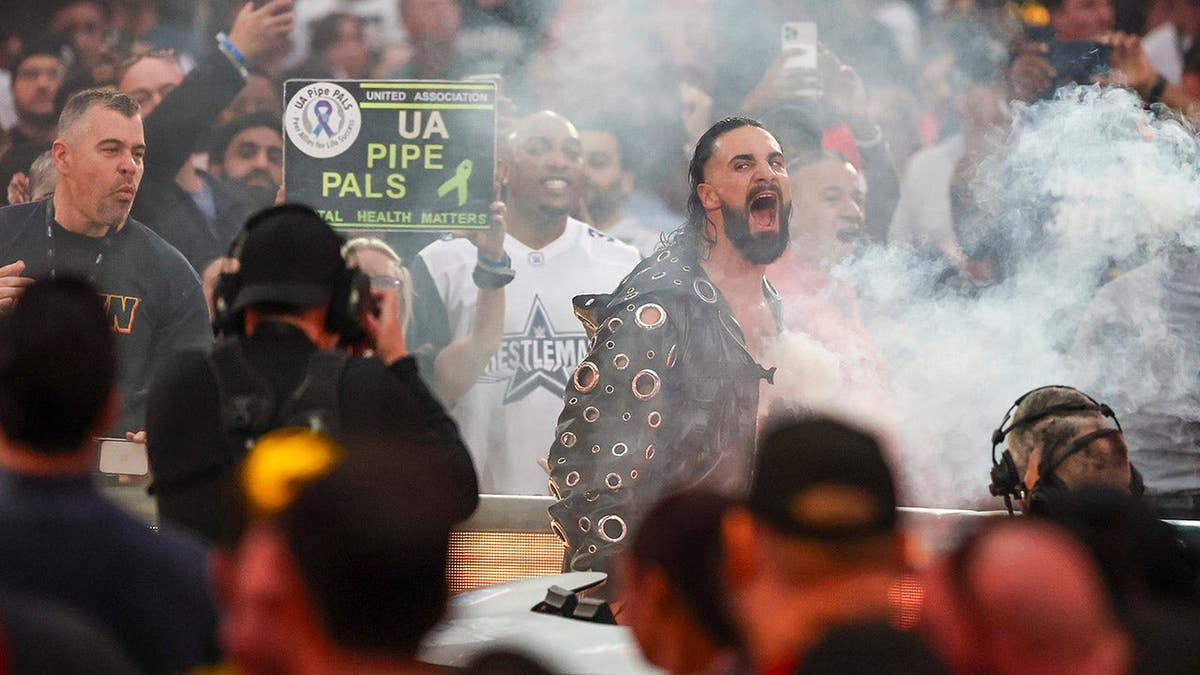
Seth Rollins enters the arena before his match against Gunther on night one of WrestleMania 42 at Allegiant Stadium in Las Vegas, Nev., on April 18, 2026. (Ethan Miller/Getty Images)
CLICK HERE TO DOWNLOAD THE FOX NEWS APP
This will not be the last of Breakker and Rollins. On the flip side, Paul Heyman will now owe Gunther a favor. It’ll will be interesting to see how the favor gets cashed in.


Rs 20,000 crore gold, silver rush: What will people buy this Akshaya Tritiya? – The Times of India

Prince Harry corrects blunder before peace with King Charles suffers again

The cost of rising rents: Working four jobs and pushed on to benefits

-

 Entertainment6 days ago
Palace left in shock as Prince William cancels grand ceremony
-

 Sports6 days ago
The case for Man United’s Fernandes as Premier League’s best
-

 Politics1 week ago
Chinese, Taiwanese will unite, Xi tells Taiwan opposition leader
-

 Entertainment1 week ago
Dua Lipa hits major career high ahead of wedding with Callum Turner
-
 Business1 week ago
100% road tax waiver for electric cars, new rules for 2, 3 and 4 wheelers – what Delhi govt’s draft EV policy says – The Times of India
-
 Business6 days ago
UK could adopt EU single market rules under new legislation
-
 Business1 week ago
The FAA wants gamers to apply for air traffic control jobs
-

 Sports1 week ago
Lamar Jackson hits back at critics with faithful message on social media