

Business
FTSE 100 nudges higher but weak data dents pound

The FTSE 100 posted modest gains on Tuesday, outperforming European and US peers, while weak UK data put sterling under pressure.
The FTSE 100 index closed up 9.90 points, 0.1%, at 9,452.77. The FTSE 250 ended 36.14 points lower, 0.2%, at 22,028.18, and the AIM All-Share dropped 2.91 points, 0.4%, to 789.56.
The UK unemployment rate unexpectedly rose in the three months to August, numbers showed.
According to the Office for National Statistics, the jobless rate was 4.8% in the three months to August, rising from 4.7% in the three months to July.
It had been expected to stay at 4.7%, according to consensus cited by FXStreet.
The ONS said payrolled employees in the UK fell by 93,000 on-year in August alone but did rise by 10,000 on-month.
In the early estimate for September, which the ONS warns is likely to be revised, payrolled employees fell by 100,000 on-year and by 10,000 on-month to 30.3 million.
Annual growth in regular earnings, so excluding bonuses, was 4.7% in the three months to August, easing from 4.8% in the three months to July. The figure landed in line with consensus.
Deutsche Bank’s chief UK economist Sanjay Raja said “one thing is clear, slack continues to build in the labour market”.
“Wage pressures are easing on the back of softening labour market and hiring plans remain stalled,” he added.
“Bottom line, we continue to think that a [fourth quarter 2025] rate cut may be underpriced by markets. We hold on to our view for a December 2025 rate cut.”
Citi said the jobs and wage growth figures add to its conviction that Bank of England meetings in November and December are “live”.
“Inflation data next week will be an important test with an undershoot likely to trigger further repricing towards an additional cut this year,” the broker said.
Elsewhere, a leading policymaker at the Bank of England warned that there is a “rising” risk that the UK economy could see a “more forceful downturn” because of higher borrowing costs.
Alan Taylor, a member of the central bank’s nine-strong Monetary Policy Committee, said there was a small but growing chance that the UK will witness negative growth and “recession dynamics start to kick in”.
He cautioned that it is “increasingly likely” that the UK economy will fall into a “weakened state for a sustained period”, with inflation sliding below target levels.
He said he believes this could lead to “undue damage” to economic activity in the UK.
The pound was quoted lower at 1.3294 US dollars at the time of the London equity market close on Tuesday, compared to 1.3331 US dollars on Monday.
The euro stood at 1.1591 US dollars, higher compared to 1.1569 US dollars. Against the yen, the dollar was trading at 151.83 yen, lower compared to 152.30 yen.
In European equities on Tuesday, the CAC 40 in Paris closed down 0.2%, while the DAX 40 in Frankfurt ended 0.6% lower.
Stocks in New York were down at the time of the London close. The Dow Jones Industrial Average was down 0.2%, the S&P 500 was 0.5% lower, while the Nasdaq Composite declined 0.9%.
Wall Street’s drop came despite strong third quarter results from investment banks JPMorgan, Goldman Sachs and Citi, which all beat market expectations.
Citi climbed 1.2%, but JPMorgan fell 2.0% and Goldman Sachs dropped 2.8%.
JPMorgan chief executive Jamie Dimon cautioned: “There continues to be a heightened degree of uncertainty stemming from complex geopolitical conditions, tariffs and trade uncertainty, elevated asset prices and the risk of sticky inflation.”
The yield on the US 10-year Treasury was quoted at 4.05%, widened from 4.04% at the time of the London equities close on Monday. The yield on the US 30-year Treasury stood at 4.64%, stretched from 4.62%.
On the FTSE 100, easyJet climbed 8.0% as Italian daily Corriere della Sera reported shipping firm Mediterranean Shipping is among those mulling investing, or taking full control of the budget carrier.
MSC is working in tandem with an investment fund, Corriere said, citing three sources familiar with the matter.
EasyJet is “landing on the desks of several individuals” interested in investing in it, Corriere reported.
Bookmaker Entain climbed 1.8% as its US joint venture BetMGM reported a strong third quarter, with first-half momentum continuing and full-year guidance raised.
Owing to the strong performance full-year net revenue guidance for BetMGM was lifted to at least 2.75 billion US dollars from 2.7 billion US dollars, and Ebitda is now anticipated at approximately 200 million US dollars, from at least 150 million US dollars.
But IMI fell 0.9% as RBC Capital Markets lowered to “sector perform” from “outperform”.
The downgrade reflects “valuation, rather than a fundamental change in our view”, RBC analyst Mark Fielding explained, noting IMI is a “high quality” business.
He pointed out IMI shares are up 26% year-to-date while he also feels the firm cannot avoid some impact from wider end market uncertainties.
On the FTSE 250, Mitie jumped 14% as it upgraded operating profit guidance and launched a new £100 million share buyback, following solid first-half revenue growth and continued progress with the integration of its recent Marlowe acquisition.
Housebuilder Bellway firmed 5.3% after announcing a £150 million share buyback and reporting a 21% increase in annual pre-tax profit as revenue climbed 17%.
But Morgan Advanced Materials dropped 6.6% after its second downbeat trading update in three months, warning of increasing uncertainty in European industrial markets.
Gold traded at 4,141.29 US dollars an ounce on Tuesday, up from 4,093.56 US dollars on Monday. Brent oil traded at 61.87 US dollars a barrel, down from 63.40 US dollars late Monday.
The biggest risers on the FTSE 100 were easyJet, up 37.2p at 501.2p, Persimmon, up 30.0p at 1,199.0p, Berkeley Group, up 94.0p at 4,034.0p, Next, up 250.0p at 12,635.0p and Centrica, up 3.15p at 173.0p.
The biggest fallers on the FTSE 100 were Spirax, down 285.0p at 6,645.0p, Anglo American, down 84.0p at 2,915.0p, Croda, down 76.0p at 2,662.0p, Antofagasta, down 69.0p at 2,758.0p and Weir Group, down 54.0p at 2,794.0p.
Wednesday’s global economic diary has inflation data in China overnight, eurozone industrial production figures and the US Beige Book.
Wednesday’s UK corporate calendar has a trading statement from recruiter PageGroup and bingo and casino operator Rank.
Contributed by Alliance News
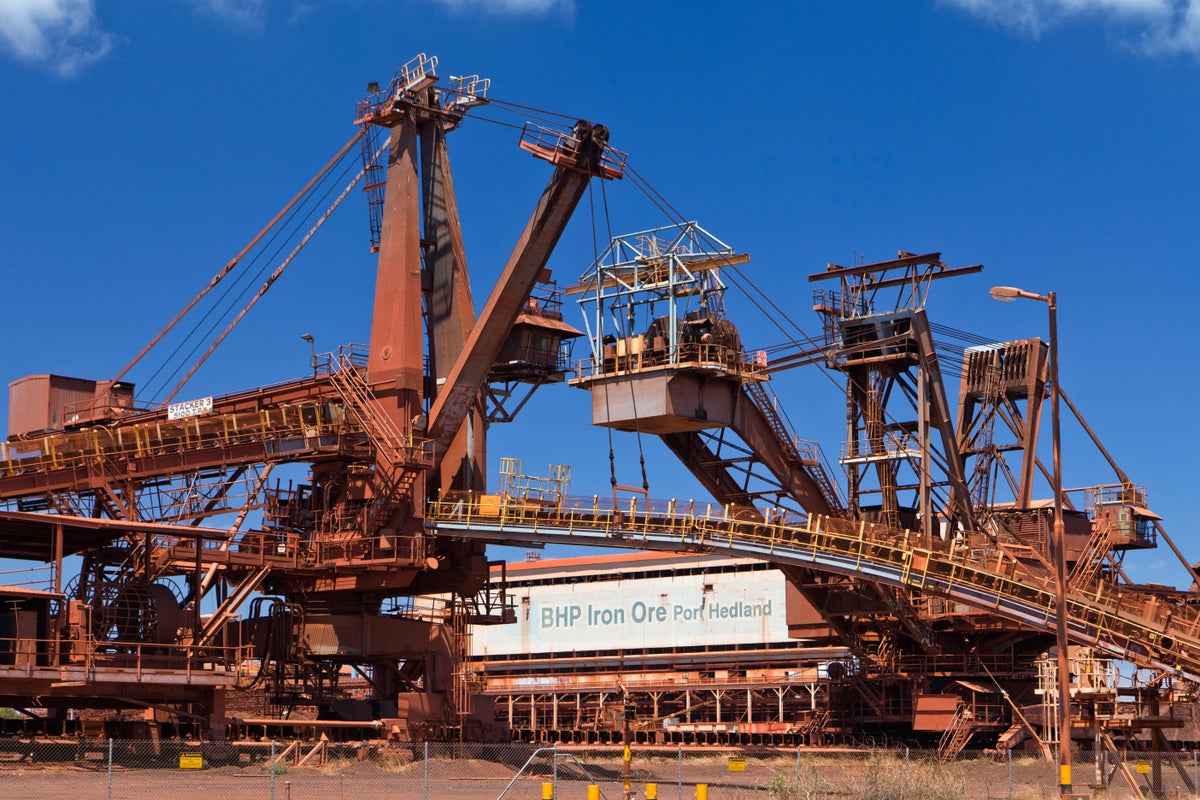
BHP has named Brandon Craig as its new chief executive to replace Mike Henry at the helm of the world’s largest mining company.
Mr Craig, who is currently BHP’s Americas boss, will start on July 1, when Mr Henry steps down after six-and-a-half years in the role.
The Australian mining giant – which switched its main listing from London to Sydney in 2022, but retained a standard listing in the UK – said Mr Henry had helped the firm establish itself as the world’s biggest copper producer.
But he also presided over two failed attempts to buy rival Anglo American to further bolster its copper portfolio, last November walking away from a deal just 18 months after its previous ill-fated approach.
Former FTSE 100 company BHP had looked to muscle in on the agreed mega-merger between Anglo and Canadian rival Teck Resources before pulling out.
Ross McEwan, BHP chairman and former NatWest chief executive, said Mr Craig’s “discipline and focus” would help him drive the group’s strategy forwards.
“We would like to recognise the outstanding contribution of Mike Henry to BHP as chief executive,” he added.
“Under his leadership, BHP has transformed into a safer and more productive company, financially strong and sharply focused on shareholder value and social value.”
Mr Craig has worked at BHP for more than 25 years, having joined in 1999.
Before his current role, he also previously led the group’s Western Australia iron ore business.
He will take on the chief executive role with a 1.9 million US dollar (£1.4 million) annual salary, plus benefits, with the potential for cash and share awards worth up to a maximum of 6.8 million dollars (£5.1 million) each year and possible long-term incentive share awards of up to 3.8 million dollars (£2.8 million) a year.
Mr Craig said: “It is an honour and privilege to succeed Mike Henry as chief of BHP.
“Thanks to his leadership, BHP is well positioned for the future.
“Mike will be remembered for his strategic decision-making, portfolio transformation, operational excellence and focus on safety and high-performance culture.”
Outgoing boss Mr Henry said: “It has been a privilege to serve as chief executive of BHP and to have worked with so many truly talented people. I am proud of what we have achieved together.”

Free childcare support for working parents varies across the UK, depending on the child’s age.
Source link
Business
LPG crisis: Centre pushes states to fast-track switch to PNG amid Hormuz supply disruption – The Times of India

As the Middle East crisis continues to escalate, its impact is now being felt across Indian households and businesses such as eateries and restaurants, with the country relying on imports for 60% of its LPG needs. Amid rising concerns over LPG supply flows, the government is encouraging both households and commercial users to shift towards PNG.It has urged states to fast-track approvals and cut charges so that more homes can shift to piped natural gas (PNG) at a time when liquefied petroleum gas (LPG) supplies remain under stress. According to an official cited by ET, states have been asked to speed up permissions for laying pipelines and to do away with road restoration and related fees imposed by local authorities. The aim is to accelerate infrastructure rollout and make it easier for households to adopt PNG.As part of the relief measures, the petroleum and natural gas regulatory board has waived imbalance charges for city gas companies, shippers and consumers “as a temporary relief measure in light of the extraordinary circumstances” due to ongoing Iran war. These charges are typically imposed when the actual quantity of gas taken or injected by a shipper differs from the amount scheduled on the pipeline network.Officials said the Centre is trying to overcome “structural constraints” that have slowed the growth of PNG connections. Sujata Sharma, joint secretary at the ministry of Petroleum and Natural Gas, outlined a series of steps proposed to states in a presentation shared on Monday.These include directing states to:
- Issuing deemed permission for pending applications for laying city gas distribution (CGD) pipelines
- Mandating approval of all new CGD permissions within 24 hours
- Waiving road restoration and permission charges levied by state or local authorities
- Relaxing working hours and working seasons
- Appointing state nodal officers for support, coordination and faster implementation
Meanwhile, the gap between LPG and PNG usage remains wide. India has around 10 million active PNG consumers, compared with about 330 million LPG users.Hospitality and consumers are already feeling the strain of LPG-related disruptions. The Hotel and Restaurant Association (Western India) (HRAWI) has approached the Maharashtra government seeking an extension or staggered payment of annual licence fees, saying a commercial LPG shortage has forced several establishments to shut. In Patna, residents have flagged delayed deliveries and cases where cylinders are marked as delivered but not received, prompting the district administration to step up monitoring, even as officials maintain there is no shortage. The impact is also visible in other industries. In Gujarat’s Morbi, around 430 ceramic units are set to remain shut for at least three weeks after the West Asia conflict disrupted gas supplies essential for manufacturing, according to an industry representative.


US’ Stitch Fix Q2 FY26 revenue rises 9.4% to $341.3 mn

Ryan Gosling ‘Project Hail Mary!’ reaches ‘New Heights’
World’s largest mining group names new chief executive

Stock market crash today (March 12, 2026): Nifty50 opens below 23,600; BSE Sensex down over 900 points on continuing US-Iran war – The Times of India

Intertextile Shanghai 2026: Fringe events spotlight market trends

What time will NASA’s 600 kg satellite crash to Earth today— 14 years after launch?

-
Business6 days ago
Stock market crash today (March 12, 2026): Nifty50 opens below 23,600; BSE Sensex down over 900 points on continuing US-Iran war – The Times of India
-
 Fashion1 week ago
Intertextile Shanghai 2026: Fringe events spotlight market trends
-
 Entertainment1 week ago
What time will NASA’s 600 kg satellite crash to Earth today— 14 years after launch?
-

 Fashion1 week ago
German brand Adidas posts 13% revenue growth in 2025
-

 Tech7 days ago
Meta Developed 4 New Chips to Power Its AI and Recommendation Systems
-

 Fashion7 days ago
UK’s Topshop unveils Tolu Coker capsule collection
-

 Fashion1 week ago
Bangladesh Brand Forum, BGMEA sign MoU to transform RMG sector
-
 Business7 days ago
8th Pay Commission: How Much Will Central Govt Employees’ Salaries Rise? What We Know So Far