

Tech
AI tools offer ‘near-real-time’ analysis of data from seized mobile phones and computers | Computer Weekly

Artificial intelligence (AI)-powered tools developed by Israeli digital intelligence company Cellebrite will give police investigators the capability to interrogate call records, text messages, images and videos stored on mobile phones and other electronic devices at ultra-high speed.
The company has developed AI tools that allow police investigators to interrogate data retrieved from multiple electronic devices, discover links between different data sets, map the location of phones over time and construct timelines of events.
Cellebrite’s Guardian Investigate platform aims to help law enforcement agencies investigate major incidents, such as shootings, terrorist attacks or large organised crime investigations, by gaining rapid insights from data as it is gathered.
The platform allows investigators from multiple departments and agencies to work on the same data – which is held on a central cloud platform – allocate tasks and identify further avenues of investigation.
The technology enables investigators to analyse data as soon as it is retrieved from a mobile phone and uploaded into Cellebrite’s Guardian cloud for decoding and analysis, without having to wait for forensic experts to submit reports on each mobile device.
Mapping people’s movements
The company demonstrated how its platform is able to take cell site data, which records the phone masts a mobile phone has connected to, along with data from Google Maps, to track the movements of an individual over time.
The platform acts as a replacement for whiteboards used by police during investigations to map locations, timelines and communications, including social media posts and video, with AI tools able to find relationships between them.
Guardian Investigate uses AI to spot anomalous behaviour – for example, it can identify when two people who are in regular phone contact suddenly stop communicating, or when someone suddenly puts their phone into airplane mode.
Cellebrite has incorporated technology from its 2021 acquisition of open source intelligence company Digital Clues to develop AI agents that can identify the owner of an email or a phone number from publicly available information on the internet.
AI is able to identify owners of mobile devices
Matt Goeckel, a former law enforcement official and now technical marketing director at Cellebrite, demonstrated how the tool is able to autonomously identify the owner of a mobile phone by analysing the emails used to log in to its apps and linking them to their owner through open source research on the internet.
“I can ask Investigate AI to go off and do an open source search, and see what’s available about this particular individual,” he told Computer Weekly. “We will find profile pictures, we will find additional names, we will find user names, phone numbers, addresses. This is all public information.”
Goeckel said that one of the platform’s most powerful capabilities is its ability to find inconsistencies in large volumes of evidence, such as when two witnesses give contradictory accounts in witness statements. An investigator would normally spot that, but “as the cases grow, the risk of missing something becomes greater”, he said.
Because the platform is able to hold all the data relating to a particular investigation, it is able to eliminate “swivel chairing”, where investigators have to look at one screen to view a surveillance video and another to view call records.
Rapid summaries of text messages
Brazoria County Sheriff’s Office in Texas, which carried out a pilot of Guardian Investigate, claims that Cellebrite’s AI technology was able to summarise the contents of a mobile device holding 200,000 text messages in a fraction of the time taken by human investigators.
The AI software “instantly” revealed connections that would have been “nearly impossible” to identify manually, allowing analysts to create operational intelligence packages in hours rather than in months, it said in a testimonial written for Cellebrite.
Another tool, Cellebrite Genesis, is a standalone AI analysis tool for organisations that want to keep their data in-house, with similar capabilities, operating through a ChatGPT-like interface.
Cellebrite claims that in one counter-terrorism case in Australia, Genesis was able to uncover evidence of a planned terrorism attack in three minutes, a task that would take a human analyst two to three weeks.
According to Cellebrite, digital evidence is now used in over 90% of criminal cases, including data from mobile phones, social media and, in recent years, drones.
In the past, investigators typically collected a phone from a crime scene and sent it to a lab for analysis, where an expert would pick out data based on a search warrant and send it back to the investigator.
Ashely Hernandez, a product management executive at Cellebrite, told Computer Weekly its AI technology will allow investigators to work directly with the data from seized devices without having to wait for experts to review the data and send in reports. “It is as close to real time as we can make it happen,” she said.
The human in the loop
Cellebrite says its AI tools allow analysts to check its decisions by reviewing the source evidence used by the AI, and has a “human in the loop” by design to guard against errors and the possibility of AI hallucinations.
Peter Sommer, a forensic expert familiar with Cellebrite’s technology, said that while AI is good at sorting through large quantities of data, its results have to be manually checked if the evidence is to stand up in court.
“In any situation where you use AI in a forensic science situation, you have to go back to the original data,” he added. “AI is fine at sorting through large quantities of data, but having pointed you in the right direction, you then have to go back manually and check it. There are just too many things that can go wrong with AI if people just take the immediate results.”
Tech
I Tried the Best Mobile Gaming Controllers That Make Playing for Hours on End Easy and Comfortable
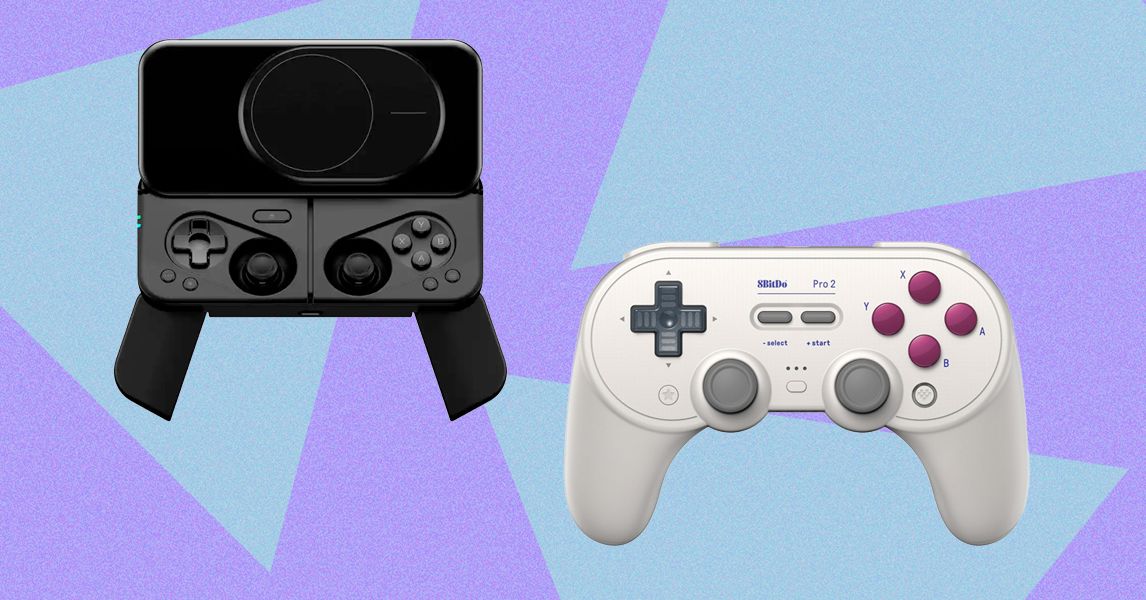
The best mobile gaming controllers are excellent tools that allow you to play compatible games for hours on end. Whether you’re looking for an iPhone or Android controller, we’ve tested all the top picks (aka we’ve played a bunch of games on our phones) and have opinions on them all. Backbone makes the best mobile gaming controllers we’ve tried that’ll work for most people, but we also have solid recommendations for specific uses, like for pairing with smart glasses or a tablet.
Make sure to check out our related buying guides, including the Best Cheap Phones, Best Android Phones, Best Gaming Controllers, and Best MagSafe Accessories.
Our Top Picks


Jump to Section
Best Mobile Gaming Controller

The Backbone One is as easy to recommend as it is to use. Slot the connector—either USB-C or Lightning—into your phone and stretch the controller over the back. The buttons and triggers are clicky and responsive, and the controller feels comfortable for hours-long gaming sessions without being too bulky. It also has pass-through charging, a screenshot or screen recording button, a mute button, and a headphone jack.
Part of what makes all Backbone controllers so great is the manufacturer’s software and additional features. The controller supports a number of gaming apps and services, and the companion app is fantastic (though not required). My favorite bit is the list of recommended games with controller support. You can also use the app to message and party chat with your friends, stream directly to Twitch, record and edit videos in 1080p at 60 frames per second, and more. Some of these features are locked behind a Backbone+ membership, which costs $40 per year. The subscription is nice, but you don’t need it to have a great experience. The controller is also available in some limited-edition styles or platform-dedicated versions like PlayStation Edition, but the differences are cosmetic.
Officially works with iPhone, Android, Nvidia GeForce Now, Xbox and PlayStation Remote Play, Amazon Luna, and Steam Link
Best Upgrade Mobile Gaming Controller
-
Photograph: Louryn Strampe
-
Photograph: Louryn Strampe
-
-


The Backbone Pro expands on all of the features I loved about the Backbone One. The Pro is slightly chunkier, grippier, and more comfortable, and although my hands are small, I can imagine this is easier to hold for folks with larger hands. It has a quieter, more premium feel, and it still has the headphone port and pass-through charging capabilities of the One. The Pro feels just as ergonomic to me as a console controller, with no drawbacks or compromises. I liked the full-size joysticks, programmable back buttons, and Hall-effect rear triggers.
The Backbone Pro also has Bluetooth connectivity, which means you can use it with your phone, tablet, laptop, VR headset, and compatible smart TVs. You can connect to multiple devices simultaneously and switch between them with just a tap. If you’re serious about mobile gaming, or you want a comfortable controller that can swap between your devices seamlessly, I recommend the Backbone Pro. I think it’s worth snagging a carrying case like this one, though, to store it.
Officially works with iPhone, Android, Nvidia GeForce Now, Xbox and PlayStation Remote Play, Amazon Luna, and Steam Link
Best Magnetic Mobile Gaming Controller
-
Photograph: Louryn Strampe
-
Photograph: Louryn Strampe

ohsnap!
Mcon Mobile Gaming Controller
The Mcon controller from Ohsnap has some quirks, but its general concept is neat. The MagSafe controller attaches to the back of your iPhone or Android phone (a magnetic ring is included for Android users, though Ohsnap recommends using a MagSafe case). Press the Eject button to pop out your phone, almost like you would with an old-school T-Mobile Sidekick, and reveal the D-pad, joystick, and buttons below. You can also pop off the entire magnetic component and use the built-in kickstand to prop up your phone while controlling it with the separate controller half of the device. There are hand grips you can pull down and out for added stability if you’d rather have a more traditional design than playing with a rectangular controller. The Mcon pairs with your phone via Bluetooth and has minimal latency, with recessed thumbsticks and buttons that feel satisfying to press.
There are myriad Mcon accessories that are neat, like the Key Cast or Dock, which can charge your controller (via USB-C) and cast your phone screen to a monitor or TV. I could see this device especially coming in handy for travel, given its compact size that you can slip it in your pocket—which is not true for many of the controllers in this guide. It’s also a great option if you’d rather play on your phone but not while you’re holding your phone.
What do you love about coffee? Is it the caffeine boost in the morning, the creamy sweetness of a cappuccino or latte, the bucket of filter coffee you can sip on all day, or the quick kick of a good espresso? Or is it the zen-like ritual of it all, the measuring of beans and the precision of the perfect extraction? Good thing it’s much better for you than science previously realized.
If the marketing hype is to be believed, you can have it all, thanks to the best in fully automatic coffee machines. These compact countertop cafés promise to deliver a vast menu of drinks at the touch of a button, all with no barista prowess needed. But are the brews actually any good?
WIRED tests a lot of coffee machines—productivity would grind to a halt if we stopped. But for this group blind test, we wanted to see what coffee professionals thought of the drinks produced by the “best” in fully automatic machines, without being influenced by any fancy design or brand awareness. We’re not judging the machine’s usability here, the app’s interface (there’s always an app), or how easy it is to clean. We only want to know about the Joe.
By the end of our experiment, it was clear that while money can buy you endless choice and push-button convenience, it doesn’t necessarily guarantee barista-grade, café-quality coffee at home.
Our Experts
Adam Cozens is the cofounder of Perky Blenders, a UK specialty coffee brand from coffee-shop-dense, hipster-populated East London. He was joined in WIRED’s test café by his business manager and coffee aficionado Calum Hunt. Launching in 2015 from a three-wheeled coffee cart, they now have multiple cafés and more than 100 retail partners across the UK.
For this test, they chose their Forest Blend beans, noted for their dark chocolate, molasses, and walnut notes, creamy body, low acidity, and a sweet, lingering finish. Crucially, Cozens and Hunt know implicitly how the Forest Blend beans should taste, and they are ideally positioned to decide which of our machines produces the best coffee with the most accurate flavor profile from the beans provided.
The Test
Each of the machines we chose is a fully automatic bean-to-cup behemoth capable of producing upwards of 50 types of coffee drinks at the push of a button; everything from espresso and cortado to iced lattes with syrup or a simple long black.
WIRED chose the latte—America’s most popular steamed-milk coffee order—and a classic espresso to blind taste test. The latte allows us to test the milk-heating, frothing, and steaming mechanisms, while the espresso reveals any weaknesses in extraction and coffee flavor. Per Cozens’ instructions, we used organic whole milk.
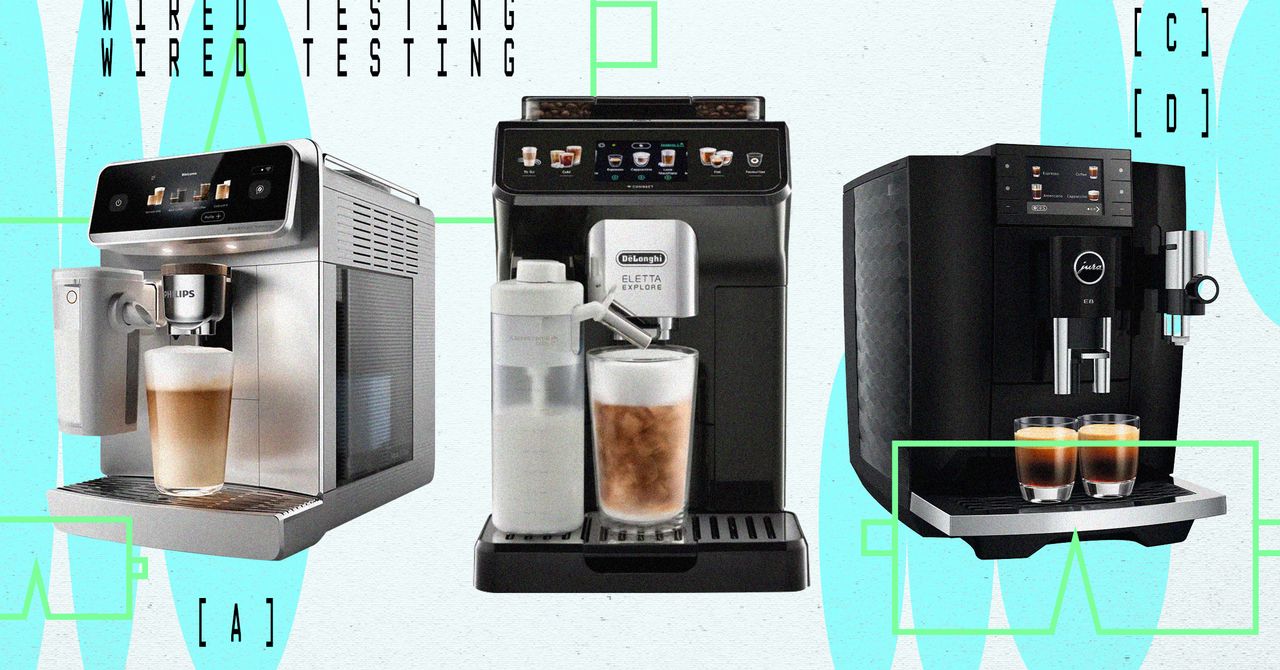
Our experts were blindfolded and then presented with one latte and one espresso from each machine. Labelled A, B, C, and D, the machines were visible to the testers, but they had no idea which coffee came from which. They then assessed each drink on looks, milk-steaming quality, crema (the golden aromatic foam on top of espresso), temperature, extraction, and flavor. The coffees were then ranked in order from best to worst.
To reiterate, this is not a test of the machine’s usability, desirability, or features. Each design can have every aspect of every recipe tweaked, but we’re not convinced the average buyer will want to dive deep into the settings. These are sophisticated push-button machines designed to take the faff and fiddle out of making good coffee at home—anything for an easy life.
The Coffee Machines
Machine “A”
One of only a few machines capable of making espresso-based drinks and classic drip coffee, the TK-02, from NYC-based Terra Kaffe, is a gorgeous-looking piece of kitchen kit with premium components, a delightful glass milk carafe, a super-cool monochrome touchscreen, extensive personalization, and full app control.

Virtual reality (VR) has already seen many commercial and industrial uses. Yet VR also can be one of the most powerful tools for storytelling, visualising ideas and enhancing narratives – most obviously in the arts and entertainment sphere, where VR brings enhanced capabilities and enables artists to indulge in experiments to try out new approaches.
Other storytelling uses support societal causes, enable new judicial procedures, boost education and become emphatic conduits. Simply, VR can put storytelling in a higher gear.
Showing how VR enables new storytelling avenues and approaches for artists and entertainers, artist Charlotte Mikkelborg noticed the transformative power VR could unleash for narratives when she first tried on a VR headset in 2015: “I realised that I didn’t have to just watch a scene, I could live it.”
Since then, she has created an immersive concert for Coldplay; a multisensory narrative game; and Adventure, her series for Apple that portrays extreme athletes in VR.
Meanwhile, artist Estella Tse “merges tech and visual storytelling into a new art form”, adding: “The immersive nature of VR metaphorically and literally puts the viewer into a different world. The brain feels like it is transported to another place.” In contrast to Mikkelborg’s VR experiences, Tse’s stories resemble art installations rather than narratives.
It shouldn’t come as a surprise that the annual Venice Film Festival features an entire section related to the emerging artform. Venice Immersive “is entirely devoted to immersive media and includes all XR means of creative expression”. Eligible for submission are all immersive videos, VR, MR, AR and XR works of any length, including installations and virtual worlds. A review by the Guardian describes 2025’s selection as a “flourishing lineup of immersive storytelling experiments, [which] are taking visitors into novels, nightclubs and outer space”.
At the 82nd Venice Film Festival in August and September 2025, the island of Lazzaretto Vecchio featured a wide range of XR artwork that invited audience members to immerse themselves into stories rather than just looking onto them. For example, The Time Before is “a virtual reality journey through memory, imagination and dreams”, which steps into the main character’s mind to explore the imaginary worlds his sister builds to protect them from the anger of their father. The piece 1968 is “communal VR theatre that explores the transformative power of protest through illusions to 1968, which was a year charged by societal, political and cultural unrest”.
Venice Immersive Jury chair Eliza McNitt sees XR as “the beginning of a revolution … [artists can] push the boundaries of storytelling”.
Conveying societal causes
The way VR can bring stories and narratives closer to an audience lends itself to highlight social and societal issues in more impactful ways than previously possible. Journalist Becca Warner outlined her experience with VR content created by South African Habitat XR. The company’s objective is to create “immersive nature storytelling that drives public engagement, education, fundraising and conservation outcomes.”
Warner watched A Predicament of Pangolins, an immersive story featuring two wild pangolins in the Kalahari Desert who are facing the challenges of climate change. The anthropomorphised animals are created “for maximum empathy and cognitive connection to the present reality of climate change”. Warner highlights VR’s impact: “A virtual reality pangolin made me cry and care more about the planet: is this the real power of VR headsets?”
Exploring how humans live with nature is a common theme. French company Wild Immersion is “dedicated to raising awareness of environmental issues through 360° films, VR experiences, AR journeys, wildlife encyclopaedias and interactive drawings”. And the British artist collective Marshmallow Laser Feast is using stories in immersive experiences and XR that are “designed to carve out space to expose, explore and expand our relationship with the living world”.
The UK’s Natural History Museum uses VR headsets to look a century into the future to visualise humans’ impact on nature. The showcase’s main takeaway is that “the actions we take today will help build a better tomorrow.”
Alex Burch, director of public programmes at the museum, explains that the immersive story shows “the aftermath of centuries of human industrial activity as well as to the interventions we have introduced to remedy our unsustainable activity”.
New York artist Sam Wolson uses VR to tell political narratives. For instance, Re-educated puts viewers into a Chinese re-education camp to convey the experience of prisoners, with first-hand testimony informing the animation. And No Place at Home follows a mother and her transgender teenager on their search for gender-affirming care, combining photorealistic three-dimensional imagery.
Wolson explains where VR can improve storytelling: “With virtual reality and interactive visual features, it comes down to whether a story is suited to multimedia or nonlinear narratives, in which the viewer can be placed directly into a story with the freedom to move around.”
Recovering memories, creating experiences
A less-known and emerging use of VR is visualising memories to resurrect past experiences. For instance, in December 2024, judge Andrew Siegel of Florida’s Broward County Circuit Court used a VR headset to a recreate the imagery of an aggravated assault. The defence hired an expert to visualise the defendant’s perspective in a stand-your ground trial.
Previous research at the University of South Australia indicated that test subjects showed improvements in spatial recall, “remembering the correct placement of evidence items”, and some aspects of narrative recall when using VR in comparison to the use of still imagery.
The approach offers benefits when crime-site visits are difficult or dangerous, contextual information plays an important role, or interactions among individuals are complicated to follow. Louisiana Fifth Circuit Court judge Scott Schlegel, who investigates new technologies for legal applications, points to a potential drawback. Virtual reality recreations “may powerfully convey emotions and perspective; it may be less reliable for conveying specific factual details that are crucial in legal proceedings.” In other words, emotions might cloud or even bias factual judgement.
Other applications for recreating memories exist. Researcher Rob Martin at South Carolina’s Clemson University employs VR so that hospice patients can have an experience they always wanted to have. After taking a survey of local patients, he found that most wanted to experience one more Clemson football game. With the help of the Clemson’s Tandem VR team, Martin created such a visualisation.
Tandem VR is a part of Clemson’s Virtual Reality and Nature Lab. The lab’s director Olivia McAnirlin developed a concept that allows users to share a VR experience “in tandem”. The “experiences are synchronised (simultaneous) so they can fully enjoy them together, personalised to their preferences based on their experiences, dreams or memories”.
Informing education
Storytelling is set to play a bigger role in tomorrow’s teaching and learning, and XR can transform education though new ways to bring stories alive. Eli Joseph at Columbia University School in New York believes that the merging of literature and technology “transforms storytelling from a linear into an interactive experience in which the reader’s choices can influence the narrative”.
Joseph notes that readers can immerse themselves in stories by addressing multiple senses, and that multisensory environments for genuinely immersive experiences enables users to take a closer look at ways how XR can create layers of experiences. Joseph also believes that the technology can benefit text books – for instance, by visualising dissection of cells in biology class.
VR not only can create narratives but also tell stories from the past. For example, the Illinois Holocaust Museum’s Experience360 is using VR to make history palpable. The Chicago museum uses the technology “to witness stories of survival, ask questions and reflect on the past in ways that inspire empathy, respect and hope”.
Other institutions have taken note. The Centreville Regional Library in Fairfax, Virginia, partnered with the Illinois Holocaust Museum. Luis Aponte, an information services librarian who brought the experience to Centreville, praises “the Illinois Holocaust Museum’s dedication to preserving history in a way that transforms the future”.
Eliciting empathy
Educational use of VR can deepen the experience by eliciting empathy for history’s protagonists and witnesses. In a study by Stanford University, researchers looked at the effect VR can have to “reduce psychological distance to locations affected by climate change, influencing climate emotions and risk perceptions”.
One group of test subjects were only listening to news broadcasts about flooding in selected locations due to climate change while other participants were virtually flying through a three-dimensional representation of the floodings. Participants that experienced the virtualisation became concerned about climate change.
“Utilising VR for climate education can enhance awareness and inspire constructive actions, moving beyond traditional fear-driven narratives,” said the study.
VR can also elevate emotional participation. In 2015, musician Björk released the album Vulnicura, which deals with her emotional breakup of a long-time relationship. She recently worked with Pulse Jet Studios to create a VR visualisation of the songs. Björk explained her motivation: “I realised that I’d written a whole heartbreak album … what most people were complaining about with VR is it was very isolating.”
The VR journey starts in an austere landscape of Iceland, where Björk hails from. Users then can thread together Björk’s broken heart. Her initial VR art was released shortly after the album’s release, but over time she frequently updated the storytelling as VR become more powerful and capable, resulting in the most recent 2025 version.
And this takes the conversation back to arts and entertainment. VR’s impact on storytelling can affect many applications areas across industries, sometimes in surprising ways. Over time immersive capabilities will become an expectation rather than a surprise when experiencing stories and narratives across various types of content.
Martin Schwirn is the author of ‘Small data, big disruptions: How to spot signals of change and manage uncertainty’ (ISBN 9781632651921). Schwirn has advised companies internationally for SRI International and Business Finland. He is a strategy and innovation consultant for Global 2000 companies.


H&M debuts on Nordstrom for its first curated marketplace launch in US

TG Jones faces administration if not restructuring by end of July, lenders told

Govt dismisses ‘mala fide’ reports of Pakistanis’ deportation from UAE

-
 Business1 week ago
PSX plunges over 4,800 points | The Express Tribune
-

 Politics5 days ago
Iran weighs US reply delivered via Pakistan as Trump signals opposition to deal terms
-

 Fashion6 days ago
US’ J.Jill, Inc. appoints Kimberly Wallengren as CMO
-

 Tech1 week ago
Almost half of UK businesses hit by cyber attacks | Computer Weekly
-

 Tech1 week ago
This Indigenous Language Survived Russian Occupation. Can It Survive YouTube?
-

 Fashion1 week ago
Canada’s Lululemon appoints Esi Eggleston Bracey to board of directors
-

 Entertainment1 week ago
David Allan Coe, country singer who wrote “Take This Job and Shove It,” dies at age 86
-
 Business1 week ago
Government hikes jet fuel prices by 5% for international airlines – The Times of India