

Business
GST rate cuts a booster shot! What do tax changes mean for stock markets? Explained – The Times of India

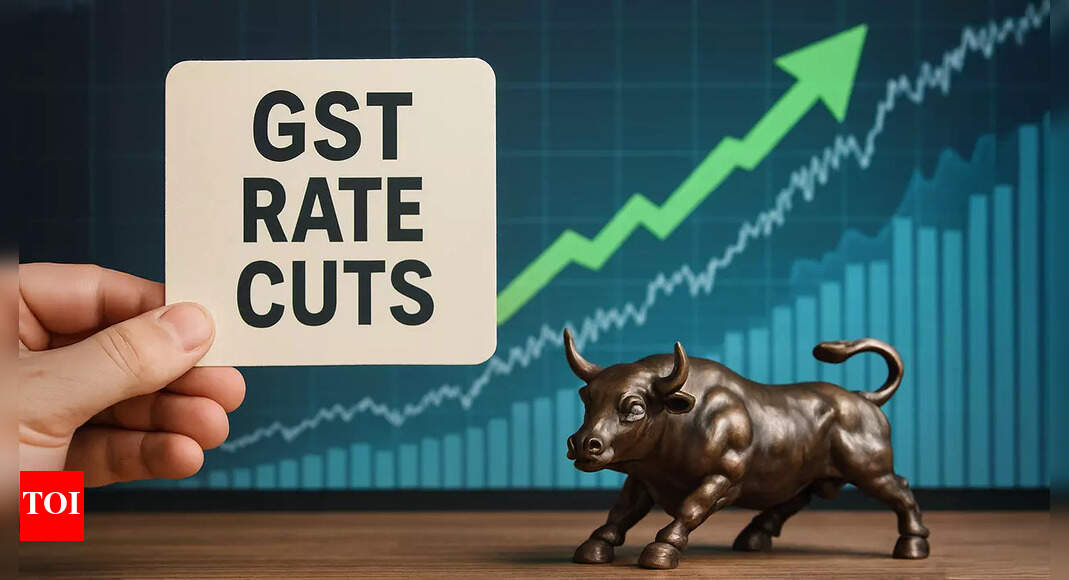
GST rate cuts announced by the Modi government have served as a booster shot for the Indian economy and markets, with consumption driven growth expected to aid the economy at a time when it is faced by 50% US tariffs.The comprehensive GST modifications announced by Finance Minister Nirmala Sitharaman, with revenue implications of Rs 48,000 crore, have been regarded by market analysts as a “consumption revival bombshell” that has energised the previously sluggish Sensex and Nifty, according to an ET analysis.
The market’s immediate reaction was significant, with the Sensex recording an increase of nearly 900 points, whilst the Nifty advanced by 1%, approaching a potential breakthrough above the critical 25,000 mark. These movements have sparked considerable interest in understanding the specific changes and their implications for the market.Speaking about the wider implications, Dr. VK Vijayakumar, Chief Investment Strategist at Geojit Investments Limited, states: “The revolutionary GST reform has come better than expected benefitting a wide spectrum of sectors. The ultimate beneficiary is the Indian consumer who will benefit from lower prices. The potential big boost to consumption in an economy that is already in growth momentum will be big and may surprise on the upside.“Also Read | GST rate cuts from September 22! All you need to know about new tax rates for items – 75 FAQs answered
GST rate cuts: Auto sector a big beneficiary
The surge in automotive shares aligns with substantial tax benefits. According to Jefferies, the reduction in GST rates from 28% to 18% for two-wheelers below 350cc and small cars could trigger significant market growth, benefiting companies like TVS and Maruti. For M&M, the unexpected reduction in SUV taxation from 50% to 40%, including cess, presents a remarkable advantage.The rural market segment shows promising developments. Emkay’s study indicates that “tractors and agri-machinery that have witnessed a GST cut to 5% from 12%” will experience considerable demand growth. “Such sharp reduction directly lowers acquisition costs for farmers and boosts affordability,” presenting substantial opportunities for organisations like Mahindra & Mahindra and Escorts.According to the research organisation, “this strategic tax relief in the auto space could potentially offer a 5-10% boost in demand across categories,” explaining the current market momentum in automotive shares.In the stock market, automotive shares showed remarkable performance, with M&M recording a notable 6% increase. Other manufacturers including Eicher Motors, TVS, Bajaj Auto and Hero Moto experienced gains between 1-2%.
FMCG booster
The FMCG sector emerges as the second-largest beneficiary of the tax reduction, receiving more comprehensive relief than anticipated. According to Amit Agarwal, SVP-Fundamental Research at Kotak Securities: “The GST rate for almost all food items (biscuits, instant noodles, nutrition, namkeen, instant coffee, chocolates, ice cream, fruit juices, sauces and cheese) has been cut to 5% from 18%/12% and that for select daily essential personal care categories (soaps, shampoo, hair oil and toothpaste) has been reduced to 5% from 18%.“Jefferies indicates this development was “largely unanticipated,” resulting in “positive for consumer staples companies, notably Colgate, Britannia, Nestlé, followed by HUL, GCPL, Marico, Dabur, Patanjali.” The extensive range of products affected explains the increased investor attention towards FMCG stocks.Also Read | GST rate cuts bonanza! What is cheaper and dearer? Check full list of items in 0%, 5%, 18% & 40% slabs
Cement sector rejoices
The cement industry benefits from a substantial GST reduction of 10 percentage points, decreasing from 28% to 18%, addressing persistent investor worries. Jefferies elaborates on the significance: “The reduction in GST rate by 10ppt creates some volume upside but potentially also headroom for price hikes, where the sensitivity of the industry to a profit increase is high (1% pricing is 4-5%).”The combined advantages of increased volume and pricing flexibility explain why analysts predict an upturn in cement stocks, which have remained relatively stable until now.
GST rate cuts: Impact on Indian economy
The GST reforms carry significant implications beyond sectoral advantages, contributing to broader economic momentum. As Garima Kapoor, Economist and Executive Vice President at Elara Capital, states: “We expect GST related demand boost to add 100 to 120 bps to the GDP growth over next 4-6 quarters, thereby nullifying the negative impact of higher tariffs on exports to US.”According to Dr. Vijayakumar’s assessment, these changes could “boost India’s growth to 6.5% in FY 26 and perhaps 7% in FY 27 with impressive gains in corporate earnings,” establishing solid foundations for continued market advancement.The implementation arrives at an opportune moment as various policy instruments demonstrate positive alignment. As noted by Kapoor: “Today’s GST rate changes, along with RBI’s rate cuts, income tax rebates announced in FY26 budget and easing inflation are all levers for a consumption uptick in the economy. We remain constructive on the uptick in consumption demand in the economy as multiple policy levers turn favourable for the first time in a decade.“Nilesh Shah, MD of Kotak Mahindra AMC, indicated that the GST restructuring would help counterbalance the negative effects of US tariffs in subsequent quarters.Also Read | Prices of small cars, two-wheelers under 350cc, to come down significantly on GST cut; bigger cars in 40% slab
GST rate cuts: What should investors do?
The stock market responded favourably as investors recognised how reduced GST rates could boost consumer demand across various sectors. Jefferies anticipates “festive demand should see a positive boost,” whilst cautioning about “some negative demand impact in September.”The projected increase in consumption could generate cascading benefits for broader economic expansion. Analysts emphasise that swift transfer of tax benefits to consumers by companies would be crucial, potentially enhancing both consumer confidence and expenditure.“Lower taxes on essentials, FMCG products, autos and cement will leave consumers with more money in hand. This should directly boost demand, help traders and businesses see higher volumes, and may even favourably impact next quarter’s earnings. It also carries the potential to ease inflation.” said Shripal Shah, MD & CEO, Kotak Securities.These wide-ranging tax adjustments, encompassing both everyday necessities and substantial purchases, have led investors to consider this a fundamental transformation rather than a short-term measure. This perspective has driven widespread market gains across diverse sectors including automobiles, FMCG, white goods, cement, and insurance.(Disclaimer: Recommendations and views on the stock market and other asset classes given by experts are their own. These opinions do not represent the views of The Times of India)







Inflation has risen to 3.4% in the year to December, driven by higher tobacco prices and airfares, according to official figures.
The increase in average prices across the UK economy – the first in five months – was just above expectations, with many economists predicting only a slight uptick to 3.3%.
The cost of airfares was a contributor “likely because of the timing of return flights over the Christmas and New Year period”, the Office for National Statistics (ONS) said. It also reflected an increase in tobacco duty introduced in late November.
It is the last set of monthly inflation figures released before the Bank of England’s decision on interest rates in February.
In addition to tobacco and transport prices, “rising food costs, particularly for bread and cereals, were also an upward driver,” said ONS chief economist Grant Fitzner.
“These were partially offset by a fall in rents inflation and lower prices for a range of recreational and cultural purchases.”
In response to the figures, Chancellor Rachel Reeves said her priority was cutting the cost of living, citing measures in her November Budget including a freeze to rail fares and prescription charges.
“Money off bills and into the pockets of working people is my choice.
“There’s more to do, but this is the year that Britain turns a corner,” Reeves said.
Inflation in the UK is a measure of the Consumer Prices Index, which is a virtual basket of hundreds of everyday goods and services selected by the ONS that includes things like bread, fruit, furniture and different items of clothing.
The prices of these items are tracked by the ONS over the previous 12 months, and the basket is regularly updated to reflect shopping trends.
MUMBAI: AU Small Finance Bank, which has received RBI nod to convert into a commercial bank, reported a net profit of Rs 667.66 crore for the December 2025 quarter, up 26.3% from Rs 528.45 crore in the corresponding quarter last year. The improvement was driven by strong growth in core earnings and a sharp reduction in credit costs, which offset higher operating expenses.Net interest income (NII) rose 15.8% year-on-year to Rs 2,341.27 crore, compared with Rs 2,022.71 crore in the December 2024 quarter. Interest earned increased to Rs 4,727.47 crore from Rs 4,113.48 crore, while interest expended rose to Rs 2,386.20 crore from Rs 2,090.77 crore. On a sequential basis, NII increased 9.2% from Rs 2,144.42 crore in the September 2025 quarter, reflecting improved yields on advances and relatively stable funding costs.During the quarter, the bank also announced a series of board and senior management changes as part of a broader leadership realignment. The board approved the appointment of Phani Shankar as non-executive independent director for a three-year term. It also cleared the appointment of Vivek Tripathi, chief credit officer, as whole-time director, subject to regulatory and shareholder approvals. Uttam Tibrewal, who will complete his current term as whole-time director in April 2026, will continue as deputy CEO, while Divya Sehgal, non-executive non-independent director, resigned after completion of the integration of Fincare Small Finance Bank. V G Kannan is set to complete his second term as independent director in January 2026.Other income increased 17.0% year-on-year to Rs 723.80 crore from Rs 618.41 crore a year earlier, supporting overall revenue growth. Total income for the quarter rose to Rs 5,451.26 crore, compared with Rs 4,731.89 crore in the corresponding period last year.Operating expenses climbed 28.8% year-on-year to Rs 1,849.75 crore from Rs 1,436.21 crore, driven by higher employee costs and expansion-related spending, including regulatory-linked adjustments. Despite this, operating profit before provisions remained broadly stable at Rs 1,215.31 crore, compared with Rs 1,204.91 crore in the year-ago quarter.Provisions (other than tax) declined 34.0% year-on-year to Rs 331.14 crore from Rs 501.68 crore, reflecting lower credit costs. Tax expense increased to Rs 216.51 crore from Rs 174.78 crore, in line with higher profitability.Asset quality remained stable, with gross NPAs at Rs 2,880.54 crore, compared with Rs 2,335.51 crore a year earlier, while the gross NPA ratio was largely unchanged at 2.30% against 2.31% in the corresponding quarter last year. The bank’s capital position strengthened, with the capital adequacy ratio improving to 19.01% from 18.01%, providing headroom for future growth.
Business
‘Our refineries are robust!’: India can process Venezuelean crude oil when available; here’s what IOCL chairman said – The Times of India

Indian Oil Corporation Ltd (IOCL) said that the country’s refineries are capable of processing Venezuelan crude if supplies resume. “If at all things start settling down, if at all a lot of crude starts coming out of Venezuela, then can’t we import oil from Venezuela?” he said.The executive further added that the company, used to process Venezuelean crude a decade back and can do so again. “Venezuelan crude earlier when it was available, like 10 years back or eight years back when it used to be there in the market,” Sahney said at the World Economic Forum (WEF) in Davos.
Speaking about the capabilities of the refineries, the chairman highlighted that they are strong and can process the supplies. “So our refineries are varied, our refineries are robust. They can process in an admixed manner, but we can process Venezuelan crude if and when it is made available.”The remarks follow the US’s capture of outsted Venezuelan President Nicolas Maduro in a military operation and an agreement to send 50 million barrels of oil, worth $5.2 billion, to the interim Venezuelan government.Sahney also highlighted India’s favourable economic and energy landscape. “India is growing at a phenomenal rate, and everybody is interested in talking about doing business with India,” he said.Commenting on global crude prices, he noted, “Crude has been trading in the range of $60-65 per barrel over the past several months. For the better part of the last six months, they were at $60 or below. This is a good zone where economic growth is also happening and sellers of crude are comfortable.”Pointing out India’s reliance on imports, he said, “India remains heavily dependent on imports to meet its energy needs, with IOCL importing about 85-87% of its crude oil requirements. The current price band is supportive for economic stability.”Sahney explained that refining margins depend on more than crude prices. “Refining margin is a very broad term. It is finally affected by the cracks in the international market. Today, cracks are working fine. They have returned to normalcy but are still in a healthy zone,” he said.He added that government policy has also supported the sector. “There is no problem on the policy side. Whatever support is required has already been given. It is up to us to improve profitability by increasing efficiency, reducing costs and optimising the supply chain,” Sahney said.Moving forward, Indian Oil plans to continue investing across the energy value chain, including downstream petrochemicals and cleaner energy solutions.The WEF’s 56th Annual Meeting runs from January 19 to 23, 2026, in Davos-Klosters, with around 3,000 participants from over 130 countries, including world leaders, CEOs, innovators and policymakers, under the theme “A Spirit of Dialogue.”


Indian economy to grow 7.5-7.8% in FY2025-26: Deloitte

Transfer rumors, news: Man United explore Loftus-Cheek loan

US tariffs hit domestic economy, not foreign exporters

-

 Tech1 week ago
New Proposed Legislation Would Let Self-Driving Cars Operate in New York State
-

 Entertainment1 week ago
X (formerly Twitter) recovers after brief global outage affects thousands
-

 Sports6 days ago
Pak-Australia T20 series tickets sale to begin tomorrow – SUCH TV
-

 Politics4 days ago
Saudi King Salman leaves hospital after medical tests
-

 Tech6 days ago
Two Thinking Machines Lab Cofounders Are Leaving to Rejoin OpenAI
-
 Business5 days ago
Trump’s proposed ban on buying single-family homes introduces uncertainty for family offices
-

 Tech5 days ago
Meta’s Layoffs Leave Supernatural Fitness Users in Mourning
-

 Fashion4 days ago
Bangladesh, Nepal agree to fast-track proposed PTA