

Tech
How to reduce greenhouse gas emissions from ammonia production

Ammonia is one of the most widely produced chemicals in the world, used mostly as fertilizer, but also for the production of some plastics, textiles, and other applications. Its production, through processes that require high heat and pressure, accounts for up to 20% of all the greenhouse gases from the entire chemical industry, so efforts have been underway worldwide to find ways to reduce those emissions.
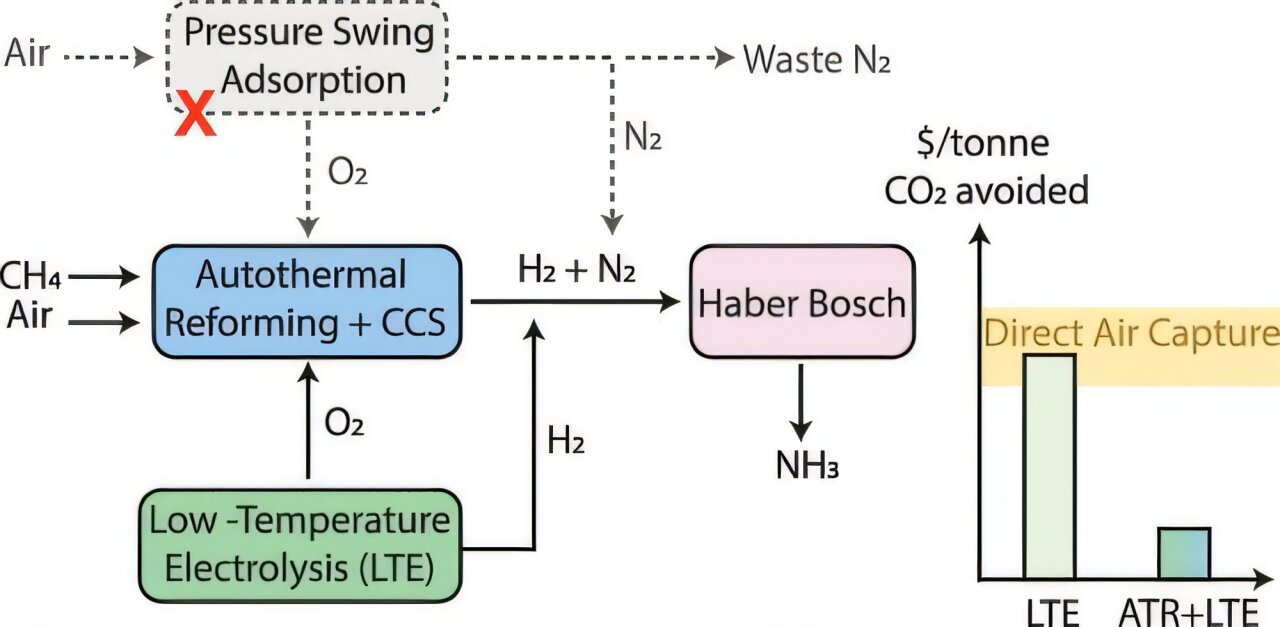
Now, researchers at MIT have come up with a clever way of combining two different methods of producing a compound that minimizes waste products, that—when combined with some other simple upgrades—could reduce the greenhouse emissions from production by as much as 63%, compared to the leading “low-emissions” approach being used today.
The new approach is described in the journal Energy & Fuels, in a paper by MIT Energy Initiative (MITEI) Director William H. Green, graduate student Sayandeep Biswas, MITEI Director of Research Randall Field, and two colleagues.
“Ammonia has the most carbon dioxide emissions of any kind of chemical,” says Green, who is the Hoyt C. Hottel Professor in Chemical Engineering.
“It’s a very important chemical,” he says, because its use as a fertilizer is crucial to being able to feed the world’s population.
Until late in the 19th century, the most widely used source of nitrogen fertilizer was mined deposits of bat or bird guano, mostly from Chile, but that source was beginning to run out, and there were predictions that the world would soon be running short of food to sustain the population. But then a new chemical process, called the Haber-Bosch process after its inventors, made it possible to make ammonia out of nitrogen from the air and hydrogen, which was mostly derived from methane. But both the burning of fossil fuels to provide the needed heat and the use of methane to make the hydrogen led to massive climate-warming emissions from the process.
To address this, two newer variations of ammonia production have been developed: so-called blue ammonia, where the greenhouse gases are captured right at the factory and then sequestered deep underground, and green ammonia, produced by a different chemical pathway, using electricity instead of fossil fuels to hydrolyze water to make hydrogen.
Blue ammonia is already beginning to be used, with a few plants operating now in Louisiana, Green says, and the ammonia mostly being shipped to Japan, “so that’s already kind of commercial.” Other parts of the world are starting to use green ammonia, especially in places that have lots of hydropower, solar, or wind to provide inexpensive electricity, including a giant plant now under construction in Saudi Arabia.
But in most places, both blue and green ammonia are still more expensive than the traditional fossil-fuel-based version, so many teams around the world have been working on ways to cut these costs as much as possible so that the difference is small enough to be made up through tax subsidies or other incentives.
The problem is growing, because as the population grows, and as wealth increases, there will be ever-increasing demand for nitrogen fertilizer. At the same time, ammonia is a promising substitute fuel to power hard-to-decarbonize transportation such as cargo ships and heavy trucks, which could lead to even greater needs for the chemical.
“It definitely works” as a transportation fuel, by powering fuel cells that have been demonstrated for use by everything from drones to barges and tugboats and trucks, Green says.
“People think that the most likely market of that type would be for shipping,” he says, “because the downside of ammonia is it’s toxic and it’s smelly, and that makes it slightly dangerous to handle and to ship around.”
So its best uses may be where it’s used in high volume and in relatively remote locations, like the high seas. In fact, the International Maritime Organization will soon be voting on new rules that might give a strong boost to the ammonia alternative for shipping.
The key to the new proposed system is to combine the two existing approaches in one facility, with a blue ammonia factory next to a green ammonia factory. The process of generating hydrogen for the green ammonia plant leaves a lot of leftover oxygen that just gets vented to the air. Blue ammonia, on the other hand, uses a process called autothermal reforming that requires a source of pure oxygen, so if there’s a green ammonia plant next door, it can use that excess oxygen.
“Putting them next to each other turns out to have significant economic value,” Green says.
This synergy could help hybrid “blue-green ammonia” facilities serve as an important bridge toward a future where eventually green ammonia, the cleanest version, could finally dominate. But that future is likely decades away, Green says, so having the combined plants could be an important step along the way.
“It might be a really long time before [green ammonia] is actually attractive” economically, he says. “Right now, it’s nowhere close, except in very special situations.”
But the combined plants “could be a really appealing concept, and maybe a good way to start the industry,” because so far only small, standalone demonstration plants of the green process are being built.
“If green or blue ammonia is going to become the new way of making ammonia, you need to find ways to make it relatively affordable in a lot of countries, with whatever resources they’ve got.” This new proposed combination, he says, “looks like a really good idea that can help push things along. Ultimately, there’s got to be a lot of green ammonia plants in a lot of places,” and starting out with the combined plants, which could be more affordable now, could help to make that happen. The team has filed for a patent on the process.
Although the team did a detailed study of both the technology and the economics that showed the system has great promise, Green points out, “No one has ever built one. We did the analysis, it looks good, but surely when people build the first one, they’ll find funny little things that need some attention,” such as details of how to start up or shut down the process.
“I would say there’s plenty of additional work to do to make it a real industry.”
But the results of this study, which show the costs to be much more affordable than existing blue or green plants in isolation, “definitely encourage the possibility of people making the big investments that would be needed to really make this industry feasible.”
This proposed integration of the two methods “improves efficiency, reduces greenhouse gas emissions, and lowers overall cost,” says Kevin van Geem, a professor in the Center for Sustainable Chemistry at Ghent University, who was not associated with this research.
“The analysis is rigorous, with validated process models, transparent assumptions, and comparisons to literature benchmarks. By combining techno-economic analysis with emissions accounting, the work provides a credible and balanced view of the trade-offs.”
He adds, “Given the scale of global ammonia production, such a reduction could have a highly impactful effect on decarbonizing one of the most emissions-intensive chemical industries.”
The research team also included MIT postdoc Angiras Menon and MITEI research lead Guiyan Zang.
More information:
Sayandeep Biswas et al, A Comprehensive Costing and Emissions Analysis of Blue, Green, and Combined Blue-Green Ammonia Production, Energy & Fuels (2025). DOI: 10.1021/acs.energyfuels.5c03111
This story is republished courtesy of MIT News (web.mit.edu/newsoffice/), a popular site that covers news about MIT research, innovation and teaching.
Citation:
How to reduce greenhouse gas emissions from ammonia production (2025, October 8)
retrieved 8 October 2025
from https://techxplore.com/news/2025-10-greenhouse-gas-emissions-ammonia-production.html
This document is subject to copyright. Apart from any fair dealing for the purpose of private study or research, no
part may be reproduced without the written permission. The content is provided for information purposes only.













I was delighted to see that the Acer Chromebook Plus 516 didn’t skimp on a crappy touchpad. That goes a long way toward improving the experiencing of actually using the laptop on a moment-by-moment basis. I wasn’t annoyed every time I had to click-and-drag or select a bit of text. This one’s biggest weakness is definitely the screen, which is true of just about every cheap Chromebook I’ve tested. The colors are ugly and desaturated, giving the whole thing a sickly green tint. It’s also not the sharpest in the world, as it’s stretching 1920 x 1200 pixels across a large, 16-inch screen. But in terms of usability and performance, the Acer Chromebook Plus 516 is a great value, combining an Intel Core i3 processor with 8 GB of RAM and a 128 GB of storage. For a Chromebook that’s often on sale for $350, it’s a steal.
While we’re here, let’s go even cheaper, shall we? Asus has two dirt-cheap Chromebooks that I tested last year that I was mildly impressed by. The Asus Chromebook CX14 and CX15. Notice in the name that these are not “Chromebook Plus” models, meaning they can be configured with less RAM and storage, and even use lower-powered processors. That’s exactly what you get on the cheaper configurations of the CX14 and CX15, which is how you sometimes get prices down to as low as $130. I definitely recommend the version with 8 GB of RAM, but regardless of which you choose, the both the CX14 and larger CX15 are mildly attractive laptops. You’d know that’s a big compliment if you’ve seen just how ugly Chromebooks of this price have been in the past.
With these, though, I appreciate the relatively thin bezels and chassis thickness, as well as the larger touchpad and comfortable keyboard. The CX15 even comes in a striking blue color. The touchpad isn’t great, nor is the display. Like the Acer Chromebook Plus 516, it suffers from poor color reproduction and only goes up to 250 nits of brightness. It only has a 720p webcam too, which makes video calls a bit rough. But that’s going to be true of nearly all the competition (and there isn’t much).
Of the two models, I definitely prefer the CX14 though, as it doesn’t have a numberpad and off-center touchpad, which I’ve always found to be awkward to use. Look—no one’s going to love using a computer that costs the less than $200, but if it’s what you can afford, the Asus Chromebook CX14 will at least get you by without too much frustration.
Whatever you do, don’t just head over to Amazon and buy whatever ancient Chromebook is selling for $100 for your kid. It’s worth the extra cash to get something with better battery life, a more modern look, and decent performance.
Other Good Chromebooks We’ve Tested
We’ve tested dozens and dozens of Chromebooks over the past years, having reviewed every major release across the spectrum of price. Unlike Macs and Windows laptops, Chromebooks tends to stick around a bit longer though, and aren’t refreshed as often. I stand by my picks above, but here are a few standouts from our testing that are still worth buying for the right person.
Photograph: Daniel Thorp-Lancaster
Tech
Interview: Critical local infrastructure is missing link in UK cyber resilience | Computer Weekly

Critical local infrastructure that supports council services, social care services and local transport in the UK is falling through the gaps in government and business planning for cyber resilience, claims Jonathan Lee, director of cyber strategy at cyber security company TrendAI.
In an interview with Computer Weekly, Lee says that municipal areas, such as London or Greater Manchester, could be at risk from multiple cyber attacks that could damage local infrastructure, causing escalating problems for residents that could add up to severe disruption.
“We need to be thinking about what would happen if multiple attacks happened at the same time across the city region – and the human impact of not being able to do your job properly, not being able to travel around and not being able to deliver public services,” he says.
The Cyber Security and Resilience Bill (CSRB), which is currently going through Parliament, aims to ensure that critical national services, such as healthcare, water, transport and energy, are protected against cyber attacks that cost the economy billions of pounds a year. But local infrastructure has been relatively neglected, claims Lee.
The National Cyber Security Centre’s (NCSC) Cyber Assurance Framework, for example, aims to help operators of critical national infrastructure (CNI) demonstrate a base level of cyber security preparedness – but it is not mandatory, and not every organisation that should implement it is implementing it.
Whole of society risk
“We need to be more stringent in making sure that people are taking this seriously and are looking not just at their own organisation, but are looking at the whole of society risk,” says Lee.
Attacks on public services, such as council-run social care, can have a catastrophic, knock-on effect on the NHS and patient care, he adds.
There is a need for more “top-down” advice for regional infrastructure providers, from organisations such as the NCSC, which is not as well known as it could be among the companies and public sector bodies that provide local infrastructure.
“The message has got to be diffused down into local levels to ensure that a consistent message is spread out, and that can also be through industry partners. That is something I feel quite strongly about,” says Lee.
The Cyber Essentials programme, which has been updated to include new requirements for organisations to use multifactor authentication (MFA), and requirements for cloud providers to patch vulnerabilities within 14 days, has helped build resilience, but only for organisations that choose to adhere to it.
Keeping the resilience score
The UK government is also intending to publish a Cyber Action Plan in the coming months, which will guide organisations to get basic security right and improve their cyber security over time.
Although there is no shortage of initiatives and action plans, there is a danger that many of these plans will be left on a shelf.
One approach is for organisations to rate themselves on a scorecard for cyber resilience, on a scale of, say, 1 to 100, and to report their progress back to board-level directors.
“We need a mechanism to measure how impactful these interventions are, whether it be things like the Cyber Assessment Framework, Cyber Essentials or legislation,” says Lee.

Two of Big Tech’s most influential billionaires, Sam Altman and Elon Musk, will go head-to-head in a highly anticipated trial beginning April 27. In Musk v. Altman, a judge, advised by a jury, will ultimately determine whether OpenAI has strayed from its founding mission to ensure that artificial general intelligence (AGI) benefits humanity, and the ruling could influence how the world’s leading AI developer controls and distributes its technology. For now, you can learn more about the trial here.
On the Panel
On May 8, a panel of WIRED experts will go live to answer your questions about this consequential case.
- Zoë Schiffer: WIRED’s director of business and industry, who oversees coverage of business and Silicon Valley.
- Maxwell Zeff: a senior writer at WIRED covering the business of artificial intelligence. He writes the weekly Model Behavior newsletter, which focuses on the people, communities, and companies behind Silicon Valley’s AI scene.
- Paresh Dave: a senior writer at WIRED covering the inner workings of Big Tech companies. He writes about how apps and gadgets are built and about their impacts while giving voice to the stories of the underappreciated and disadvantaged.
Ask a Question
Submit all your burning questions about this historic legal battle at WIRED’s next, subscriber-only livestream scheduled for May 8 at noon ET / 9 PT. To leave questions in advance as the trial unfolds, head to the comment section below.
Become a Subscriber
The event will be streamed right here. For subscribers who are not able to join, a replay of the livestream will be available after the event. Not a subscriber yet? Subscribe now to get access to this livestream, plus full access to WIRED.
In the meantime, check out past livestreams on Big Tech and the military, the future of electric vehicles, and more.


Life sciences lab real estate is clawing back from disaster. Here’s what that means for investors

Men’s college basketball buzz: State of blue blood rebuilds

IRGC seizes Israeli ship, second vessel for violations in Strait of Hormuz

-

 Fashion6 days ago
France’s LVMH Q1 revenue falls 6%, shows resilience amid Iran war
-

 Entertainment1 week ago
Is Claude down? Here’s why users are seeing errors
-

 Sports1 week ago
PSL 11: Peshawar Zalmi win toss, opt to field first against Quetta Gladiators
-

 Tech1 week ago
The Deepfake Nudes Crisis in Schools Is Much Worse Than You Thought
-

 Tech1 week ago
Bremont Is Sending a Watch to the Moon’s Surface
-

 Tech1 week ago
Human-machine teaming dives underwater
-
 Business1 week ago
BP sees ‘exceptional’ oil trading result as Iran war sends crude costs soaring
-

 Fashion1 week ago
What no one is saying about the 2026 apparel slowdown