

Tech
How to reduce greenhouse gas emissions from ammonia production

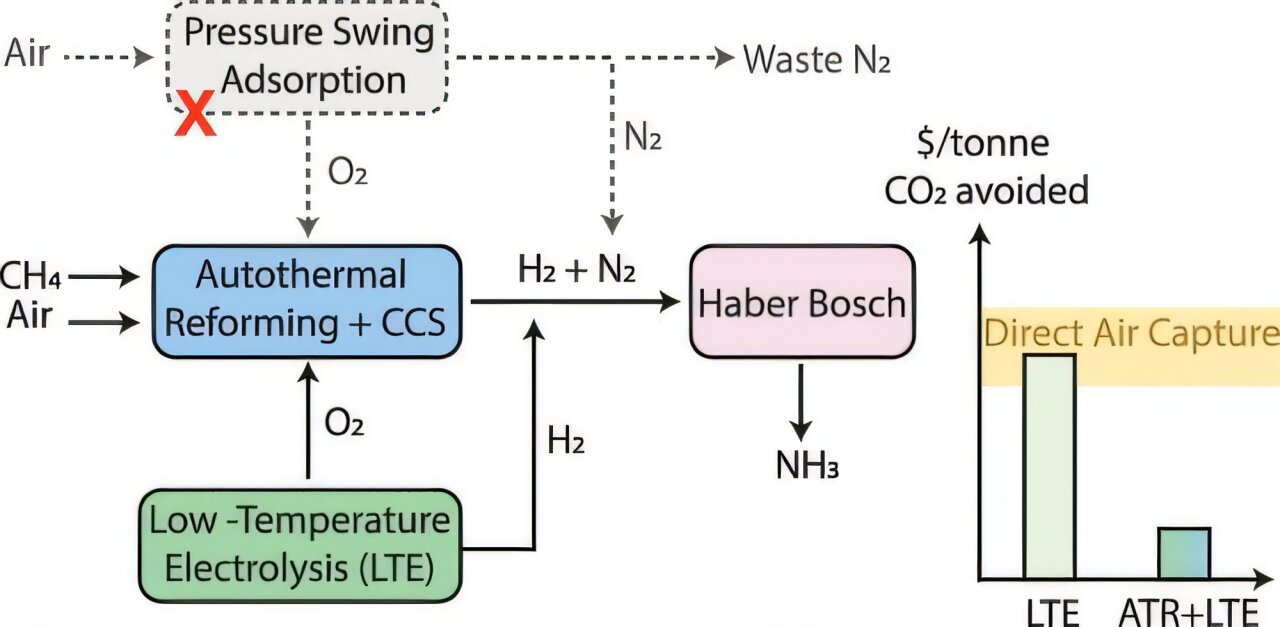
Ammonia is one of the most widely produced chemicals in the world, used mostly as fertilizer, but also for the production of some plastics, textiles, and other applications. Its production, through processes that require high heat and pressure, accounts for up to 20% of all the greenhouse gases from the entire chemical industry, so efforts have been underway worldwide to find ways to reduce those emissions.
Now, researchers at MIT have come up with a clever way of combining two different methods of producing a compound that minimizes waste products, that—when combined with some other simple upgrades—could reduce the greenhouse emissions from production by as much as 63%, compared to the leading “low-emissions” approach being used today.
The new approach is described in the journal Energy & Fuels, in a paper by MIT Energy Initiative (MITEI) Director William H. Green, graduate student Sayandeep Biswas, MITEI Director of Research Randall Field, and two colleagues.
“Ammonia has the most carbon dioxide emissions of any kind of chemical,” says Green, who is the Hoyt C. Hottel Professor in Chemical Engineering.
“It’s a very important chemical,” he says, because its use as a fertilizer is crucial to being able to feed the world’s population.
Until late in the 19th century, the most widely used source of nitrogen fertilizer was mined deposits of bat or bird guano, mostly from Chile, but that source was beginning to run out, and there were predictions that the world would soon be running short of food to sustain the population. But then a new chemical process, called the Haber-Bosch process after its inventors, made it possible to make ammonia out of nitrogen from the air and hydrogen, which was mostly derived from methane. But both the burning of fossil fuels to provide the needed heat and the use of methane to make the hydrogen led to massive climate-warming emissions from the process.
To address this, two newer variations of ammonia production have been developed: so-called blue ammonia, where the greenhouse gases are captured right at the factory and then sequestered deep underground, and green ammonia, produced by a different chemical pathway, using electricity instead of fossil fuels to hydrolyze water to make hydrogen.
Blue ammonia is already beginning to be used, with a few plants operating now in Louisiana, Green says, and the ammonia mostly being shipped to Japan, “so that’s already kind of commercial.” Other parts of the world are starting to use green ammonia, especially in places that have lots of hydropower, solar, or wind to provide inexpensive electricity, including a giant plant now under construction in Saudi Arabia.
But in most places, both blue and green ammonia are still more expensive than the traditional fossil-fuel-based version, so many teams around the world have been working on ways to cut these costs as much as possible so that the difference is small enough to be made up through tax subsidies or other incentives.
The problem is growing, because as the population grows, and as wealth increases, there will be ever-increasing demand for nitrogen fertilizer. At the same time, ammonia is a promising substitute fuel to power hard-to-decarbonize transportation such as cargo ships and heavy trucks, which could lead to even greater needs for the chemical.
“It definitely works” as a transportation fuel, by powering fuel cells that have been demonstrated for use by everything from drones to barges and tugboats and trucks, Green says.
“People think that the most likely market of that type would be for shipping,” he says, “because the downside of ammonia is it’s toxic and it’s smelly, and that makes it slightly dangerous to handle and to ship around.”
So its best uses may be where it’s used in high volume and in relatively remote locations, like the high seas. In fact, the International Maritime Organization will soon be voting on new rules that might give a strong boost to the ammonia alternative for shipping.
The key to the new proposed system is to combine the two existing approaches in one facility, with a blue ammonia factory next to a green ammonia factory. The process of generating hydrogen for the green ammonia plant leaves a lot of leftover oxygen that just gets vented to the air. Blue ammonia, on the other hand, uses a process called autothermal reforming that requires a source of pure oxygen, so if there’s a green ammonia plant next door, it can use that excess oxygen.
“Putting them next to each other turns out to have significant economic value,” Green says.
This synergy could help hybrid “blue-green ammonia” facilities serve as an important bridge toward a future where eventually green ammonia, the cleanest version, could finally dominate. But that future is likely decades away, Green says, so having the combined plants could be an important step along the way.
“It might be a really long time before [green ammonia] is actually attractive” economically, he says. “Right now, it’s nowhere close, except in very special situations.”
But the combined plants “could be a really appealing concept, and maybe a good way to start the industry,” because so far only small, standalone demonstration plants of the green process are being built.
“If green or blue ammonia is going to become the new way of making ammonia, you need to find ways to make it relatively affordable in a lot of countries, with whatever resources they’ve got.” This new proposed combination, he says, “looks like a really good idea that can help push things along. Ultimately, there’s got to be a lot of green ammonia plants in a lot of places,” and starting out with the combined plants, which could be more affordable now, could help to make that happen. The team has filed for a patent on the process.
Although the team did a detailed study of both the technology and the economics that showed the system has great promise, Green points out, “No one has ever built one. We did the analysis, it looks good, but surely when people build the first one, they’ll find funny little things that need some attention,” such as details of how to start up or shut down the process.
“I would say there’s plenty of additional work to do to make it a real industry.”
But the results of this study, which show the costs to be much more affordable than existing blue or green plants in isolation, “definitely encourage the possibility of people making the big investments that would be needed to really make this industry feasible.”
This proposed integration of the two methods “improves efficiency, reduces greenhouse gas emissions, and lowers overall cost,” says Kevin van Geem, a professor in the Center for Sustainable Chemistry at Ghent University, who was not associated with this research.
“The analysis is rigorous, with validated process models, transparent assumptions, and comparisons to literature benchmarks. By combining techno-economic analysis with emissions accounting, the work provides a credible and balanced view of the trade-offs.”
He adds, “Given the scale of global ammonia production, such a reduction could have a highly impactful effect on decarbonizing one of the most emissions-intensive chemical industries.”
The research team also included MIT postdoc Angiras Menon and MITEI research lead Guiyan Zang.
More information:
Sayandeep Biswas et al, A Comprehensive Costing and Emissions Analysis of Blue, Green, and Combined Blue-Green Ammonia Production, Energy & Fuels (2025). DOI: 10.1021/acs.energyfuels.5c03111
This story is republished courtesy of MIT News (web.mit.edu/newsoffice/), a popular site that covers news about MIT research, innovation and teaching.
Citation:
How to reduce greenhouse gas emissions from ammonia production (2025, October 8)
retrieved 8 October 2025
from https://techxplore.com/news/2025-10-greenhouse-gas-emissions-ammonia-production.html
This document is subject to copyright. Apart from any fair dealing for the purpose of private study or research, no
part may be reproduced without the written permission. The content is provided for information purposes only.













Today, Apple announced its new budget MacBook. At $599, it looks seriously impressive. While I haven’t tested its performance, battery life, or display just yet, it may end up being hard to beat at that price based on some of the specs alone.
But that doesn’t mean the competition isn’t there. I want to recommend a couple of Windows laptops deals that offer various advantages over the MacBook Neo, showing where the Neo has both strengths and weaknesses.
First, check out this Asus Vivobook 14, a laptop I’ve been happy to recommend as a budget computer for the past year. In many ways, this is the Windows version of a laptop like the MacBook Neo. It uses a highly-efficient ARM chip, the Qualcomm Snapdragon X, meaning it gets great battery life and performs admirably in daily tasks. It’s not quite as thin or light as the MacBook Neo, but it’s fairly portable for a laptop at this price.
Unlike the MacBook Neo, the Vivobook 14 comes with 16 GB of RAM and 512 GB of storage. That’s twice what you get in the MacBook Neo’s starting configuration. Right now, this configuration of the Vivobook 14 is on sale for $539. That’s a killer deal for those specs. It even comes with a healthier mix of ports, including HDMI, two USB-A, one USB-C, and a headphone jack. That also means it can support two external displays unlike the MacBook Neo, which can only handle just one.
Don’t get me wrong—I’m not at all saying the Vivobook 14 is a slam dunk over the MacBook Neo. Based on specs alone, I know the Vivobook 14 is a serious step down when it comes to the display. It’s less sharp, stretched across a larger screen, and the color performance isn’t so good. The Vivobook 14 maxes out at 280 nits, whereas Apple says the MacBook Neo can go all the way up to 500 nits. I have a hunch that the MacBook Neo will deliver a much better display in just about every regard.
There’s also the touchpad. It’s a little clunky to use, which is typical of budget Windows laptops. This is just a guess—but the touchpad on the MacBook Neo will likely feel smoother. It’s a mechanical trackpad (unlike the MacBook Air’s haptic feedback trackpad), but Apple has almost never made a bad trackpad.
If you’re not convinced by the Asus Vivobook 14, I’d also recommend the HP OmniBook 5, which is currently on sale for $500 and uses the same Snapdragon X chip. While it only has 256 GB of storage, it has a much better screen than the Vivobook 14, using an OLED display. It’s not any brighter than the Vivobook 14, but it gives you far better color performance and contrast. It’s also just 0.50 inches thick, matching the MacBook Neo exactly in portability.

Other Good USB Hubs to Consider
Ugreen Revodok Pro 211 Docking Station for $64: Most laptop docking stations are bulky gadgets that often require a power source, but this one from Ugreen straddles the line between dock and hub. It has a small, braided cable running to a relatively large aluminum block. It’s a bit hefty but still compact, and it packs a lot of extra power. It has three USB ports (one USB-C and two USB-A) that each reached up to 900 MB/s of data-transfer speeds in my testing. That was enough to move large amounts of 4K video footage in minutes. The only problem is that using dual monitors on a Mac is limited to only mirroring.
Photograph: Luke Larsen
Hyper HyperDrive Next Dual 4K Video Dock for $150: This one also straddles the line between dock and USB hub. Many mobile docks lack proper Mac support, only allowing for mirroring instead of full extension. The HyperDrive Next Dual 4K fixes that problem, though, making it a great option for MacBooks (though it won’t magically give an old MacBook Air dual-monitor support). Unfortunately, you’ll be paying handsomely for that capability, as this one is more expensive than the other options. The other problem is that although this dock has two HDMI ports that can support 4K, though only one will be at 60 Hz and the other will be stuck at 30 Hz. So, if you plan to use it with multiple displays, you’ll need to drop the resolution 1440p or 1080p on one of them. I also tested this Targus model, which is made by the same company, which gets you two 4K displays at 60 Hz but not on Mac.
.png)
Anker USB-C Hub 5-in-1 for $20: This Anker USB hub is the one I carry in my camera bag everywhere. It plugs into the USB-C port on your laptop and provides every connection you’d need to offload photos or videos from camera gear. In our testing, the USB 3.0 ports reached transfer speeds over 400 MB/s, which isn’t quite as fast as some USB hubs on this list, but it’s solid for a sub-$50 device. Similarly, the SD card reader reached speeds of 80 MB/s for reading and writing, which isn’t the fastest SD cards can get, but adequate for moving files back and forth.—Eric Ravenscraft
Kensington Triple Video Mobile Dock for $83: Another mobile dock meant to provide additional external support, this one from Kensington can technically power up to three 1080p displays at 60 Hz using the two HDMI ports and one DisplayPort. It’s a lot of ports in a relatively small package, though the basic plastic case isn’t exactly inspiring.
Power up with unlimited access to WIRED. Get best-in-class reporting and exclusive subscriber content that’s too important to ignore. Subscribe Today.

Global oil and gas prices have skyrocketed following the US attack on Iran last weekend. But another key global supply chain is also at risk, one that may directly impact American farmers who have already been squeezed for months by tariff wars. The conflict in the Middle East is choking global supplies of fertilizer right before the crucial spring planting season.
“This literally could not be happening at a worse time,” says Josh Linville, the vice president of fertilizer at financial services company StoneX.
The global fertilizer market focuses on three main macronutrients: phosphates, nitrogen, and potash. All of them are produced in different ways, with different countries leading in exports. Farmers consider a variety of factors, including crop type and soil conditions, when deciding which of these types of fertilizer to apply to their fields.
Potash and phosphates are both mined from different kinds of natural deposits; nitrogen fertilizers, by contrast, are produced with natural gas. QatarLNG, a subsidiary of Qatar Energy, a state-run oil and gas company, said on Monday that it would halt production following drone strikes on some of its facilities. This effectively took nearly a fifth of the world’s natural gas supply offline, causing gas prices in Europe to spike.
That shutdown puts supplies of urea, a popular type of nitrogen fertilizer, particularly at risk. On Tuesday, Qatar Energy said that it would also stop production of downstream products, including urea. Qatar was the second-largest exporter of urea in 2024. (Iran was the third-largest; it’s also a key exporter of ammonia, another type of nitrogen fertilizer.) Prices on urea sold in the US out of New Orleans, a key commodity port, were up nearly 15 percent on Monday compared to prices last week, according to data provided by Linville to WIRED. The blockage of the Strait of Hormuz is also preventing other countries in the region from exporting nitrogen products.
“When we look at ammonia, we’re looking at almost 30 percent of global production being either involved or at risk in this conflict,” says Veronica Nigh, a senior economist at the Fertilizer Institute, a US-based industry advocacy organization. “It gets worse when we think about urea. Urea is almost 50 percent.”
Other types of fertilizer are also at risk. Saudi Arabia, Nigh says, supplies about 40 percent of all US phosphate imports; taking them out of the equation for more than a few days could create “a really challenging situation” for the US. Other countries in the region, including Jordan, Egypt, and Israel, also play a big role in these markets.
“We are already hearing reports that some of those Persian Gulf manufacturers are shutting down production, because they’re saying, ‘I have a finite amount of storage for my supply,’” Linville says. “‘Once I reach the top of it, I can’t do anything else. So I’m going to shut down my production in order to make sure I don’t go over above that.’”
Conflict in the strait has intensified in the early part of this week, as the Islamic Revolutionary Guard Corps have reportedly threatened any ship passing through the strait. Traffic has slowed to a crawl. The Trump administration announced initiatives on Tuesday meant to protect oil tankers traveling through the strait, including providing a naval escort. Even if those initiatives succeed—which the shipping industry has expressed doubt about—much of the initial energy will probably go toward shepherding oil and gas assets out of the region.
“Fertilizer is not going to be the most valuable thing that’s gonna transit the strait,” says Nigh.


US’ Wolverine Worldwide 2025 revenue rises 6.8% on Active Group growth

Brooklyn Beckham finally reacts to special birthday wish

Extreme heat threatens health, jobs in Indian textile sector: Report

India Us Trade Deal: Fresh look at India-US trade deal? May be ‘rebalanced’ if circumstances change, says Piyush Goyal – The Times of India

What are Iran’s ballistic missile capabilities?

Attock Cement’s acquisition approved | The Express Tribune

-
Business6 days ago
India Us Trade Deal: Fresh look at India-US trade deal? May be ‘rebalanced’ if circumstances change, says Piyush Goyal – The Times of India
-
 Politics7 days ago
What are Iran’s ballistic missile capabilities?
-
Business7 days ago
Attock Cement’s acquisition approved | The Express Tribune
-
 Business1 week ago
Households set for lower energy bills amid price cap shake-up
-

 Politics1 week ago
US arrests ex-Air Force pilot for ‘training’ Chinese military
-

 Fashion7 days ago
Policy easing drives Argentina’s garment import surge in 2025
-

 Fashion1 week ago
OECD GDP growth slows to 0.3% in Q4 amid mixed trends
-

 Sports6 days ago
LPGA legend shares her feelings about US women’s Olympic wins: ‘Gets me really emotional’