

Tech
Humans keep building robots that are shaped like us—what’s the point?


Robots come in a vast array of shapes and sizes. By definition, they’re machines that perform automatic tasks and can be operated by humans, but sometimes work autonomously—without human help.
Most of these machines are built for a specific purpose: think of the puck-shaped robot vacuum or a robotic assembly arm in a factory. But recently, human-shaped or humanoid robots have increasingly entered the spotlight.
Humanoid robots are exactly what they sound like—machines with arms, legs, a torso and a head, typically walking upright on two legs. Investment in humanoid robot development has been skyrocketing recently. If you have several thousand dollars, some are already available for purchase.
But why is there so much interest in human-shaped robots? What are they good for, apart from showcases such as Beijing’s World Humanoid Robot Games or funky dance routine videos?
A machine just like us
A robot vacuum is a single-purpose machine. The promise of humanoid robots is they might work as general-purpose platforms, doing multiple tasks in various environments.
That’s because robots similar in shape to humans can potentially better fit into human environments—ones already designed for bodies and physical capabilities such as ours.
A robot vacuum—or any other machine with wheels—can’t climb the stairs. In principle, humanoids would be much more mobile in busy human environments, able to climb stairs, use doors, navigate and reach diverse spaces not just at home, but our workplaces, streets and the outdoors.
Humanoid robots existed in entertainment long before humans actually built one. From Maschinenmensch in Fritz Lang’s 1927 film Metropolis to C-3PO in Star Wars, they’ve influenced our imagination. Of course, these were costumed actors—real humanoid robots didn’t start walking until WABOT-1 in 1972, built in Japan.
A lucrative industry?
Developers, manufacturers and investors have been betting big on humanoid robots and believe they will have an enormous impact on society.
Last year, a Goldman Sachs report estimated the global market for humanoid robots would be US$38 billion by 2035 (A$58 billion), with between 3 million and 27 million humanoid robots installed worldwide. They could be “particularly appealing” for dangerous tasks, potentially saving the lives of human workers who could delegate hazardous jobs to robots.
A 2025 Bank of America report estimates there will be 1 million humanoid robots sold annually by 2030, and a staggering 3 billion humanoid robots in service by 2060—that’s almost one humanoid for every three humans.
Even conservative estimates of the future number of humanoid robots signal a significant shift across nearly all aspects of society.
However, to achieve this impact humanoids would truly need to be everywhere, including entertainment, care, home, services and hospitality.
In reality, the path to a multi-talented, general-purpose robot is still a fair way off.
We’re not yet living in the future
Building a machine that can move like a human is notoriously difficult.
In recent years, humanoid robots have vastly improved thanks in large part to artificial intelligence (AI) learning algorithms that are augmenting and even replacing previous robot programming methods.
AI methods such as reinforcement learning are generating more robust walking, running and high-level skills that adjust better to uneven terrain and external challenges like being pushed or bumped.
But machines like those these robot kick-boxers are still under human control when deciding which moves to do, although they can autonomously keep balance even when doing complex kicks and punches.
General logic, situational and socially appropriate awareness are also still rather basic. Robots need help from humans to act appropriately. For example, humanoid robots don’t understand the physical, social and cultural differences in how to appropriately engage with a baby, a child, an adult or an older person.
The game-changer that could give us truly general-purpose humanoid robots would have to be an ability to draw on human knowledge and skills directly. For example, you could show a robot how to wash the dishes and it would then copy your behavior.
To do so, however, robots also need to become more adaptable to different environments—not just the lab they were trained in.
Recently, AI learning techniques such as imitation learning or learning from demonstration and deep reinforcement learning that uses powerful algorithms have been showing great results in speeding up how robots pick up new, complex skills from examples.
The next smartphone?
Current predictions for when humanoids will be in your home vary widely. While some robots are already tested in home environments, others suggest consumer applications could be five to ten years away.
Companies such as Boston Dynamics (Hyundai), Tesla, Unitree, Figure AI, Agility, UBTech and many more are now vying for a place in a future market they think could be as big as the car industry and “as ubiquitous as smartphones.”
However, critics argue robot designs still need to improve to truly match human dexterity.
If humanoid robots really do enter our homes en masse, the future social impact could be enormous and is little understood. It will require concerted leadership from business, government, research and public to see that such a momentous change has a positive impact on people’s lives.
And while this future is not yet certain, it’s one we’ve been collectively imagining for at least 100 years.
This article is republished from The Conversation under a Creative Commons license. Read the original article.
Citation:
Humans keep building robots that are shaped like us—what’s the point? (2025, August 20)
retrieved 20 August 2025
from https://techxplore.com/news/2025-08-humans-robots.html
This document is subject to copyright. Apart from any fair dealing for the purpose of private study or research, no
part may be reproduced without the written permission. The content is provided for information purposes only.










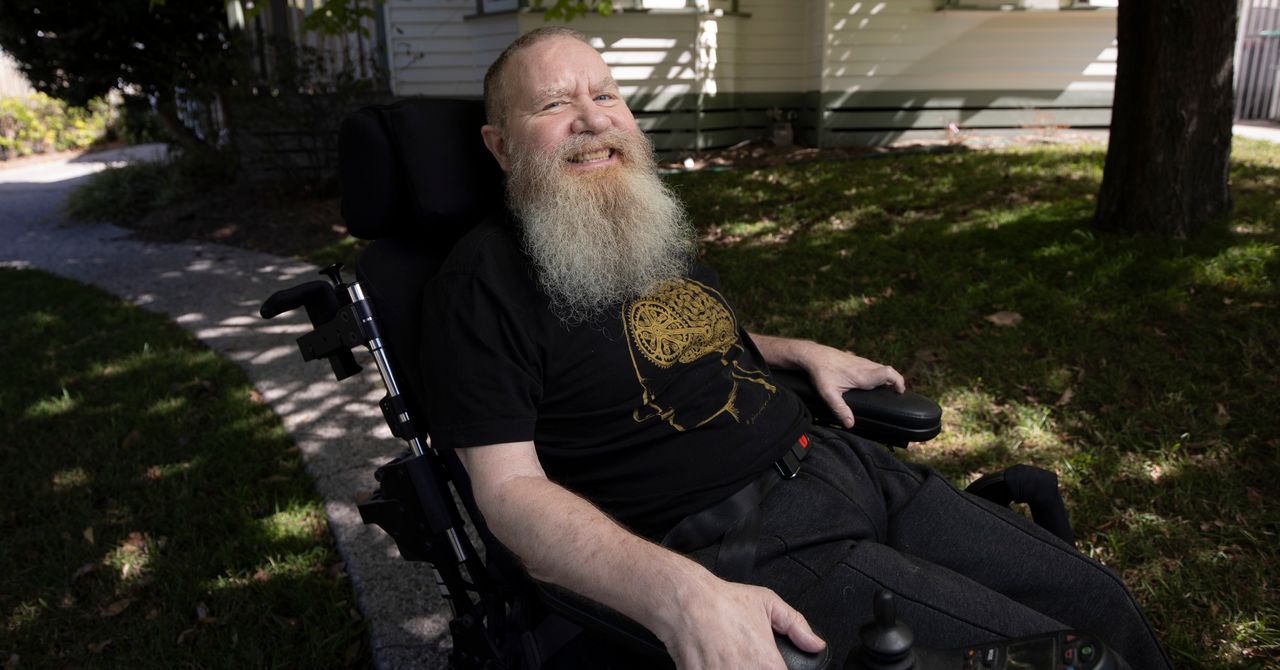
Initially, Gorham used his brain-computer interface for single clicks, Oxley says. Then he moved on to multi-clicks and eventually sliding control, which is akin to turning up a volume knob. Now he can move a computer cursor, an example of 2D control—horizontal and vertical movements within a two-dimensional plane.
Over the years, Gorham has gotten to try out different devices using his implant. Zafar Faraz, a field clinical engineer for Synchron, says Gorham directly contributed to the development of Switch Control, a new accessibility feature Apple announced last year that allows brain-computer interface users the ability to control iPhones, iPads, and the Vision Pro with their thoughts.
In a video demonstration shown at an Nvidia conference last year in San Jose, California, Gorham demonstrates using his implant to play music from a smart speaker, turn on a fan, adjust his lights, activate an automatic pet feeder, and run a robotic vacuum in his home in Melbourne, Australia.
“Rodney has been pushing the boundaries of what is possible,” Faraz says.
As a field clinical engineer, Faraz visits Gorham in his home twice a week to lead sessions on his brain-computer interface. It’s Faraz’s job to monitor the performance of the device, troubleshoot problems, and also learn the range of things that Gorham can and can’t do with it. Synchron relies on this data to improve the reliability and user-friendliness of its system.
In the years he’s been working with Gorham, the two have done a lot of experimenting to see what’s possible with the implant. Once, Faraz says, he had Gorham using two iPads side by side, switching between playing a game on one and listening to music on the other. Another time, Gorham played a computer game in which he had to grab blocks on a shelf. The game was tied to an actual robotic arm at the University of Melbourne, about six miles from Gorham’s home, that remotely moved real blocks in a lab.
Gorham, who was an IBM software salesman before he was diagnosed with ALS in 2016, has relished being such a key part of the development of the technology, his wife Caroline says.
“It fits Rodney’s set of life skills,” she says. “He spent 30 years in IT, talking to customers, finding out what they needed from their software, and then going back to the techos to actually develop what the customer needed. Now it’s sort of flipped around the other way.” After a session with Faraz, Gorham will often be smiling ear to ear.
Through field visits, the Synchron team realized it needed to change the setup of its system. Currently, a wire cable with a paddle on one end needs to sit on top of the user’s chest. The paddle collects the brain signals that are beamed through the chest and transmits them via the wire to an external unit that translates those signals into commands. In its second generation system, Synchron is removing that wire.
“If you have a wearable component where there’s a delicate communication layer, we learned that that’s a problem,” Oxley says. “With a paralyzed population, you have to depend on someone to come and modify the wearable components and make sure the link is working. That was a huge learning piece for us.”

A judicial review against the Home Office’s electronic visa (eVisa) system will argue that the department’s refusal to issue alternative proof of immigration status in the face of persistent data quality and integrity issues is unlawful.
On 31 December 2024, the immigration documents of millions of people living in the UK expired after being replaced by the Home Office with a real-time, online-only immigration status.
While the department has been issuing eVisas for several years – including to European Union (EU) citizens who applied to the European Union Settlement Scheme (EUSS) after Brexit, those applying for Skilled Worker visas, and people from Hong Kong applying for the British National (Overseas) visa – paper documents have now been completely phased out.
Instead, people are now expected to use a UK Visas and Immigration (UKVI) digital account to generate “share codes”, which they must use to prove their immigration status when dealing with a range of third parties, including employers, letting agencies and landlords.
Despite persistent data quality and integrity issues plaguing the system since its inception, current Home Office policy means the eVisa system is the only way people can prove their lawful residence in the UK and evidence their associated rights and entitlements.
Two unnamed individuals affected by the system – a recognised refugee and survivor of trafficking, and a vulnerable adult – were previously granted permission to proceed with a judicial review against the Home Office in October 2025, with the Cardiff Administrative Court noting it is in the public interest for the legality of the Home Office’s policy to be determined.
Legal arguments
Beginning on 3 March 2026, lawyers from Deighton Pierce Glynn (DPG) argued across a two-day hearing in the High Court that the Home Office’s digital, online-only approach to visas is an “unlawful fettering of discretion” and the overall policy of not providing alternative proof of status is “irrational”.
Highlighting how the claimants were either unable to access an eVisa at all or their account displayed inaccurate information that meant it could not be relied on, the lawyers detailed that their situations lasted for nine and six months, respectively, “during which time, the [Home Office] … refused to provide them with any alternative means of proving their legal status”.
They detailed how one claimant was unable to claim the benefits they and their child were entitled to, as when they gave the share code to the Department for Work and Pensions (DWP), an error meant they were wrongly denied benefits.
This led the individual to mistakenly believe that their eVisa was correct and that they were not entitled to the benefits.
During this time, they were also living in “inadequate asylum support accommodation”, and at one point were notified by the Home Office that they would no longer be able to stay in the accommodation.
While this was eventually resolved, the Home Office did not explain the reason for the error or how long it would take to resolve, and did not provide any response to the request for urgent alternative proof.
The second individual – a recognised refugee and survivor of trafficking – experienced distress after their UKVI account showed the name used by their traffickers on their false passport.
While they approached the Home Office to correct this, it took nine months to resolve the issue, during which time the individual was also unable to prove their status to the DWP.
Lawyers claimed the distress caused to these and other individuals is the result of the Home Office’s “blanket” policy of only issuing visas digitally, noting that while the home secretary “undoubtedly” has the discretion to issue alternative forms of proof, officials have been “fettered” by their own policy decisions.
The lawyers further argued that if the court does not agree that there has been an unlawful fettering of discretion, then it must still see the blanket policy as irrational.
“Having adopted a policy that eVisas are the only operative proof of immigration status, the defendant’s failure to provide alternative proof of immigration status in circumstances where an individual’s UKVI account and/or eVisa is not functioning accurately or at all, is irrational,” they said.
“The claimants’ case is that where issues do arise and persist, as sometimes they do, then a rational policy would permit officials to consider providing an alternative means of proof where not doing so would cause real injustice and possible harm.
“It is not rational to have a policy which provides that however grave the harm and however long it may persist, caused by inability to prove status through the eVisa system, no consideration will be given to providing an alternative proof of status.”
Home Office stance
The Home Office, on the other hand, argued that it has put in place measures and support mechanisms to reduce the risk of issues associated with its eVisa system, and has implemented a 12-month stabilisation plan to improve the functioning of the system (although lawyers did not offer any details on this programme).
Home Office lawyers also argued that the home secretary’s policy has been “considered”, and that in the two particular cases in question, the home secretary has acted lawfully and rationally.
They added that while the Home Office accepts there have been glitches and delays for the claimants – which have negatively affected them and could therefore allow a judge to grant relief or order the home secretary to rectify the issues within a certain time frame – there is no basis for the entire eVisa policy to be found unlawful.
The lawyers said there were also a number of alternatives through which immigration status could be proved outside of the eVisa system, which include checking services for employers and landlords, as well as status verification services for visa holders.
They added the home secretary is also obliged to issue a formal notice in writing when status is granted, meaning that while the system is fully digital, applicants always receive a letter setting out their status.
Based on the existence of such alternatives, the lawyers said the home secretary has chosen not to exercise her discretion to issue physical proof, and outlined four further reasons for this.
These include claiming that the reintroduction of physical proof would lead to greater abuse of the immigration system due to outdated information on documents, there would be a substantial cost to taxpayers “at a time when public finances are constrained”, there might be practical difficulties associated with people appealing their status, and the reintroduction of physical proof would also require legislative changes via Parliament.
They also contended that if incorrect information is appearing on eVisas, then the same issues would persist with physical proof because the underlying data is the same. However, when the judge pointed out that eVisas have pulled out incorrect information from the underlying data, Home Office lawyers said they “accept” that, and this is one of many submissions.
Home Office lawyers concluded there was no way of implementing physical proof “without compromising the entire policy framework”, and that under the current circumstances, the secretary of state “would not be issuing physical proof to anyone”
It is the Home Office’s long-standing policy not comment on ongoing legal proceedings.
Serious, long-standing issues
People experiencing technical errors with the system have long reported being unable to travel, losing jobs and being denied housing due to faulty eVisa data.
It should be noted that even if people’s eVisa issues are resolved once, Computer Weekly has heard concerns that, because of how the system is set up to trawl dozens of disparate government databases in real time, every time a status is needed, the same people could once again find themselves without access to a working eVisa.
Not being able to reliably prove their immigration status in the face of a hostile and unresponsive bureaucracy has also taken a psychological toll on many of those affected, causing great anxiety.
Speaking on condition of anonymity, those affected variously told Computer Weekly that the entire experience had been “anxiety-inducing” and described how their lives had been thrust into “uncertainty” by the transition.
Each also described how the “inordinate amount of stress” associated with not being able to reliably prove their immigration status had been made worse by a lack of responsiveness and help from the Home Office, which they accused of essentially leaving them in the lurch.
In one case that was reported to the Information Commissioner’s Office (ICO), the technical errors with data held by the Home Office were so severe that the regulator found there had been a breach of UK data protection law.
In January 2025, Computer Weekly also reported that despite repeated warnings from civil society and migrant support groups, which started as early as October 2021, people were already having trouble proving their immigration status while travelling back to the country, just two weeks after the UK’s formal transition to the eVisa system.
While groups such as ORG and the3million have directly proposed alternatives to the Home Office, such as the use of QR codes or “stable token” systems, the department’s eVisa policy team insisted as far back as December 2023 that it would not “compromise on the real-time aspect” of the eVisa checks, as “any check of an individual’s immigration status must be done in real time to reflect the current immigration status held” on its systems.
“As we warned, people are having problems using eVisas to travel back to the UK,” said the ORG at the time. “We asked the Home Office to make the simple change of allowing people to have a QR code. This could be saved or printed without having to rely on a flawed online-only system.
“Many refugees are still waiting for their eVisas,” it said. “Without them, they cannot work, set up a bank account, rent somewhere to live or claim benefits. The Home Office needs to sort out this mess urgently.”
The Home Office states in the eVisa terms and conditions that it will take no liability for any problems or disruptions, and direct or indirect losses, when using a UKVI account – including for “any information that is lost or corrupted while data is being transmitted, processed or downloaded from the UKVI account” – which ORG said implies the department “is already aware of the many technical issues with the eVisa scheme and is pre-emptively protecting itself against legitimate legal claims”.
ORG and others have said the use of eVisas should be seen in the context of the UK’s “hostile environment” approach, which is intended to make life in the UK as difficult as possible for people choosing to live there.

Expect datacentre spending to increase tenfold. That was among the claims Nvidia CEO Jensen Huang made during the company’s latest quarterly earnings call. He forecast that capital expenditure (CapEx) on datacentres would increase from the $300-400bn mark today to $3-4tn by 2030.
Huang’s remarks at the end of February came a few days after Microsoft’s AI Tour London event, when CEO Satya Nadella effectively called for enterprise software developers to use the capabilities now built into Microsoft 365 to create agentic AI workflows for streamlining business processes.
Nadella discussed the need to have an efficient token factory, where phrases or tokens can be streamed into AI engines that interpret natural language for querying large language models (LLMs). The Microsoft vision of enterprise AI is built on the M365 foundation, which acts as a knowledge store on which a new category of knowledge-based software can be built.
During his keynote presentation, Nadella spoke about the intelligence that exists in the various IT systems used across the business. He said that businesses should be able to harness the intelligence that already exists enterprise-wide, starting with what he described as the “data underneath Microsoft 365”, which, according to Nadella, represents the people in the business, their relationship to coworkers, and work artefacts such as projects, calendars and communications data. “This is massive information,” he said, which can be used to bootstrap agentic AI projects.
“Our goal is to have all of the innovation and the systems available in the token factory,” said Nadella. “That way you can build software which has the ability to use all of the capability [we provide] to train models and deliver models for inference.”
In effect, he sees the Windows software developer ecosystem evolving to where it is now a Microsoft 365 ecosystem, where enterprise data is stored in AI-enabled office productivity tools such as Word, Excel, PowerPoint, Teams and Outlook, and these can be used as the foundation for a new generation of applications that can draw on these AI knowledge sources.
It is this idea that all software will need to be knowledge-aware, which Huang spoke about during the company’s earnings call. “Token generation is at the centre of almost everything that relates to software in the future and relates to computing,” he said. “If you look at the way we use computing in the past, however, the amount of computation demand for software in the past is a tiny fraction of what is necessary in the future.”
According to Huang, the amount of computation necessary to run AI is 1,000 times higher than the computing power needed to run non-AI software. “The computing demand is just a lot higher,” he said. “And so, if we continue to believe there’s value in it, then the world will invest to produce that token.”
When asked whether Nvidia is confident that its customers will continue to have the ability to spend more on AI infrastructure, which could impact Nvidia’s ability to grow, Huang spoke about the opportunity in enterprises to make use of agentic AI and its widespread usefulness across organisations.
“We have now seen the inflection of agentic AI, and the usefulness of agents across the world and enterprises everywhere,” he said. “You’re seeing incredible compute demand because of it. In this new world of AI, compute is revenues. Without compute, there’s no way to generate tokens. Without tokens, there’s no way to grow revenues.”
At least, that is how he positioned AI for the investment bank analysts on the earnings call. The company posted fourth quarter revenue of $68bn, up 73% year-over-year. Datacentre revenue increased by 75% to $62bn, which Nvidia said was being driven by demand for its Blackwell architecture and AI inference deployments. It also reported networking revenue of $1bn, up 3.5x year-over-year, fuelled by adoption of NVLink, Spectrum X and other Nvidia ethernet technologies.
Last year, during his keynote presentation at the GTC conference in the US, Huang claimed that the lowest cost per token was being achieved using the most expensive GPU – which at the time was the Grace Blackwell NVLink 72.
Nvidia describes the GB200 Grace Blackwell as a “superchip”, which connects two high-performance Nvidia Blackwell Tensor Core GPUs and the Nvidia Grace CPU with the NVLink-Chip-to-Chip (C2C) interface, capable of delivering 900 GBytes/s of bidirectional bandwidth.
Significantly, the architecture means that applications have coherent access to a unified memory space. According to Nvidia, this simplifies programming and supports the larger memory needs of trillion-parameter LLMs, transformer models for multimodal tasks, models for large-scale simulations, and generative models for 3D data.
‘Huang’s Law’
Some industry observers have coined the term “Huang’s Law” to describe his perspective of how each new generation of GPU delivers a 10x increase in performance, compared with Moore’s Law’s doubling of performance every 18 months.
Nadella and Huang both spoke about how newer hardware is more energy-efficient at running AI workloads. During the Microsoft AI tour, Nadella noted that today’s system supports an entirely different memory hierarchy, which he said means “there’s now no latency with AI inference”.
The messaging from both the Microsoft and Nvidia chiefs is that the best efficiency is achieved by taking advantage of the capabilities available in these new systems. “There’s an unbelievable renaissance happening with these systems and workloads, whether they’re training workloads or inference workloads, they are unlike anything we’ve seen in the past,” said Nadella.
The tech sector is dead set on getting enterprises to adopt more and more AI. It is being built into knowledge-aware enterprise software likely to draw on the capabilities available in the newest generation of AI acceleration hardware.
Clearly, the business models of Microsoft and Nvidia are tied to increased demand for AI. But it is also apparent that the cost of deploying advanced AI systems is not going to get any cheaper. If anything, capital expenditure on datacentres will continue to increase at a phenomenal rate, fuelled by demand for these new AI systems and the AI acceleration hardware they need.

Reeves to stress commitment to end windfall tax in talks with North Sea bosses

Miami (Ohio) improves to 30-0 as Cinderella run gets more magical

From ‘Freaky Friday’ to ‘Cruella’: Andrew Gunn’s blockbuster legacy

India Us Trade Deal: Fresh look at India-US trade deal? May be ‘rebalanced’ if circumstances change, says Piyush Goyal – The Times of India

Households set for lower energy bills amid price cap shake-up

What are Iran’s ballistic missile capabilities?

-
Business5 days ago
India Us Trade Deal: Fresh look at India-US trade deal? May be ‘rebalanced’ if circumstances change, says Piyush Goyal – The Times of India
-
Business1 week ago
Households set for lower energy bills amid price cap shake-up
-
 Politics6 days ago
What are Iran’s ballistic missile capabilities?
-

 Politics6 days ago
US arrests ex-Air Force pilot for ‘training’ Chinese military
-

 Fashion6 days ago
Policy easing drives Argentina’s garment import surge in 2025
-

 Sports1 week ago
Top 50 USMNT players of 2026, ranked by club form: USMNT Player Performance Index returns
-
 Business6 days ago
Attock Cement’s acquisition approved | The Express Tribune
-
 Business1 week ago
Lucid widely misses earnings expectations, forecasts continued EV growth in 2026