

Business
Income Tax Act 2025 Gets President’s Assent: Centre Notifies New Rules To Replace 1961 Law


Last Updated:
The new Act removes redundant provisions and archaic language and cuts the number of Sections from 819 in the Income Tax Act, 1961, to 536 and the number of chapters from 47 to 23.


Income Tax Act, 2025.
The central government on Friday notified the Income Tax Act, 2025, in the Official Gazette. It comes a day after the President gave assent to the Act on Thursday. The Act, which will come into effect from April 1, 2026, consolidates and amends the existing Income Tax Act, 1961.
“The Income-tax Act, 2025 has received the Hon’ble President’s assent on 21st Aug 2025. A landmark reform replacing the 1961 Act, it ushers in a simpler, transparent & compliance-friendly direct tax regime. Access the official document here: https://egazette.gov.in/(S(p0hzyo3qrxli3juyloktgdrv))/ViewPDF.aspx,” Income Tax India said in a post on X on August 22.
The Act was passed by Parliament in the just-concluded monsoon session.
The Income-tax Act, 2025 has received the Hon’ble President’s assent on 21st Aug 2025.A landmark reform replacing the 1961 Act, it ushers in a simpler, transparent & compliance-friendly direct tax regime.
Access the official document here: https://t.co/wOPk1PFQbP pic.twitter.com/Xw84hzpPb3
— Income Tax India (@IncomeTaxIndia) August 22, 2025
The new Act removes redundant provisions and archaic language and reduces the number of Sections from 819 in the Income Tax Act of 1961 to 536 and the number of chapters from 47 to 23. The number of words had been reduced from 5.12 lakh to 2.6 lakh in the new Income Tax Bill, and for the first time, it introduces 39 new tables and 40 new formulas, replacing the dense text of the 1961 law to enhance clarity.
As the new law will come into force from April 1, 2026, the computer systems of the Income Tax department are required to be rebooted to operationalise the new legislation.
The new Income Tax Bill was drafted within a record time of six months and introduced in the Budget session in February 2025. It was referred to the Select Committee for a comprehensive study of the Bill. Subsequently, in order to incorporate the suggestions made by the Committee, the Bill (No.1) was withdrawn and a fresh Bill (No.2) was introduced in the monsoon session of Parliament.
While presenting the revised Bill in Lok Sabha on August 11, Finance Minister Nirmala Sitharaman said the government had accepted “almost all of the recommendations of the Select Committee”, along with suggestions from stakeholders to ensure the law’s intent is “conveyed more accurately”.
“There are corrections in the nature of drafting, alignment of phrases, consequential changes and cross-referencing. Therefore, a decision has been taken by the government to withdraw the Income Tax Bill, 2025, as reported by the Select Committee. Consequently, Income-tax (No. 2) Bill, 2025, has been prepared to replace the Income-tax Act, 1961,” according to the statement of objects and reasons.
Key Changes Proposed By The Committee
Tax refunds
Removal of the provision that denied income-tax refunds if returns were filed after the due date.
The withdrawn version required taxpayers to file ITRs within the due date to claim a refund (Section 433). The revised Bill ensures refunds can still be claimed even if the ITR is filed late.
Inter-corporate dividends
Restoration of Section 80M deduction (Clause 148) for inter-corporate dividends for companies availing the special tax rate under Section 115BAA.
This provision had been missed in the earlier draft.
Nil TDS certificate
Taxpayers will be allowed to avail of Nil TDS certificates, enabling no tax deduction at source under certain conditions.
Exemption on anonymous donations
Anonymous donations to purely religious trusts will be exempt from tax. The exemption will not apply to trusts that are both religious and engaged in social services such as running hospitals or schools.
Digital-first tax process
The new Bill aims to make the tax process more digital, automated, and faceless, to enhance convenience and minimise the scope for corruption.
Clarification on capital gains tax rumours
Reports last month suggested that the new Bill might change capital gains tax rates. The Income Tax Department denied this in a post on X, stating that the Bill’s objective is language simplification and removal of redundant or obsolete provisions, not altering tax rates.

Haris is Deputy News Editor (Business) at news18.com. He writes on various issues related to personal finance, markets, economy and companies. Having over a decade of experience in financial journalism, Haris h…Read More
Haris is Deputy News Editor (Business) at news18.com. He writes on various issues related to personal finance, markets, economy and companies. Having over a decade of experience in financial journalism, Haris h… Read More
Read More


The federal government announced a Rs26.77 per litre hike in the price of petrol and high-speed diesel each on Friday, according to a notification issued by the Petroleum Division.
The new prices will be effective from April 25, 2026 for a week, the notification stated.
Following the increase, the price of HSD has jumped from Rs353.42 to Rs380.19, while the petrol price now stands at Rs393.35.
The government has been reviewing petroleum prices every Friday night following the now-paused US-Israel war on Iran, which began on February 28.
In the previous weekly review, the prime minister announced a reduction of Rs32.12 per litre in the price of high-speed diesel, while the petrol price remained unchanged.
The government jacked up petrol and diesel prices despite oil prices falling globally on Friday after it appeared a second round of Middle East talks was back on, bolstering prospects for an end to a war that has crippled energy shipments from the Gulf.
Oil prices had been climbing earlier as investors worried about a lack of progress in ending the Middle East crisis, with Tehran keeping the Strait of Hormuz closed and the US maintaining a blockade of Iranian ports.
But they dropped on reports that Iran’s Foreign Minister Abbas Araghchi was to arrive in Islamabad on Friday night.
Brent crude, the international benchmark contract, fell back below $100 a barrel.
facebook twitter
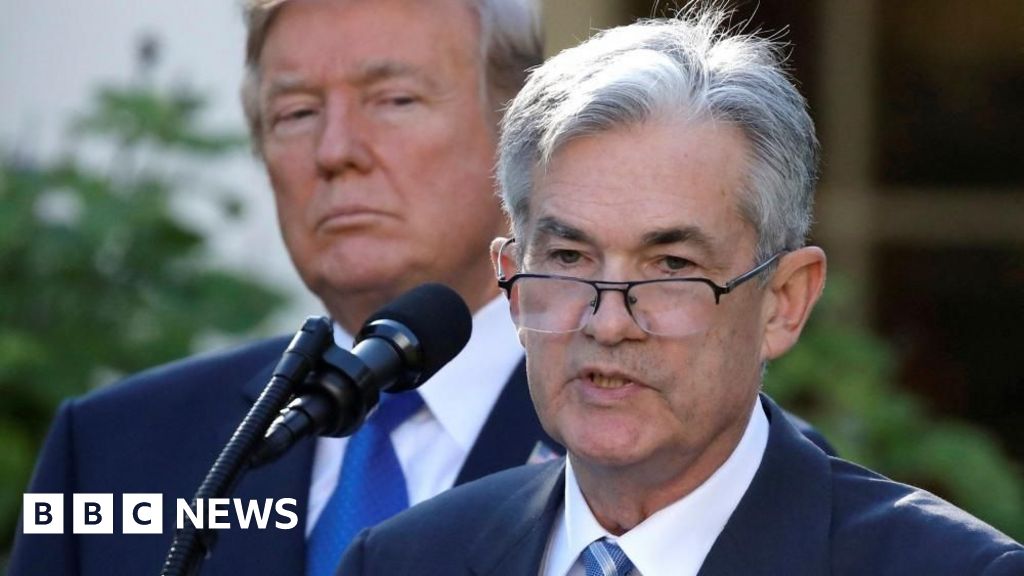
Powell’s term is nearing its end and the US Senate is considering Trump’s nominee for his replacement, Kevin Warsh. A key Republican, Thom Tillis, has withheld his support for Warsh unless the Trump administration would drop its investigation into Powell.
Business
Intel bags big gains! Chipmaker’s shares jump 26% on blockbuster results; how Trump admin benefits – The Times of India
Intel share price soared sharply on Friday after the chipmaker delivered a first-quarter performance that exceeded market expectations. And the win was not just for the chipmaker, but also the whole of US!The stock climbed 26.7% during trading on Friday, marking what could be its strongest single-day gain since 1987. Momentum continued after the closing bell, with shares rising a further 20% in after-hours trading as investors reacted to signs of a sustained turnaround driven by artificial intelligence.Intel reported revenue of $13.58 billion (€11.6bn) for the quarter, ahead of the $12.3 billion (€10.5 bn) forecast and up 7.2% from a year earlier. Adjusted earnings per share came in at $0.29, far exceeding expectations of $0.01.A key contributor to this performance was the company’s Data Centre and AI (DCAI) division, which delivered revenue of $5.05 billion (€4.2bn), up 22.4% year-on-year and well above analyst estimates of $4.41 billion (€3.77bn). The results indicate strong demand for Intel’s Xeon 6 processors and Gaudi 3 AI accelerators, particularly among enterprise clients and cloud service providers.Chief executive Lip-Bu Tan pointed to a broader shift in artificial intelligence usage as a major factor behind the growth. He said, “the next wave of AI will bring intelligence closer to the end user, moving from foundational models to inference to agentic.” He added, “This shift is significantly increasing the need for Intel’s CPUs and wafer and advanced packaging offerings.”The company also issued an upbeat outlook for the second quarter, forecasting revenue in the range of $13.8 billion (€11.8billion) to $14.8 billion (€12.6billion), surpassing investor expectations of $13 billion (€11.1billion).
But how is Washington winning?
The rally has had a direct impact on the US administration’s investment in Intel. In 2025, during a period of severe financial strain for the company, the administration of Donald Trump acquired a 9.9% stake in a move aimed at stabilising the business. The government invested $8.9 billion (€7.8bn) at a share price of $20.47 (€18.01), with $5.7 billion (€5bn) of that amount coming from previously approved but unpaid grants, according to the Euro News.At the time, Intel was facing multi-billion dollar losses and operational challenges, prompting concerns over its viability. As part of the intervention, the company cancelled planned factory projects in Germany and Poland, redirected focus towards US-based manufacturing, and reduced its global workforce by 25%, cutting around 25,000 jobs.Following the latest jump, Intel’s shares are now trading at $81.3 (€71.5), representing an increase of nearly 300% since the government first took its stake. The sharp rise highlights how the company’s improved financial performance has translated into substantial gains for the US administration.


NASCAR makes major change in front office, including new CEO in unprecedented move: report

Extended interview: Don Cheadle – CBS News

Charlie Sheen updates on relationship with old pal Jon Cryer

-

 Fashion1 week ago
France’s LVMH Q1 revenue falls 6%, shows resilience amid Iran war
-

 Tech1 week ago
CYBERUK ’26: UK lagging on legal protections for cyber pros | Computer Weekly
-

 Sports5 days ago
WWE WrestleMania 42 Night 2: Live match results and analysis
-

 Sports1 week ago
Faheem Ashraf backs Islamabad United’s push, calls league a ‘career-changing platform’
-

 Sports5 days ago
NCAA men’s gymnastics championship: All-time winners list
-
 Business1 week ago
PepsiCo earnings beat estimates as North American food business improves
-

 Tech1 week ago
Anthropic Plots Major London Expansion
-

 Entertainment4 days ago
Lee Anderson, Zarah Sultana kicked out of UK Parliament for calling PM ‘liar’