

Tech
Inside the trend of tech ‘spinouts’ solving real-world problems | Computer Weekly


Silicon Valley has created the impression of the archetypal technology company as founded by smart, young guns in a garage who tinker around to find a product that can make them, and their investors, a fortune. When things fail to work out, it is often down to the fact their creation failed to address a real-world problem.
The opposite of such a scenario is when a business finds itself with a problem and, failing to identify an offering in the marketplace, develops one itself. The retail and hospitality industries have been hotbeds for such activity in recent years, no doubt driven by the exponential increase in technology use since the advent of the pandemic.
The best products have then been “spun out” of the original operator businesses to then sell their capabilities to others in the sector who are encountering the same issues. Joel Robinson, founder of Openr, says that before it was a tech company, the firm started as a solution to a problem faced by the Azzurri Group, a leading hospitality operator with Zizzi, Ask Italian and Coco di Mama among its brands.
Having joined Azzurri Group in 2019 from the retail sector, working latterly at Sainsbury’s, Robinson encountered a growing digital landscape in hospitality involving a fragmented mess of scattered data, manual processes and inflexible systems.
“We were experiencing the pain,” he says. “In 2017/18, [hospitality] was a simple business involving configuring tills in restaurants and ‘off you go’. But post-pandemic, it was about order at the table, click and collect, website ordering and catering platforms. Managing identical data across these platforms was proving inefficient.”
Having failed to find a market offering that could truly solve its unique needs of handling this data, Robinson decided to build one. “If we felt we needed something then we’d build it ourselves,” he says. “We also spoke to peers to see if it was a sector-wide problem. Pubs, quick service restaurants and cafés all had the same [data-related] problem, so we knew there was external consumption for the solution.”
Openr was built as a business to ultimately spin out, and obviously had the benefit of being prototyped within the Azzurri Group. This gave the product credibility and authenticity in the sector. “We could speak with empathy to others,” says Robinson. “There are huge upsides to being a genuine solution for operators … and it opens doors.”
Development team
Although Robinson had built up some decent tech chops, and his team had built its own click and collect – as well as pay-at-table – services, the Openr data platform required bringing in a development team with the capabilities to scale and bring to market. The company has since gone on to supply its offering to the likes of Stonegate, Caffé Nero and Burger King.
It has been a similar story for Andrew Xeni, co-founder of Nobody’s Child and Fabacus, who gained experience in the retail and manufacturing sectors from working at his family’s business, Europride Ltd, producing and supplying value womenswear to big high street retailers. During this time, he discovered the opportunities to create both the fashion brand Nobody’s Child and tech business Fabacus.
He describes the latter as a trusted system of record for the products of large brands and retailers. It comprises all the product data to meet companies’ ESG reporting needs, and provides the infrastructure for implementing digital product passports.
“I did a lot of the ground work early on, speaking with most of our then retail customers – including New Look and Asos – to build a product lifecycle management [platform] for the family business, but the data aggregation platform – Fabacus – was always intended for go-to-market [spin-out], as I realised it was solving a common problem,” says Xeni.
Having scanned the landscape, he discovered that no-one was addressing the fundamental challenge of siloed and fragmented data across products. With his fashion experience, he says: “The main ingredient I brought to the table was the business logic and understanding of the problem and the solution needed. Anyone can build technology, but it’s like letting an architect build and decorate your home, expecting it to meet your needs.”
Xeni says Fabacus was initially a passion project that he self-funded, but as he discovered the common challenges across the clothing sector, he needed to source external capital and sell the product to third parties.
“It’s tough, so make sure you’re addressing a real problem,” he says. “We developed a solution architectured by a team of experienced execs that understood the problem intimately, and knew how to articulate the solution and plan an implementation succinctly. Nothing we have built to date is a challenge I haven’t operationally faced in to personally.”
Fabacus is currently working with a myriad of brands and retailers, including Nobody’s Child, Paramount, NBC Universal, Hasbro, Fanatics and Tesco. Across brand licensing, Xeni says the business has reached a critical mass of customers, while in the retail sector, there is “very exciting early engagement”.
Like Xeni and Robinson, there was recognition by JP Then, founder of Crosstown Doughnuts and Slerp, that fundamental change was happening to his business through structural change in the wider sector. As a very early user of Deliveroo and UberEats, he found a need for an e-commerce platform to host the growing volumes of online orders for his doughnuts.
“I had 10 locations with click and collect and on-demand delivery, but they all had different attributes (such as opening times),” he says. “I did not want to build a platform – I wanted to find something, but there was nothing out there. Slerp was born out of my need to solve a problem.”
Separate business
During conversations with other operators in the sector, Then found they were also experiencing online sales growth, so there was recognition of the opportunity to ultimately sell his offering to others in the industry. He incorporated the business in 2016 because he understood being separate was important: “A bakery running a tech company did not make sense!
“By 2020, there was enough proof from Crosstown that it could be important enough for other companies [to use],” he says. “By then there was also more sophistication in last mile logistics so Slerp could work with various delivery providers.”
The product gives hospitality companies greater control over their margins for delivery orders and ensures they have a direct relationship with the customer. This enables them to avoid having to rely wholly on the delivery marketplaces – Deliveroo, Just Eat and Uber Eats.
As the delivery marketplace model has developed, the Slerp platform has ultimately been able to plug into the network of delivery riders at these companies while still owning the customer relationships and the associated data.
Being an operator has been massively important for the development of Slerp, according to Then, who says: “Having operator domain knowledge has been pivotal to building out an operator-first view. Slerp solved a genuine operator problem.”
He believes this is in contrast to the technology firms that find there is not a market for their products and make radical changes to their propositions – hence the frequent use of the term “pivot” in the tech world.
Although Then left Crosstown in 2020, amid the tough times of Covid-19, he continues to run Slerp, which has gone on to work with many hospitality companies, including Nell’s, Zia Lucia, Dom’s Subs, Sourdough Sophia, Chicken Cottage and Chopstix.
Enterprise resource planing
Ed Brown, co-founder of Double Puc and Percy Labs, is also aware of the tough nature of the hospitality industry. He co-founded healthy food chain Friska, which reached eight sites before it hit difficulties in 2021 and changed hands. During his time at Friska, he had created a dedicated enterprise resource planing system for hospitality – to handle the likes of purchasing, supply chain and ingredients – that was not tied into a point-of-sale system.
This became RocketOS, and was an early product in the field as a software as-a-service offering for the hospitality industry. Brown now acknowledges it would have been a better business decision at the time to have focused on this technology and spun it out to sell to other operators rather than put more money into Friska.
Armed with this experience, he now operates Double Puc Café & Catering – with four units in the Bristol area – along with the fledgling Percy Labs, an artificial intelligence-powered purchasing platform that consolidates baskets of product orders across wholesalers to save on the purchase cost, built with a view to spinning it out and selling it to other hospitality businesses.
Although there are third-party group purchasing organisations acting as middlemen, Brown believes they do not benefit the hospitality companies nor the wholesalers. The advent of ChatGPT and its ability to accurately match food product data has enabled the creation of Percy Labs to provide a more efficient service that he says could save businesses 10% on their ingredients costs.
“We know it is a challenge to build a product, but we’ve done similar with RocketOS and Friska,” he says. “We know that these solutions will be easy for operators to use. Every feature we build, we can see it’s useful.”
Building it from within Double Puc means the product can be prototyped very quickly. “We know how it needs to work. It’s all customer-centric. Everything has been tested in a real environment,” says Brown, adding that building the service in-house also helps with conversations with wholesalers and operators. “Coming from us builds trust and confidence,” he adds.
As technology becomes an ever more important part of the operations of retail and hospitality businesses – and they have increasingly tech-literate workforces – the appetite for implementing real problem-solving products is likely to grow, thereby providing a fertile ground for in-house developments and potential spinouts.

Starting today, eager customers of the US pizza restaurant chain Papa Johns living in one corner of southern North Carolina will have the opportunity to receive their food from the sky, thanks to a new collaboration with Alphabet’s drone company, Wing. But Papa Johns’ signature pizzas won’t be on offer. Instead, drone-loving North Carolinians will have to choose between three kinds of sandwiches, a newer product for the fast-food chain: Philly cheesesteak, chicken bacon ranch, or steak and mushroom varieties.
Drone deliveries are popping up in more communities across the US and the world. Questions about the long-term economics and regulatory picture around unmanned aerial vehicles persist, but Wing boasts partnerships with Walmart, Panera, and DoorDash and is delivering through the sky to customers in four metro areas: Atlanta, Charlotte, Dallas-Fort Worth, and Houston. (In 2019, Wing received the US Federal Aviation Administration’s first certificate allowing a drone delivery company to operate in the country.) Competing drone companies, including Zipline, Amazon Prime Air, and Flytrex, fly packages, medical supplies, and Chipotle burritos in select communities across countries like Ghana, Japan, and the US.
But until very recently, drone operators have struggled to fly full-size pizzas. For companies hoping to break into the food delivery space, this is unfortunate: 11 percent of the US population eats a slice on any given day, according to the US Department of Agriculture. In a fast-diversifying restaurant industry, getting them to customers is still big business. But the realities of physics, engineering, and the restaurant business conspire to make pizzas a challenge for drones.
Flying Pizzas
Traditionally, pizza is the experimental tech delivery of choice. The familiar and cheap cheese-sauce-bread combo has been loaded onto self-driving cars and autonomous sidewalk delivery vehicles and has been assembled by robots. It’s a fast and satisfying option, especially for busy families tight on time. And theoretically, a great fit for automated drones, among one of the faster delivery options—people love fresh, piping-hot pizza.
But transporting one by drone requires some extra work, says Wing CEO Adam Woodworth. “Pizza comes in a very different box, with a big, flat surface area,” he says. They’re not naturally aerodynamic. Also, “you don’t want a pizza tilted.”
Wing’s relatively lightweight drones are engineered to carry three specific package sizes; right now, pizza boxes aren’t one of them. Woodworth says a new design is on the horizon. “I want to see pizzas coming at me from the sky,” he says.
Flytrex, an Israel-based drone delivery company, announced late last month that it had finally solved the problem. In collaboration with rival pizza chain Little Caesars, the company began delivering via drone up to two large pizzas (16 inches each), plus sodas and bread, in Wylie, Texas, a suburb of Dallas. The leap comes courtesy of a much bigger new drone, capable of carrying up to 8.8 pounds for four miles.
Courtesy of Flytrex
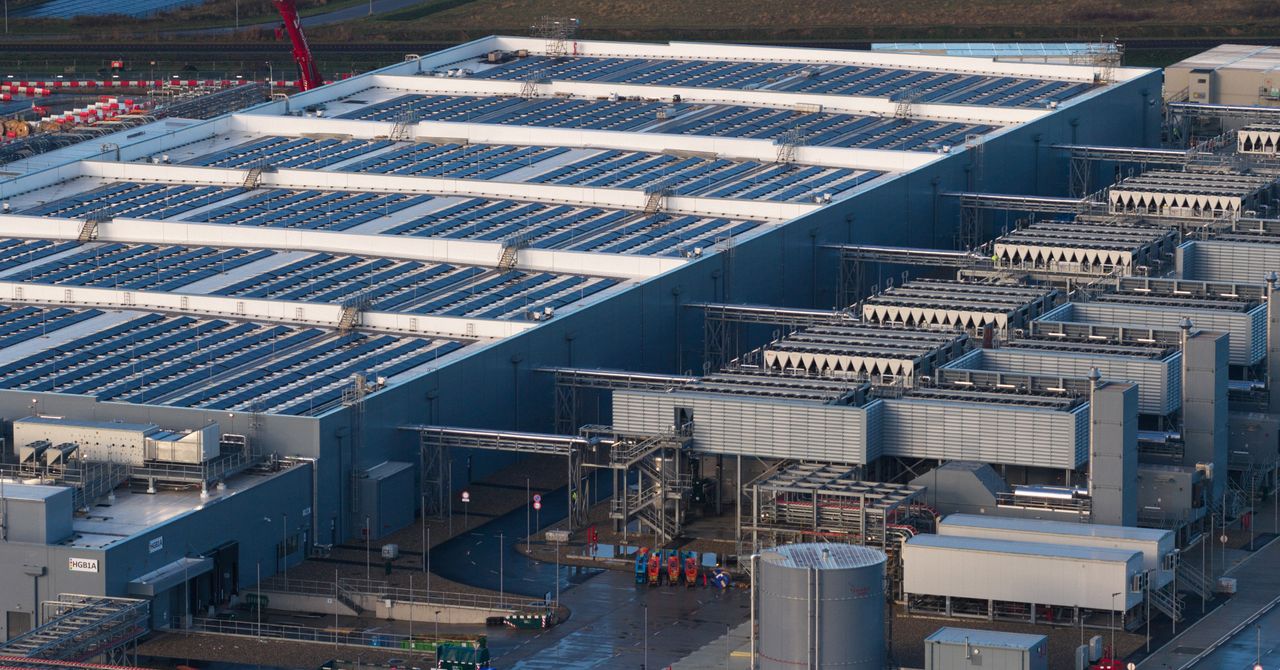
A major oil company is seeking a state tax break in Texas worth hundreds of millions of dollars to build a massive power plant. The energy won’t be going to residential customers, though. Instead, the gas plant will be used to power a data center whose eventual tenant could be Microsoft.
Chevron subsidiary Energy Forge One has filed an application with the State Comptroller’s board to obtain a tax abatement for a power plant it’s building in West Texas. In late January, the comptroller’s office made a recommendation to support the application’s approval—the first such approval under the program for a power plant intended solely for data center use.
In March, following news reports that Microsoft was looking into purchasing power from the Energy Forge project, Chevron said that it had entered into an “exclusivity agreement” with Microsoft and Engine 1, an investment fund involved in the project. In January, Microsoft pledged to be a “good neighbor” in communities where it is building data centers, including promising to pay a “full and fair share of local property taxes.”
The potential tax abatement for the project comes as big tech companies are battling rising public fury about data centers and electricity costs. It also comes as lawmakers start to cast a more critical eye on ballooning incentives for data centers, some of which have cost some states—including Texas—$1 billion or more each year.
Chevron spokesperson Paula Beasley told WIRED in an email that all tax incentives under consideration for the Energy Forge project “apply solely to the power generation facility” to “support new energy infrastructure, and do not extend to any future data center facilities that may be served.” Beasley also said that there is currently “no definitive agreement” with Microsoft for this power plant.
“Microsoft is in discussions with Chevron,” Rima Alaily, Microsoft’s corporate vice president and general counsel for infrastructure, said in a statement to WIRED. “No commercial terms have been finalized, and there is no definitive agreement at this time.”
Chevron is applying for a tax abatement for the project under Texas’ Jobs, Energy, Technology, and Innovation (JETI) Act. Passed in 2023, the program is intended to incentivize businesses to build large infrastructure projects in the state in exchange for guarantees to bring jobs and revenue. Accepted projects get a cap set on the amount of taxable property they can be charged through local school district taxes.
The Pecos-Barstow-Toyah school board approved the project’s application at a meeting in February. The state pays for the tax abatement, so the school district itself does not lose out on any money.
According to documents from the state, the Chevron project could net more than $227 million in savings for the company over a 10-year period, depending on the eventual size of the project and investment. The application says the plant will provide “over 25 permanent, full-time jobs,” though there’s no requirement to do so because it’s considered an electricity generation facility.
The planned gas plant won’t connect to the grid, instead providing “electricity for direct consumption by a data center,” according to its application. So-called behind-the-meter gas plants have become increasingly popular for data center developers facing yearslong waits to connect to the grid. According to data from nonprofit Global Energy Monitor, the US at the start of the year had nearly 100 gigawatts of gas-fired power in the development pipeline solely to power data centers, with several more massive gas projects announced since the data was published.
A WIRED analysis of less than a dozen power plants being constructed to explicitly serve data centers, including the Chevron project, found that these power plants are permitted to emit more greenhouse gases than many small- to medium-size countries. The Energy Forge plant alone could emit more than 11.5 million tons of CO2 equivalent annually—more than the country of Jamaica emitted in 2024. Beasley told WIRED that the plant “is being designed to comply with applicable environmental regulations, including all applicable federal and state air quality standards.”

Forgive me for starting with a cliché, a piece of finance jargon that has recently slipped into the tech lexicon, but I’m afraid I must talk about “moats.” Popularized decades ago by Warren Buffett to refer to a company’s competitive advantage, the word found its way into Silicon Valley pitch decks when a memo purportedly leaked from Google, titled “We Have No Moat, and Neither Does OpenAI,” fretted that open-source AI would pillage Big Tech’s castle.
A few years on, the castle walls remain safe. Apart from a brief bout of panic when DeepSeek first appeared, open-source AI models have not vastly outperformed proprietary models. Still, none of the frontier labs—OpenAI, Anthropic, Google—has a moat to speak of.
The company that does have a moat is Nvidia. CEO Jensen Huang has called it his most precious “treasure.” It is not, as you might assume for a chip company, a piece of hardware. It’s something called CUDA. What sounds like a chemical compound banned by the FDA may be the one true moat in AI.
CUDA technically stands for Compute Unified Device Architecture, but much like laser or scuba, no one bothers to expand the acronym; we just say “KOO-duh.” So what is this all-important treasure good for? If forced to give a one-word answer: parallelization.
Here’s a simple example. Let’s say we task a machine with filling out a 9×9 multiplication table. Using a computer with a single core, all 81 operations are executed dutifully one by one. But a GPU with nine cores can assign tasks so that each core takes a different column—one from 1×1 to 1×9, another from 2×1 to 2×9, and so on—for a ninefold speed gain. Modern GPUs can be even cleverer. For example, if programmed to recognize commutativity—7×9 = 9×7—they can avoid duplicate work, reducing 81 operations to 45, nearly halving the workload. When a single training run costs a hundred million dollars, every optimization counts.
Nvidia’s GPUs were originally built to render graphics for video games. In the early 2000s, a Stanford PhD student named Ian Buck, who first got into GPUs as a gamer, realized their architecture could be repurposed for general high-performance computing. He created a programming language called Brook, was hired by Nvidia, and, with John Nickolls, led the development of CUDA. If AI ushers in the age of a permanent white-collar underclass and autonomous weapons, just know that it would all be because someone somewhere playing Doom thought a demon’s scrotum should jiggle at 60 frames per second.
CUDA is not a programming language in itself but a “platform.” I use that weasel word because, not unlike how The New York Times is a newspaper that’s also a gaming company, CUDA has, over the years, become a nested bundle of software libraries for AI. Each function shaves nanoseconds off single mathematical operations—added up, they make GPUs, in industry parlance, go brrr.
A modern graphics card is not just a circuit board crammed with chips and memory and fans. It’s an elaborate confection of cache hierarchies and specialized units called “tensor cores” and “streaming multiprocessors.” In that sense, what chip companies sell is like a professional kitchen, and more cores are akin to more grilling stations. But even a kitchen with 30 grilling stations won’t run any faster without a capable head chef deftly assigning tasks—as CUDA does for GPU cores.
To extend the metaphor, hand-tuned CUDA libraries optimized for one matrix operation are the equivalent of kitchen tools designed for a single job and nothing more—a cherry pitter, a shrimp deveiner—which are indulgences for home cooks but not if you have 10,000 shrimp guts to yank out. Which brings us back to DeepSeek. Its engineers went below this already deep layer of abstraction to work directly in PTX, a kind of assembly language for Nvidia GPUs. Let’s say the task is peeling garlic. An unoptimized GPU would go: “Peel the skin with your fingernails.” CUDA can instruct: “Smash the clove with the flat of a knife.” PTX lets you dictate every sub-instruction: “Lift the blade 2.35 inches above the cutting board, make it parallel to the clove’s equator, and strike downward with your palm at a force of 36.2 newtons.”


UK–India CETA’s 12-point tariff cut reshapes apparel sourcing

Papa Johns Is Getting Into Drone Delivery—but Not for Pizza

S Korea to exempt tariffs on higher shipping costs for Hormuz reroutes

-

 Politics1 week ago
Iran weighs US reply delivered via Pakistan as Trump signals opposition to deal terms
-

 Fashion1 week ago
US cotton export sales show strong recovery, Upland rise 36%
-

 Sports1 week ago
Sajid Ali Sadpara summits world’s fifth-highest peak
-

 Tech7 days ago
DHS Demanded Google Surrender Data on Canadian’s Activity, Location Over Anti-ICE Posts
-
 Business1 week ago
Heineken to invest £44.5m in hundreds of pubs creating 850 jobs
-
 Business1 week ago
Government notifies FDI changes on China funds – The Times of India
-
 Business1 week ago
UK airlines to be allowed to cancel flights in advance over fuel shortages
-

 Politics1 week ago
Two women die on migrant boat seeking to reach UK