

Business
John Deere faces a crossroads amid decreasing demand, increasing investments


Attendees view a John Deere 7R 270 row crop tractor at the Deere & Co. booth during the World Ag Expo at the International Agri-Center in Tulare, California on February 11, 2025.
Patrick T. Fallon | AFP | Getty Images
John Deere is facing a crossroads as the company continues to see weaker demand in the agricultural sector even while it has committed to investing millions in U.S. manufacturing and promised a brighter road ahead.
The agricultural machinery company warned on its fiscal third-quarter earnings call last week that it is seeing much softer demand, posting significant year-over-year decreases in net income and sales.
The company is working to position itself in the larger agricultural sector, which has seen growing challenges with rising costs, climate change impacts, labor shortages and more.
Farmers have also been dealing with lower prices on crops like corn and grain and have pared back their spending as a result. In turn, Deere’s target audience has pulled back on its willingness to buy new agricultural equipment.
Deere has also been hit by tariff costs, estimating that it could take a $600 million hit for the fiscal 2025 year. The company has already seen $300 million in tariff expenses year to date.
Just after reporting its earnings, the company confirmed to CNBC that it announced 238 layoffs across its Illinois and Iowa factories, adding to thousands who have been laid off over the past year. The company cited decreased demand and lower order volumes as the main factors behind the job reductions.
“As stated on our most recent earnings call, the struggling ag economy continues to impact orders for John Deere equipment,” Deere told CNBC in a statement. “This is a challenging time for many farmers, growers and producers, and directly impacts our business in the near term.”
The manufacturer employs more than 70,000 people globally.
Still, Deere has identified enough green shoots to point to a less-troubling future.
On its most recent earnings call, company executives emphasized the growth in demand in both Europe and South America after seeing weakness in North America. Despite macroeconomic headwinds, Deere’s president of its worldwide agriculture and turf division said the company remains confident in its future.
“We think there’s positive tail winds from both what we see in the trade deals, and we think there are positive tail winds from what we see in tax policy,” Cory Reed said on the call.
And in June, the company released a statement that “myth busted” any claims that Deere might need to shut down its U.S. manufacturing due to the fall in demand. Instead, the company said it was making a “bold move” to invest $20 billion into U.S. manufacturing over the next 10 years.
It follows a similar string of announcements from companies trying to shore up their “Made in the USA” bona fides since President Donald Trump took office. Before the election, Trump threatened Deere with 200% tariffs if it moved production to factories in Mexico.
“Over the next decade, we will continue to make significant investments in our core U.S. market,” CEO John May said in the statement in June. “This underscores our dedication to innovation and growth while staying cost-competitive in a global market.”
What Wall Street is saying
Despite the struggles in the broader agricultural sector, Wall Street analysts on the whole remain optimistic about Deere’s road ahead.
Oppenheimer analyst Kristen Owen wrote last week that she remains bullish on Deere and expects increased confidence into 2026, telling CNBC that she believes the company is taking an “appropriately cautiously optimistic outlook.”
Even Truist analyst Jamie Cook, who lowered his target after Deere’s earnings last week and emphasized an uncertain outlook for 2026, said he still believes this year marks a bottoming for the company’s earnings per share.
The company’s stock has seen a nearly 30% increase over the one-year period.
Deere stock
Looking at Deere’s history and the hit that the farming industry has taken over the past few years, D.A. Davidson analyst Michael Shlisky told CNBC he can’t imagine the company going much lower from here.
“The way I’d say it is 2025 could be the worst, the lowest number of tractor sales in the history of modern agriculture,” he said, with the potential for the trend to swing upward becoming imminent.
While the optimism might not be directly translating to sales today, Shlisky said the “hints” of progress are enough to make him excited about the company’s future, including the growth in Europe and South America.
“When parts of the world are doing better, the parts that aren’t doing as well are likely to follow,” Shlisky said.
While not commenting directly on the latest round of layoffs, Shlisky said he doesn’t think investors would be surprised to see the necessary cost-cutting measures at this point in the company’s trajectory.
Similarly, Morgan Stanley analysts wrote in a note that while demand may be decreasing, they stand behind a thesis that Deere earnings have bottomed and that the company remains an “attractive opportunity longer term.”
Analyst Angel Castillo told CNBC that Deere and the agricultural sector at large are cyclical, so while the short-term remains uncertain, the long-term outlook for the company is likely to bounce back, noting that precision agriculture in particular is likely to take off.
“This is one of the unique areas where we think even if there’s more challenges next year, as we kind of expect, the earnings downside risk is much more de-risked or already captured by expectation,” Castillo said.
With its latest cost-cutting measures, Deere is saving itself by not overproducing or creating a supply chain issue, Castillo added.
“The reality today is that we’re still in an uncertain environment, and I think they’re managing in a disciplined, rational way to try to make sure not to create a worse environment,” he said.






The UK must not “cut ourselves off” from trade opportunities in China despite security and business risks, the head of the Confederation for British Industry has warned.
CBI chief Rain Newton-Smith highlighted that British businesses see increased trade with Chinese firms as an opportunity to drive growth.
Her remarks came as business leaders were questioned by MPs on Parliament’s Business and Trade Select Committee regarding the UK’s economic relationship with China.
Last December, Prime Minister Sir Keir Starmer admitted China poses security threats to the UK but urged for greater business ties.
Ms Newton-Smith, chief executive of one of the UK’s largest business groups, was positive about the Government’s engagement with China.
“You can’t have a growth strategy without a strategy for China,” she said.
“China has the biggest contribution to global growth, is the third largest trading partner, and the world’s largest consumer market.
“The UK is second largest exporter of trade and services.
“We are mindful as all businesses are of security risks but it is really important that we have a strategy towards China.
“This Government has increased the economic engagement with China and including business within this does help us as a country.”
She added: “If we think about the future economy, there is a huge market in China and I think we mustn’t cut ourselves off from some of the opportunities there, even if in some areas there are difficult conversations and negotiations that need to be had.”
Peter Burnett, chief executive of the China-Britain Business Council, told the committee: “There are risks associated with technology advancement, AI, industrial development that they need to assess.
“Increasingly you will find them saying that they need to engage more in China to understand those risks and to develop some of the technologies along some of those risks themselves.”

The consultancy Teneo says airspace restrictions caused by the conflict have forced airlines to reroute many flights.
Source link
Business
Us-India Trade Talks: US–India trade deal: Where do talks stand & what to expect – explained – The Times of India
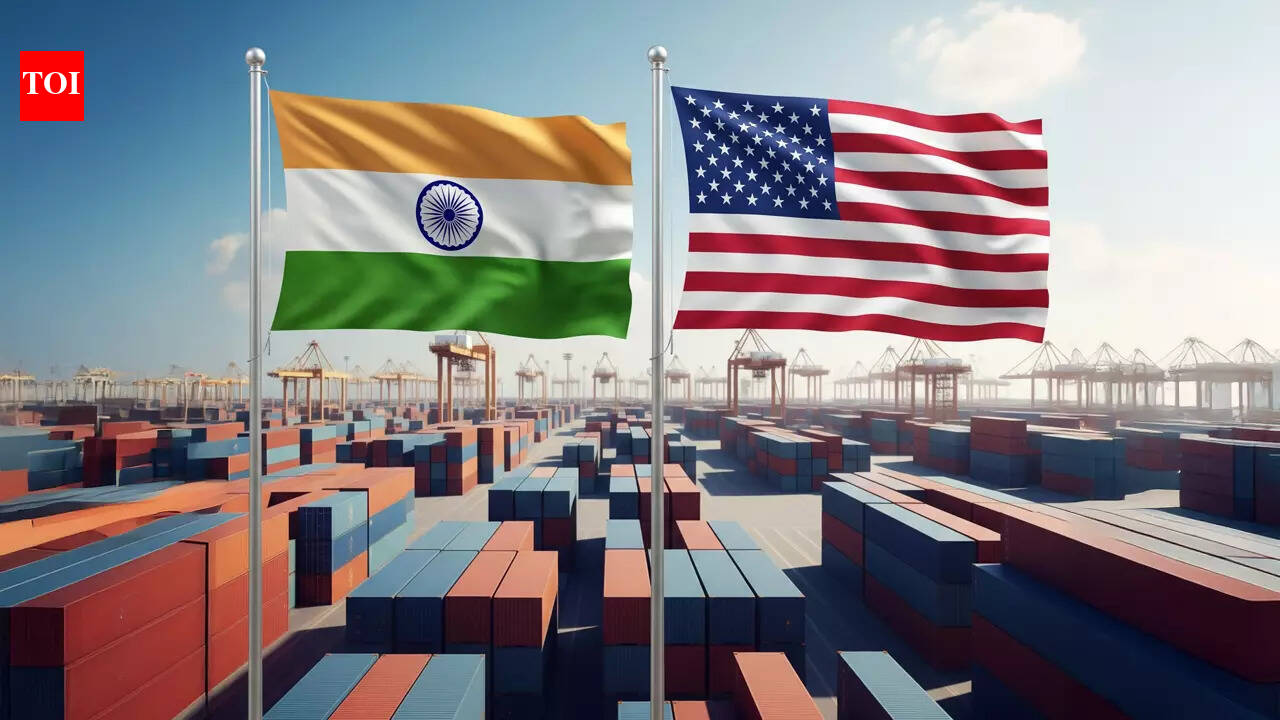
Fresh negotiations between India and the United States are underway in Washington, DC this week, with officials indicating that a long-running effort to seal a bilateral trade agreement is nearing completion.A senior US official, responding to queries on the progress of the talks, said, “The Trump administration and India continue to have positive and productive discussions towards a finalised trade deal.” The negotiations come as Indian representatives visit the American capital for discussions scheduled from April 20 to 22, marking a renewed push to conclude the first phase of the agreement.People familiar with the matter suggested that only a handful of issues remain unresolved. “Most of it is almost done,” one official said on condition of anonymity, adding, “There aren’t many loose ends left.” The current round is expected to concentrate on closing these remaining gaps, with much of the agreement already worked out.The Indian side is being led by Darpan Jain, Additional Secretary in the Department of Commerce, accompanied by officials from the customs department and the ministry of external affairs. On the US side, Brendan Lynch, Assistant US Trade Representative for South and Central Asia, is heading the negotiations under the Office of the US Trade Representative.The timing of the talks follows recent developments in the US tariff structure. After the US Supreme Court struck down reciprocal tariffs imposed under the 1977 International Emergency Economic Powers Act, the US administration introduced a temporary flat 10% tariff on all countries for 150 days starting February 24. These changes had earlier delayed a planned February meeting between the chief negotiators, with discussions now resuming under the revised framework.In addition to tariff-related matters, negotiators are also expected to address two Section 301 investigations initiated by the US Trade Representative. India has contested these probes, seeking their withdrawal and arguing that the notices lack adequate justification.The ongoing discussions build on a framework for an interim agreement announced on February 7, which outlined reciprocal and mutually beneficial trade measures. The framework reaffirmed a commitment to broader bilateral trade agreement (BTA) negotiations launched by US President Donald Trump and Prime Minister Narendra Modi on February 13, 2025, aimed at enhancing market access.US Ambassador to India Sergio Gor described the visit of the Indian delegation as a significant step towards finalising the deal. In a post on X, he said, “The Indian trade delegation will be arriving in Washington this week. A great step to finalise our bilateral trade deal. A win-win for both nations!”Commerce and Industry Minister Piyush Goyal also indicated that the first tranche of the agreement is close to completion. “We have almost finalised our free trade agreement, the first tranche of the bilateral trade agreement with them. We are trying to close the Ts and dots on that and work out what would be the mechanism by which India can get a preferential access, market access in the US market compared to our competitors,” he said at the India-Korea Business Forum in New Delhi.He added, “We have almost finalised the first tranche of bilateral trade agreement with them… We are trying to work out what would be the mechanism on which India would get a preferential access in the US market compared to our competitors. The team will be discussing this while they are in Washington.”With senior officials from both sides now engaged in discussions and most substantive issues already settled, expectations are building that an announcement on the proposed agreement could follow soon.


OpenAI Beefs Up ChatGPT’s Image Generation Model
Britain ‘mustn’t cut ourselves off from China trade opportunities’, CBI chief warns

Oil prices climb 5% after Trump says he does not want to extend Iran ceasefire

-

 Fashion5 days ago
France’s LVMH Q1 revenue falls 6%, shows resilience amid Iran war
-

 Sports1 week ago
The case for Man United’s Fernandes as Premier League’s best
-

 Entertainment1 week ago
Palace left in shock as Prince William cancels grand ceremony
-
 Business1 week ago
UK could adopt EU single market rules under new legislation
-

 Entertainment6 days ago
Is Claude down? Here’s why users are seeing errors
-

 Fashion1 week ago
Energy emerges as biggest cost driver in textile margins
-
 Business1 week ago
Delta Air Lines unveils first new Delta One suite in premium cabin arms race
-

 Fashion1 week ago
Asia claims largest share of markets on Kearney FDI Confidence Index