

Tech
Minimal 3D model reveals fundamental mechanisms behind toughening of soft–hard composites

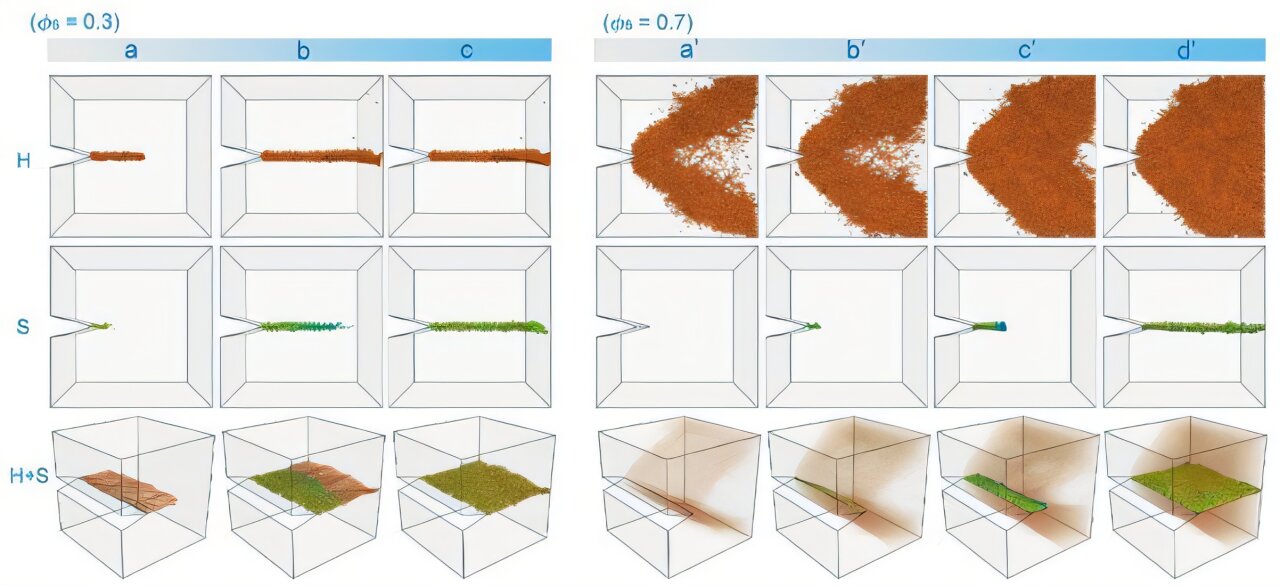
Engineers have long grappled with a fundamental challenge: creating materials that are both strong and tough enough to resist deformation and prevent fractures. These two properties typically exist in opposition, as materials that excel in one area often fail in the other.
Nature, however, has elegantly solved this trade-off in biological materials like bone, teeth, and nacre, which strategically combine soft and hard components in multi-layered architectures. These blueprints have inspired scientists to develop artificial soft–hard composites—from advanced dual-phase steels to specialized gels and reinforced rubbers—that demonstrate performance exceeding that of their individual components.
While artificial soft–hard composites have shown impressive performance in laboratory tests and real-world applications, the fundamental mechanisms behind their enhanced properties remain largely unclear. The inherent complexity of these materials, encompassing nonlinear behaviors, intricate internal structures, and multi-scale interactions, has made it difficult to isolate the essential design principles.
Specifically, scientists have struggled to understand how these materials transition from brittle-to-ductile (BTD) fracture behavior, and what the minimum requirements are for constituent components to achieve this toughening effect.
In this vein, a research team including Dr. Fucheng Tian and Professor Jian Ping Gong from the Faculty of Advanced Life Science, Hokkaido University, Japan, as well as Specially Appointed Professor Katsuhiko Sato from the Program of Mathematics and Informatics, University of Toyama, Japan, recently undertook a study to tackle this complex problem.
In their pioneering work published in the journal Proceedings of the National Academy of Sciences, the researchers introduce a minimal three-dimensional soft–hard composite (SH-com) framework. By eliminating complicated nonlinear effects and intricate network structures, their model enabled them to focus on the core underlying principles governing the toughening effect.
The SH-com model uses randomly distributed linear-elastic soft and hard elements, each characterized by its elastic stiffness and the energy required for failure. Despite its simplicity, this model successfully reproduced several hallmark behaviors of tough composite materials, including mechanical hysteresis (the Mullins effect), sacrificial bond-driven toughening, and the critical BTD transition fracture behavior. Through systematic testing of different compositions, the team discovered that the BTD transition occurs when the soft and hard phases reach a specific mechanical equilibrium.
Moreover, they found that optimal toughening occurs at a specific ratio of soft to hard components, governed by a universal scaling relationship linked to the differences in fracture toughness between components. When an optimal composition is achieved, the composite can exceed the toughness of its individual constituents.
“Though the SH-com model is anchored in the fundamental linear-elastic regime, the outcomes exhibit compelling consistency with the experimental findings from nonlinear soft–hard composite materials. This consistency emphasizes the fundamental principles underlying the toughening mechanisms in general soft–hard composite materials,” remarks Dr. Fucheng.
Based on these insights, the team developed a “toughening phase diagram,” which serves as a practical guide illustrating the optimal combinations of stiffness and toughness between components to achieve superior material performance. Notably, the simplicity and universality of their model suggest that these principles can be applied broadly.
“Our study reveals the fundamental toughening mechanisms of SH-com systems, offering insights for designing tougher materials,” conclude the authors. “In fields such as regenerative medicine, the development of tough gels is required, and we expect our study to contribute to those efforts.”
From the development of more resilient components for aerospace and automotive applications to advanced biomaterials for tissue engineering and medical devices, this research provides a powerful theoretical foundation for engineering materials that are both strong and tough.
More information:
Fucheng Tian et al, Fundamental toughening landscape in soft–hard composites: Insights from a minimal framework, Proceedings of the National Academy of Sciences (2025). DOI: 10.1073/pnas.2506071122
Citation:
Minimal 3D model reveals fundamental mechanisms behind toughening of soft–hard composites (2025, August 28)
retrieved 28 August 2025
from https://techxplore.com/news/2025-08-minimal-3d-reveals-fundamental-mechanisms.html
This document is subject to copyright. Apart from any fair dealing for the purpose of private study or research, no
part may be reproduced without the written permission. The content is provided for information purposes only.













The past year has been traumatic for many of the volunteer tech warriors of what was once called the United States Digital Service (USDS). The team’s former coders, designers, and UX experts have watched in horror as Donald Trump rebranded the service as DOGE, effectively forced out its staff, and employed a strike force of young and reckless engineers to dismantle government agencies under the guise of eliminating fraud. But one aspect of the Trump initiative triggered envy in tech reformers: the Trump administration’s fearlessness in upending generations of cruft and inertia in government services. What if government leaders actually used that decisiveness and clout in service of the people instead of following the murky agendas of Donald Trump or DOGE maestro Elon Musk?
A small though influential team is proposing to answer that exact question, working on a solution they hope to deploy during the next Democratic administration. The initiative is called Tech Viaduct, and its goal is to create a complete plan to reboot how the US delivers services to citizens. The Viaduct cadre of experienced federal tech officials is in the process of cooking up specifics on how to remake the government, aiming to produce initial recommendations by the spring. By 2029, if a Democrat wins, it hopes to have its plan adopted by the White House.
Tech Viaduct’s advisory panel includes former Obama chief of staff and Biden’s secretary of Veterans Affairs Denis McDonough; Biden’s deputy CTO Alexander Macgillivray; Marina Nitze, former CTO of the VA; and Hillary Clinton campaign manager Robby Mook. But most attention-grabbing is its senior adviser and spiritual leader, Mikey Dickerson, the crusty former Google engineer who was the first leader of USDS. His hands-on ethic and unfiltered distaste for bureaucracy embodied the spirit of Obama’s tech surge. No one is more familiar with how government tech services fail American citizens than Dickerson. And no one is more disgusted with the various ways they have fallen short.
Dickerson himself unwittingly put the Viaduct project in motion last April. He was packing up the contents of his DC-area condo to move as far away as possible from the political scrum (to an abandoned sky observatory in a remote corner of Arizona) when McDonough suggested he meet with Mook. When the two got together, they bemoaned the DOGE initiative but agreed that the impulse to shred the dysfunctional system and start over was a good one. “The basic idea is that it’s too hard to get things done,” says Dickerson. “They’re not wrong about that.” He admits that Democrats had blown a big opportunity “For 10 years we’ve had tiny wins here and there but never terraformed the whole ecosystem,” Dickerson says. “What would that look like?”
Dickerson was surprised a few months later when Mook called him to say he found funding from Searchlight Institute, a liberal think tank devoted to novel policy initiatives, to get the idea off the ground. (A Searchlight spokesperson says that the think tank is budgeting $1 million for the project.) Dickerson, like Al Pacino in Godfather III, was pulled back in. Ironically, it was Trump’s reckless-abandon approach to government that convinced him that change was possible. “When I was there, we were severely outgunned, 200 people running around trying to improve websites,” he says. “Trump has knocked over all the beehives—the beltway bandits, the contractor industrial complex, the union industrial complex.”
Tech Viaduct has two aims. The first is to produce a master plan to remake government services—establishing an unbiased procurement process, creating a merit-based hiring process, and assuring oversight to make sure things don’t go awry. (Welcome back, inspector generals!) The idea is to design signature-ready executive orders and legislative drafts that will guide the recruiting strategy for a revitalized civil service. In the next few months, the group plans to devise and test a framework that could be executed immediately in 2029, without any momentum-killing consensus building. In Viaduct’s vision that consensus will be achieved before the election. “Thinking up bright ideas is going to be the easy part,“ Dickerson says. “As hard as we’re going to work in the next three to six months, we’re going to have to spend another two to three years, through a primary season and through an election, advocating as if we were a lobbying group.”

In case you didn’t get the memo, everyone is feeling very Chinese these days. Across social media, people are proclaiming that “You met me at a very Chinese time of my life,” while performing stereotypically Chinese-coded activities like eating dim sum or wearing the viral Adidas Chinese jacket. The trend blew up so much in recent weeks that celebrities like comedian Jimmy O Yang and influencer Hasan Piker even got in on it. It has now evolved into variations like “Chinamaxxing” (acting increasingly more Chinese) and “u will turn Chinese tomorrow” (a kind of affirmation or blessing).
It’s hard to quantify a zeitgeist, but here at WIRED, chronically online people like us have been noticing a distinct vibe shift when it comes to China over the past year. Despite all of the tariffs, export controls, and anti-China rhetoric, many people in the United States, especially younger generations, have fallen in love with Chinese technology, Chinese brands, Chinese cities, and are overall consuming more Chinese-made products than ever before. In a sense the only logical thing left to do was to literally become Chinese.
“It has occurred to me that a lot of you guys have not come to terms with your newfound Chinese identity,” the influencer Chao Ban joked in a TikTok video that has racked up over 340,000 likes. “Let me just ask you this: Aren’t you scrolling on this Chinese app, probably on a Chinese made phone, wearing clothes that are made in China, collecting dolls that are from China?”
Everything Is China
As is often the case with Western narratives about China, these memes are not really meant to paint an accurate picture of life in the country. Instead, they function as a projection of “all of the undesirable aspects of American life—or the decay of the American dream,” says Tianyu Fang, a PhD researcher at Harvard who studies science and technology in China.
At a moment when America’s infrastructure is crumbling and once-unthinkable forms of state violence are being normalized, China is starting to look pretty good in contrast. “When people say it’s the Chinese century, part of that is this ironic defeat,” says Fang.
As the Trump administration remade the US government in its own image and smashed long-standing democratic norms, people started yearning for an alternative role model, and they found a pretty good one in China. With its awe-inspiring skylines and abundant high-speed trains, the country serves as a symbol of the earnest and urgent desire among many Americans for something completely different from their own realities.
Critics frequently point to China’s massive clean energy investments to highlight America’s climate policy failures, or they point to its urban infrastructure development to shame the US housing shortage. These narratives tend to emphasize China’s strengths while sidelining the uglier facets of its development—but that selectivity is the point. China is being used less as a real place than as an abstraction, a way of exposing America’s own shortcomings. As writer Minh Tran observed in a recent Substack post, “In the twilight of the American empire, our Orientalism is not a patronizing one, but an aspirational one.”
Part of why China is on everyone’s mind is that it’s become totally unavoidable. No matter where you live in the world, you are likely going to be surrounded by things made in China. Here at WIRED, we’ve been documenting that exhaustively: Your phone or laptop or robot vacuum is made in China; your favorite AI slop joke is made in China; Labubu, the world’s most coveted toy, is made in China; the solar panels powering the Global South are made in China; the world’s best-selling EV brand, which officially overtook Tesla last year, is made in China. Even the most-talked about open-source AI model is from China. All of these examples are why this newsletter is called Made in China.
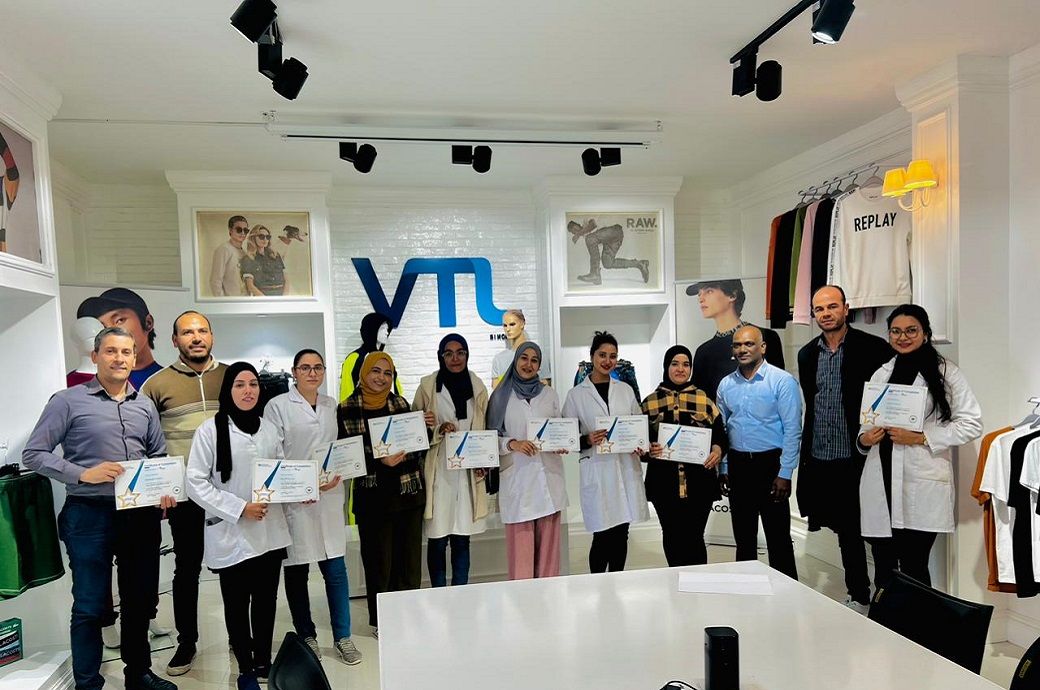
With over 5,000 employees and 3,000 sewing machines across 90 sewing lines, VTL Group specialises in jersey knits and denim, producing up to 20 million garments per year for world-renowned brands such as Lacoste, Adidas, G-Star, Hugo Boss, Replay and Paul & Shark. The company operates six garment production units, along with dedicated facilities for screen printing, knitting, dyeing and textile finishing. This extensive vertical integration gives VTL complete control over quality, lead-times and cost-efficiency, which is vital for meeting the stringent demands of its global customer base.
VTL Group has adopted Coats Digital’s GSDCost to standardise production, boost productivity, and improve pricing accuracy across its Tunisian operations.
The solution cut SMVs by 15–20 per cent, raised line output by 10 per cent, and enhanced planning, cost accuracy, and customer confidence, enabling competitive pricing, lean operations, and stronger relationships with global fashion brands.
Prior to implementing GSDCost, VTL calculated capacity and product pricing using data from internal time catalogues stored in Excel. This approach led to inconsistent and inaccurate cost estimations, causing both lost contracts due to inflated production times and reduced margins from underestimations. In some cases, delays caused by misaligned time predictions resulted in increased transportation costs and operational inefficiencies that impacted customer satisfaction.
Hichem Kordoghli, Plant Manager, VTL Group, said: “Before GSDCost, we struggled with inconsistent operating times that directly impacted our competitiveness. We lost orders when our timings were too high and missed profits when they were too low. GSDCost has transformed the way we approach planning, enabling us to quote confidently with accurate, reliable data. We’ve already seen up to 20% reductions in SMVs, a 10% rise in output, and improved customer confidence. It’s a game-changer for our sales and production teams.”
Since adopting GSDCost across 50 sewing lines, VTL Group has been able to establish a reliable baseline for production planning and line efficiency monitoring. This has led to a more streamlined approach to managing load plans and forecasting. Importantly, GSDCost has given the business the flexibility to align pricing more effectively with actual production realities, contributing to greater customer satisfaction and improved profit margins.
Although it’s too early to determine the exact financial impact, VTL Group has already realised improvements in pricing flexibility and competitiveness thanks to shorter product times and better planning. These gains are seen as instrumental in enabling the company to pursue more strategic orders, reduce wasted effort and overtime, and maintain the high expectations of leading global fashion brands.
Hichem Kordoghli, Plant Manager, VTL Group, added: “GSDCost has empowered our teams with reliable data that has translated directly into real operational benefits. We are seeing more consistent line performance, enhanced planning precision, and greater confidence across departments. These improvements are helping us build stronger relationships with our brand partners, while setting the foundation for sustainable productivity gains in the future.”
The company now plans to expand usage across an additional 30 lines in 2025, supported by a second phase of GSD Practitioner Bootcamp training to strengthen in-house expertise and embed best practices throughout the production environment. A further 10 lines are expected to follow in 2026 as part of VTL’s phased rollout strategy.
Liz Bamford, Customer Success Manager, Coats Digital, commented: “We are proud to support VTL Group in their digital transformation journey. The impressive improvements in planning accuracy, quoting precision, and cross-functional alignment are a testament to their commitment to innovation and excellence. GSDCost is helping VTL set a new benchmark for operational transparency and performance in the region, empowering their teams with the tools needed for long-term success.”
GSDCost, Coats Digital’s method analysis and pre-determined times solution, is widely acknowledged as the de-facto international standard across the sewn products industry. It supports a more collaborative, transparent, and sustainable supply chain in which brands and manufacturers establish and optimise ‘International Standard Time Benchmarks’ using standard motion codes and predetermined times. This shared framework supports accurate cost prediction, fact-based negotiation, and a more efficient garment manufacturing process, while concurrently delivering on CSR commitments.
Key Benefits and ROI for VTL Group
- 15–20% reduction in SMVs across 50 production lines
- 10% productivity increase across key sewing facilities
- More competitive pricing for strategic sales opportunities
- Improved cost accuracy and quotation flexibility
- Standardised time benchmarks for future factory expansion
- Enhanced planning accuracy and load plan management
- Greater alignment with lean and sustainable manufacturing goals
- Increased brand confidence and satisfaction among premium customers
Note: The headline, insights, and image of this press release may have been refined by the Fibre2Fashion staff; the rest of the content remains unchanged.
Fibre2Fashion News Desk (HU)


PSL 11 to kick off from March 26, says PCB

Former USDS Leaders Launch Tech Reform Project to Fix What DOGE Broke

UK GDP expected to grow 1.4% in 2026: Goldman Sachs Research

-

 Entertainment1 week ago
Does new US food pyramid put too much steak on your plate?
-

 Politics1 week ago
UK says provided assistance in US-led tanker seizure
-

 Entertainment1 week ago
Why did Nick Reiner’s lawyer Alan Jackson withdraw from case?
-

 Sports6 days ago
Clock is ticking for Frank at Spurs, with dwindling evidence he deserves extra time
-
 Business1 week ago
Trump moves to ban home purchases by institutional investors
-

 Tech4 days ago
New Proposed Legislation Would Let Self-Driving Cars Operate in New York State
-

 Sports1 week ago
PGA of America CEO steps down after one year to take care of mother and mother-in-law
-
Sports7 days ago
Commanders go young, promote David Blough to be offensive coordinator