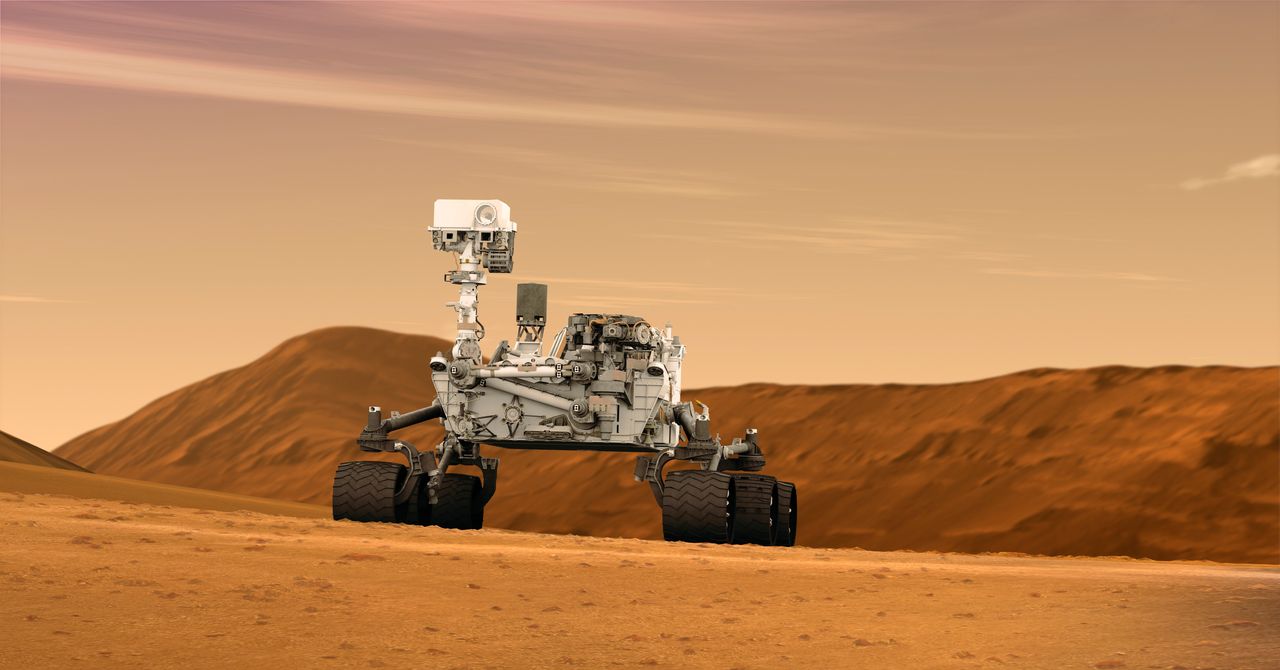
While it has enabled many exciting discoveries, the Curiosity Rover has also encountered its share of setbacks. The latest left NASA engineers speechless.
On April 25, Curiosity drilled into a rock nicknamed “Atacama” to collect a sample. When the rover retracted the robotic arm after drilling, the entire rock unexpectedly lifted off the Martian surface—all 28.6 pounds of it. While other Curiosity drilling operations have caused cracks or breaks in the upper layers of Martian rocks during the rover’s nearly 14-year mission, this is the first time one has remained stuck to the sleeve that surrounds the drill’s rotating tip.
As the space agency itself recounts, it was the black-and-white obstacle-detection cameras mounted on the front of the rover’s chassis that captured this peculiar “accident” in a sequence of images that allowed engineers to get to work immediately to free it, moving its robotic arm and operating the drill repeatedly over several days.
Engineers initially tried to remove the rock by vibrating the drill, to no avail. On April 29, they adjusted the position of the robotic arm and tried vibration again, but only managed to knock some sand off the rock. On May 1, the team gave it another try by tilting the drill more, rotating and vibrating it, and spinning the drill bit. The team expected to have to repeat these operations several times, but instead the rock broke loose on the first attempt, shattering into a multitude of pieces when it hit the Martian soil.
NASA’s Curiosity rover was developed by the Jet Propulsion Laboratory and landed on Mars in August 2012 with the purpose of looking for evidence that the Red Planet might have once had conditions that could support microbial life. In 2020, it conducted an experiment in the Glen Torridon region within Gale Crater, an area rich in clay minerals that strongly indicate the presence of water in the past and that it collected using onboard instruments known as Sample Analysis on Mars.
This story originally appeared inWIRED Italiaand has been translated from Italian.
Isomorphic Labs, a company founded by Demis Hassabis, which uses frontier artificial intelligence (AI) for drug design and development, has received investment from the UK government’s Sovereign AI fund.
Isomorphic’s work builds on the breakthrough success of DeepMind’s AlphaFold, the AI model co-created by Hassabis that demonstrated in 2016 how AI could beat the Go world champion, Leo Sedol.
The company is developing a number of proprietary breakthrough AI models, which together form its unified drug design engine across multiple therapeutic areas and drug modalities.
Backing AI innovators, founders and entrepreneurs
Launched in April, the Sovereign AI fund provides grants of £1m up to £9m to fund the creation of strategic AI assets. The programme is initially aimed at high-value AI datasets and autonomous or automated laboratory infrastructure. It is open to UK-registered companies, research organisations, universities and consortia with a credible plan that aligns with the Sovereign AI focus areas. It aims to secure long-term strategic advantage for the UK by growing and anchoring strategically significant AI companies.
Britain has a proud history of world-changing medical breakthroughs. Now, in the AI era, we are backing a brilliant UK firm working on another huge jump forward in science to the benefit of people across the country and around the world Liz Kendall, DSIT
The government’s goal is to shape Britain’s future in the years ahead, using what it calls “strong, homegrown AI capability”. Its strategy is based on backing AI innovators, founders and entrepreneurs to develop new ideas and bring them to market. According to the Department for Science, Innovation and Technology (DSIT), the UK has the third-largest AI market in the world and more AI startups than anywhere else in Europe.
Speaking previously about the Sovereign AI fund, science and technology secretary Liz Kendall said it represents the government’s “bet on Britain”, adding that the UK believes in its entrepreneurs and innovators and is “backing them to seize the benefits of AI for the UK”.
During a speech at the Royal United Services Institute on 28 April, Kendall spoke about the importance of AI to the UK economy and its ability to compete globally. “Today, the defining currency is AI,” she said. “And the countries which harness AI will not only lead the race to cure diseases, discover new materials and create trillion-dollar companies, but also build far more powerful militaries,” she said.
Kendall believes AI is the engine of both economic power and “hard power”.
Funding a giant leap forward in science
Discussing the funding, Sovereign AI head of ventures Joséphine Kant said: “Isomorphic is one of the most consequential companies being built anywhere in the world today, and it’s being built in Britain. Sovereign AI exists to invest in the companies that will shape what this country becomes next. Sir Demis Hassabis, Max Jaderberg, and the team they have built deserve a country willing to match their ambition with its own, and we intend to make sure it does.”
Commenting on the Isomorphic funding, Kendall said: “Britain has a proud history of world-changing medical breakthroughs – from penicillin to MRI scanners. Now, in the AI era, we are backing a brilliant UK firm working on another huge jump forward in science to the benefit of people across the country and around the world.”
At the time of writing, three companies had received funding through the Sovereign AI Fund. Along with Isomorphic, the government previously announced funding for Ineffable Intelligence, a company that is developing algorithms that learn through experience, and AI infrastructure firm Callosum. A further six companies have been granted access to the AI Research Resource (AIRR) supercomputer network.
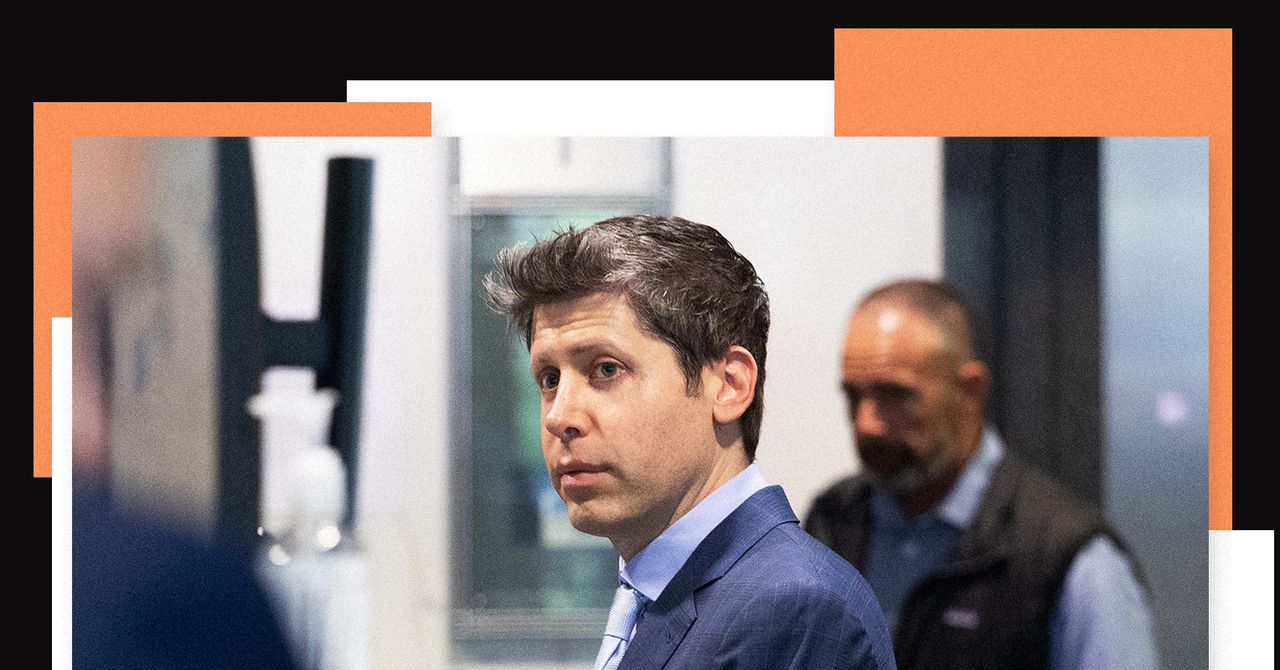
Sam Altman took to the witness stand to defend his reputation in the Musk v. Altman trial on Tuesday, as Elon Musk’s lawyers peppered the OpenAI CEO with hours of questions regarding his alleged history of deceptive behavior.
The cross-examination was a much needed win for Musk, who has so far struggled to make a convincing case. Tuesday’s testimony included several heated exchanges in which the OpenAI CEO had to respond to allegations from former colleagues suggesting he’s untrustworthy.
Highlighting this evidence is not only important for Musk winning over a jury, but also for beating OpenAI in the court of public opinion. Days before the trial started, Musk texted OpenAI president Greg Brockman and told him that he and Altman would soon “be the most hated men in America.”
Musk’s lawsuit accuses Altman of effectively stealing the OpenAI charity, and taking the $38 million Musk donated to the nonprofit organization and using it to create a for-profit business worth more than $850 billion.
However, there was little evidence on Tuesday to address the gaps in Musk’s legal case. Altman and Sam Teller, Musk’s former chief of staff, testified on Tuesday that they did not recall Musk ever attaching any special conditions to his donations to OpenAI. Additionally, it appears increasingly likely that Musk filed his case too late, years after he made his last donation to OpenAI and developed suspicion that the organization had breached its charitable trust. By then, the statute of limitations had already expired.
Brockman and his wife, Anna, sat in the gallery alongside OpenAI’s chief futurist, Joshua Achiam. While Altman and Brockman were present to watch Musk on the witness stand, Musk did not stay for Altman’s testimony. (Flight records suggest he was traveling to the Washington, DC, area on Tuesday to fly to China with President Donald Trump.)
Before fielding questions from Musk’s lawyers, Altman had the chance to tell his side of the story, answering gentle questions from OpenAI’s lawyers. Wearing a purple tie, Altman painted himself as an entrepreneur and investor who’s always been fascinated by, and concerned about, the power of artificial intelligence.
Altman testified that Musk has long been obsessed with controlling OpenAI. He recalled “a particularly hair-raising moment” when Musk suggested that control of OpenAI should pass to his children if Musk were to die. “We didn’t feel comfortable with that,” Altman said. Altman also suggested that Musk’s attempt in 2018 to start an AI unit within Tesla—and offering him the chance to run it—felt like a “vague, lightweight threat” that Musk would effectively crush OpenAI with or without him.
Bombarding Altman
Steven Molo, Musk’s lawyer, wasted no time in his cross-examination, asking Altman: “Are you completely trustworthy?” as his first question. Altman responded that he believes so, and then Molo immediately asked whether the jury should trust the testimony he just gave. Altman responded, “That’s up to them. I’m not going to tell the jury what to think.” Here’s the heated exchange that followed, as best as WIRED could capture it:
Molo: Do you always tell the truth?
Altman: I’m sure there is some time in my life where I have not.
Molo: Do you tell lies to advance your business interests?
Altman: No.
Molo: Have you misled people with whom you do business?
Datacentre capacity has reached 67.7GW globally, with five countries accounting for 69% of that total, and the US alone accounting for 43%, according to the International Datacentre Authority’s (IDCA)Datacentre report 2026.
The study based its research on data from organisations such as the International Energy Agency, World Bank, United Nations and International Telecommunications Union, as well as governments, datacentre developers and operators.
It discovered that where datacentres account for 5% or more of electricity grid usage, there seemed to be a threshold at which public opposition rises significantly and governments move from incentives to regulation.
And while there was huge growth in the datacentre industry, whether a nation or region can profit optimally depended on using its resources wisely and attaining tech sector skills among 2.5% of the workforce, it found.
The US was the site for the most datacentre capacity, with 29.2GW of a global total 67.7GW. US datacentres accounted for 6% of the country’s electricity supply. Behind the US are: China, 8.5GW and 0.8% of electricity use; Germany, 5.5GW (9.5%), UK, 2GW (5.8%), and Japan, 1.7GW (1.5%). Those five states accounted for 69% of global datacentre capacity.
In the US, however, the IDCA research estimated that 13% of datacentre consumption – around 3GW – was unused but still live capacity.
China emerged as the “sleeping giant”, according to the report, because less than 1% of electricity production was devoted to datacentres, despite producing almost twice the amount of electricity as the US.
International haves and have-nots
The report concluded that 5% of electricity grid usage going to datacentres was the threshold at which public concern, government regulation and grid supply can be seen to increase. It pointed to the US, which has seen community pushback and connection difficulties in the Midwest, Texas and California, with multi-year delays in the ability to provision power new facilities.
Meanwhile, in Europe, the Netherlands, Germany, and Switzerland have exceeded the 9% consumption level, while that’s also the case for Singapore.
Also in Europe, the report found that countries with electricity grids driven by nuclear power – such as France, Slovakia and Slovenia – may relieve these constraints.
At the other end of the scale, it discovered that more than 70 countries devoted less than 0.1% of their power to datacentres, and for more than 30 countries that figure was less than 0.01%.
Datacentre energy use league table
Singapore used the highest proportion of its electricity to power datacentres at 19.5% of the total generated. Next in the IDCA report was Lithuania (11.1%), the Netherlands (9.7%), Denmark (8.4%), Ireland (8.2%), Estonia (6.9%), Luxembourg (6.3%), Germany (6.1%), Hong Kong (6%) and the US (6%). Further down the rankings are Australia (5.1%), the UK (3.6%), South Korea (2%), Japan (1.2%), and India and China (both 0.8%).
IDCA built what it described as an optimised national model of ideal consumption levels for each nation, noting that construction of new datacentres was contingent on stronger electricity grids and robust fibre-optic networks.
For developed nations, IDCA said 6.25% of national electricity consumption was an effective cap on datacentre growth – i.e., it was the point at which the correlation was very strong between datacentre consumption and political actions and community pushback that result in projects being cancelled or slowed.
Meanwhile, IDCA ranked countries by the headroom they possess to build datacentres without significantly needing to develop new electricity generation. Here, IDCA ranked countries by headroom measured in GW. China led the way with 58.9GW of headroom, followed by India (12.7GW), Russia (6.7GW), Japan (5.5GW), Brazil (4.5GW), Canada (3.6GW), South Korea (3.2GW), Saudi Arabia (2.6GW), Iran (2.4GW) and Mexico (2.4GW).
The water stress scale
IDCA pointed out that modern AI datacentres require liquid cooling but that a lot of pushback around perceived worries over water use are misguided. That’s because the latest direct-to-chip cooling systems are closed systems that recycle water somewhat similar to a car radiator.
Having said that, the IDCA report stated: “The vast majority of existing traditional cloud and enterprise facilities rely on older, less efficient cooling architectures like water-cooled chillers or evaporative cooling towers. In these legacy designs, water is evaporated to remove the latent heat of vaporisation from the air, and that evaporated water is never recovered.”
The IDCA report ranked countries on a “water stress” scale of 0-100, where those with deserts are unsurprisingly high on the scale and mountainous and riverine states at the low end. Most at risk are Bahrain (100), Belize (86), Libya (80), Kuwait (80) and South Sudan (73). The least at risk are Norway (0), New Zealand (0), Iceland (1), Canada (2) and Bhutan (3).
Servers per head differential of 100,000x
The IDCA report said there was a difference of 100,000x in the number of servers per head of population between the most and least dense in this respect. Providing connectivity alongside this, IDCA said there was an estimated 1.3 to 1.5 million km of subsea cables, in around 550 systems, with about 1,200 landing stations.
Out of these, there are around 70 landing stations in the US, 50 in the UK and more than 12 in countries that include the Philippines, Indonesia, Japan, Spain, Denmark, Sweden and some Middle Eastern countries. Meanwhile, there are around 14 million km of terrestrial cables in main networks.
IT jobs deficit
IDCA found that IT jobs worldwide account for between 0.1% and 4% of populations. According to IDCA, 2.5% of the workforce employed in tech was optimum to “to ensure a thorough, successful digital economy creation and management”, though this varied based on local conditions and expectations.
Overall, the IDCA found that there was a deficit of 100 million IT-related jobs worldwide, with developing nations accounting for 80% of that.
Ranking countries with the most deficit, top of the list was India, with a shortfall of 28.8 million in the IT workforce, followed by China (17.5 million), Pakistan (5.8 million), Nigeria (5.8 million), and Indonesia (5.3 million).
Gamma, Sigma and Goldilocks
The report covered a number of other areas in connection with datacentres that include datacentre security, standards, design, investment and community pushback. It also provided three indexes: Gamma, Sigma and Goldilocks, with countries ranked 0-100.
The Gamma index looked at technological and social factors in digital readiness. Top of the list was: Finland at 85 (with Scandinavia collectively ranking 83), the Netherlands (83), Estonia (80), New Zealand (79) and Switzerland (79). Bottom of the list was: Equatorial Guinea (4), South Sudan (12), Turkmenistan (17), Haiti (17), and Democratic Republic of Congo (19). The UK ranked 14th, with a score of 74.
The Sigma index integrated the Gamma index, with adjustments for stress on water and electricity grids, such as the amount of headroom they possess, for example. The Sigma index was topped by Finland (99), followed by Sweden (97), Norway (97), New Zealand (94) and Iceland (94). The UK was ranked 15th (84).
“The Sigma Index is useful in determining a nation’s overall suitability for rapid datacentre growth and the digital infrastructure that would accompany it,” the report said.
Finally, the IDCA report provided a Goldilocks index, which technological factors are separated from the rest then comparing those to the cost of living and income. That way, it hoped to provide an idea of countries for whom rapid development would not be disruptive and would hit “just right”. Top of the Goldilocks index was Colombia with a score of 5.2, followed by North Macedonia, China, South Africa and Montenegro, all on 5.2 except the last of these (5.1).






















 Tech1 week ago
 Tech5 days ago
 Tech5 days ago
 Sports5 days ago
 Tech5 days ago
 Tech5 days ago

 Fashion5 days ago